

Turn recordings into transcripts and summaries in minutes
Upload audio or video for multilingual transcription, AI notes, and action items
Many people looking for a free speech-to-text tool first think about downloading an app or opening a webpage and converting directly. But they often run into two situations: one is that the free allowance is only 5 minutes, and you get a payment reminder as soon as you start recording; the other is that it claims to be free, but the transcript is full of errors, and you end up having to listen to the whole thing again. A more reasonable approach is to first confirm what tasks the free plan can actually accomplish and what its limitations are. This article uses Tinrec as an example to show you how to use speech-to-text for free and turn meetings, interviews, and course content into usable text.
What Can a Free Speech-to-Text Plan Do for You?
A free plan isn't just for testing; if used correctly, it can solve many daily text-recording pain points. Using Tinrec's free version as an example, here are a few things you can do with it.
Scenario 1: Get meeting minutes 5 minutes after the meeting ends Previously, after a two-hour meeting, you might spend another hour organizing the key points. Now with Tinrec's free version, you can start recording during the meeting or upload the audio file afterward, and it will automatically generate a transcript while also organizing a summary and to-do items. You don't need to listen and type at the same time; just open Tinrec after the meeting to review the content, fill in anything the AI didn't catch clearly, and send it to your colleagues.
Scenario 2: Quickly turn interview recordings into transcripts For user interviews or expert interviews, the most time-consuming part is transcribing the audio. Tinrec's free version allows you to import interview audio files, and after transcription, you can search for keywords like "price," "pain point," or "budget" to quickly locate the interviewee's exact words. You don't have to listen from start to finish to find key quotes.
Scenario 3: Course or lecture notes During class or a lecture, instead of frantically taking notes, focus on listening. Afterward, upload the recording to Tinrec and let it generate a transcript and chapters, making the key points clear at a glance. If there's a section you don't understand, you can use the AI Q&A feature to ask, "What example did the teacher just give?"
What Are the Core Capabilities of Tinrec's Free Plan?
The focus of the free version isn't on crippled features but on letting you experience the complete workflow. Tinrec's free version provides basic credits so you can complete the key steps from recording to organizing.
Real-time transcription as you record Tinrec supports real-time speech-to-text, not just transcription after the recording is complete. During a meeting or interview, the text appears on the screen simultaneously, so you can check if you've missed any key points. This is especially useful for those who need to take notes on the spot.
Online meeting notes without a meeting bot If you use Zoom, Google Meet, or Microsoft Teams for meetings, Tinrec's desktop version can directly capture your computer's system audio, so you don't need to add a bot account to the meeting. This way, you don't disturb other participants, and you can still keep the meeting audio and transcript.
Automatic summaries and to-do lists after audio import Many people only think of speech-to-text as "converting sound to text," but Tinrec's free version goes further by organizing meeting summaries, chapters, and to-do items after transcription. You don't have to read the entire transcript from scratch; just open the summary to know what was discussed and who is responsible for what.
Chinese and multilingual content organization Tinrec is quite friendly for transcribing Chinese meetings and interviews, and it also supports mixed Chinese-English content. If you occasionally need to process recordings in other languages, the free version lets you experience basic transcription and summarization, though actual results may vary based on audio quality and accents.
Stop organizing recordings by hand
Upload audio or video and automatically get a transcript, summary, and action items
Practical Use Cases: How to Use the Free Version
Meeting minutes Before a meeting, open Tinrec's desktop version or mobile app and hit record. After the meeting, the transcript, summary, and to-do items are already waiting for you in Tinrec. Decisions and action items mentioned during the meeting don't have to be recalled from memory or by searching chat logs.
Classes and lectures Start recording in Tinrec during class, and after class, you'll have a complete transcript. Use the AI summary feature to quickly review what chapters were covered and what key points need review. The free version's basic credits are enough for organizing a few classes.
User interviews and research Prepare your recording device before the interview, and after the interview, upload the audio file to Tinrec. After transcription, you can search for keywords to find important points mentioned by the interviewee, or ask the AI follow-up questions about the interview content, such as "What is the interviewee's attitude toward pricing?"
Content creation and idea organization If you're a content creator or self-media person, inspiration often strikes while walking or driving. Take out your phone, record a voice memo with Tinrec, and later convert it to text, letting the AI help you organize it into an outline or key points. This saves a lot of time compared to typing manually.
4 Things to Watch Out for When Choosing a Free Speech-to-Text Tool
Is the free allowance enough? Don't just look at the word "free"; first check whether the free plan offers "a fixed number of minutes per month" or "a one-time trial." Tinrec's free version provides basic credits, suitable for occasional recording organization or trying out the workflow. If you have multiple meetings to transcribe every week, it's better to use up the free credits and then consider a paid plan, so you don't lose out.
Can you continue organizing after transcription? Many tools only convert sound to text, leaving summaries, to-do lists, and Q&A to you. Tinrec's free version combines transcription and organization, so you don't need to copy the text to another AI tool; you can handle most post-processing in one place.
Will it force you to add a meeting bot? Some online meeting transcription tools use a bot account to join meetings, which can be intrusive for teams concerned about privacy or who don't want to be disturbed. Tinrec's desktop version directly captures system audio, so no extra bot is needed, and this is available in the free version.
Actual performance for Chinese transcription If your content is primarily in Chinese, be sure to test with your own real recordings, not just official demo videos. Tinrec's strength is its ability to organize Chinese meetings and interviews, but actual results are still affected by audio clarity, accents, and multiple people speaking at once. The free version is the best opportunity to test it.
Frequently Asked Questions
Will Tinrec's free version automatically charge me? No. The free version doesn't require a credit card; you just need to register an account to use the basic credits. Once you run out, you can either wait for the next cycle or upgrade to a paid plan.
Is the transcription accuracy of the free version high? Under conditions of clear audio and clear speech, Tinrec can significantly reduce manual organizing time, but it's not recommended to treat it as 100% accurate. For important content, you should still verify against the recording and timestamps.
Can I record online meetings with the free version? Yes. Tinrec's desktop version can capture your computer's system audio, so you can record meetings on Zoom, Google Meet, Teams, etc. Just make sure you have consent from participants and comply with local laws.
What languages does the free version support? Tinrec supports Chinese and multiple languages for transcription, with particularly good results for Chinese content. If your meetings are in mixed Chinese-English, you can still get usable transcripts and summaries.
Conclusion
Free speech-to-text plans are not unusable; you just need to find the right tool and understand the actual use of the free credits. Tinrec's free version lets you experience the complete workflow of "recording → transcript → summary → to-do list" without requiring a credit card or upfront payment. If you have more than three meetings or interviews to organize each week, try the free version first and then decide whether to upgrade. Save your time for more important things.
References
- Tested 4 Best "Speech-to-Text" Online Tools Recommended, Free Instant Conversion of Recordings to Transcripts
- Audio to Text - Free Speech-to-Text Tool
- Online AI Voice, Video, Recording Auto-Transcription - Free Trial - cSubtitle
- Unlimited Time! 3 Free AI Transcript Tools, Highly Recommended! AI Voice Notes Generate Meeting Minutes, Presentations, Mind Maps | 104 Career
- Online Speech-to-Text AI Tool, Free Convert MP3 or Recordings to Text Transcripts - MyEdit
Turn every recording into actionable outcomes
Get 60 free transcription minutes when you sign in. No credit card required.
Related Reading
You might also like
6 AI Meeting Transcription Tools Compared for 2026: From Transcripts to Post-Meeting Summaries
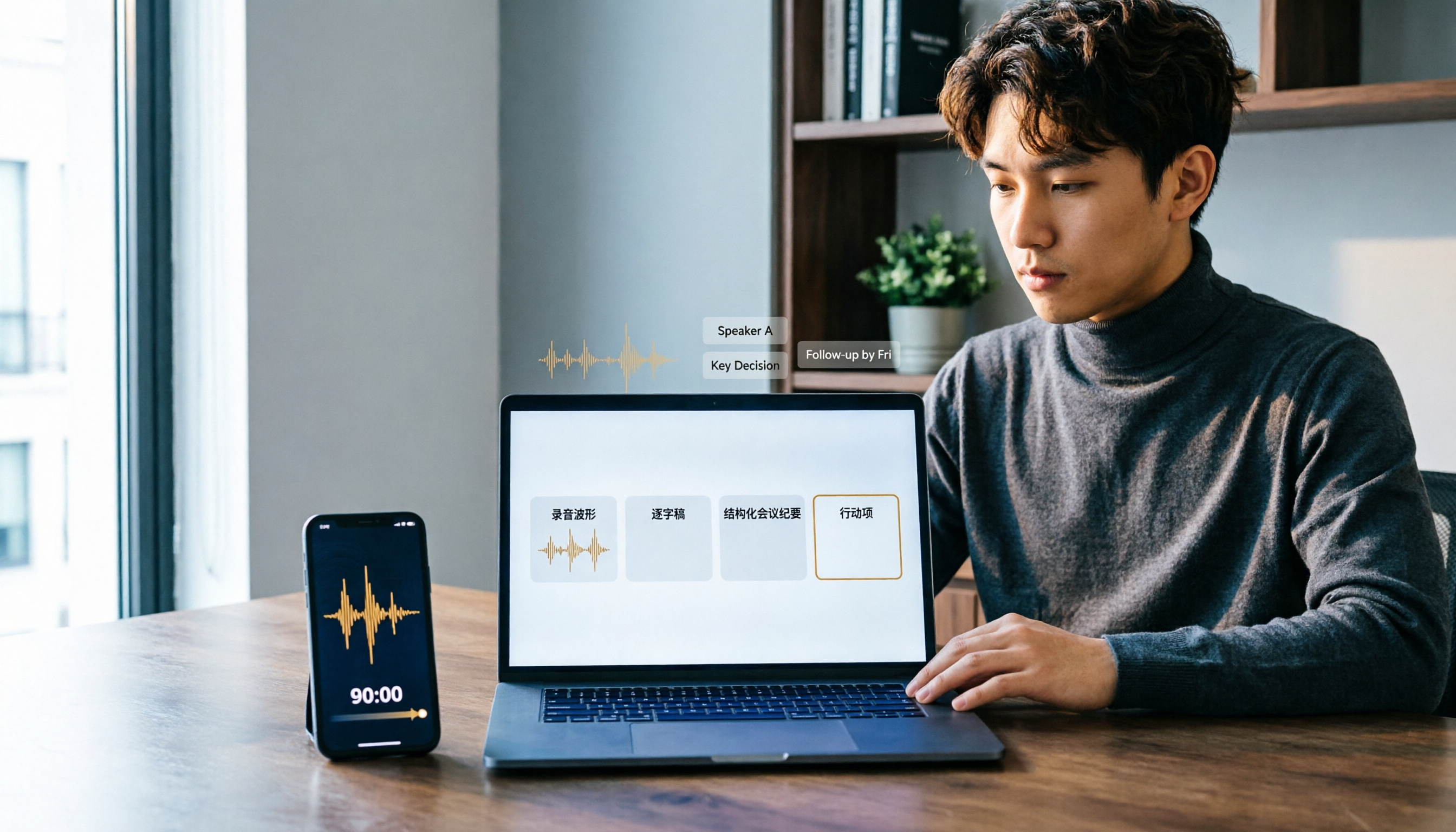
A 90-minute interview recording is sitting on your phone, and the transcript is due tomorrow morning. This article breaks down AI meeting notes into two steps—transcription and organization—and compares six practical solutions, including bot-free recording, multilingual transcription, hardware recorders, and free post-meeting organization tools, to help you choose the right one for your scenario.

2026 AI Meeting Notes Comparison: Tinrec vs Granola for Chinese Transcription and Free Tiers
In Dcard's 2024 AI meeting notes discussions, the most common questions are whether free tiers are sufficient, how well Chinese transcription works, and whether post-meeting summaries can be shared directly. This article compares Tinrec and Granola, two bot-free meeting note tools, across recording retention, old file import, Chinese and bilingual support, post-meeting outputs, team data governance, and pricing to help you decide which fits your meeting scenario.

How to Choose AI Meeting Notes Tools in 2026: 5 Steps to Understand Comparison Tables and Key Selection Criteria
2026 AI meeting notes tool comparison and buying guide: use 5 steps to understand meeting capture, post-transcription processing, Chinese language support, team governance, and pricing quotas, and compare use cases for Tinrec, Otter.ai, Notta, Granola, TurboScribe, and PLAUD.

2026 AI Meeting Notes Comparison: Tinrec vs Notta — Which Is Better for Chinese-Speaking Teams?
A meeting notes table isn't just pasting a transcript. This article uses a typical weekly meeting workflow to compare Tinrec and Notta across five dimensions: meeting capture methods, table output, free quota and pricing, Chinese and real-time translation, and team governance. It also includes a ready-to-use meeting notes table template with fields and a manual verification checklist.

Tinrec vs Notta 2026: 5-Dimension Comparison for Chinese Meeting Notes
Based on the popular PTT discussion about AI meeting notes, we compare Tinrec and Notta across 5 key dimensions: bot-free recording, post-meeting AI Q&A, team data retention, and quota rules, to help you choose the right tool for Chinese meetings.

2026 AI Meeting Notes: Record Online Meetings Without a Bot + Auto To-Dos in One Go
The latest shift in AI meeting notes for 2026 is moving from "inviting a bot into the meeting" to "getting data you can use right after the meeting." This article takes the perspective of a mid-level manager, breaks down 4 key purchasing criteria, tests Tinrec's bot-free recording, automatic to-dos, and AI Q&A, and briefly reviews who Meeting Ink, SeaMeet, and CLOVA Note are each best for.

2026 AI Meeting Notes Comparison: Which Latest Version Actually Saves You Time?
A guide to choosing the latest AI meeting notes tools in 2026, covering common pitfalls, core capabilities, real-world use cases, team seat pricing, and how Tinrec turns meetings into searchable, collaborative, actionable data.

2025 AI Meeting Notes Guide: Auto-Generate Transcripts and Action Items in One Go
How to choose an AI meeting notes tool in 2025? We break down 5 key buying factors: meeting capture methods, post-transcript organization, mixed Chinese-English recognition, team data ownership, and quota calculations. Plus, we compare Tinrec, Otter.ai, Notta, and Granola to help you find the right fit.

4 Real-Time Transcription Tools Tested for 2026: Which One Keeps Up as You Speak?
How do you do real-time transcription? We tested 4 tools with the same Chinese meeting recording, comparing live transcription, Chinese and mixed Chinese-English recognition, post-meeting summaries and AI follow-up questions, as well as free quotas, team seats, and pricing, to help you find the approach that truly keeps up during meetings.