
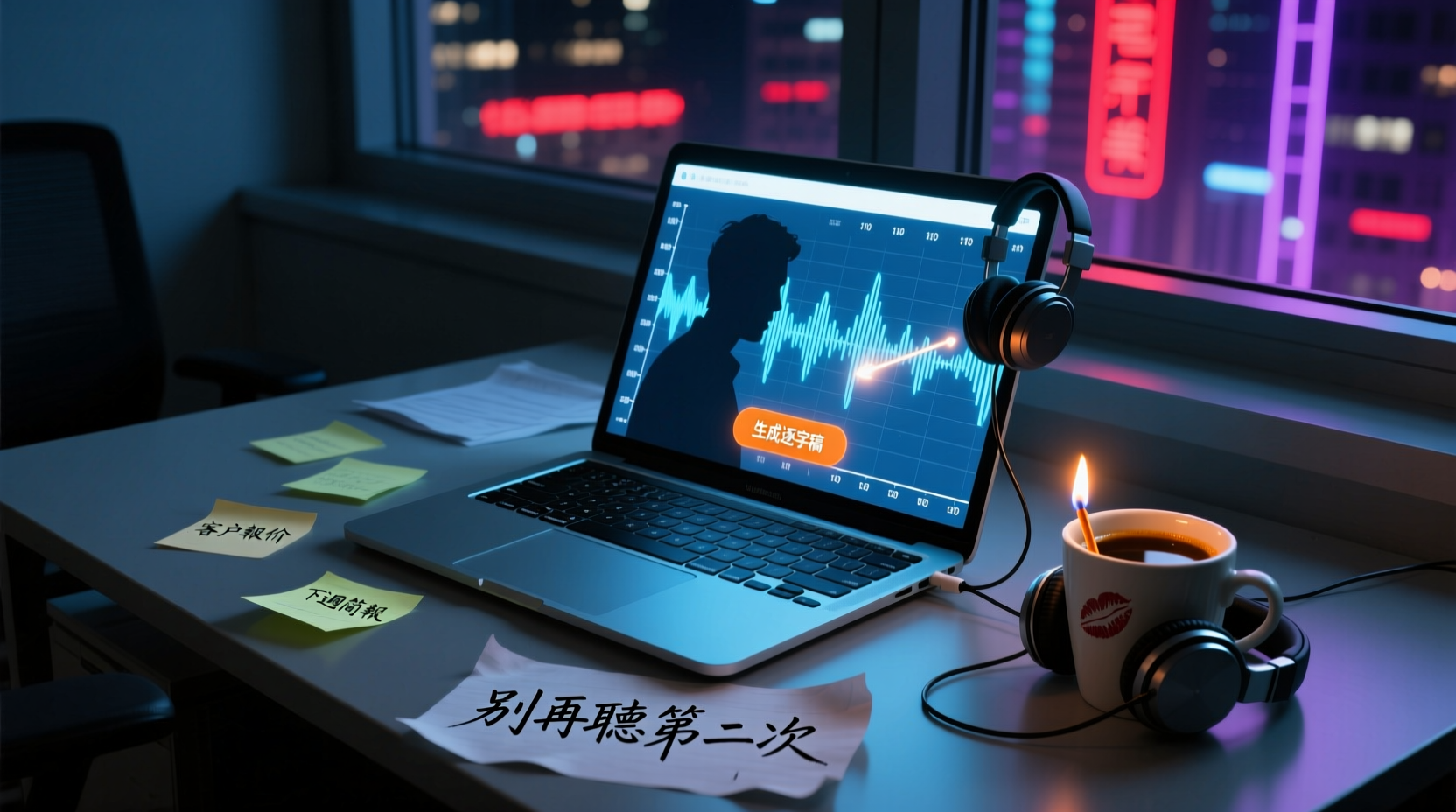
Turn recordings into transcripts and summaries in minutes
Upload audio or video for multilingual transcription, AI notes, and action items
When searching for "speech-to-text recommendation" on PTT, common questions include: Which tool can accurately transcribe Chinese? Is the free version sufficient? Can it handle online meetings? Behind these questions lies the same core need—how to quickly turn recordings into usable data after meetings.
However, discussions on PTT are mostly personal experience sharing, with scattered information; the same tool may be recommended by some and criticized by others. Instead of following a single recommendation, it's better to first grasp a few key selection dimensions, then filter based on your meeting type, Chinese language needs, and team collaboration style.
What People Are Asking on PTT: Common Pain Points and Discussion Types for Speech-to-Text Recommendations
Reviewing discussions on PTT and other communities, several recurring pain points emerge:
- Post-meeting cleanup is time-consuming: A 1-hour meeting often requires an additional 1–2 hours to manually create transcripts, highlight key points, and list action items.
- Chinese transcription quality varies: Some tools claim multilingual support, but outputs often contain simplified Chinese, wording that doesn't match Taiwanese conventions, or errors in mixed Chinese-English contexts.
- Transcripts alone are not enough: A transcript is just text; the real value lies in decisions, action items, and accountability.
- Recording online meetings is cumbersome: Some tools require inviting a bot to join the meeting, adding burden to participants and raising privacy concerns.
PTT recommendation posts can be broadly categorized into three types:
1. Single-tool reviews: Users share their experience with a specific tool; pros and cons are often tied to their particular meeting style.
2. Multi-tool comparisons: Compare transcription quality, pricing, or features of several tools, but evaluation criteria vary.
3. Help requests: Posters describe their needs and ask for recommendations; replies are often a collection of personal experiences.
After understanding these discussion types, the next step is learning how to extract useful information from them.
How to Interpret PTT Recommendation Posts: 3 Methods to Extract Useful Information from Personal Experiences
Method 1: Check the Poster's Meeting Type First, Then Judge if the Recommendation Applies
Everyone's meeting style differs: some primarily have online meetings, others often visit clients on-site, and some need to process large volumes of historical recordings. If the poster mainly has online meetings, the tool they recommend may not suit you if you primarily conduct in-person interviews.
Method 2: Look for Specific Descriptions of "Chinese Transcription," Not Just "Accuracy"
"Accuracy" is subjective and affected by recording quality, noise, accents, and overlapping speech. Instead of trusting claims like "98% accuracy," see if the poster specifically describes: Does the Chinese wording match Taiwanese conventions? Can it correctly recognize mixed Chinese-English speech? Can it output Traditional Chinese?
Method 3: Confirm Whether the Recommendation Covers "Post-Meeting Outputs," Not Just Transcription
If the poster only mentions "fast transcription" but doesn't explain how summaries, action items, or follow-up documents are organized, the tool may only solve "turning audio into text," not "turning text into actionable data."
4 Key Dimensions to Verify if a Recommendation Suits You: Meeting Type, Chinese Language Needs, Post-Meeting Outputs, and Team Collaboration
1. Meeting Type
- Primarily online meetings: Need a tool that can capture system audio, such as Tinrec's desktop app, which directly captures computer system sound without requiring a bot to join the meeting.
- In-person meetings or interviews: Need mobile recording or file import capabilities.
- Historical recording cleanup: Need support for uploading audio files and batch processing.
2. Chinese Language Needs
- Do you need Traditional Chinese output?
- Do you often encounter mixed Chinese-English speech?
- Do you need real-time translation or bilingual comparison?
3. Post-Meeting Outputs
- Do you only need transcripts, or do you need summaries, chapters, action items, reports, or tables?
- Do you need AI Q&A to continue asking questions about the meeting content afterward?
4. Team Collaboration
- Do meeting materials need to be shared with team members?
- Do you need centralized storage, search, and long-term accumulation?
- Do you need to manage member permissions, usage, and activity logs?
Comparison of Mainstream Tools: Tinrec, Otter, Notta, Granola, TurboScribe, Fireflies, PLAUD
| Tool | Core Positioning | Meeting Capture Method | Input Sources | Chinese Experience | Post-Meeting Outputs |
|---|---|---|---|---|---|
| Tinrec | AI meeting notes and team collaboration | Desktop app captures system audio without a bot | Live recording, online meetings, files, mobile | Traditional Chinese, mixed Chinese-English, real-time translation | Summaries, chapters, action items, Q&A, Agent post-processing, multi-format export |
| Otter.ai | AI meeting assistant | Bot and desktop app among other methods | Primarily online meetings, also supports files | Stronger for English business meetings | Summaries, action items, Q&A, team analytics |
| Notta | Transcription, translation, and file processing | Meeting bot, desktop app, or upload | Files and some meeting scenarios | Strong multilingual support | Subtitles, translation, summaries |
| Granola | Bot-free AI meeting notes | Desktop app captures without a bot | Live meetings, does not support pre-recorded file import | Stronger for English meeting notes | Note enhancement, Q&A, integrations |
| TurboScribe | High-value file transcription | File upload | Long files, batch upload | Multilingual | Subtitles, translation |
| Fireflies.ai | Meeting automation and sales analytics | Meeting bot | Primarily online meetings | Stronger for English business meetings | Summaries, action items, AskFred, team analytics |
| PLAUD | AI recording hardware | Hardware recording | Portable recording, phone call recording | Depends on device and app | Summaries, templates, Q&A |
Stop organizing recordings by hand
Upload audio or video and automatically get a transcript, summary, and action items
Key Notes
- Tinrec: Emphasizes Chinese meetings, bot-free recording, and post-meeting workflows, suitable for teams that need to turn meeting content into actionable data.
- Otter.ai: A mature choice for English business meetings, but the Chinese experience may not be as good as tools focused on Chinese.
- Notta: A balance of multilingual and file processing; the free version has a per-session time limit.
- Granola: A lightweight bot-free note-taking option, but does not support uploading pre-recorded audio files and does not retain meeting audio.
- TurboScribe: Advantages in long files and batch transcription, suitable for processing large volumes of historical recordings.
- Fireflies.ai: Meeting automation and sales analytics, but "unlimited transcription" is still subject to storage, upload rate, and AI credit rules.
- PLAUD: A hardware portable recording option, suitable for users who value on-the-go recording.
Bot-Free Recording vs. Meeting Bots: Which Is Better for Your Online Meetings?
Meeting Bots
Represented by Fireflies, meeting bots join online meetings as participants and automatically record and transcribe. The advantage is that they can automatically join after setup; the disadvantage is that they add burden to participants and may raise privacy concerns.
Bot-Free Desktop Recording
Represented by Tinrec and Granola, these tools capture system audio via a desktop app without requiring an additional bot to join the meeting. The advantages are less disruption and higher privacy; the disadvantage is that you need to actively start recording and they do not automatically join all meetings.
Which Is Better for You?
- If you often host meetings and don't want a bot to appear in the participant list, bot-free recording is more suitable.
- If you need to automatically record all meetings, meeting bots may be more convenient, but you need to consider participant consent and privacy issues.
From Transcripts to Actionable Data: How Post-Meeting Outputs Affect Your Work Efficiency
Tools That Only Provide Transcripts
Traditional transcription tools only output text; you still need to manually organize summaries, action items, and accountability. For professionals with frequent meetings, this only solves half the problem.
Tools That Provide a Complete Post-Meeting Workflow
Taking Tinrec as an example, in addition to transcripts, it can automatically generate summaries, chapters, key points, and action items, and supports AI Q&A. Furthermore, an AI assistant (Agent) can, based on meeting minutes and context, help further process action items into action plans, follow-up materials, reports, tables, and documents. For example, after a project meeting, you can instruct the AI assistant: "Based on the meeting action items, organize an action plan including owners, deadlines, and next steps." It will produce a draft for you to manually review and adjust.
Recommendations for Different Roles: How Sales, Product/R&D, and Institutional Staff Should Choose
Sales, Business Development, and Account Managers
- Core needs: Reviewing client communications, extracting commitments and action items, client analysis, and determining next follow-up timing and talking points.
- Recommendation: Choose a tool that can quickly organize client meeting content, extract action items, and generate follow-up materials. Tinrec's Agent post-processing can help produce client follow-up plans, reducing post-meeting organization time.
Product, R&D, and Design Professionals
- Core needs: Accurately preserving requirements, decisions, and division of labor, and forming PRDs, action items, acceptance criteria, or retrospective documents.
- Recommendation: Choose a tool that can structurally organize meeting content and generate decision lists and task assignments. Tinrec's AI Q&A and document generation capabilities help turn discussions into PRD drafts.
Institutional Staff
- Core needs: Organizing meeting minutes, deployment items, division of responsibilities, archiving, and long-term retrieval.
- Recommendation: Emphasize structured organization, manual confirmation, privacy, and data boundaries. Choose a tool that can output Traditional Chinese, support file import and long-term storage, and pay attention to data security.
Team Collaboration: From Personal Tools to Team Spaces
When meeting materials need to be shared with team members, personal tools often fall short. Taking Tinrec's team edition as an example, it provides a dedicated team space where meeting recordings, transcripts, summaries, and action items can be centrally stored, and members can view and reuse historical meeting materials.
In practice, administrators can create a team space, invite members, and allocate seats. Members with seats can record, upload, and edit meeting materials, while members without seats can still view, play, and read team materials. This way, meeting materials are no longer scattered across personal devices and chat logs, but are accumulated as searchable, collaborative, and traceable digital assets for the team.
Important Considerations: Accuracy, Privacy, Manual Confirmation, and Legal Boundaries
- Accuracy: Affected by recording quality, noise, accents, overlapping speech, and technical jargon; no fixed accuracy can be guaranteed. For important content, it is recommended to cross-check with transcript timestamps and recording playback.
- Privacy: When recording and transcribing, you should comply with local laws and obtain participant consent when necessary.
- Manual confirmation: For important decisions, sensitive data, and externally sent content, manual confirmation is recommended; do not rely entirely on AI.
- Legal boundaries: Different regions have different regulations on recording consent; verify legality before use.
When choosing a speech-to-text tool, instead of chasing individual PTT recommendations, first clarify your meeting type, Chinese language needs, post-meeting outputs, and team collaboration style, then verify recommendations against these dimensions. Only then can you find a tool that truly improves your work efficiency.
References
- Which audio-to-text tool is the best? First conclusion: PTT users' top 5 AI tools tested - Seconds Recording Blog
- Expert-reviewed ranking of the top 10 audio-to-text tools | mybest
- Speech-to-text App PTT hot recommendations: 2026 efficient meeting notes and recording transcription tool comparison - Seconds Recording Blog
- [Review] Hands-on comparison of 3 speech-to-text tools using an AI PC - Notebook Board - PTT
- [Question] App for continuous interpretation transcripts - Android Board - PTT
Turn every recording into actionable outcomes
Get 60 free transcription minutes when you sign in. No credit card required.
Related Reading
You might also like
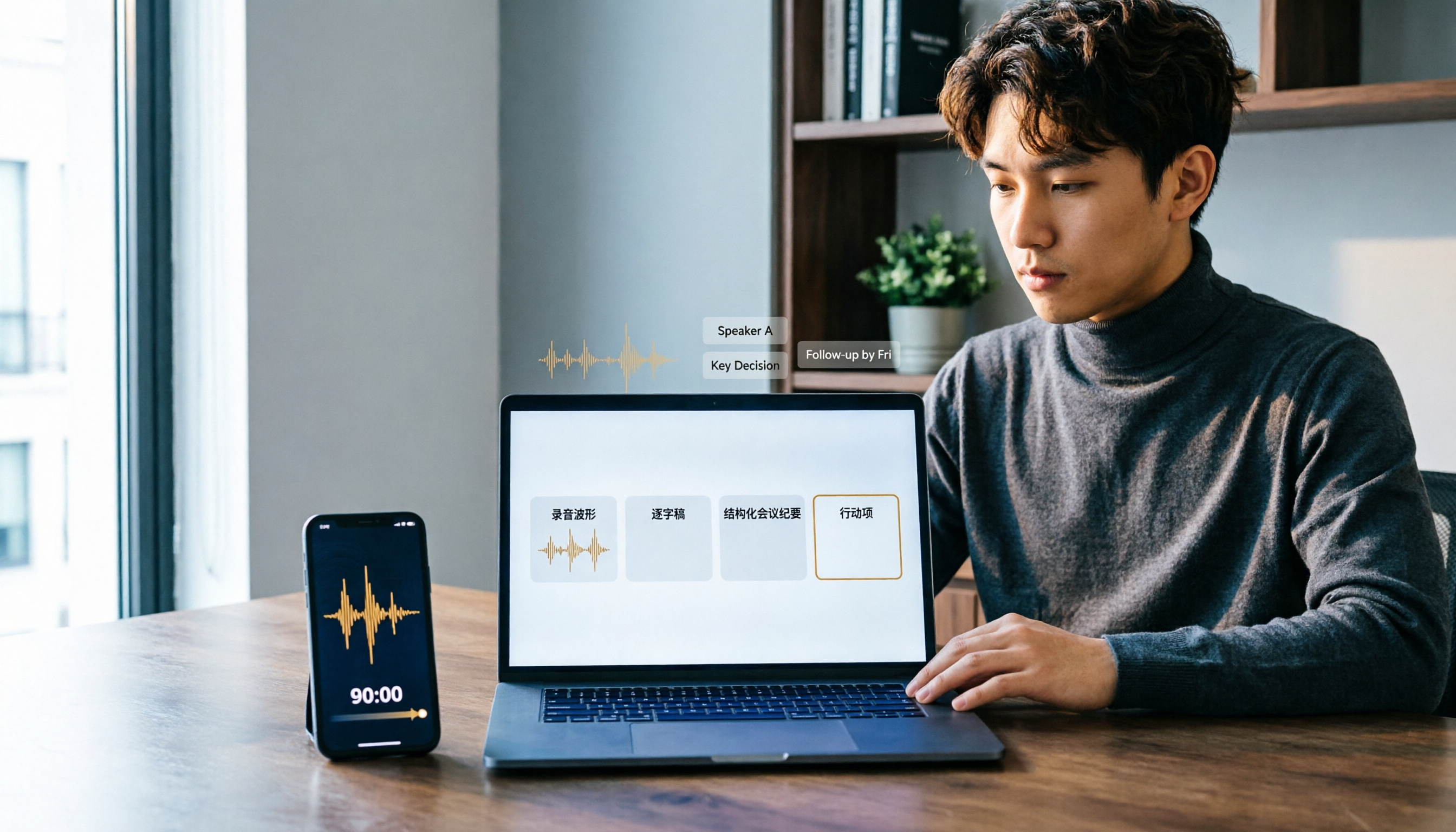
6 AI Meeting Transcription Tools Compared for 2026: From Transcripts to Post-Meeting Summaries
A 90-minute interview recording is sitting on your phone, and the transcript is due tomorrow morning. This article breaks down AI meeting notes into two steps—transcription and organization—and compares six practical solutions, including bot-free recording, multilingual transcription, hardware recorders, and free post-meeting organization tools, to help you choose the right one for your scenario.

2026 AI Meeting Notes Comparison: Tinrec vs Granola for Chinese Transcription and Free Tiers
In Dcard's 2024 AI meeting notes discussions, the most common questions are whether free tiers are sufficient, how well Chinese transcription works, and whether post-meeting summaries can be shared directly. This article compares Tinrec and Granola, two bot-free meeting note tools, across recording retention, old file import, Chinese and bilingual support, post-meeting outputs, team data governance, and pricing to help you decide which fits your meeting scenario.

How to Choose AI Meeting Notes Tools in 2026: 5 Steps to Understand Comparison Tables and Key Selection Criteria
2026 AI meeting notes tool comparison and buying guide: use 5 steps to understand meeting capture, post-transcription processing, Chinese language support, team governance, and pricing quotas, and compare use cases for Tinrec, Otter.ai, Notta, Granola, TurboScribe, and PLAUD.

2026 AI Meeting Notes Comparison: Tinrec vs Notta — Which Is Better for Chinese-Speaking Teams?
A meeting notes table isn't just pasting a transcript. This article uses a typical weekly meeting workflow to compare Tinrec and Notta across five dimensions: meeting capture methods, table output, free quota and pricing, Chinese and real-time translation, and team governance. It also includes a ready-to-use meeting notes table template with fields and a manual verification checklist.

Tinrec vs Notta 2026: 5-Dimension Comparison for Chinese Meeting Notes
Based on the popular PTT discussion about AI meeting notes, we compare Tinrec and Notta across 5 key dimensions: bot-free recording, post-meeting AI Q&A, team data retention, and quota rules, to help you choose the right tool for Chinese meetings.

2026 AI Meeting Notes: Record Online Meetings Without a Bot + Auto To-Dos in One Go
The latest shift in AI meeting notes for 2026 is moving from "inviting a bot into the meeting" to "getting data you can use right after the meeting." This article takes the perspective of a mid-level manager, breaks down 4 key purchasing criteria, tests Tinrec's bot-free recording, automatic to-dos, and AI Q&A, and briefly reviews who Meeting Ink, SeaMeet, and CLOVA Note are each best for.

2026 AI Meeting Notes Comparison: Which Latest Version Actually Saves You Time?
A guide to choosing the latest AI meeting notes tools in 2026, covering common pitfalls, core capabilities, real-world use cases, team seat pricing, and how Tinrec turns meetings into searchable, collaborative, actionable data.

2025 AI Meeting Notes Guide: Auto-Generate Transcripts and Action Items in One Go
How to choose an AI meeting notes tool in 2025? We break down 5 key buying factors: meeting capture methods, post-transcript organization, mixed Chinese-English recognition, team data ownership, and quota calculations. Plus, we compare Tinrec, Otter.ai, Notta, and Granola to help you find the right fit.

4 Real-Time Transcription Tools Tested for 2026: Which One Keeps Up as You Speak?
How do you do real-time transcription? We tested 4 tools with the same Chinese meeting recording, comparing live transcription, Chinese and mixed Chinese-English recognition, post-meeting summaries and AI follow-up questions, as well as free quotas, team seats, and pricing, to help you find the approach that truly keeps up during meetings.