
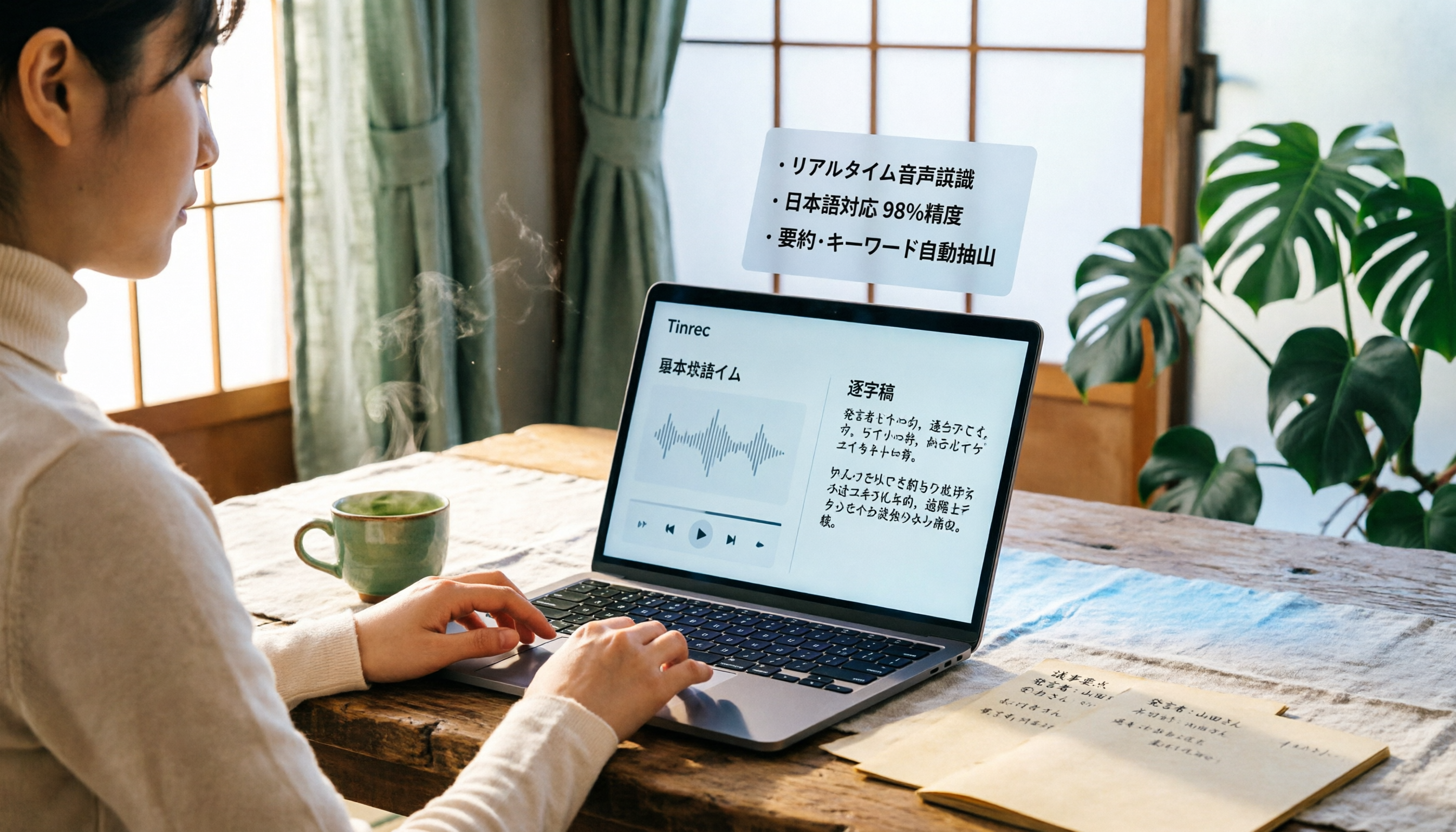
Turn recordings into transcripts and summaries in minutes
Upload audio or video for multilingual transcription, AI notes, and action items
For Japanese Audio Notes, You Need More Than Just "Transcription"—You Need "Usable Output"
When dealing with Japanese meetings, interviews, or lecture recordings, the first thought for many is to find a tool that can "convert Japanese to text."
But once you start, you realize the issue isn't just "whether it can transcribe": How do you review a transcript that's too long? Which sections are key points? How do you organize action items scattered throughout the conversation? And if you need to translate it into Chinese or English, can it be done in one place?
So this article not only introduces Notta's Japanese transcription features but also shows you what you can do after transcription, and whether the free plan is sufficient.
Before Choosing a Japanese Transcription Tool, Consider These 4 Key Points
1. Japanese Recognition Quality Matters More Than "Support"
Many tools claim to support Japanese, but in practice, accuracy varies greatly with honorifics (keigo), technical terms, sentence-ending particles, and overlapping speech.
Don't just look at the official number of languages supported. Test with your own real Japanese recordings. The key is whether the tool can correctly recognize mixed Chinese/English in meetings, product names, and proper nouns.
2. What Can You Do After Transcription?
If it just turns a Japanese audio file into a wall of text, honestly, that's of limited help.
Ideally, the tool should automatically generate summaries, segment the text, extract action items, and even let you quickly find key discussion points via Q&A. This way, you don't have to read the entire transcript from start to finish.
3. Is the Free Tier Actually Usable?
Free plans usually limit session length or monthly minutes. If the limits are too strict—like a 3-minute max per file—then for typical meetings or interviews, it's just a trial, not a real solution.
4. Do You Need Cross-Platform and Team Features?
If you record on your phone but need to edit and export on your computer, or share meeting notes with colleagues, cross-platform and team features are crucial.
What is Notta? A Quick Verdict After Testing
Notta is an AI speech-to-text and meeting notes tool deeply established in the Japanese market.
It supports transcription and translation in 58 languages, including Japanese, Chinese, English, Spanish, and German. Core features include:
- Transcribing Japanese audio files, videos, or live recordings into text.
- Automatically generating summaries, segments, and key points.
- Supporting translation between Japanese and other languages.
- Exporting subtitles, transcripts, or meeting notes.
- Offering web, mobile app, and other usage methods.
For users in Taiwan dealing with Japanese content, Notta's advantage is that it's designed for the Japanese market, so its Japanese interface, recognition, and use cases are relatively mature.
Note that Notta's free plan has strict limits: according to official info, free users can transcribe 1 audio or video file, with a max of 3 minutes per file.
In other words, if you just want a quick test of Japanese transcription, the free plan works; but for full meetings or interviews, the free plan is basically insufficient.
Step-by-Step: Using Notta for Japanese Transcription
Step 1: Log in to Notta Web
First, create a Notta account and log in to Notta Web.
Once in the dashboard, you'll see "Import Files" or a similar file upload option on the right side.
Step 2: Select Japanese as the Transcription Language
Before uploading, set the transcription language to Japanese.
This is important because specifying the correct language significantly impacts Japanese recognition accuracy, especially when sentences mix kanji, hiragana, and katakana.
Step 3: Upload Audio or Video
Drag and drop your Japanese audio or video file into the upload area, or click "Select Documents" to choose a file.
Notta supports various common audio and video formats, and transcription starts automatically after upload.
Step 4: Review Transcript and Summary
Once transcription is complete, you can view the Japanese transcript on the web page.
Notta also provides a summary and key points, so you can quickly grasp the content without listening to the entire recording.
Step 5: Export or Translate
If you need to translate the Japanese content into English or another language, you can use Notta's built-in translation feature.
Stop organizing recordings by hand
Upload audio or video and automatically get a transcript, summary, and action items
You can also export the transcript or subtitles to continue working in other document or editing tools.
Notta vs. Tinrec: Use Case Differences
If you also need to handle Chinese meetings, online meetings, or team collaboration, Tinrec is another option to consider.
Tinrec is more focused on "AI meeting notes and team collaboration," whereas Notta leans toward multilingual transcription, translation, and subtitle processing.
If Your Main Need Is Quick Japanese Audio Transcription, Translation, or Subtitles
Notta's multilingual capabilities and Japanese market experience fit better here.
Especially if you have many Japanese audio files to quickly convert to text, or need to translate Japanese content into other languages, Notta is worth trying.
If You Need to Record Online Meetings and Organize Action Items
Tinrec has a capability Notta doesn't emphasize as much: its desktop app can record Zoom, Google Meet, and Microsoft Teams meetings without a bot.
Users don't need to add a meeting bot; instead, the desktop app captures system audio directly, generating transcripts, summaries, and action items.
If you often have Chinese or mixed Chinese-English meetings and want to organize action items afterward, export to Notion or Google Docs, Tinrec's post-meeting workflow and team spaces are more convenient.
If You Want to Build a Shared Meeting Knowledge Base for Your Team
Tinrec's team plan offers team spaces, role and seat management, usage analytics, and audit logs.
It's more about turning meeting data into a searchable, queryable, and reusable asset for the team. Notta also has a Business plan, but it's more focused on multilingual transcription and translation.
In short:
- Japanese audio to text, translation, subtitles → Notta.
- Chinese or mixed Chinese-English meetings, bot-free recording, post-meeting action items, and team collaboration → Tinrec.
If you need both, try the free versions first to see which fits your primary use case.
3 Things People Often Overlook with Japanese Transcription Tools
1. Free Plan Limits Can Be Stricter Than You Think
Notta's free plan limit of 3 minutes per file is very short for typical meetings or interviews.
If you plan to use the free plan for full content, check the current plan limits first. Don't wait until you've recorded a 60-minute meeting only to find the free quota covers just a small segment.
2. Recording Quality Affects Accuracy More Than the Tool Itself
Any Japanese transcription tool will see accuracy drop with background noise, overlapping speech, quiet voices, or distant mics.
For better Japanese transcripts, use a clear recording device and minimize ambient noise—this is more effective than just switching tools.
3. Always Cross-Check AI-Generated Summaries Against the Original
Auto-summaries and action item extraction are convenient, but AI can occasionally misinterpret Japanese context or miss nuances like hesitation or hedging.
For important decisions or client requirements, always refer back to the Japanese transcript and original recording, not just the summary.
Conclusion: Should You Choose Notta or Another Tool?
If you mainly handle Japanese audio files, need translation to other languages, or create subtitles, Notta is a solid option worth trying. Its Japanese support is comprehensive, and the workflow is simple.
If your needs lean more toward Chinese meeting notes, bot-free online meeting recording, post-meeting action items, and team knowledge management, Tinrec is a better fit.
Start with the free versions:
- For Japanese audio transcription or translation/subtitles → Try Notta.
- For recording online meetings and organizing action items → Try Tinrec.
Don't rush to pay. Test with your own real recordings to confirm the tool fits your use case before upgrading.
FAQ
How long can I use Notta's free Japanese transcription?
According to official info, Notta's free plan allows each user to transcribe 1 audio or video file, with a max of 3 minutes per file. This is suitable for a quick trial; for full meetings or interviews, you'll likely need a paid plan.
Can Notta translate Japanese into Chinese or English?
Yes. Notta supports multilingual transcription and translation. You can translate Japanese content into other languages or view it bilingually. Actual translation quality depends on the clarity of the original audio and technical terms.
Is Notta suitable for recording online meetings?
Notta has meeting-related features, but if you need bot-free recording of Zoom, Google Meet, or Microsoft Teams meetings, Tinrec's desktop app is more direct. Notta is better for multilingual transcription, translation, and subtitle processing.
Which is better: Notta or Tinrec?
It depends on your primary needs. Notta is mature in Japanese transcription and multilingual translation; Tinrec is more focused on Chinese meetings, bot-free recording, post-meeting action items, and team collaboration. We recommend testing both with your own recordings using the free plans.
How can I improve accuracy when transcribing Japanese with Notta?
Set the transcription language to Japanese before uploading, and use clear recordings. Reducing background noise and avoiding overlapping speech will improve the quality of the Japanese transcript.
References
Turn every recording into actionable outcomes
Get 60 free transcription minutes when you sign in. No credit card required.
Related Reading
You might also like

2026 Complete Guide to AI Meeting Notes: Transcript Comparison and Tinrec Alternatives
Many people think AI meeting notes just mean turning recordings into transcripts, but the real time sink is turning all that text into actionable conclusions and to-dos. Based on a student's real project experience, this article compares transcripts and meeting notes, and explains how Tinrec handles bot-free recording, post-meeting organization, AI Q&A, and team spaces—helping you decide if the free version is enough.

2026 AI Meeting Recorder Comparison: 5 Tools Tested — Which One Actually Turns Meetings into Actionable To-Dos?
Most people choose an AI meeting recorder based only on transcription accuracy, then end up never using it after a year of recordings. This article uses five practical criteria to compare Tinrec, Otter.ai, Granola, Notta, and others on meeting capture methods, post-meeting outputs, Chinese language handling, and team governance—helping you pick the right solution within your budget.

2026 AI Meeting Recorder Comparison: No-Bot Online Meeting Transcription and the Fastest Meeting Minutes
Many people think AI meeting notes just means adding a bot and waiting for a transcript, but the real problems start after transcription. This article addresses common misconceptions, outlines four key factors for choosing an AI meeting recorder, and compares Tinrec, Notta, Otter.ai, and Granola on capture methods, post-meeting organization, and team collaboration, with a buying guide and recommendations.

AI Meeting Notes in 2026: How to Choose — 5-Step Hands-On Comparison to Find Your Best Fit
If you can't keep up with meeting notes, the problem is often not the meeting itself but choosing the wrong tool. This article compares Tinrec and PLAUD Note step by step across five dimensions — recording sources, online meetings, post-meeting output, Chinese-language experience, and team governance — to help you decide which one better fits your work style.

2026 AI Meeting Notes Software Comparison: Are Free Versions Enough, and Which Really Saves You Time?
We tested and compared AI meeting notes tools like Tinrec, Otter.ai, Notta, and PLAUD from three angles: how meeting audio gets in, what you can do after transcription, and who controls team data. We also break down free version limits, team seat and billing differences to help you pick the one that truly saves time.

2026 AI Meeting Notes Software Comparison: Which One Actually Saves You Time After the Meeting?
Most people approach choosing AI meeting notes software the wrong way from the start: they mistake transcription for meeting notes and assume a bot must join the meeting. This article tackles common misconceptions, breaks down the selection logic using five key points, and compares Tinrec, Notta, Otter.ai, and PLAUD with hands-on testing, plus a guide to avoiding pitfalls and specific recommendations.

2026 AI Meeting Recorder Comparison: Tinrec vs Otter.ai vs Notta vs PLAUD for Chinese Meetings
The pain starts after the meeting ends. We compare Tinrec, Otter.ai, Notta, and PLAUD on recording methods, Chinese recognition, post-meeting organization, and team collaboration, with free tiers, pricing, and pitfalls to help you pick the one that truly saves time.

Tinrec vs Notta 2026: 5-Dimension Comparison for Chinese Online Meeting Notes
After an online meeting, do you still need to spend extra time organizing meeting notes? Starting from the real needs of 'online viewing,' this article compares Tinrec and Notta across 5 dimensions, and summarizes key purchasing considerations, practical use cases, and FAQs for AI meeting notes tools, helping you find the right way to organize Chinese meetings.

4 AI Meeting Transcription Tools Tested for 2026: Which Free Version Is Actually Enough?
People searching for 'free AI meeting transcription online' really need to decide three things: whether the free quota can last through a meeting, whether the meeting requires inviting a bot, and whether there's AI to organize the transcript afterward. This article uses these three criteria to test and compare the free plans and post-meeting workflows of Tinrec, Notta, Otter.ai, and PLAUD NotePin, and provides practical tips and selection advice for office workers in Hong Kong.