

Turn recordings into transcripts and summaries in minutes
Upload audio or video for multilingual transcription, AI notes, and action items
Which Teams and Roles Use Google Meet Most
Google Meet is the primary meeting tool for many teams. It's free, easy to use, and anyone with a Google account can start or join a meeting, making it widely used for cross-departmental communication, client demos, project reviews, and remote interviews.
From a practical standpoint, the teams that rely most on Meet generally fall into a few categories:
- Sales and Business Teams: Use Meet for client demos, solution walkthroughs, and regular check-ins. After meetings, they need to organize client needs, objections, and commitments, and schedule next steps.
- Product and R&D Teams: Use Meet for requirements reviews, technical discussions, and weekly meetings. They need to preserve requirements context, decision rationale, and task assignments to avoid losing information after discussions.
- HR and Functional Teams: Use Meet for remote interviews, employee communications, and cross-departmental coordination. Interview records, feedback, and follow-up arrangements need to be stored for multiple stakeholders.
- Management and Project Owners: Use Meet for project status meetings, retrospectives, and decision-making sessions. They need to clearly define conclusions, action items, and owners, and track progress continuously.
These teams choose Meet because it lowers the barrier to remote communication. But after the meeting ends, the real problem emerges: Where are the notes? Who is responsible for action items? How can you quickly review the last meeting's conclusions before the next one?
Post-Meeting Disconnects Across Different Meeting Scenarios
Different teams face different post-meeting disconnects, but they all share a common issue: Meeting content is scattered, making it difficult to turn into reusable team data.
For example, after a client demo, a salesperson might save the recording on their phone, jot down key points in a notebook, and write commitments in chat messages. When following up later, they have to search through multiple places to piece together the full context.
Product and R&D teams face similar challenges. Requirements review meetings cover many details, but relying solely on handwritten notes makes it hard to fully convey the requirements context, decision rationale, and action items to those who didn't attend.
HR interview scenarios are even more typical. Interviewers each record their impressions, but without a unified interview record and feedback summary, comparing candidates later becomes fragmented.
The essence of these disconnects is: Meetings happen in Meet, but the outcomes don't end up in a place where the whole team can access, search, and continue working on them.
Turning Meet Meetings into Searchable Data: The Complete Tinrec Workflow
Tinrec is an AI meeting notes and collaboration tool that not only transcribes audio but also helps you organize meeting content into searchable, summarizable, and further processable data.
For Google Meet, Tinrec's desktop app can directly capture your computer's system audio, so you don't need to add a bot to the meeting. Just open Tinrec and start recording during the meeting, and you'll get a full transcript when it ends.
Here's the specific workflow:
1. Record or Import: During a Google Meet session, open the Tinrec desktop app and start recording; if you already have a meeting recording or video file, you can also import it directly.
2. Automatic Transcription and Organization: Tinrec generates a transcript and automatically extracts summaries, chapters, key points, and action items. You don't need to listen to the entire recording from scratch.
Stop organizing recordings by hand
Upload audio or video and automatically get a transcript, summary, and action items
3. AI Q&A and Further Processing: You can ask questions about the meeting content, such as "What objections did the client have about pricing?" or "What technical solutions were confirmed in this review?" Tinrec's AI assistant can also help turn action items into action plans, follow-up materials, reports, or tables based on the meeting notes and context.
4. Save to Team Space: Store meeting data (recordings, transcripts, summaries, action items) in the Tinrec team space, where team members can view, search, and continue using them.
For example, after a sales meeting, Tinrec's AI assistant can help you organize the client's needs, objections, and commitments into a follow-up document and list next steps. You only need to manually verify the content before sending it to the client or sharing it with internal colleagues.
How the Team Space Handles Meeting Notes and Action Items
Tinrec's team edition is not about "multiple people sharing one account" but rather an independent team collaboration space. Meeting data belongs to the team, and members can view shared content; those with seats can also record, upload, and edit.
Specifically, the team space can handle three types of content:
- Meeting Notes and Transcripts: Complete records of every Meet meeting are stored in the team space, so new members can view historical data.
- Action Items and Follow-up Materials: Action items extracted by the AI assistant and generated follow-up materials can be stored in the team space for easy assignment and updates.
- Shared Meeting Data: Teams can build a unified meeting database, categorized by project, client, or department, for easy search and reuse.
For example, after a requirements review, a product and R&D team can place meeting notes, decision lists, and action items into the team space. Product managers can generate a draft PRD based on the notes, R&D leads can confirm technical solutions, and QA testers can review acceptance criteria. All content is in one place, avoiding scattered data.
How Managers Can Review Team Usage and Follow-up
As a manager, you might be more concerned about whether the team is effectively using the meeting notes tool and whether action items are actually being followed up. Tinrec's team edition provides usage analytics so you can review team usage trends, member activity, and meeting organization status.
With usage analytics, you can:
- See which members are frequently using meeting notes and which meeting types take up the most time.
- Review the team's overall meeting organization volume to determine if the tool is truly being adopted.
- Combine action items and follow-up materials in the team space to track the progress of project or client meetings.
Of course, Tinrec won't make management decisions for you. It provides factual evidence so you can clearly see the shift from "meetings end and are forgotten" to "meetings become data."
Frequently Asked Questions and Usage Boundaries
Does Tinrec automatically join Google Meet meetings?
No. Tinrec's desktop app records meetings by capturing your computer's system audio, so you need to actively open it and start recording. It is not a meeting bot and won't automatically join meetings from your calendar.
How accurate is meeting transcription?
Tinrec provides high-quality transcription in clear audio and common scenarios, but actual results can be affected by recording quality, noise, accents, overlapping speech, and technical jargon. For important decisions and external communications, we recommend manually verifying against the transcript and recording playback.
How is team member permission managed?
Tinrec's team edition distinguishes between members, roles, and seats. All active members can view team data, but only members with seats can record, upload, edit, and export. Admins can manage roles, seats, and team settings.
Will meeting data be lost when a member leaves?
No. Team resources belong to the team. When a member leaves or loses their seat, their assigned team resources can be transferred to other active members, and historical data remains in the team space.
If you want to turn your Google Meet meetings into searchable, collaborative, and traceable team data, consider starting with Tinrec's team edition to turn every conversation into a team asset.
References
Turn every recording into actionable outcomes
Get 60 free transcription minutes when you sign in. No credit card required.
Related Reading
You might also like

4 AI Meeting Note Tools Tested for 2026: Which Saves the Most Time for Chinese Meetings?
Still spending two hours writing meeting notes after the meeting? This article compares four AI meeting note tools, breaking down Chinese and mixed Chinese-English recognition, meeting recording methods, post-meeting summaries and action items, cross-platform export, and team member management. It also lists four key pitfalls to avoid when choosing a tool, helping you find a solution that truly saves time.

2026 Guide: Convert Audio to Transcripts — Stop Typing Manually & Auto-Generate Meeting Minutes with AI
Don't want to type transcripts by hand? This guide covers two scenarios—live meetings and pre-recorded files—and outlines 4 key buying factors. We tested Tinrec's bot-free meeting recording, AI summaries, and Q&A workflow, compared Notta, Granola, and PLAUD, and included the most common pitfalls to avoid.

4 AI Recording Tools Tested for 2026: Which Saves the Most Time on Chinese Meeting Notes?
Recorded a meeting but never have time to organize it? This hands-on comparison looks at four common approaches—built-in phone features, free online tools, AI recording hardware, and dedicated AI meeting note tools—and tests Tinrec on Chinese meeting transcription, summaries, and action items. Includes 6 buying considerations and FAQs.

2026 Medical Meeting Transcription Tools Compared: Which AI Saves You the Most Time with Chinese Transcripts and Summaries?
For professionals juggling over a dozen meetings a week and still stuck with post-meeting notes, which tool should you use? This article dives into practical decision points, covering 5 key factors for choosing a medical meeting transcription tool. We tested Tinrec's bot-free recording, AI summaries, action item extraction, and AI Q&A, and briefly review alternatives like Notta, Otter.ai, and PLAUD. We also provide a guide to avoid common pitfalls and final recommendations.
How to Choose an Automatic Transcription Tool in 2026: 5 Steps to Compare Yating Transcription and Tinrec
How do you choose an automatic transcription tool? Starting from the actual checklist I use when picking tools, I compare Yating Transcription and Tinrec across five dimensions, covering online meeting recording methods, post-meeting organization depth, AI Q&A, cross-platform team collaboration, and quota pricing, to help you determine which one better fits your workflow.

4 Best Audio-to-Text Apps in 2026: Which One Actually Saves You Post-Meeting Time?
A mid-level manager who attends 15 meetings a week shares hands-on experience. From online meeting recording methods and transcription performance for Chinese and mixed Chinese-English to post-meeting summaries and action item organization, this breaks down the differences among four types of audio-to-text apps and explains how Tinrec uses bot-free recording, AI summaries, action item extraction, and team spaces to turn meetings into searchable, collaborative, actionable data.
4 Interview Transcription Tools Compared in 2026: From Recording to Citable Text
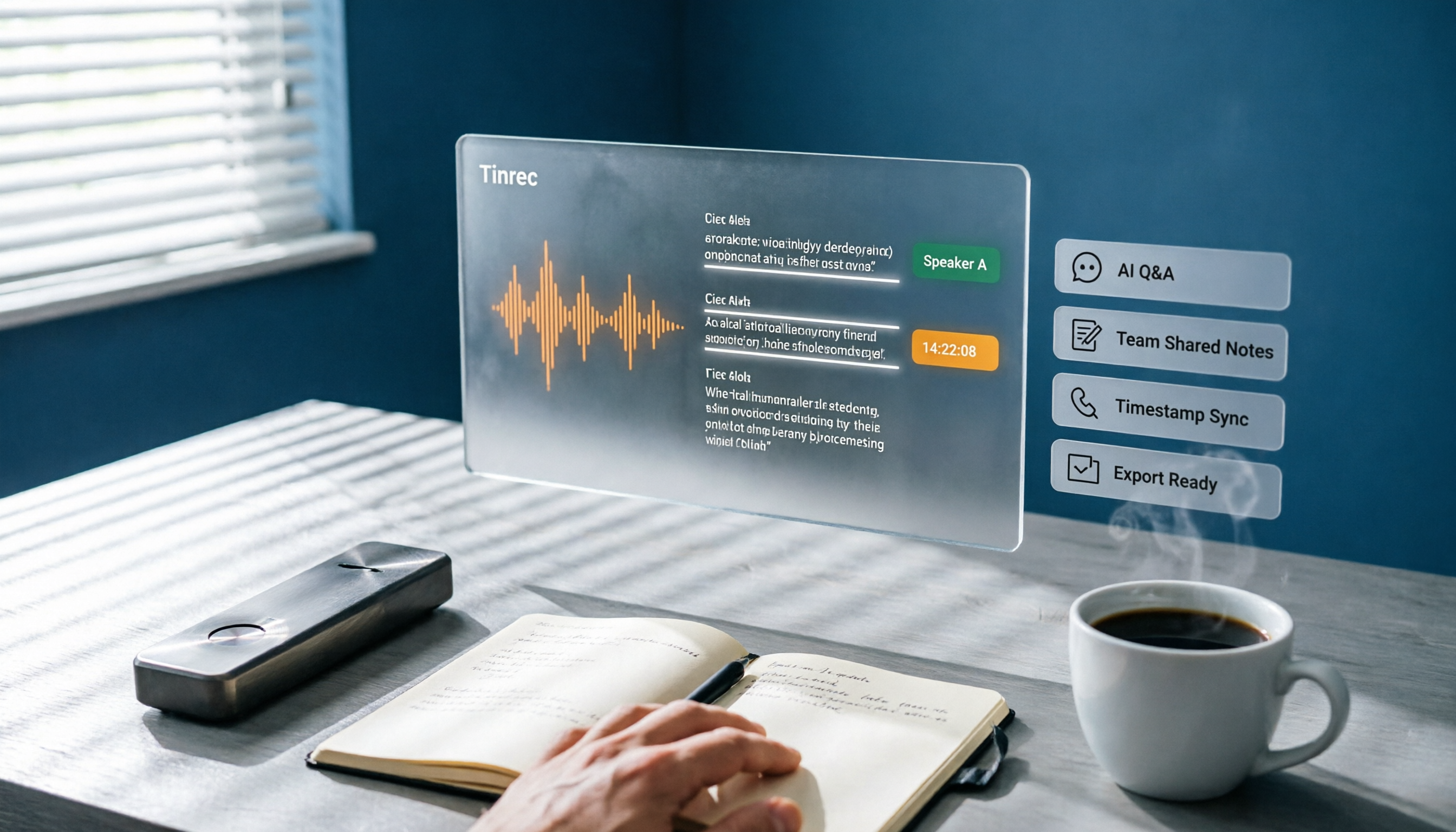
After an interview, organizing the transcript often feels more exhausting than the interview itself. This article starts from 'recording to citable text' and compares 4 interview transcription tools, covering speaker labeling, AI Q&A, audio retention, and team sharing, plus common pitfalls and selection advice.

Tinrec vs Notta 2026: 5-Dimension Comparison for Chinese Meeting Transcription Tools
Starting from the decision focus of 'Do you want transcription, or usable meeting data?', this article compares Tinrec and Notta across 5 dimensions, covering selection criteria, a full breakdown of Tinrec, other options, and pitfalls to avoid, helping Chinese meeting users make a quick choice.

5 Transcription Tools Tested and Compared in 2026: Transcription Takes Too Long—Which One Actually Saves Time?
Transcription takes too long, and the problem is often not typing speed but the "listen, type, re-read" workflow. This article tests 5 transcription and AI meeting note tools, covering how to judge accuracy, post-meeting organization, audio retention and export, free quotas, and team seat licensing. It provides criteria you can follow directly and analyzes Tinrec's actual performance in bot-free recording, AI Q&A, and team knowledge retention.