

Turn recordings into transcripts and summaries in minutes
Upload audio or video for multilingual transcription, AI notes, and action items
Two hours in a meeting, then another two hours writing up the minutes—that was my weekly nightmare.
To make it worse, some team members record with iPhones, others bring voice recorders, and we end up with scattered files, no one transcribing the audio, and action items relying on memory.
If you're also torn between "should I buy a voice recorder or just stick with my iPhone," here are my hands-on conclusions.
First, Figure Out: Do You Need "Just a Recording" or "Something You Can Organize"?
Before picking a recording tool, ask yourself one question.
Do you just want a backup of the audio, or do you need transcripts, key summaries, and action items afterward?
If it's just for the record, the iPhone Voice Memos app or a budget voice recorder will do.
But if your time is valuable and you'd otherwise be manually transcribing, what you really need isn't a recording tool—it's an AI organization tool.
Recording stability: Dedicated voice recorders stay focused, while iPhones can be interrupted by calls, messages, or app switching.
Battery and storage: Voice recorders typically last a long time; iPhones can run low on battery and space during long recordings.
Post-processing: This is the key. Both voice recorders and iPhones just give you an audio file—you still have to transcribe it yourself.
Cross-platform and collaboration: If you need to share meeting materials with your team, a hardware-only recorder is almost useless.
Tinrec—My Go-To Solution After Testing
Tinrec is an AI meeting notes and collaboration tool that supports iOS, Android, and web.
My current workflow: for in-person meetings, I open the Tinrec app on my phone; for online meetings, I use the desktop version to record system audio—no need to add a bot to Zoom or Meet.
Transcribes as It Records—Transcript Ready When the Meeting Ends
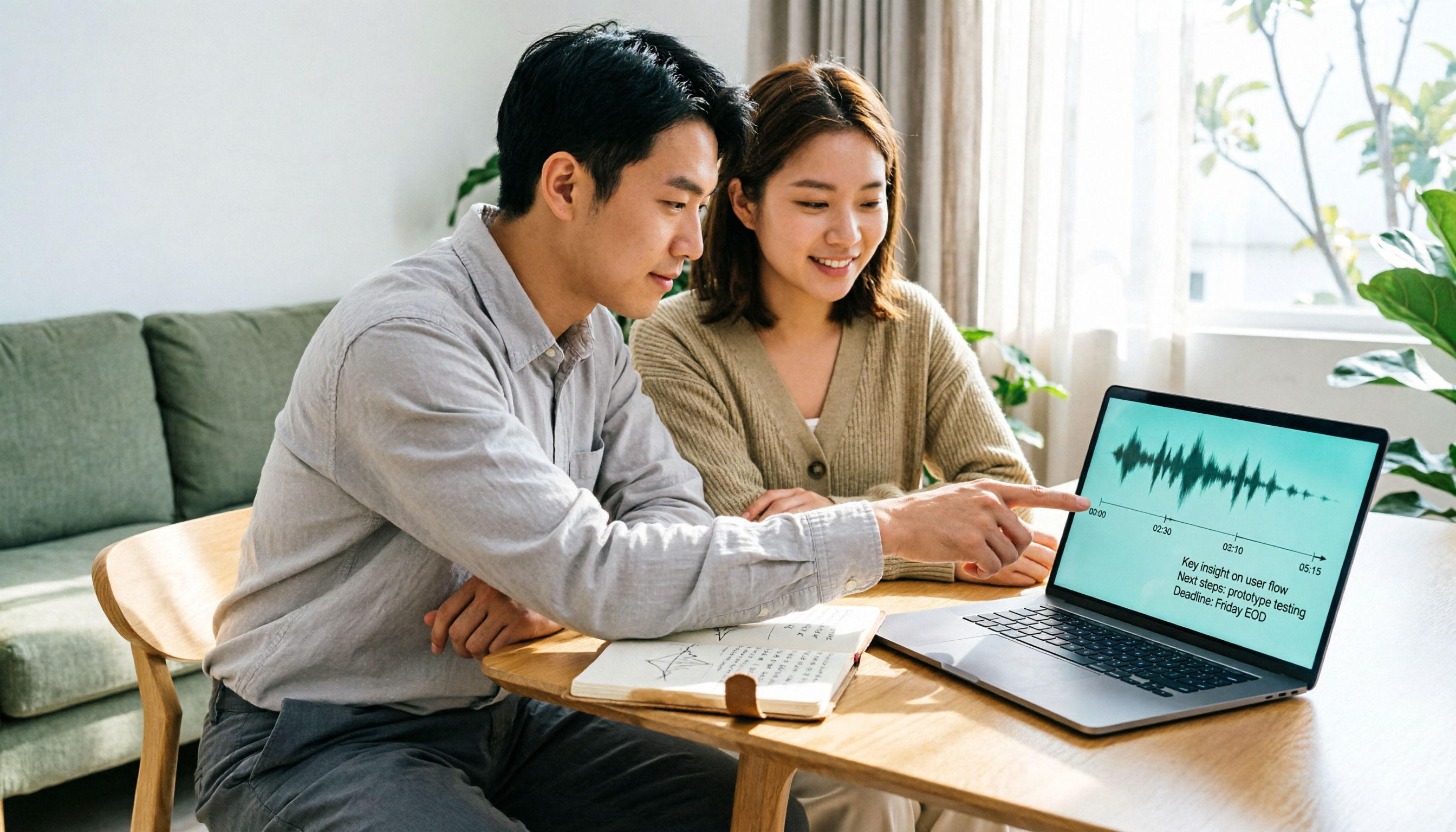
During meetings, Tinrec transcribes in real time, so by the time the meeting wraps up, you have a written record.
No more begging colleagues to transcribe or staying up late with headphones on.
AI Summaries and Action Items—Faster Than Manual Notes
After recording, Tinrec automatically generates a summary, chapters, and action items.
Who's responsible for what, and deadlines—all laid out.
What surprised me most is the AI Q&A feature—you can ask it, "Who mentioned the budget in the last meeting?" and it finds the answer based on meaning, not just keyword search.
Few tools in this price range offer that.
Handles Chinese Meetings Really Well
I mostly record Chinese meetings, occasionally with some English mixed in.
Tinrec's transcription quality for Chinese, Traditional Chinese, and multilingual meetings has been more stable than I expected.
Real-world performance can still be affected by background noise or people talking over each other, but for everyday meetings, it's been great.
Team Version Solved My Biggest Headache: Scattered Files
Our team of eight used to keep meeting recordings on individual iPhones or voice recorders.
Now, with Tinrec's team version, all meeting materials are stored in a shared team space, and new members can access historical data.
Stop organizing recordings by hand
Upload audio or video and automatically get a transcript, summary, and action items
Admins can allocate seats, control who can upload and edit, and when a member leaves, the data stays.
The team plan costs USD 29.80 per paid seat per month, or about USD 16.58 per month when billed annually—reasonable for a small team.
Honestly, There Are Limitations
The free plan has basic usage limits, and heavy users will need to pay.
Also, Tinrec isn't the type to "auto-join every meeting"—you need to actively open the desktop app or mobile app to start recording.
If you're recording a concert or need professional-grade audio in extreme environments, you'll still need a physical device with a directional microphone.
What Other Options Are There Besides Tinrec?
Physical voice recorders (e.g., Sony, Philips): Stable recording and long battery life, ideal for pure recording without transcription. However, most budget models' transcription software struggles with multiple speakers or mixed Chinese-English, and files need manual export, making post-meeting organization less efficient than Tinrec.
iPhone Voice Memos: Convenient and free, but it only gives you audio files—no AI summaries, action items, or Q&A. It can occasionally cut out when the screen locks or you switch apps, and team collaboration is a hassle. If you only record occasional personal memos, this is enough.
Otter.ai: Excellent for English meetings, and the free plan's 300 minutes per month is generous. But it doesn't support Cantonese, and for Chinese scenarios, it's not as smooth as Tinrec. If you mainly record English content, Otter is worth considering.
Pitfall Guide: 4 Common Mistakes When Choosing a Recording Solution
Mistake 1: Only looking at hardware specs, ignoring post-processing costs.
No matter how good a recorder's audio is, you'll still be manually transcribing afterward. A two-hour meeting can take another two hours to transcribe.
Mistake 2: Assuming iPhone recording is enough.
iPhone recording is convenient, but calls and notifications can interfere, and there's no AI transcription or summary.
Mistake 3: Buying an AI tool but only using it for transcription.
If you only use Tinrec as a transcription tool, you're using about a third of its capability.
After recording, just ask it "What was the meeting conclusion?"—it's way faster than manually scanning 30 minutes of transcript.
Mistake 4: Ignoring team collaboration needs.
Personal recording tools solve personal problems, but when meeting materials need to be shared, handed off, or traced back, not having a team space is painful.
Summary: Which One Should You Choose?
If you just need to "record it and keep it," a physical voice recorder or iPhone is enough.
But if, like me, your real pain point is "post-meeting organization takes too long," Tinrec is the most reasonable choice right now.
- Need real-time transcripts, AI summaries, and action items → Tinrec
- Want to ask AI for key points afterward instead of digging through transcripts → Tinrec
- Need cross-platform use (iPhone, Android, computer) → Tinrec
- Team needs to share meeting materials, manage members and usage → Tinrec Team Plan
- Only recording English content, zero budget → Otter.ai
- Pure recording for the record, no transcription needed → Physical voice recorder or iPhone
I suggest trying Tinrec's free plan first—run a 10-minute meeting recording through transcription and summary to see if this "recording plus action items" workflow suits you.
If you like it, then consider paying; no need to spend money upfront.
References
Turn every recording into actionable outcomes
Get 60 free transcription minutes when you sign in. No credit card required.
Related Reading
You might also like

2026 Comparison of 4 Online Transcription Tools: Yating vs. Tinrec — Which Should You Choose?
Starting from the real need for 'Yating online transcription,' this comparison examines Tinrec, Yating, Notta, and TurboScribe across Chinese recognition, post-meeting organization, online meeting recording, and team collaboration. It clearly explains each tool's limitations and ideal users to help you pick the one that truly saves time.

Cantonese Speech-to-Text App Comparison 2026: Tinrec vs Otter.ai — Which Wins on Five Dimensions?
Comparing Tinrec and Otter.ai across five dimensions—Cantonese with mixed English recognition, bot-free meeting recording, post-meeting AI organization, cross-platform input, and team seat governance—to help you decide which Cantonese speech-to-text app truly fits your meeting scenarios and budget.
2026 Comparison of 5 Transcription Tools' Free Tiers: Which Free Version Is Most Generous?
How many free minutes does Yating Transcription actually offer? Public sources cite 20 minutes, 120 minutes, and about 300 minutes. This article explains why these figures conflict, how pricing works after the free quota runs out, and compares the free plans and ideal use cases of Tinrec, Notta, Otter.ai, and TurboScribe to help you judge whether a one-time free allotment covers your actual usage.

Best Transcription Tools in 2026: Testing 3 Options, Yating Free Plan Limits and Tinrec Differences
People searching for "Yating transcription free" often ask: how much can the free version handle, do I have to pay to upload audio files, and is it enough for a meeting? This article compares Yating, Tinrec, Otter.ai, and Notta in terms of free quotas, Chinese recognition, and post-meeting organization, and lists 3 common pitfalls when choosing a tool to help you decide which one is worth using long-term.

Yating Transcription 2026 Guide: Is It Good, Limitations, and Better Alternatives
From a student's real-world usage scenarios, this guide examines whether Yating Transcription is good, common pitfalls, and why transcription is only the first step. It also explains how Tinrec uses live transcription, AI summaries, action item extraction, and AI Q&A to turn class and group discussion recordings into materials that can actually be reviewed and delivered.

3 Transcription Tools Tested for 2026: How Long Can Yating Record, and Which Tool Is Best for Long Meetings?
How long can Yating Transcribe record? The official documentation doesn't specify a single-recording limit; the real constraints are audio-file billing and free hours. This article breaks down Yating's duration and pricing rules, and compares Notta, TurboScribe, and Tinrec on long meetings, post-meeting organization, and team collaboration to help you choose the right tool.

4 Online Audio Transcription Tools Tested in 2026: PLAUD File-to-Text vs. AI Meeting Summaries—Which Saves the Most Time?
Stuck with a pile of PLAUD recordings and unsure how to quickly transcribe and summarize them online? This article uses a real meeting workflow to compare Tinrec, PLAUD, Otter.ai, and Notta, and shows you how to export audio from the PLAUD App and turn it into searchable, queryable meeting data.

Tinrec vs Plaud Note in 2026: 5-Dimension Comparison — Is Plaud Recording Still Worth It?
How to choose an AI recording tool in 2026? This article compares Tinrec and Plaud Note across 5 dimensions: bot-free online meeting recording, post-meeting summaries and AI Q&A, team spaces and seat management, and the cost structure of hardware versus subscription. It's for SMB managers and team leads evaluating meeting note tools, with a pitfalls guide and scenario-based selection advice at the end.

2026 AI Recording & Note-Taking Tools Compared: After Plaud's Cloud Playback, Which One Actually Saves You Time?
Starting from the real frustration of 'Plaud recording online viewing,' this hands-on comparison of Plaud, Otter.ai, Granola, and Tinrec examines differences in meeting transcription, post-meeting organization, Chinese language support, and team collaboration, offering mid-level managers who need to report upward and track downward an actionable selection guide.