

Turn recordings into transcripts and summaries in minutes
Upload audio or video for multilingual transcription, AI notes, and action items
The Real Limitations of Free Speech-to-Text: Usage Limits, Duration, and Feature Restrictions
When you search for "free speech to text," you often see terms like "free trial" or "free credits," but in practice, you'll encounter three hidden limitations:
- Usage limits: Most tools offer a fixed number of minutes per month, such as Otter.ai's 300 minutes per month or Notta's 120 minutes per month. Once you exceed the limit, you have to wait until the next period or upgrade to a paid plan.
- Per-session duration limits: Some tools restrict the length of each transcription session. For example, Notta's free plan allows a maximum of 3 minutes per session, while TurboScribe's free plan allows up to 30 minutes per file. Long meeting recordings cannot be processed in one go.
- Feature restrictions: Free plans typically do not include advanced features such as AI summaries, action item extraction, translation, or team collaboration. You only get the raw transcript, and you'll need to do the subsequent organization yourself.
In other words, free plans are suitable for "occasional use with short recordings." If you need to handle multiple meetings every week, your free quota will quickly run out, and you'll either have to switch tools or upgrade to a paid plan.
Comparison of Free Plans from Mainstream Tools: Whose Free Version Is Most Sufficient?
Below is a comparison of free plans from several common tools. The information is based on official pages and may be subject to change. Please verify before use.
| Tool | Free Quota | Per-Session Duration Limit | Main Limitations |
|---|---|---|---|
| Otter.ai | 300 minutes per month | Check official page | Advanced features require payment |
| Notta | 120 minutes per month | Max 3 minutes per session | Long meetings cannot be processed in one go |
| TurboScribe | 3 files per day | Max 30 minutes per file | Long files require payment |
| Fireflies.ai | Unlimited transcription (subject to other rules) | Check official page | Storage, upload speed, and AI credit limits |
| Granola | Free plan (Basic) | Does not support uploading pre-recorded audio | Does not retain meeting audio |
| Tinrec | Basic quota | Check official page | Advanced features require payment |
Otter.ai Free Plan: 300 Minutes per Month, Suitable for Light Users
Otter.ai's free plan offers 300 minutes per month, which is relatively generous for those who occasionally need to transcribe meeting recordings. However, if you have multiple meetings per week, 300 minutes may not be enough, and the free plan does not include advanced features such as advanced search or team management.
Notta Free Plan: 120 Minutes per Month, Max 3 Minutes per Session
Notta's free plan only provides 120 minutes per month, and each transcription session is limited to 3 minutes. This means you cannot upload a 1-hour meeting recording in one go; you must split it into segments, which is very inconvenient. If your meetings typically last more than 3 minutes, Notta's free plan is almost unusable.
TurboScribe Free Plan: 3 Files per Day, Max 30 Minutes per File
TurboScribe's free plan allows you to process 3 files per day, with each file up to 30 minutes. This quota is practical for short recordings or interview clips, but if you need to process meeting recordings longer than 30 minutes, you'll need to upgrade to a paid plan.
Fireflies.ai Free Plan: Unlimited Transcription Is Not Entirely Unlimited
Fireflies.ai's free plan advertises "unlimited transcription," but in reality, it is subject to rules such as storage space, file upload speed, and AI credits. Not all features are completely unlimited. If you need extensive transcription, it's advisable to check the latest quota details on the official page.
Granola Free Plan: Does Not Support Uploading Pre-Recorded Audio Files
Granola is a bot-free AI meeting notes tool. Its free plan (Basic) offers basic features, but it does not support uploading pre-recorded audio files and does not retain meeting audio. In other words, Granola is only suitable for "live meeting participation and recording" scenarios; it cannot process existing audio files you have.
Tinrec Free Plan: Basic Quota to Experience Recording, Import, Summarization, and Transcription
Tinrec's free plan provides a basic quota, allowing you to experience core features such as recording, import, summarization, and transcription. For those new to speech-to-text tools, the free plan is a great starting point to see if the tool meets your meeting note needs before deciding whether to upgrade to a paid plan.
How Free Plans Can Meet Meeting Note Needs: From Recording to Usable Minutes
Although free plans have limitations, they can still handle the basic workflow from recording to usable minutes for those who occasionally need to organize meeting recordings:
1. Record or obtain audio: Use your phone, a voice recorder, or the recording feature of online meetings to get the meeting audio file.
2. Upload and transcribe: Upload the audio file to a free tool and wait for the transcription to complete.
3. Initial organization: After obtaining the transcript, manually mark key points, decisions, and action items.
Stop organizing recordings by hand
Upload audio or video and automatically get a transcript, summary, and action items
4. Produce minutes: Organize the transcript into meeting minutes and confirm action items and responsible persons.
What free plans can do is "turn speech into text." What free plans typically cannot do is "automatically organize key points, extract action items, and generate follow-up documents." If your meeting note needs go beyond a transcript and you want to quickly get actionable minutes, a free plan may cause you to spend more time on subsequent organization.
The Boundary Between Free and Paid: When Is It Worth Upgrading?
Whether a free plan is sufficient depends on your usage frequency and meeting types. The following situations may indicate that you should consider upgrading to a paid plan:
- High meeting frequency: If you have more than 2–3 meetings per week, your free quota will quickly run out.
- Long meeting duration: If individual meetings exceed 30 minutes, the per-session duration limit of free plans will prevent you from processing them in one go.
- Need for advanced features: You want automatic summaries, action items, translation, or the ability to export meeting data to other tools.
- Need for team collaboration: Meeting data needs to be shared with team members and tracked continuously.
If you only occasionally transcribe short recordings, a free plan may be sufficient. But if you need a stable, efficient meeting note workflow, upgrading to a paid plan is more cost-effective.
Free Plan Recommendations for Different User Groups: Sales, Product/Engineering, and Government Employees
Sales, Business Development, and Account Managers
Sales meetings typically involve customer needs, commitments, and follow-ups, requiring quick organization of customer communication content. Among free plans, Otter.ai's 300-minute quota is relatively generous and suitable for light users. However, if meeting frequency is high, it's recommended to upgrade to a paid plan to gain AI summaries and action item extraction features, accelerating customer follow-ups.
Product, R&D, and Design Personnel
Product and engineering meetings (such as requirements reviews and technical reviews) often need to preserve decisions and task assignments. Free plans may not meet the need to "convert discussions into PRDs or action items." It's recommended to first use Tinrec's free plan to experience core features. If it proves to improve efficiency, consider upgrading to a paid plan to access the full post-meeting workflow.
Government Employees
Government meetings typically require structured organization and long-term archiving, with high sensitivity to privacy and accuracy. Free plans may not provide sufficient organization features, and data security should be considered. It's recommended to first verify that the tool complies with internal regulations before deciding whether to use a paid plan.
Free Plans and Team Collaboration: When Meeting Data Needs to Be Shared and Tracked
Free plans are typically designed for individual use. When meeting data needs to be shared with team members and tracked continuously, free versions often fall short. For example, free plans may not offer team spaces, member management, or shared quotas, leading to meeting data scattered across personal accounts and difficult to manage centrally.
Take Tinrec as an example: when you upgrade from the free plan to the team plan, you can create a team space to centrally store meeting recordings, transcripts, summaries, and action items. Team members can view historical meeting data, and administrators can manage members and permissions, turning meeting data from personal records into a searchable, collaborative asset for the team.
Specifically, the team plan helps you accomplish two key steps:
1. Share meeting data: After a meeting, place transcripts, summaries, and action items into the team space. Members can view and search them at any time, preventing data from being scattered across personal devices or communication apps.
2. Track action items continuously: Team members can mark progress and assign responsible persons on meeting data, ensuring action items are not just "recorded" but actually tracked and executed.
If your work often involves collaborating with colleagues and sharing meeting outcomes, the team plan will better meet your actual needs than the free plan.
Important Considerations: Accuracy, Privacy, and the Boundary of Human Review
When using speech-to-text tools, there are several important considerations to keep in mind:
- Accuracy is affected by multiple factors: Recording quality, background noise, accents, and overlapping speech can all affect transcription accuracy. No tool can guarantee 100% accuracy.
- Important content requires human review: AI-generated summaries, action items, and decision lists should be cross-checked against the transcript and recording to avoid omissions or misunderstandings.
- Be mindful of privacy and legal compliance: Recording and transcription may involve personal data and privacy. Before use, ensure compliance with local laws and obtain consent from participants when necessary.
- Feature limitations of free plans: Free versions typically do not offer full features. Before use, check the quota and limitations to avoid discovering mid-recording that you cannot process the file.
Conclusion: Free Plans Are a Starting Point, Not the End
Free speech-to-text plans can help you experience the basic features of a tool. However, for professionals who frequently need to transcribe meeting recordings and convert meeting content into actionable data, free versions are often insufficient. It's recommended to start with a free plan to see if the tool meets your needs, then decide whether to upgrade to a paid plan based on usage frequency and team collaboration needs.
Free plans are a starting point for getting to know a tool, not the end. When you find that the free version cannot meet your work needs, upgrading to a paid plan is often a more efficient choice.
Tinrec doesn't just produce transcripts. After organizing summaries, key points, and action items, the Agent can help further process action items into action plans, follow-up materials, reports, tables, or documents based on the meeting context. Important commitments and external communications should still be reviewed by personnel.
Tinrec's team plan places meeting data, action items, and post-meeting outputs in a shared team space, allowing members to continue following up, search context, and accumulate knowledge over time. The capabilities selected for this scenario include "team space."
If these meeting notes need to be managed by multiple people, you can further use Tinrec's team plan to establish a consistent collaboration workflow.
References
- Audio to Text - Free Speech to Text Tool
- Online AI Voice, Video, and Recording Auto-Transcription - Free Trial - cSubtitle
- Free Online Text to Speech - TTSMaker
- 2026 Comprehensive Review of Free Transcription Platforms: Evaluation and Recommendations of 15 Free Speech-to-Text Tools
- Ondoku - Traditional Chinese Text to Speech Software | Yindu
Turn every recording into actionable outcomes
Get 60 free transcription minutes when you sign in. No credit card required.
Related Reading
You might also like

Good Tape Billing and Invoices: The Complete Guide to Subscription Management, Cancellation, and Flexible Pricing Compared with Tinrec
Received a Good Tape charge but unclear about the details? This article explains Good Tape's subscription plans, invoice retrieval, billing management, and cancellation process, and compares Tinrec's flexible pricing from a cost perspective to help you make a budget-friendly choice.
How to Use AI Transcription in 2026: 5 Steps to Turn Recordings into Actionable Meeting Notes
AI transcription software isn't just about converting speech to text. This article takes a practical workflow approach to rethink the true purpose of transcripts: from recording, transcribing, and organizing to tracking action items—turning every meeting and interview into searchable, queryable, reusable assets.
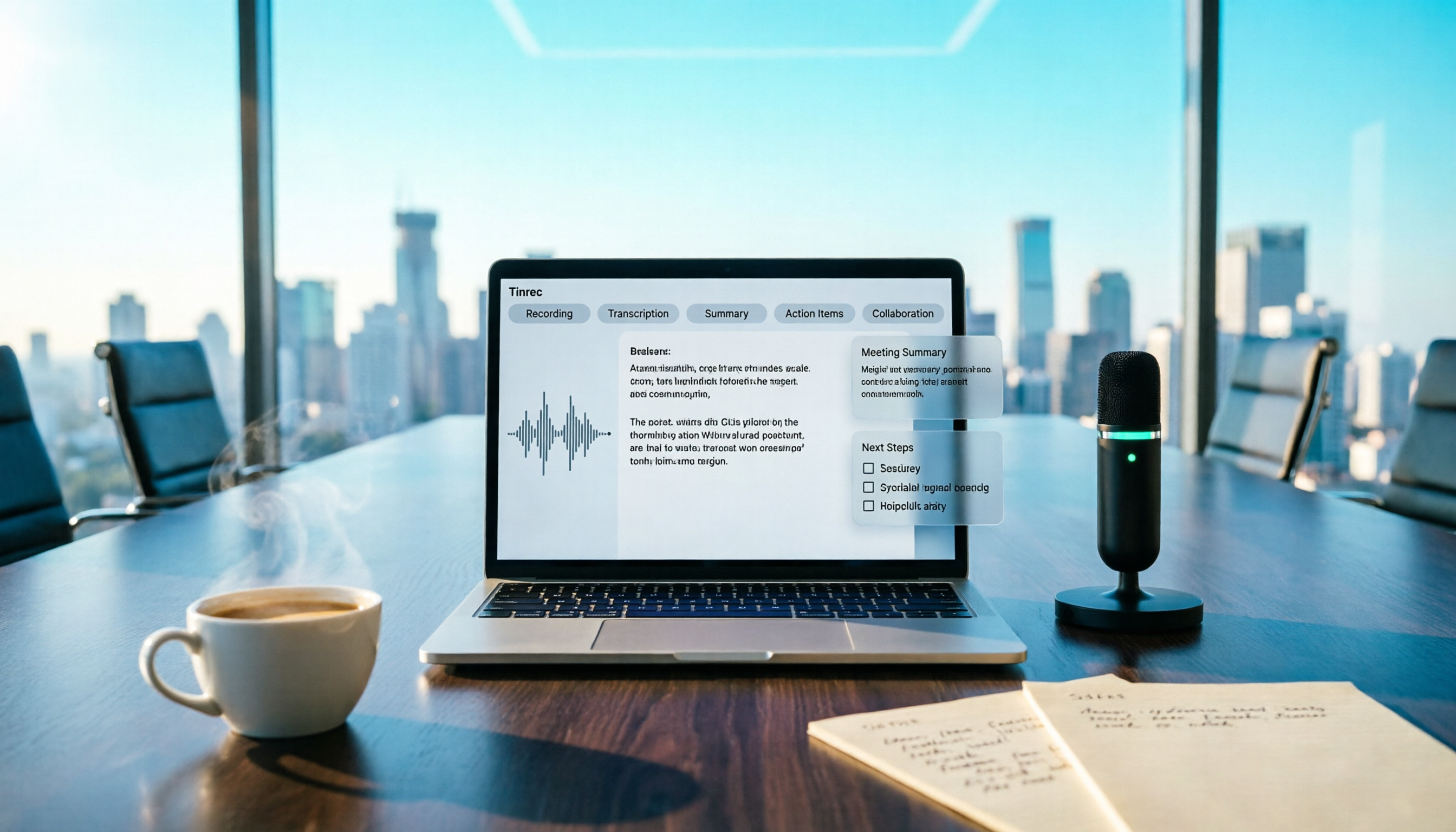
How to Take AI Meeting Notes in 2026: A 5-Step Guide from ChatGPT to Tinrec
Stop manually copying and pasting meeting recordings into transcripts, summaries, and action items. This guide walks through 5 steps—from recording to searchable, collaborative, and actionable team knowledge—using ChatGPT with Whisper, Record mode, and Tinrec. It also compares free personal plans, ChatGPT Plus, and team meeting tools to help you choose the right fit.

Apple Podcast Transcripts in 2026: Turn Podcasts into a Language Learning Database with Built-in Tools
Apple Podcast transcripts officially launched with iOS 17.4, but many people only use them as subtitles. This article takes a practical approach, showing you how to use built-in translation, select-and-copy, and keyword search to turn English podcasts into a readable, searchable, and reviewable language learning resource.

2026 AI Meeting Notes Software Test: Tinrec vs Otter vs Notta – Which Saves You the Most Time?
Tired of spending hours on meeting minutes after endless meetings? We tested 5 AI meeting note tools, comparing Cantonese recognition, online meeting recording, AI summaries, and team collaboration to help Hong Kong professionals find the best time-saving solution.

6 Best AI Meeting Note Tools Compared in 2026: Which Free Plan Is Enough?
AI meeting note tools are proliferating, but are the free plans sufficient? This article tests six popular options across dimensions like bot-free recording, Chinese transcription, AI summaries, action item extraction, and team collaboration, and explains in which scenarios Tinrec suits US users better.

The Complete 2026 Guide to ChatGPT Voice-to-Text Transcription: From Recording to Searchable Notes
Tired of messy transcripts after recording lectures? This guide walks you through a real student's workflow—from voice input and transcript cleanup to class notes and group discussion records—and compares free and paid options that work for students.
2026 Free AI Transcription Tools Roundup: 3 Options Compared
A look at 3 truly free, unlimited AI transcription tools, from NotebookLM to desktop recording solutions. Avoid the 'free for a few minutes, then paywall' trap and build a workflow that turns recordings into actionable data.

2026 AI Meeting Notes Software Guide: Bot-Free Recording + Automated Action Items
A mid-level manager who attends 15 meetings weekly tests AI meeting notes software—from missing action items to turning meetings into searchable, collaborative, trackable team assets. This guide covers bot-free recording, AI summaries, action item extraction, and team spaces, with an honest comparison of Otter, Notta, Granola, and more.