

Turn recordings into transcripts and summaries in minutes
Upload audio or video for multilingual transcription, AI notes, and action items
After a meeting ends, the real work begins. Transcripts need to be organized, decisions archived, and action items assigned—these tasks often take more time than the meeting itself. If you're torn between Google Meet and Zoom, the question isn't just "which has better video quality," but which tool can turn meeting content into trackable, actionable data.
This article starts from the pain point of missed meeting notes and action items, directly compares the two on transcription, summaries, and follow-up, and ends with a decision framework based on meeting type.
Why Is Organizing Meeting Notes More Tiring Than the Meeting Itself?
Most teams follow this meeting workflow: send invites before, someone takes handwritten notes during, and after, photos of notes are posted to the group chat. By the next week's review, decisions are scattered across chat logs, action items have no owners, and even last meeting's conclusions take forever to find.
Both Google Meet and Zoom have built-in recording and transcription, but they have different focuses: Meet emphasizes integration with Google Workspace, while Zoom goes deeper into meeting interaction and collaboration tools. For small to medium teams, the key isn't "whose video quality is better," but "who can automatically turn meeting content into next steps."
Google Meet vs Zoom: Core Differences at a Glance
| Comparison Dimension | Google Meet | Zoom |
|---|---|---|
| Ecosystem Integration | Deep integration with Google Workspace (Calendar, Gmail, Drive, Docs) | Independent meeting hub, works with various tools including Google Workspace |
| Recording & Transcription | Built-in recording and live captions; transcription may have plan limitations | Built-in recording and live captions; transcription may have plan limitations |
| AI Summaries & Action Items | AI summaries on some plans; action item extraction still evolving | AI summaries on some plans; action item extraction still evolving |
| Best For | Google ecosystem users, standard internal meetings | Teams needing more advanced meeting features, larger organizations |
| Cost | Relatively lower | Advanced features require paid plans |
Dimension 1: Meeting Recording and Transcription Capabilities
Google Meet
Google Meet has built-in recording that saves to Google Drive and offers live captions. After recording, you can generate transcripts using Google's speech recognition, but this feature isn't available on all plans, and language support and accuracy may be limited. For Google Workspace users, recordings and transcripts are stored directly in Drive, making sharing and collaboration easier.
Zoom
Zoom also has built-in recording, with options to save locally or to Zoom Cloud, and offers live captions. Zoom's transcription feature (Audio Transcript) is more complete on paid plans and supports multiple languages, but accuracy is still affected by audio quality. Zoom recordings and transcripts can be downloaded, but sharing with your team typically requires manual upload to other platforms.
Efficiency Comparison
| Item | Google Meet | Zoom |
|---|---|---|
| Recording Storage | Directly to Google Drive | Local or Zoom Cloud |
| Live Captions | Yes | Yes |
| Transcripts | Available on some plans | Available on paid plans |
| Language Support | Primarily English; Chinese support limited | Multiple languages, but Chinese accuracy needs testing |
| Post-Meeting Sharing | Integrated with Drive, easy to share | Requires manual download or link sharing |
Dimension 2: AI Summaries and Action Item Extraction
Google Meet
Google Meet's AI features are evolving; some Workspace plans offer meeting summaries and action item suggestions, but these aren't widely available and are typically English-focused. For Chinese meetings, summary and action item accuracy may not meet expectations.
Zoom
Zoom's AI Companion provides meeting summaries, action items, and next steps, but requires a paid plan. AI Companion supports multiple languages, but Chinese summary quality needs real-world testing. Zoom's AI features are deeply integrated with its ecosystem, but if your team doesn't use Zoom's other tools, these summaries may not easily flow into your workflow.
Stop organizing recordings by hand
Upload audio or video and automatically get a transcript, summary, and action items
Efficiency Comparison
| Item | Google Meet | Zoom |
|---|---|---|
| AI Summaries | Available on some plans | AI Companion (paid) |
| Action Item Extraction | Limited | Can extract action items |
| Chinese Support | Limited | Needs testing |
| Integration with Other Tools | Integrates with Google Docs | Integrates with Zoom ecosystem |
Dimension 3: Ecosystem Integration and Post-Meeting Follow-Up
Google Meet
Google Meet's biggest advantage is deep integration with Google Workspace. Meeting invites automatically appear in Calendar, recordings save to Drive, and transcripts can be opened in Docs—allowing meeting materials to flow naturally into existing workflows. For teams in the "Google ecosystem," Meet is the most efficient choice.
Zoom
Zoom is an independent "meeting hub" that integrates with many tools, including Google Workspace, Microsoft 365, Slack, and more. Zoom's strength lies in richer meeting features like breakout rooms, polling, virtual backgrounds, etc., making it suitable for teams needing complex meeting interactions. However, post-meeting data may need manual transfer to other platforms.
Efficiency Comparison
| Item | Google Meet | Zoom |
|---|---|---|
| Meeting Scheduling | Integrated with Google Calendar | Integrates with multiple calendars |
| File Storage | Google Drive | Zoom Cloud or local |
| Post-Meeting Collaboration | Google Docs, Sheets | Requires manual export |
| Third-Party Tools | Primarily Google ecosystem | Broader integration range |
Efficiency Choices for Different Meeting Types
Google Ecosystem Users
If your team already uses Gmail, Calendar, Drive, and Docs, Google Meet is the most seamless choice. Meeting invites, recordings, and transcripts are automatically stored in Google services, so post-meeting organization and collaboration don't require switching platforms. For standard internal meetings, Meet can meet needs at a lower cost.
Teams Needing Complex Meeting Features
If your meetings require breakout rooms, large-scale webinars, or highly interactive sessions, Zoom's meeting features are more complete. Zoom's AI Companion can also provide summaries and action items, but requires a paid plan. For large organizations or scenarios needing to accommodate more participants, Zoom is a more suitable choice.
Hybrid Teams
If your team uses multiple platforms (e.g., some members use Google, others use Microsoft), the choice becomes more complex. In this case, consider a standalone AI meeting notes tool like Tinrec, which can handle recordings from Zoom, Google Meet, Teams, and other platforms, and bring the organized results into your preferred workflow.
Connecting Meeting Notes to Your Team's Next Steps
Whether you choose Google Meet or Zoom, the real efficiency lies in post-meeting organization and follow-up. Built-in transcription and summary features often stop at "generating a transcript" and "listing key points," but the actual action items—who is responsible, when it's due, how to track—often still require manual organization.
Take Tinrec, for example. It's an AI meeting notes tool that can directly record audio from Google Meet or Zoom meetings via its desktop app, without needing to invite a bot to the meeting. After recording, Tinrec automatically generates transcripts, summaries, chapters, and action items, and allows AI Q&A about the meeting content.
Step 1: Put Meeting Materials into a Team Space
After the meeting, compile the transcript, summary, and action items into a meeting note and upload it to Tinrec's team space. Team members can view, search, and reference historical meeting materials anytime, without digging through chat logs. For example, after a project meeting, the PM uploads the meeting note to the team space, and engineers and designers can directly see decisions and assignments, reducing redundant questions.
Phase 2: Team Handoff and Ongoing Follow-Up
Tinrec's AI assistant can help turn action items into deliverable follow-up materials, such as action plans, client follow-up emails, or report drafts. Team members can continue collaborating on meeting materials, converting to-dos into concrete tasks and tracking progress. For example, after a sales meeting, a salesperson can ask the AI assistant to draft a client follow-up email based on the meeting content, then send it after manual review. For important decisions and external communications, manual verification is still recommended to ensure accuracy.
When choosing a meeting tool, ask yourself: After the meeting, who will organize the notes, who will follow up, and where will the materials be stored? Google Meet and Zoom each have their strengths, but what truly boosts efficiency is turning meeting content into actionable team assets automatically.
References
Turn every recording into actionable outcomes
Get 60 free transcription minutes when you sign in. No credit card required.
Related Reading
You might also like

2026 Comparison of 4 Meeting Data Centralization Solutions: Stop Treating Cloud Storage as Organization
Centralizing meeting data isn't just dumping attachments into a shared cloud drive. This article examines common pitfalls, breaks down four common approaches to meeting data management, and uses Tinrec as an example to explain real-time transcription, AI summaries and action items, AI Q&A, team spaces, and seat governance. It concludes with 5 purchasing considerations and FAQs.

Tinrec vs Notta 2026: 5-Dimension Comparison — Which Is Better for Team Meeting Databases?
A mid-level manager who holds 15 meetings a week compares Tinrec and Notta across 5 dimensions to help you choose the right team meeting database. From bot-free recording and AI action item extraction to team spaces and pricing quotas, get it all in one article.
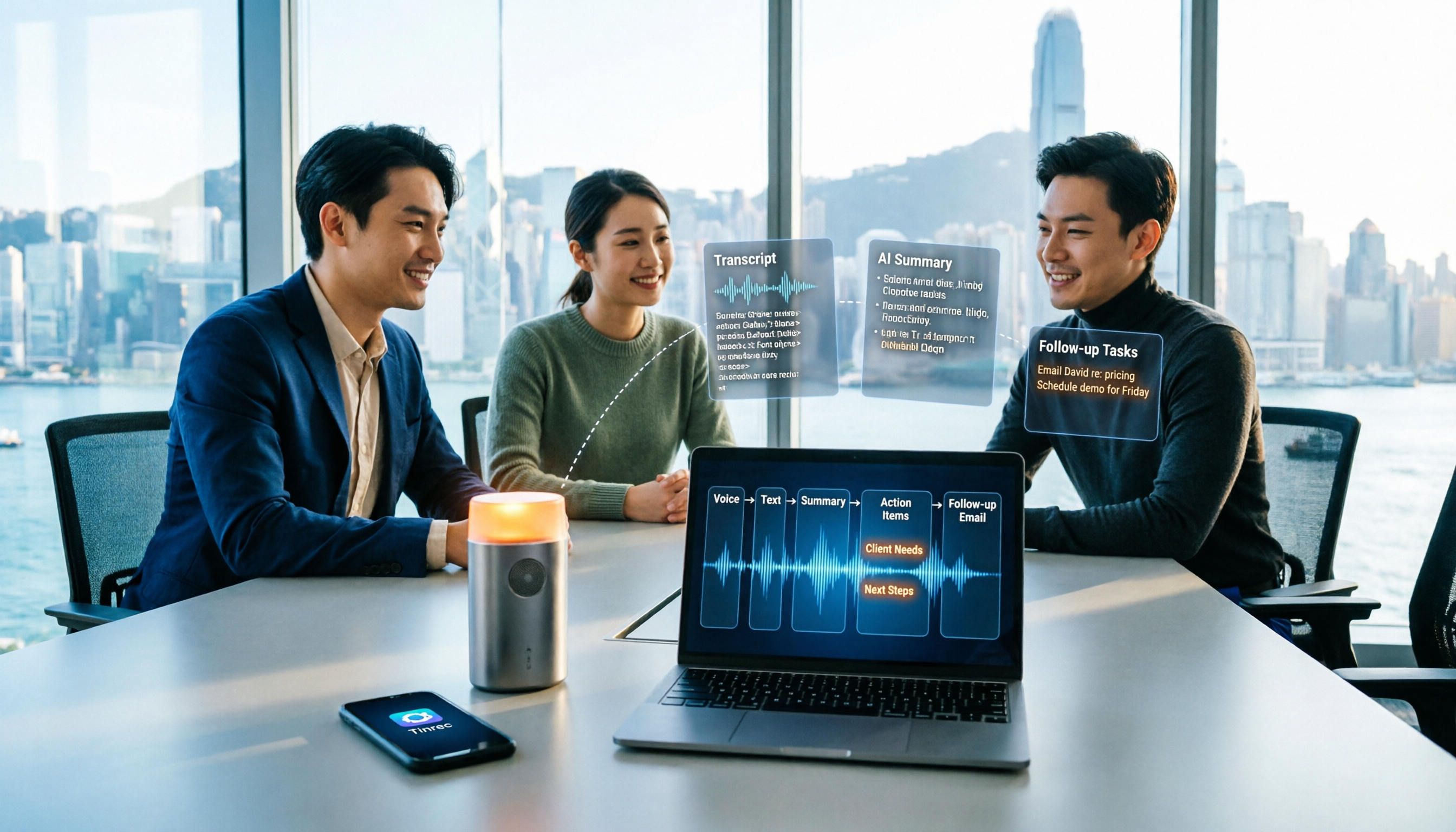
How to Take Sales Meeting Notes in 2026: 5 Steps from Recording to Customer Follow-Up
Sales meeting notes shouldn't wait until the meeting ends. This article breaks down the complete process in 5 steps, from recording, transcription, AI summaries to customer follow-up, and compares Tinrec and Otter.ai dimension by dimension to see which is better suited for Hong Kong sales teams communicating in Chinese.

5 AI Meeting Knowledge Base Tools Tested and Compared in 2026: Can Meeting Notes Become Searchable Team Assets?
Meeting notes aren't just about speed—you need to find them later. This article approaches the topic from a purchasing decision perspective, breaking down the core capabilities of AI meeting knowledge base tools, real-world use cases, and 5 key buying considerations. It uses Tinrec to demonstrate a complete workflow: bot-free online meeting recording, transcripts and real-time translation, AI summaries and action items, AI Q&A, and team spaces with seat governance.
2026 AI Meeting Agent Tools: Record Zoom Without Bots, Auto-Generate Action Items
Two-hour meeting, then another two hours to organize? This guide shows you how to choose an AI meeting agent tool, breaking down four key aspects: bot-free recording, AI summaries and action items, AI follow-up questions, and team spaces. It also compares Tinrec with Otter.ai, Granola, and PLAUD Note, and provides clear recommendations based on scenarios.

Tinrec vs Granola 2026: 5-Dimension Comparison for Chinese Meetings
Meetings are easy, but taking notes is hard. Can AI meeting agents really help? This article compares Tinrec and Granola across 5 dimensions, with brief reviews of Otter.ai and Notta, covering bot-free recording, post-meeting summaries and action items, AI Q&A, and team seat management to help you save overtime after every meeting.

2026 Meeting AI Agent Solutions: Bot-Free Recording + Auto-Generated Action Items
The meeting is over, but the work has just begun. This article addresses the real pain points of mid-level managers, explaining 4 key factors for choosing a meeting AI agent solution. It tests Tinrec's bot-free online meeting recording, AI Q&A, and action item extraction, compares it with Otter.ai, Granola, and Notta, and provides selection advice for team plan seat and usage management.

Tinrec vs Otter.ai 2026: 5-Dimension Comparison — Which Free AI Meeting Agent Is Right for You?
Before searching for a free AI meeting agent, understand how free quotas work. This article compares Tinrec and Otter.ai across 5 practical dimensions, with brief notes on Notta and Granola, covering differences in Chinese/Cantonese meeting support, bot-free recording, post-meeting AI Q&A, and team data management. Includes a pitfalls guide and selection advice to help you save time writing meeting minutes.

2026 Smart Meeting Agent Comparison: Tinrec vs Otter.ai — Which Is Better for Chinese-Speaking Teams?
Smart meeting agents don't just transcribe meetings—they also summarize, extract action items, and answer questions. This article compares Tinrec and Otter.ai across five dimensions: meeting capture, Chinese-language experience, post-meeting organization, team governance, and pricing, to help you decide which one fits your meeting scenarios.