

Turn recordings into transcripts and summaries in minutes
Upload audio or video for multilingual transcription, AI notes, and action items
First, Clear Up a Common Misconception: Teams' "Automatic" Only Goes Halfway
Many people think that once you turn on Teams' built-in recording, the transcript and meeting notes will just appear on their own. In reality, that's not how it works.
Teams' transcription feature has a clear limitation: it can only be used for meetings initiated by your own organization. You can't turn it on for meetings hosted by external organizations. Also, an admin must first enable transcription in the meeting policy before the button even appears.
Another easy trap is language. Teams doesn't automatically detect the language spoken in a meeting. If the transcript language setting doesn't match what's actually being said, the resulting text is basically unusable.
In other words, "automatic" usually only applies up to the point of "automatically recording." The post-meeting organization, summarization, and action item tracking still require manual work.
This is why many people have switched to third-party AI meeting notes tools. Below, we'll use Tinrec as an example to see how far today's tools can go.
What Can Tinrec Do for You?
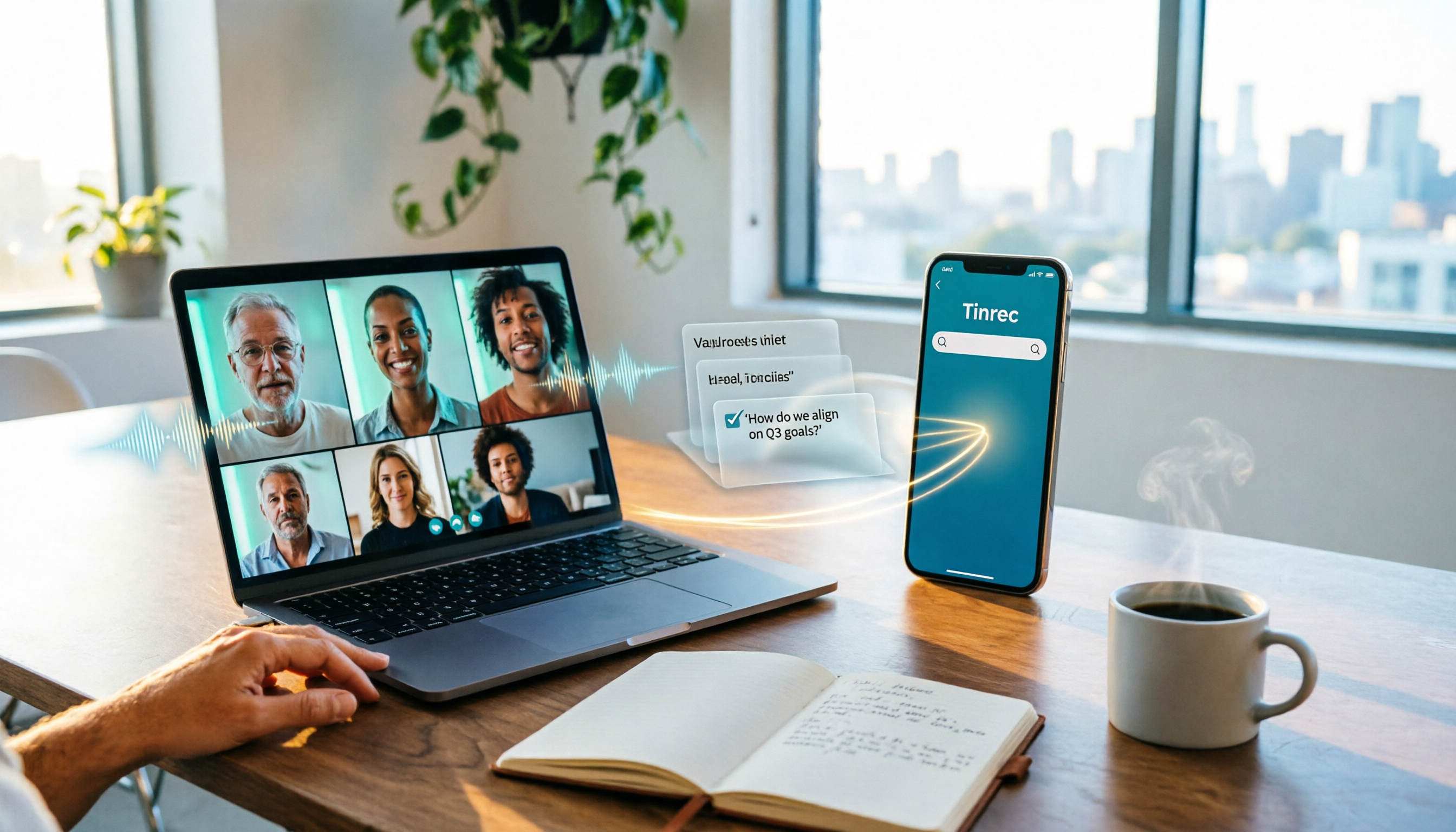
Scenario 1: After the meeting, the summary is already laid out Previously, after a two-hour meeting, you might spend another hour organizing. Tinrec generates a transcript while recording, and after the meeting, it directly gives you a summary, chapters, and action items—who's responsible for what, what the deadlines are, listed one by one.
Scenario 2: Meetings with external parties can also be recorded Tinrec's desktop version directly captures your computer's system audio, so you don't need to invite a meeting bot. It can handle meeting audio played on your computer from Teams, Zoom, Google Meet, and Webex, and won't get stuck just because the meeting isn't hosted by your organization.
Scenario 3: Old recording files can also be organized Got a pile of old meeting recordings or interview audio files? Tinrec supports uploading audio and video files for transcription, so you don't have to redo the meeting.
Scenario 4: Meeting data becomes a team asset When meeting notes are stored in individual accounts, data scatters once people leave. Tinrec's team plan centralizes meeting data in a team space, so new members can see past meetings, and data stays with the team even when members leave.
What Are Tinrec's Core Capabilities?
Real-time transcript: Transcribes as it records, so you can check the text during the meeting to make sure nothing important is missed—no need to wait until afterward.
AI summary and chapters: It doesn't just condense the transcript into a paragraph; it organizes it structurally—meeting topics, discussion conclusions, and action items are listed separately, so you can quickly grasp key points even in long meetings.
Action item extraction: Picks out follow-up actions from the discussion—who needs to deliver what by when—so you can work directly from the list after the meeting.
AI Q&A: After transcription is complete, you can ask questions directly, such as who mentioned the budget in this meeting or what the client's concerns about pricing were. It answers based on semantics, so you don't have to flip through pages yourself.
Translation and bilingual view: For cross-language meetings, you can view the original text, translation, or bilingual comparison.
Agent post-processing and export: Meeting results can be further used to generate reports, tables, and documents, and can also be exported to tools like Notion, Google Docs, OneNote, and Dropbox for further processing.
Team space and governance: Create teams, invite members, assign seats, view usage trends and activity logs, and maintain team hotwords to improve recognition of specialized terminology.
Practical Use Cases
Project weekly meetings: The biggest fear is that no one remembers what was said last week. Record with Tinrec, and the action item list is generated directly. Before the next meeting, review the previous meeting's action items to track progress without relying on memory.
Customer interviews: Customer needs, concerns, and commitments are scattered throughout the conversation. With transcripts and AI Q&A, you can directly ask what key points the customer mentioned afterward and quickly pull out critical sections.
Stop organizing recordings by hand
Upload audio or video and automatically get a transcript, summary, and action items
Training and courses: Course content is usually long and dense. Real-time transcripts with chapter segmentation let you jump directly to the topic you want to review.
Cross-department meetings: With many people and scattered comments, writing meeting minutes afterward is often the most painful part. Tinrec's summaries and chapters can save most of the organizing time, and you can go back to verify important details against the transcript and recording.
5 Things to Consider When Choosing a Teams Meeting Notes Tool
1. Can it handle meetings not hosted by your own organization? Teams' built-in transcription has clear limitations here. Tinrec's desktop version takes the system audio capture route, requiring no additional bot to join the meeting, so it can record meetings with external parties too.
2. Chinese recognition and specialized terminology Chinese meetings and mixed Chinese-English content are weak points for many tools. Tinrec covers Chinese and multilingual scenarios and also supports team hotwords. Actual performance is affected by recording quality, accents, noise, and overlapping speakers, so it's recommended to test with your own recordings.
3. Can you use it directly after transcription? Tools that only provide transcripts still require manual organization afterward. Tinrec emphasizes the workflow after transcription: summary, chapters, action items, Q&A, and export—all in one go.
4. Will audio files be kept? Whether you can replay the original recording determines whether you can verify details later. Tinrec retains audio and provides an audio recycle bin, so accidentally deleted files have a chance of being recovered.
5. Team collaboration and permissions If meeting data is to be used by a group, you need to see how the tool manages people. Tinrec's team plan separates roles and seats: roles determine who can manage the team, and seats determine whether someone can record, upload, edit, and export. Members who are active but have no seat can still view, play, and read team data.
Plans and Pricing
Individual plan: The free version lets you experience recording, importing, summaries, and transcription with a basic quota; for short-term intensive use, consider the weekly pass; for steady weekly use, the Pro monthly plan is suitable; if you need to accumulate recording data long-term, the annual plan has a lower monthly equivalent.
Team plan: The first eligible team trial is 7 days, 1 free seat, and 300 minutes of team shared import quota. Team monthly is USD 29.80 per paid seat per month, and annual is USD 199 per paid seat per year, equivalent to about USD 16.58 per month. Each paid seat provides 2,000 minutes of team shared import quota per month; under an active team plan and active seat, real-time recording currently does not deduct minutes, while file and web imports use the team shared quota.
Prices, currencies, and promotions are subject to the official purchase page.
FAQ
Q1: What's the difference between Teams' built-in transcription and Tinrec? Teams transcription can only be used for meetings in your own organization, requires admin enablement, manual language settings, and you still have to download and organize afterward. Tinrec uses desktop system audio capture, requires no bot to join, and directly produces summaries, chapters, and action items after recording.
Q2: Does Tinrec need to add a bot to Teams meetings? No. Tinrec's desktop version directly captures computer system audio and does not require an additional meeting participant. Note that this is not automatic calendar joining; the user actively starts the recording.
Q3: Is the free version enough? If you only occasionally organize a recording, the free version's basic quota is a good way to try it. If you have regular weekly meetings, Pro will be smoother; for long-term data accumulation, consider the annual plan.
Q4: Can accuracy be guaranteed? It's not recommended to expect that. Transcription quality is affected by the recording environment, accents, noise, and specialized terminology. A practical approach: use summaries and action items to save organizing time, and verify key details against the transcript and recording.
Q5: After team members leave, will meeting data be taken away? No. Team resources belong to the team. When a member exits, is removed, or loses their seat, their team resources can be handed over to other active members.
Conclusion
With Teams automatic meeting notes, the bottleneck is usually not recording but post-meeting organization. If you have more than 3 meetings per week, instead of spending time piecing together minutes after each one, let a tool produce a first draft for you.
Tinrec's free version lets you test the waters and see what it feels like to have AI organize your meeting notes; if your team wants to use it together, then evaluate how to allocate team plan seats and shared quota.
References
- How Teams Meetings Automatically Record Meeting Transcripts – Weblink International KS010S Microsoft Cloud Knowledge Base
- Create Teams Meetings and Generate Meeting Analysis | Microsoft Learn
- Enable 'Meeting Transcription' and Copilot Meeting Notes/Summary Features in Teams
- Teams' AI Features! Automatically List Meeting Minutes! Tag Multiple Members with One Click! Save Important Conversations! How to Buy Copilot? Pricing and Licensing Overview #PowerPlatform #PowerWisdomKing #Copilot - YouTube
- Can Teams in Microsoft 365 Business Standard Automatically Generate Meeting Notes? - Microsoft Q&A
Turn every recording into actionable outcomes
Get 60 free transcription minutes when you sign in. No credit card required.
Related Reading
You might also like

6 Ways to Use Google Meet on Apple TV in 2026: Screen Mirroring, Streaming Devices, and Post-Meeting Tools Compared
Google Meet doesn't have an official Apple TV app. This guide covers 6 practical workarounds, from AirPlay screen mirroring and Mac mirroring to Google TV streaming devices, plus post-meeting tools like Notta, Granola, and Tinrec, with free and paid pricing to help you decide which is easiest.

How to Use Google Meet in Gmail (2026): Start a Meeting in 3 Steps & Auto-Organize Notes
Google Meet is built right into the Gmail sidebar, so you can start or join video meetings without switching to Calendar. This guide walks you through 3 steps, explains entry points for different account types, and tackles the part most people get stuck on—organizing transcripts, summaries, and action items after the meeting.

How to Record Google Meet Without a Bot and Auto-Generate Action Items with AI (2026 Guide)
Tired of forgetting key points after a Google Meet call? This guide explains the relationship between Google Meet and Google One plans, then hands-on tests Tinrec's bot-free desktop recording, AI summaries, and action item extraction. We also compare Otter.ai, Notta, and Granola, with key buying factors and pitfalls to avoid.

Google Meet Time Limit in 2026: Free 60-Minute Cap and Which Meeting Notes Tool to Choose
Google Meet free version limits group meetings with 3+ participants to 60 minutes, while 1-on-1 calls can last up to 24 hours. Paid Workspace plans allow up to 24 hours. This article breaks down how the limit actually works and compares Google Meet with Tinrec for meeting notes, cross-platform support, post-meeting output, and team data retention, helping you decide which to choose.

Best Google Meet Note-Taking Tools in 2026: 7 Tested, This One Excels for Chinese Meetings Without a Bot
Starting from the need to join a meeting via Google Meet now, this guide reviews 7 Google Meet note-taking and transcription tools, including Tinrec, Otter, Fireflies, Notta, Granola, TurboScribe, and Google Meet's built-in capabilities. It compares Chinese meeting support, bot-free recording, AI Q&A, team knowledge retention, and pricing.

Google Meet Pricing in 2026: Free Plan Limits and Tinrec as an Alternative
Google Meet's free version caps group meetings at 60 minutes, and recording and AI features are tied to Workspace subscriptions (annual billing around $7/$14/$22 per user per month). This article, from a student's hands-on perspective, explains why post-meeting organization is the real pain point and compares Tinrec's differences in bot-free recording, Chinese transcription, AI summaries, and team knowledge retention.
How to Share System Audio in Google Meet (2026): Full System Sound + High-Quality Stereo
Google Meet now lets you share your entire device's system audio during presentations, not just Chrome tab audio. This guide covers the steps to enable it, system requirements, rollout timeline, and common limitations, plus how to use Tinrec after a presentation to turn transcripts, summaries, and action items into searchable meeting records.

3 Google Meet on Windows Options Tested in 2026: Which Meeting and Note-Taking Method Saves the Most Time?
Using Google Meet on Windows, most people only solve the meeting itself but not how to keep the post-meeting data. This article walks you through: from browser and PWA to Tinrec desktop bot-free recording, automatically turning Google Meet meetings into transcripts, summaries, action items, and team-searchable data.

How to Check Your Google Meet Version in 2026: 4 Steps to Confirm the Latest Version
Can't find the version number in Google Meet settings? This guide covers how to check and update Google Meet across web, Android, iOS, Meet hardware, and the REST API, plus a practical way to organize transcripts, summaries, and action items after meetings.