
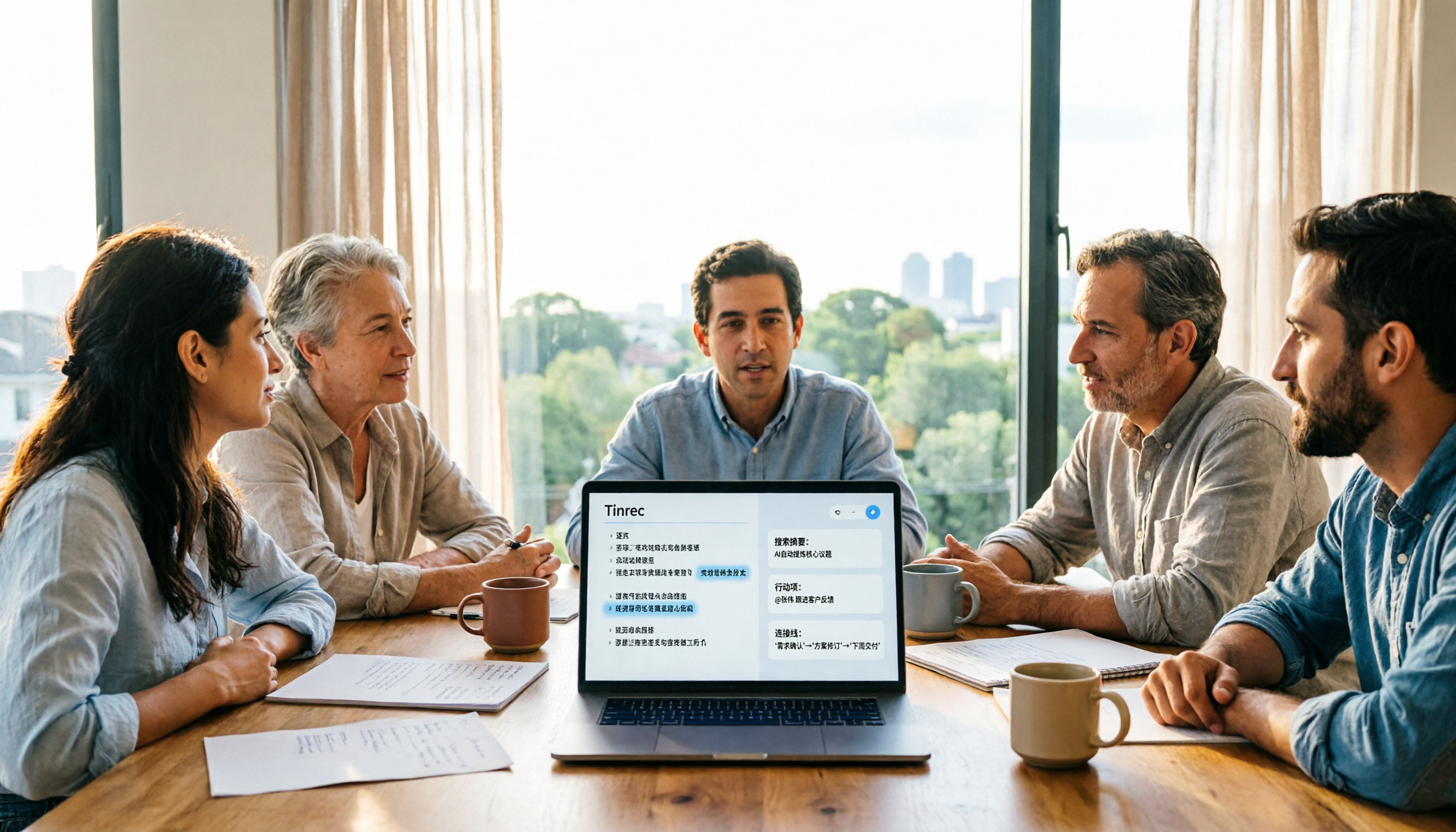
Turn recordings into transcripts and summaries in minutes
Upload audio or video for multilingual transcription, AI notes, and action items
There Are Countless Meeting Transcription Tools—Start by Asking Yourself These 5 Questions
Open a search page and every meeting transcription tool claims to be the best. But what really determines whether you'll keep using one usually isn't "can it turn audio into text"—it's these questions: Are you recording online meetings or in-person interviews? Do you need a meeting bot to join, or do you prefer bot-free recording? Is the recognition experience for Chinese and mixed Chinese-English content stable enough? After transcription, who organizes the summary, action items, and Q&A? And finally, should meeting data stay in a personal account, or become a team asset that can be searched and handed off?
This article uses five decision dimensions to compare Tinrec, Notta, Otter, Fireflies, and Granola side by side. If you're currently using Notta or looking for a Notta alternative, you can first see how Tinrec performs in Chinese meetings, bot-free recording, and team data governance.
Why Are People Starting to Look for Notta Alternatives?
Notta is a common multi-platform transcription tool. Its official Free plan offers 120 minutes per month with a maximum of 3 minutes per recording; Pro annual billing is about USD 8.17/month with 1,800 minutes per month; Business annual billing is about USD 16.67/seat/month, providing unlimited transcription, role permissions, and usage reports.
These plans are sufficient for light users, but if you have cross-department meetings every week, need to handle Chinese and mixed Chinese-English content, and want to get summaries and action items immediately after meetings, you may find that transcription is just the first step. Tinrec's entry point is precisely the "post-transcription workflow": after recording or importing, it automatically generates summaries, chapters, and action items, and you can use AI Q&A to follow up on meeting conclusions, finally placing the data into a team space.
Tinrec vs Notta: What's Different in the Core Experience?
Meeting capture method is a major dividing line. Tinrec's desktop version directly captures computer system audio, so when handling online meetings on Zoom, Google Meet, Microsoft Teams, Webex, etc., it doesn't need to invite a meeting bot to join. Notta covers meeting bots, desktop clients, or file uploads. If you don't want an extra bot participant in your meeting, Tinrec's bot-free recording will be closer to your needs.
Chinese and multilingual meetings are the second dimension. Tinrec covers Chinese, Traditional Chinese, and multilingual meetings, supports real-time translation during recording, original/translated/bilingual viewing, and can maintain professional terminology with team hotwords. Notta's multilingual transcription capability is also good, but Tinrec is more suitable for handling Chinese meetings, mixed Chinese-English discussions, and team terminology in the same workflow.
Depth of post-meeting organization is the third dimension. Tinrec doesn't just provide transcripts; it also generates AI summaries, chapters, key points, action items, and mind maps, and supports AI Q&A around meeting content; when you need deliverables, you can use Agent post-processing to generate reports, tables, and documents, then export to Notion, Google Docs, OneNote, Dropbox, and other tools. Notta excels at transcription, subtitles, and translation, while Tinrec focuses on "ready to use right after the meeting."
Team governance is the fourth dimension. Tinrec's team version provides independent team spaces, member invitations, owner/admin/regular member roles, seat allocation, usage analytics, audit logs, audio recycle bin, and team hotwords. Notta Business also has role permissions and usage reports. The difference is that Tinrec separates roles and seats: roles determine governance permissions, seats determine whether one can record, upload, edit, import/export; valid members without seats can still view and read team data.
Free and trial quotas are the fifth dimension. Tinrec's free version allows you to experience recording, importing, summaries, and transcription with basic quota; the team version offers, for first-time eligible users, 7 days, 1 free seat, and 300 minutes of shared team import quota. Notta Free offers 120 minutes per month with a maximum of 3 minutes per recording. Both are suitable for trying out first, then deciding on an upgrade based on meeting volume.
Stop organizing recordings by hand
Upload audio or video and automatically get a transcript, summary, and action items
Overview of Tinrec's Core Features
Real-time recording to text: Open Tinrec to record, and text is generated simultaneously—suitable for in-person meetings, interviews, and on-site notes. You can confirm on the spot whether anything is missing, and by the time the meeting ends, the transcript is already complete.
Bot-free online meeting recording: The desktop version captures system audio, supporting platforms like Zoom, Meet, Teams, and Webex without pulling an extra bot into the meeting.
Audio/video file transcription: Existing meeting recordings or videos can also be uploaded and organized—suitable for historical meetings, interviews, and research materials.
AI summaries, chapters, and action items: Long meetings are automatically broken down into structure and key points, and action items are extracted from discussions, reducing manual post-meeting organization time.
AI Q&A and translation: You can ask follow-up questions about a single meeting or multiple meetings, such as "What was the conclusion?" or "Who is responsible for what?" You can also view original, translated, or bilingual content in cross-language meetings.
Team space and governance: The team version centrally stores Audio, Folder, TODO, and meeting data. Administrators can view usage trends, member rankings, operation audits, and hand over team resources when members leave.
Practical Use Cases
Weekly standups and project meetings: Tinrec's real-time transcription plus summaries and action items means you can assign action items to members right after the meeting without relying on manual recall.
Customer interviews and requirements meetings: Customer needs, objections, and commitments are kept in the transcript, which can later be searched via AI Q&A and exported as reports or tables.
Cross-language meetings: Real-time translation and bilingual transcripts help participants speaking different languages align on content, while team hotwords improve recognition of professional terminology.
Team knowledge retention: Meeting data belongs to the team. New members can view historical meetings, and data doesn't disappear when members change or personal accounts leave.
Points to Note When Choosing a Meeting Transcription Tool
First, confirm your meeting sources. If most are online meetings, pay attention to whether the tool requires a bot to join; Tinrec's desktop version captures system audio and doesn't need an extra bot.
Second, check free quotas and per-recording limits. Some tools' free versions can only process a few minutes per recording—fine for trials but not for weekly standups; Tinrec's free version lets you experience the full workflow with basic quota.
Third, actual performance with Chinese and mixed Chinese-English. It's recommended to test with your own meeting recordings and check whether the tool supports terminology management, real-time translation, and bilingual viewing.
Fourth, whether you can work directly after transcription. Transcripts are just raw material; summaries, chapters, action items, Q&A, export, and report generation are the time-saving steps.
Fifth, team data ownership and permissions. If meeting data is to be used by multiple people, confirm team space, roles, seats, usage, and audit capabilities to avoid data being scattered across personal accounts.
Conclusion: Is Tinrec Worth a Try?
If you need a tool that can handle Chinese meetings, doesn't require a meeting bot, and lets you directly use AI to find key points after recording, Tinrec is a choice worth including in your comparison in today's market. It connects transcripts, summaries, action items, Q&A, export, and team space into one workflow, especially suitable for SMB managers, project leads, and teams that need to retain meeting knowledge.
Notta still has advantages in transcription, translation, and subtitles; Otter and Fireflies are more mature in English business meetings and automation integrations; Granola leans toward bot-free meeting notes. The key to choosing isn't who is comprehensively stronger, but which need appears most often in your meeting scenarios. We recommend starting with Tinrec's free version, testing transcription, summaries, and Q&A with your own meeting recordings, then deciding whether to upgrade to the personal or team version.
References
- Meeting Ink - 2026 AI Meeting Notes Tool Tested | 7 Speech-to-Text and Summary Speed Comparison | Meeting Ink - AI Meeting Notes Assistant Automatic Transcription Transcript Summary Meeting Minutes
- [AI Voice Notes] Top 5 Recommended AI Speech-to-Text Tools! Generate Transcripts and Meeting Notes Highlights, Free vs Subscription, Pros and Cons Review | 104 Workplace Power
- EP10 | Boss Wants Meeting Minutes: How to Choose an AI Transcription Tool? – Knowledge Nomad Studio
- No Time Limit! 3 Free AI Transcription Tools, Highly Recommended! AI Voice Notes Generate Meeting Minutes, Presentations, Mind Maps | 104 Workplace Power
- How to Use AI for Meeting Minutes? How to Organize Meeting Transcripts? | AI Speech-to-Transcript Tutorial | 104 Workplace Power
Turn every recording into actionable outcomes
Get 60 free transcription minutes when you sign in. No credit card required.
Related Reading
You might also like

7 Meeting Transcription Tools Tested for 2026: Gemini Free Limits and Time-Saving Alternatives
Gemini can turn meeting recordings into transcripts, but the free version can't handle meetings longer than 10 minutes, AAC files fail outright, and the text you get has no timestamps. This article reviews 7 practical meeting transcription options, from Gemini, NotebookLM, and Google AI Studio to Tinrec, Otter, Notta, and TurboScribe, comparing their quotas, limitations, and best use cases to help you pick the right one.
How to Use Gemini Meeting Notes App in 2026: 5 Steps from Recording to AI Summary
How do you use the Gemini meeting notes app? This article outlines 5 steps, from uploading recordings to generating AI summaries, and compares tools like Tinrec to help you find the best meeting notes solution.

4 Meeting Transcription Tools Tested for 2026: Which One Beats NotebookLM for Your Meetings?
Tired of staying late to type up meeting transcripts? This article compares 4 meeting transcription tools from a practical workplace perspective, focusing on Chinese meeting transcription, bot-free recording, post-meeting summaries, and team collaboration. Using Tinrec as the primary test tool, it breaks down real-time transcription, AI Q&A, action item extraction, and team spaces, and answers the most common questions from NotebookLM users about differences and purchasing decisions.
4 Meeting Transcription Tools Tested for 2026: Beyond Gemini, Which Saves More Time?
Gemini can generate transcripts from audio uploads, but what happens after? This article compares Gemini, Tinrec, Otter.ai, and Notta, with hands-on testing of Chinese recognition, post-meeting organization, online meeting recording, and team sharing. It also covers 4 common pitfalls to help you find a truly time-saving meeting transcription workflow.

Notta vs Noota: What's the Difference? 2026 Hands-On Test of 3 Tools — Tinrec Wins for Chinese Meetings
Many people search for "notta vs nada" but are actually confusing product names. This article starts by clearing up the naming confusion, then hands-on tests three AI meeting tools — Tinrec, Notta, and Noota — comparing Chinese recognition, recording methods, post-meeting output, and team management, plus key buying tips and common pitfalls.

2026 Transcription App Review: 3 Key Factors—Free Quotas and Chinese Recognition
How do you choose a transcription app? This article addresses three common pitfalls, explaining the three key factors: free quotas, Chinese and mixed Chinese-English recognition, and post-meeting organization. It uses Tinrec as an example to demonstrate the complete workflow from recording, transcription, summarization, to-dos, to export, and covers practical scenarios and FAQs for meetings, classes, interviews, and content creation.

Notta vs Sonix 2026 Review: Which of 3 Meeting Transcription Tools Is Best for Chinese Meetings?
Notta or Sonix? This review compares pricing, language support, and post-meeting organization using the same criteria, plus hands-on experience with Tinrec, covering bot-free meeting recording, AI Q&A, and action item extraction to help you choose the most time-saving tool for your meeting scenario.

2026 Voice Recorder Buying Guide: Specs, Features, and a Hands-On Test of Tinrec
How do you choose a voice recorder without getting burned? We break down the three most common buying mistakes—from microphone setup and storage to post-meeting organization—and compare Tinrec and PLAUD Note from a student's perspective on Chinese transcription, online meetings, pricing, and team collaboration, so you can find a recording solution you'll actually use.

Notta AI Alternatives in 2026: 5-Dimension Comparison for Chinese-Language Meeting Teams
After two years with Notta, I started looking for alternatives. From the perspective of a mid-level manager, this article compares Notta and Tinrec across 5 dimensions: online meeting capture methods, post-transcription organization, Chinese and cross-language experience, team workspace and seat governance, and pricing and usage metrics—with an honest take on who each tool suits best.