
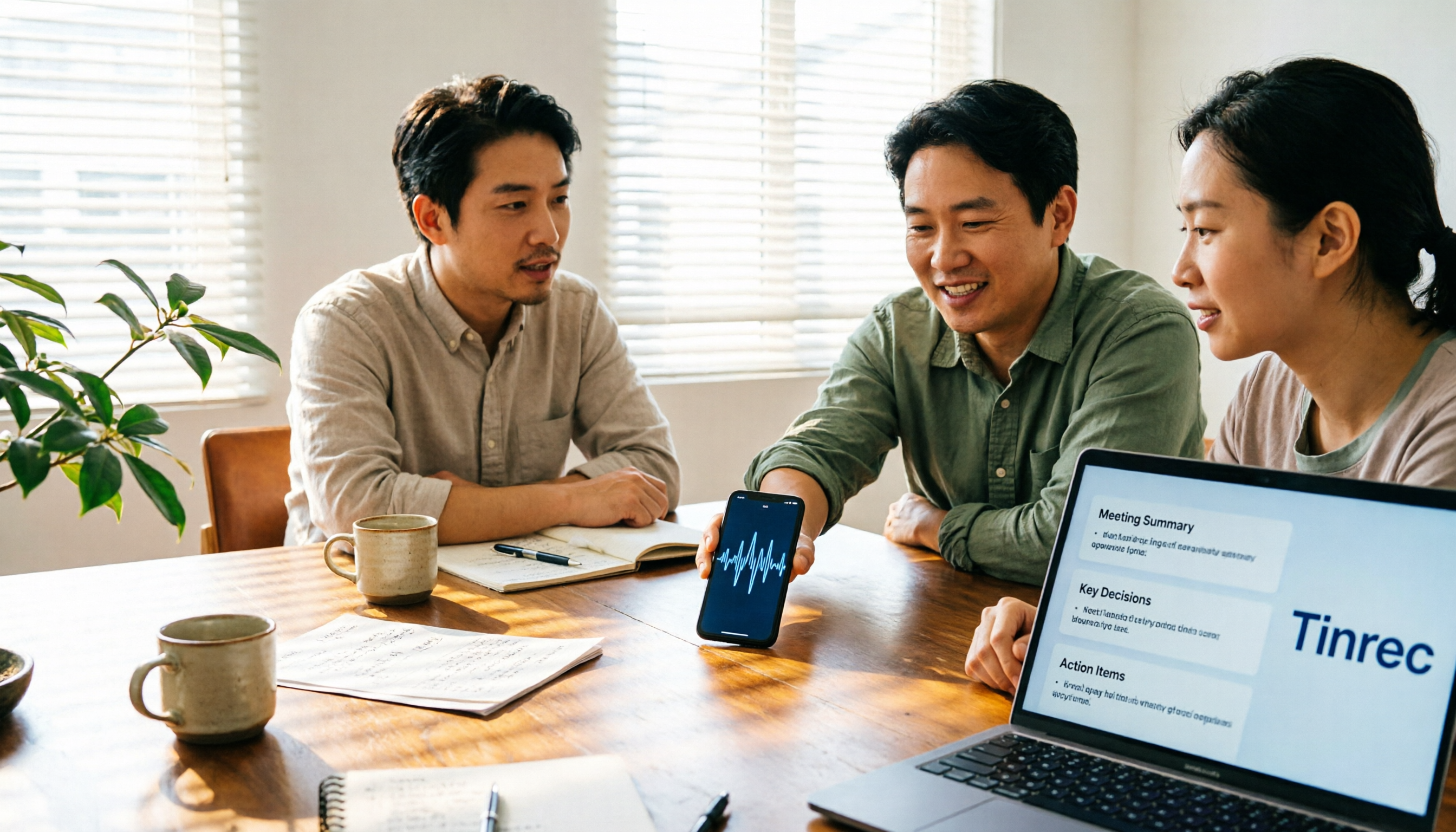
Turn recordings into transcripts and summaries in minutes
Upload audio or video for multilingual transcription, AI notes, and action items
How to Turn Meeting Notes into Work Reports in 2026: 5 Steps from Recording to AI Output
Many people rush to convert recordings into transcripts after a meeting, thinking that counts as meeting notes. But when it's time to write a work report, they realize the transcript has no decisions, no owners, and no deadlines—so they end up re-listening to the recording and organizing everything manually. A better approach: treat meeting notes as the "raw material for a work report." From the moment you start recording, generate summaries, sections, action items, and resolutions in sync, then process them directly into a report afterward.
Tinrec vs Otter.ai | Quick Overview
Tinrec is an AI meeting notes and collaboration tool for individuals and teams, emphasizing bot-free desktop recording, Chinese meeting transcription, post-meeting AI Q&A and report generation, and the ability to retain data in a team space. Otter.ai is a mature AI meeting assistant covering Zoom, Microsoft Teams, and Google Meet, offering real-time transcription, speaker identification, AI Chat, and team management.
| Item | Tinrec | Otter.ai |
|---|---|---|
| Core positioning | AI meeting notes and team collaboration, emphasizing post-meeting output and data retention | AI meeting assistant and meeting automation, strong in English business meetings |
| Meeting capture | Desktop version captures system audio without a bot; no extra bot needs to join | Offers meeting bot, desktop client, and other methods |
| Chinese and translation | Chinese, Traditional Chinese, mixed Chinese-English, real-time translation, and bilingual viewing | Primarily English business meetings; Chinese experience is not a main strength |
| Post-meeting work reports | Summaries, sections, action items, AI Q&A, Agent post-processing to generate reports/tables/documents | Summaries, action items, AI Chat, workflows |
| Team data | Team space, roles, seats, usage, audit, recycle bin | Mature team and enterprise management capabilities |
| Pricing reference | Free version, weekly pass, Pro monthly/annual; team version USD 29.80/paid seat/month, USD 199/paid seat/year | Basic free 300 minutes/month; Pro annual equivalent USD 8.49/user/month, includes 1,200 minutes/month and 10 file imports |
This article compares 5 dimensions: bot-free recording, Chinese meeting organization, post-meeting report generation, team data retention, and pricing and plan flexibility.
Dimension 1 | Meeting Recording Method: Bot-Free vs Bot Required
Otter.ai supports meeting bots joining Zoom, Teams, Google Meet, and more, and is very mature for English business meetings. But a bot joining a meeting may require host approval and can feel intrusive to participants.
Tinrec's desktop version directly captures computer system audio, so no extra bot needs to join the meeting. Users actively open Tinrec to start recording, and can record online meetings and generate transcripts in real time. This is more natural for internal discussions, client interviews, or scenarios where you don't want to add participants.
→ On this dimension: Tinrec wins on "not disrupting the meeting" and "active control."
Dimension 2 | Chinese Meetings and Mixed Chinese-English Organization
Otter.ai has deep experience in English meeting transcription and integration, but Chinese meetings and mixed Chinese-English recognition and organization are not its main strengths.
Tinrec covers Chinese, Traditional Chinese, and multilingual meetings, supports mixed Chinese-English content organization, real-time translation, and bilingual viewing, and can maintain professional terminology through team hotwords. Actual results are still affected by recording quality, noise, accents, and overlapping speakers, but it is friendlier to Chinese teams.
→ On this dimension: Tinrec is clearly better suited for Chinese meeting scenarios.
Dimension 3 | Post-Meeting Work Report Generation: Beyond the Transcript Is the Point
Otter.ai generates summaries and action items and allows follow-up questions via AI Chat, which helps with meeting review. But if what you need is a "work report," you usually still need to organize decisions, progress, blockers, and next steps into a deliverable document.
Tinrec makes the post-transcription workflow more concrete: automatically generates summaries, sections, key points, and action items, supports AI Q&A around meeting content, and can use Agent post-processing to generate reports, tables, and documents, and export to Notion, Google Docs, OneNote, Dropbox, and other tools. It's essentially a pipeline from recording all the way to report output.
Stop organizing recordings by hand
Upload audio or video and automatically get a transcript, summary, and action items
→ On this dimension: Tinrec has a more complete chain from "meeting notes → work report."
Dimension 4 | Team Data Retention and Handover
Otter.ai provides team and enterprise management capabilities, suitable for organizations already using English meeting workflows.
Tinrec's team version is an independent team space where meeting data belongs to the team, offering members, roles, seats, sharing rights, usage analytics, audit logs, and an audio recycle bin. When a member leaves or is removed, their team resources can be handed over to other active members. Note that roles determine governance permissions, while seats determine whether a member can record, upload, edit, and export; active members without seats can view, play, and read data.
→ On this dimension: Tinrec's data retention and handover design is closer to the needs of Chinese teams.
Dimension 5 | Pricing and Plan Flexibility
Otter.ai's current official pricing: Basic free 300 minutes/month; Pro annual equivalent USD 8.49/user/month, including 1,200 minutes/month of in-app recording and 10 file imports; Business offers unlimited meetings and in-app recording, with specific pricing subject to the official page.
Tinrec offers a free version, weekly pass, Pro monthly, and Pro annual, suitable for different usage frequencies. Team version is USD 29.80/paid seat/month, USD 199/paid seat/year, equivalent to about USD 16.58/month; paid seats provide 2,000 minutes/month of team shared import quota, and real-time recording within an active team plan is currently not deducted by minute. File and web imports consume team shared import minutes. Pricing and benefits are subject to the official purchase page.
→ On this dimension: Both have their own plans, but Tinrec offers more flexibility for Chinese teams and short-term project sprints.
What Unique Advantages Does Each Have?
Tinrec's unique advantages:
- Bot-free desktop recording, no extra participants needed.
- Chinese, mixed Chinese-English, and real-time translation experience.
- Post-meeting AI Q&A and Agent post-processing to directly generate reports, tables, and documents.
- Team space, seats, usage, audit, and recycle bin, suitable for data governance.
Otter.ai's unique advantages:
- Mature in English business meetings, with rich integrations and workflows.
- Complete team and enterprise management capabilities, suitable for organizations that have standardized English meeting workflows.
Conclusion: Which Should You Choose?
- If you need Chinese meetings, mixed Chinese-English organization, and real-time translation → Tinrec.
- If you don't want a bot joining the meeting and prefer direct desktop recording → Tinrec.
- If you want to generate work reports, tables, and documents directly from meeting notes → Tinrec.
- If you need team space, seat management, usage, and audit → Tinrec team version.
- If you mainly meet in English and are already used to Otter's integrations and workflows → Otter.ai is sufficient.
In one sentence: For most teams that mainly hold Chinese meetings and want to turn meeting notes into work reports, Tinrec is the more complete choice. We recommend testing a meeting recording with the free version first to confirm that transcription and summaries meet your needs.
5 Steps: From Meeting Recording to Work Report
- Pre-meeting preparation: Confirm meeting goals, agenda, and report owner, and create a folder first.
- Record or import: Use Tinrec's desktop version to record online meetings without a bot, or upload existing audio/video.
- Transcribe and organize: Get the transcript, check summaries, sections, and action items, and correct typos and proper nouns.
- AI follow-up and generation: Use AI Q&A to confirm decisions, blockers, and next steps, then use Agent to generate reports, tables, or documents.
- Export and track: Export to Notion, Google Docs, and other tools, assign action items to owners with deadlines, and review unfinished items at the next meeting.
FAQ
Q1: Can meeting notes be replaced directly by a transcript? Not recommended. A transcript is raw material; a work report needs conclusions, decisions, action items, and owners. Tinrec can help you generate summaries and action items from the transcript.
Q2: Can Tinrec record Zoom, Google Meet, and Teams? Yes. The desktop version captures computer system audio to handle meeting audio played on the computer from these platforms, without a meeting bot joining. Users need to actively start recording.
Q3: Is the free version enough? The free version is suitable for light use. If you have meetings every week, or need team sharing and report generation, consider Pro or the team version. Actual quotas and pricing are subject to the official website.
Q4: What's the difference between the team version and the personal version? Personal version data belongs to the individual account. The team version provides an independent team space where data belongs to the team, and adds members, roles, seats, usage, audit, and recycle bin.
Q5: Can members without seats see team data? They can view, play, and read, but cannot record, upload, edit, import/export, or perform other resource usage operations.
Q6: Can accuracy be guaranteed? We do not recommend promising a fixed accuracy rate. Actual results are affected by recording quality, noise, accents, overlapping speech, and professional terminology. For important content, we recommend cross-checking with transcript timestamps and the recording.
References
- Free Meeting Minutes Templates (Word, Google Docs, PDF) | HiNoter Blog
- How to Take Meeting Minutes? A Complete Guide for Beginners in 2026 - Meta Note
- Meeting Minutes = Transcript? Professional Meeting Minutes Only Record 3 Key Points | Writing Tips and Templates at a Glance | 104 Workplace
- Meeting Minutes Writing 2026: Format Tutorial | Free Sample + Template Download - ProjectManager
- How to Take Good Meeting Minutes? Record These 4 Parts! Complete Template Sharing
Turn every recording into actionable outcomes
Get 60 free transcription minutes when you sign in. No credit card required.
Related Reading
You might also like

2026 Top 5 Post-Meeting Automation Software Compared: Which One Actually Turns Meetings into Action Items?
After a meeting ends, who's responsible for organizing the transcript, summary, and action items? This article uses Tinrec as an example to break down what post-meeting automation software can do for you, its core capabilities, four practical use cases, and 5 key factors to consider when choosing one, along with pricing and plan details for personal and team versions.
Best Post-Meeting Automation Tools in 2026: We Tested 5, and This One Turns Meetings into Action Items
The meeting ending is just the beginning of the nightmare. This article starts from the pain points of post-meeting organization, breaks down what post-meeting work automation can do for you, its core capabilities, and four practical use cases. It also uses 5 buying tips and FAQs to explain how Tinrec connects transcripts, summaries, to-dos, AI Q&A, and team knowledge retention into a single post-meeting workflow.

2026 Comparison of 5 Meeting Report Generators: Free Tiers and AI Summaries Tested
Based on a student's real experience with a graduation project, this hands-on comparison tests 5 meeting report generators. It explains the core capabilities these tools should have, the 5 most overlooked pitfalls when choosing one, and uses Tinrec as an example to demonstrate the full workflow from recording, transcription, AI summary to action item extraction, while clarifying whether free tiers are sufficient for students.

2026 Best Meeting Collaboration Software: 4 Tools Tested for Post-Meeting Efficiency
From the perspective of a mid-level manager juggling 15 meetings a week, we tested and compared Tinrec, Otter.ai, Granola, and Notta—four meeting collaboration and note-taking tools. We break down the differences between 'having the meeting' and 'post-meeting wrap-up,' key buying factors like bot-free recording, mixed Chinese-English recognition, team seats, and data ownership, plus a pitfalls guide and scenario-based recommendations.

4 AI Meeting Notes Tools Compared for 2026: From Transcripts to Meeting Reports
How do you write a meeting report? I've distilled my methods from recent years into 4 key points and tested four AI meeting notes tools—Tinrec, Otter.ai, Notta, and Granola—comparing their differences in transcripts, summaries, action item extraction, AI Q&A, and team knowledge retention, guiding you from meeting notes to a deliverable meeting report.

Free Management Meeting Report Solutions in 2026: A Look at 4 Types of Tools
Starting from common pitfalls, this article reviews free solutions and tool types for management meeting reports, and explains how Tinrec uses real-time transcription, AI summaries, action items, and team spaces to turn meeting content into trackable decision data.

2026 AI Meeting Transcription Tools with Free Plans: 5 Options Compared
Tired of writing meeting minutes after a long day? This article compares 5 AI meeting transcription tools that offer free plans, breaking down free quotas, meeting capture methods, and post-meeting organization capabilities. It focuses on Tinrec and Notta to help you find the best tool for your needs.

Tinrec vs Notta 2026: 5-Dimension Comparison — Which Generates Meeting Minutes PDFs More Easily?
Generating deliverable PDF meeting minutes isn't just about transcription accuracy; it also involves format output, post-meeting organization, and team data retention. This article reviews 6 common solutions, covering recording methods, transcription, summarization, export, and team management, and helps you choose based on budget and use case.

2026 Meeting Notes Tool Comparison: Tinrec vs Notta, Otter.ai, Granola — Which Should You Choose?
How do you choose between Tinrec and other meeting note tools? This article compares Tinrec with Notta, Otter.ai, and Granola based on 4 key criteria: Chinese meeting transcription, bot-free recording, post-meeting organization, and team collaboration. We also cover selection standards and common pitfalls to help you find a meeting notes tool that truly saves time.