

Turn recordings into transcripts and summaries in minutes
Upload audio or video for multilingual transcription, AI notes, and action items
When choosing a post-meeting automation software, I usually start with a very specific question: After the meeting ends, who is responsible for organizing the transcript, summary, and action items?
If your current approach is still "record first, find someone to transcribe later," or "meeting's over, everyone just notes action items from memory," then the problem you need to solve isn't recording—it's that gap after the meeting when no one wants to do the work.
This article focuses on that as the key criterion, showing you how much these tools can actually automate and what you really need to pay attention to when choosing one. The entire article uses Tinrec as an example.
What Can Post-Meeting Automation Software Do for You?
Scenario 1: After the meeting, the transcript and summary are already there Previously, after a two-hour meeting, you might spend another hour organizing notes. Now, with Tinrec as an example, it generates a transcript in real-time during the recording, and after the meeting, it directly produces a summary and chapters—saving you that "first hour after the meeting."
Scenario 2: Action items don't rely on memory The easiest thing to miss in a meeting is "who does what and when." Tinrec can extract action items from the discussion, listing the responsible person and task separately, so you don't have to go back and listen to the recording piece by piece.
Scenario 3: You can still find key points from a meeting three months ago When meeting materials pile up, the biggest hassle is "I remember we talked about it, but I don't know which part." Tinrec supports AI Q&A around meeting content, so you can directly ask, "What was the budget cap we discussed last time?" without re-listening to the entire meeting.
Scenario 4: Meeting results can be further processed Meeting notes are often not the end point but the raw material for reports, tables, or proposals. Tinrec can export organized content to tools like Notion, Google Docs, OneNote, Dropbox, and can also use Agent post-processing to generate reports, tables, and documents.
What Are the Core Capabilities of These Tools?
Real-time transcription, text as you meet Tinrec's real-time recording-to-text is suitable for in-person meetings and interviews. You can see the transcript during the meeting and even ask follow-up questions on the spot if you notice something missed.
No bot recording for online meetings This is a more unique feature of Tinrec. The desktop version directly captures the computer's system audio, handling Zoom, Google Meet, Microsoft Teams, and Webex meetings played on the computer without needing an extra meeting bot to join. Note that this is initiated by you actively recording, not automatically joining all calendar meetings.
AI summary, chapters, and mind maps Transcription is just the raw material. Tinrec organizes long meetings into summaries, chapters, and key points, and can also generate mind maps to help you quickly understand the structure of a meeting.
AI Q&A and multi-format export After transcription, you can directly ask questions about the meeting content; the organized results can be exported to common file formats and third-party tools, bringing meeting outcomes into your existing workflow.
Real-time translation For cross-language meetings, you can choose to view the original text, translation, or bilingual content. Mixed Chinese-English discussions can also be organized together.
Team space and member management (Team version) The Tinrec Team version provides an independent team space where meeting data belongs to the team, and includes member invitations, role and seat management, usage analytics, audit logs, team hotwords, and audio recycle bin.
Practical Use Cases
Project weekly meetings and decision meetings Regular weekly project meetings need "consistency." Record the entire discussion with Tinrec, and summaries and action items are automatically generated. Next time, you can directly use the previous meeting's action item list, so the decision context doesn't break.
Customer interviews and business meetings Customer requirements, concerns, and commitments are often the basis for subsequent quotes and follow-ups. Tinrec keeps this content in the transcript and supports exporting to documents for later use.
Stop organizing recordings by hand
Upload audio or video and automatically get a transcript, summary, and action items
Classes, lectures, and internal training This type of content is usually long and dense. Tinrec's chapters and key point summaries can break a two-hour course into browsable sections, so you can jump directly to the relevant chapter when reviewing later.
Team knowledge retention The Personal version is suitable for individual organization; the Team version centralizes meeting recordings, transcripts, summaries, and action items in one space, where members can view and reuse historical data. When members change, team resources can be handed over to other active members and won't leave with the individual.
5 Things to Note When Choosing Post-Meeting Automation Software
1. Can it handle how you actually meet? If most of your meetings are on Zoom, Meet, or Teams, you need to confirm whether the tool can directly handle these meeting audios. Tinrec's desktop version uses system audio capture, so no meeting bot needs to join.
2. Is there a next step after transcription? A tool that only provides transcripts is essentially handing the organizing work right back to you. Tinrec focuses on post-processing: summaries, chapters, action items, Q&A, export, and Agent-generated documents.
3. Chinese and multilingual support Many people overlook this. Tinrec covers Chinese, Traditional Chinese, and multilingual meeting scenarios, and supports real-time translation and team hotwords; actual performance can be affected by recording quality, accents, noise, and overlapping speech. It's recommended to test with your own recordings.
4. Data ownership and team governance If used by a team, you need to distinguish between "roles" and "seats." In the Tinrec Team version, roles determine who can manage the team and settings, while seats determine whether members can record, upload, edit, and export; active members without a seat can still view, play, and read team data. Currently, it's team-level sharing, not file-level granular permissions.
5. Quotas and pricing The Tinrec Personal version has a free version, weekly card, Pro monthly, and Pro annual, which can be chosen based on usage frequency. The Team version offers a 7-day trial for first-time eligible users, 1 free seat, and 300 minutes of team shared import quota; team monthly is USD 29.80 per paid seat per month, annual is USD 199 per paid seat per year (about USD 16.58 per month), and each paid seat provides 2,000 minutes of team shared import quota per month. Under an active team plan and active seats, real-time recording is currently not deducted by minutes, while file and web imports use the team shared quota. Prices and promotions are subject to the official purchase page.
Frequently Asked Questions
How is Tinrec different from a regular recording app? A regular recording app mainly saves audio. Tinrec further converts it into a transcript and generates summaries, chapters, key points, and action items, and can also answer questions about meeting content, translate, and export.
Which meeting platforms are supported? The Tinrec desktop version captures computer system audio and can handle Zoom, Google Meet, Microsoft Teams, Webex, and other meetings played on the computer without an additional meeting bot joining. This does not imply official partnerships with these platforms.
Is the free version enough? If you only occasionally organize a recording, it's reasonable to start with the free version to experience recording, import, summary, and transcription; if you have regular meetings every week, consider the Pro plan for a smoother experience.
What's the difference between the Team and Personal versions? In the Personal version, data belongs to the individual account; the Team version provides an independent team space where data belongs to the team, and adds capabilities such as members, roles, seats, sharing benefits, usage analytics, audit logs, and audio recycle bin.
If a member leaves the team, will meeting data be taken away? It won't directly leave with the individual. Team resources belong to the team. When a member exits, is removed, or loses their seat, the team resources they were responsible for need to be handed over to other active members.
Can accuracy be guaranteed? It's not advisable to promise fixed numbers. Actual performance can be affected by recording quality, noise, accents, overlapping speech, and technical terminology. A more practical approach is to use Tinrec to reduce manual organizing time, and for important content, cross-check with transcript timestamps and recordings. Before recording and transcribing, please also ensure compliance with local regulations and obtain necessary consent.
Conclusion
What post-meeting automation really saves is not the few minutes of recording, but that "no one wants to organize" time after the meeting ends.
Tinrec connects transcripts, summaries, action items, Q&A, and export to team space into one workflow, turning meeting content into data you can continue working with, not just a recording file sitting on a hard drive.
If you have more than three meetings a week, it's recommended to start with the free version, try it with a real meeting, and feel what it's like to have "the notes already there after the meeting."
References
Turn every recording into actionable outcomes
Get 60 free transcription minutes when you sign in. No credit card required.
Related Reading
You might also like

2026 Complete Guide to Post-Meeting Deliverables: Turn Meeting Notes into Ready-to-Share Results
Post-meeting deliverables aren't just about dropping a recording into a group chat. Drawing from real experience with student projects and internship meetings, this guide covers what post-meeting deliverables should include, how Tinrec's real-time transcription, bot-free online meeting recording, AI summaries and action items, AI Q&A, multi-format export, and team spaces work, plus 6 key considerations and FAQs.

2026 Free Post-Meeting Work Automation Options: 4 Tools Compared
The real work begins after the meeting ends. This article reviews 4 automation tools that can take over post-meeting tasks, from transcripts and AI summaries to action item extraction, AI Q&A, and team knowledge retention. It lays out the free plan limits and restrictions of Tinrec, Otter.ai, Notta, and Granola honestly, helping you pick the one that best fits your meeting style.

How to Automate Post-Meeting Work in 2026: 5 Steps from Recording to Action Items
Post-meeting automation isn't just about buying a transcription tool. This article starts with common pitfalls and teaches you 5 steps to turn meeting recordings into searchable, collaborative, and actionable team data. It also hands-on tests and recommends Tinrec, while comparing Otter, Notta, Granola, and others to help you choose the right solution.

2026 Free Meeting Notes Solutions: 4 Tools Compared
The real challenge begins after the meeting ends. This guide reviews 4 AI meeting note tools that automatically generate summaries, action items, and transcripts after your meeting, covering free plans to paid options, plus a hands-on test of Tinrec's bot-free recording and post-meeting AI Q&A workflow.

How to Automate Post-Meeting Data Organization in 2026: 5 Steps from Recording to Team Database
The meeting ends, but the work begins. This article breaks down 5 key purchasing considerations for automating post-meeting data organization from a buyer's perspective, compares Tinrec, Otter.ai, Granola, and PLAUD, and includes a 5-step workflow and 4 common pitfalls to help you persuade your boss.
Best Post-Meeting Automation Tools in 2026: We Tested 5, and This One Turns Meetings into Action Items
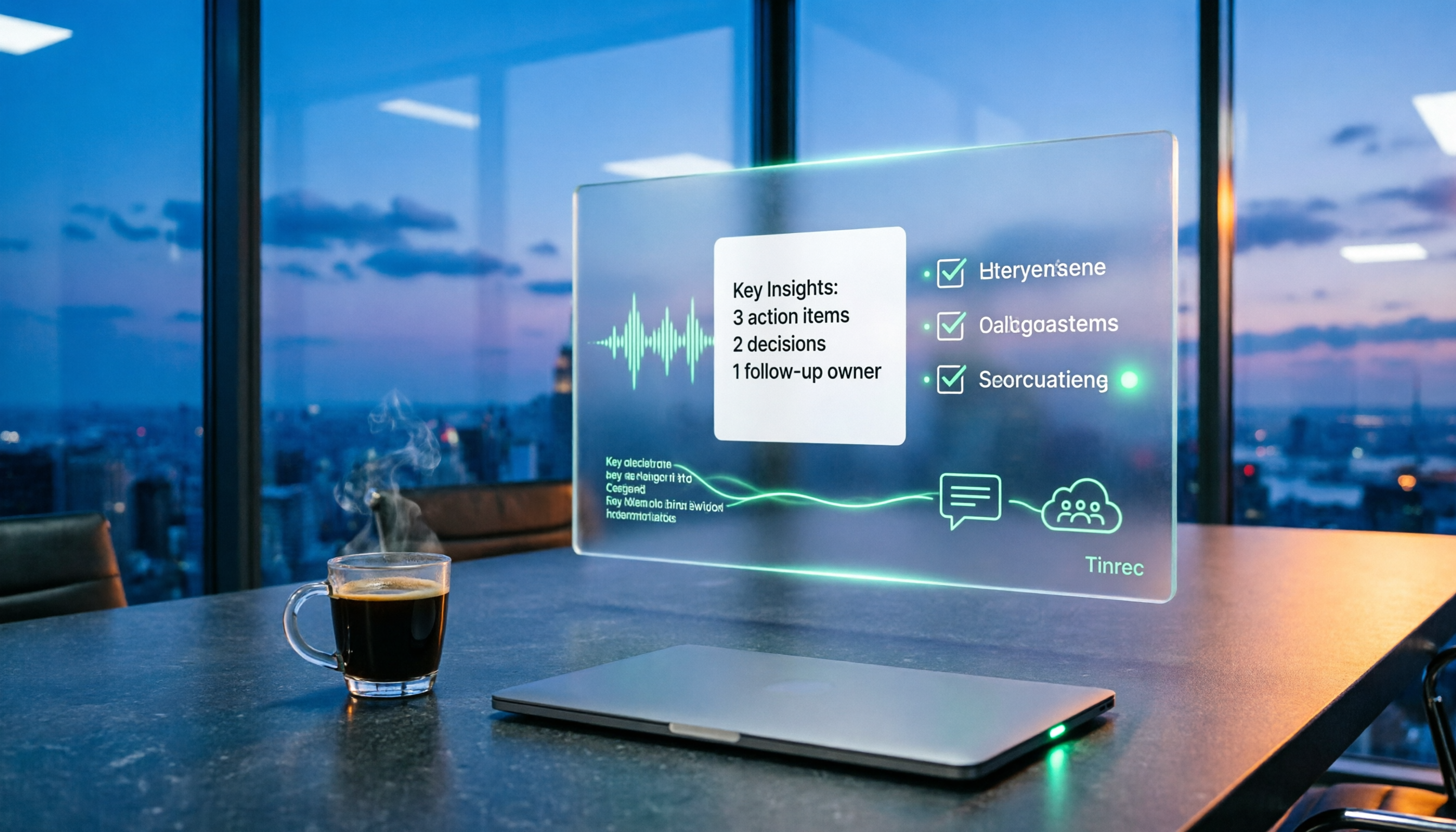
The meeting ending is just the beginning of the nightmare. This article starts from the pain points of post-meeting organization, breaks down what post-meeting work automation can do for you, its core capabilities, and four practical use cases. It also uses 5 buying tips and FAQs to explain how Tinrec connects transcripts, summaries, to-dos, AI Q&A, and team knowledge retention into a single post-meeting workflow.

2026 Comparison of 5 Meeting Report Generators: Free Tiers and AI Summaries Tested
Based on a student's real experience with a graduation project, this hands-on comparison tests 5 meeting report generators. It explains the core capabilities these tools should have, the 5 most overlooked pitfalls when choosing one, and uses Tinrec as an example to demonstrate the full workflow from recording, transcription, AI summary to action item extraction, while clarifying whether free tiers are sufficient for students.

2026 Best Meeting Collaboration Software: 4 Tools Tested for Post-Meeting Efficiency
From the perspective of a mid-level manager juggling 15 meetings a week, we tested and compared Tinrec, Otter.ai, Granola, and Notta—four meeting collaboration and note-taking tools. We break down the differences between 'having the meeting' and 'post-meeting wrap-up,' key buying factors like bot-free recording, mixed Chinese-English recognition, team seats, and data ownership, plus a pitfalls guide and scenario-based recommendations.

4 AI Meeting Notes Tools Compared for 2026: From Transcripts to Meeting Reports
How do you write a meeting report? I've distilled my methods from recent years into 4 key points and tested four AI meeting notes tools—Tinrec, Otter.ai, Notta, and Granola—comparing their differences in transcripts, summaries, action item extraction, AI Q&A, and team knowledge retention, guiding you from meeting notes to a deliverable meeting report.