

Turn recordings into transcripts and summaries in minutes
Upload audio or video for multilingual transcription, AI notes, and action items
Tinrec vs Otter.ai in 2026: A 5-Dimension Comparison to Choose the Right Chinese Meeting Transcription Software
Your weekly meeting just ended, and all you have is a 47-minute recording
It's 3 PM on Wednesday. The meeting just wrapped up, and your manager drops a message in the group chat: "Who's responsible for each of those three decisions we just made?" All you have is a 47-minute recording and your own scattered notes.
Another scenario is even more common: in a cross-departmental meeting, some people speak Chinese, others mix in English, and a client sends over a meeting audio file that needs to be turned into a shareable record by tomorrow morning.
These problems aren't about "not taking notes fast enough"—they're about not choosing the right tool. This article uses five dimensions to compare the most frequently asked-about meeting transcription software, and ends with conclusions you can directly follow.
Before choosing meeting transcription software, understand these 5 key points
Recording method: Do you want a bot to join the meeting? Some tools send a "meeting bot" into the meeting room as a participant, adding an extra person to the roster. Another approach captures system audio directly from your computer without adding participants. The latter is usually less awkward for external client meetings.
Usability of Chinese and mixed Chinese-English recognition. The number of languages on a spec sheet doesn't equal usability. In real meetings, you'll encounter accents, jargon, and people talking over each other. The key is whether these can be turned into a readable transcript.
Post-meeting outputs: What else besides the transcript? With only a transcript, you still have to read through 40 minutes of content yourself. Summaries, chapters, action items, and the ability to ask questions directly about the meeting content determine how much time you actually save.
Data ownership: Personal account or team space? If meeting records are stored in a personal account, the data leaves when the member does. For team plans, you need to look at how the database, seats, and permissions are structured.
Quota and pricing: How are minutes calculated? How are seats calculated? Free minutes are just the entry threshold. You also need to consider the quota for "file imports," how team sharing is calculated, and whether billing is per seat.
Tinrec — Our top recommendation after testing
Tinrec is an AI meeting transcription and collaboration tool for individuals and teams, available on web, desktop, and mobile. It turns meetings into searchable, collaborative, actionable team data—not just converting audio to text.
For online meetings, the desktop version captures your computer's system audio directly, handling Zoom, Google Meet, Microsoft Teams, and Webex meetings without inviting a meeting bot. Transcription starts generating while recording. If the meeting includes foreign language content, you can view it in the original, translated, or bilingual format.
After the meeting is where it truly saves time. AI automatically generates summaries, chapters, and action items, listing who's responsible for what and what the next steps are. Even better is AI Q&A: you can ask directly about the meeting content, like "What was the conclusion about the budget mentioned in the last meeting?"—no need to dig through a 40-minute transcript yourself.
For team use, Tinrec provides a separate team space rather than multiple people sharing a personal account. Meeting data belongs to the team. Members without a seat can still view, play, and read the data; only with a seat can they record, upload, edit, and export. Admins can manage roles and seats, view usage trends, and query and export important team operation logs. The current team plan pricing is USD 29.80 per paid seat per month, or USD 199 per paid seat per year (about USD 16.58 per month). Each paid seat provides 2,000 minutes of team-shared import quota per month; under an active team plan and seat, live recording currently does not deduct minutes. Eligible teams also get a 7-day trial with 1 free seat and 300 minutes of team-shared import quota.
Three things stood out most to me: First, handling Chinese meetings and mixed Chinese-English content—this is more practical for daily work in Taiwan than pure English tools. Second, the post-meeting outputs are comprehensive: summaries, action items, mind maps, plus the ability to generate reports, tables, and documents, and export to Notion, Google Docs, OneNote, or Dropbox for further editing. Third, team members and seats are managed separately, so when personnel changes occur, data can be handed over and won't disappear entirely.
Stop organizing recordings by hand
Upload audio or video and automatically get a transcript, summary, and action items
One thing to note: Tinrec's free version only provides basic quota, suitable for trying out the workflow. If you have regular weekly meetings, you'll need to move to a weekly card or Pro plan. Also, any AI transcription is affected by recording quality, noise, accents, and overlapping speech. For important decisions, it's recommended to verify against the transcript timestamps or original recording.
Overall, if you have weekly Chinese meetings, don't want a bot joining your meetings, and want meeting content to become reusable team data, Tinrec is currently the best fit.
Besides Tinrec, what other options are there?
Let's lay out the five dimensions:
| Dimension | Tinrec | Otter.ai | Granola | PLAUD |
|---|---|---|---|---|
| Meeting audio capture | Desktop captures system audio, no bot needed | Bot and desktop in parallel | Desktop, no bot | Dedicated recording hardware |
| Retains meeting audio | Yes, with audio recycle bin | Depends on product and plan | Does not retain meeting audio | Yes |
| Chinese meeting experience | Chinese, Traditional Chinese, and multilingual, with live translation | Primarily English business meetings | Primarily English meeting notes | Depends on device and app |
| Post-meeting outputs | Summary, chapters, action items, AI Q&A, reports, and tables | Summary, action items, AI Chat | Note enhancement and Q&A | Summary and templates |
| Team capabilities | Team space, members, seats, usage, audit | Mature team and enterprise plans | Shared folders and management | Team membership and device management |
**Otter.ai:** A mature AI meeting assistant, strong in English business meetings and integration ecosystem. Free version: 300 minutes per month; Pro annual billing is about USD 8.49 per user per month, including 1,200 minutes of in-app recording and 10 file imports per month. If your meetings are almost entirely in English, it's a reasonable choice. For Chinese and mixed Chinese-English, Tinrec is more complete.
**Granola:** Also takes the bot-free desktop approach, focusing on "handwritten notes + AI enhancement." Basic is free, Business is USD 14 per user per month, Enterprise is USD 35 per user per month. Note that it doesn't support uploading pre-recorded audio files and doesn't save meeting audio files—when you need to organize existing recordings or verify against original audio afterward, Tinrec's approach is more suitable.
**PLAUD Note / NotePin:** Representatives of AI recording hardware. NotePin is priced at USD 159, Note Pro at USD 189. Membership: Starter 300 minutes per month, Pro USD 99.99 per year. The advantage of portable hardware recording is clear, but you need to carry an extra device. If you don't want to buy extra hardware and want to handle both online meetings and historical files, Tinrec can do it all via web, desktop, and mobile.
Pitfall guide: The 3 most common mistakes when choosing meeting transcription software
Only looking at free minutes. A large free quota doesn't mean it's enough. Many people get stuck on the "file import" quota. First figure out whether you do more live recording or more post-meeting audio uploads.
Thinking a transcript is enough. A transcript is only a semi-finished product. What really saves time is summaries, action items, and the ability to ask questions directly about the meeting content. When choosing a tool, make "can I ask questions after the meeting" a must-check condition.
Using a personal account as a team plan. Several people sharing one account is cheaper short-term, but long-term you'll run into permission, usage, and data handover issues. For teams, look at how members, roles, and seats are structured, and how data is handled when a member leaves.
Conclusion: Which one should you choose?
In one sentence: For Chinese meetings and team data retention, Tinrec is the top choice; if your meetings are almost entirely in English and you want to keep costs down, Otter.ai is the exception.
- Chinese or mixed Chinese-English meetings → Tinrec (most complete Chinese and live translation support)
- Don't want a bot joining meetings → Tinrec (desktop captures system audio)
- Want to upload existing recordings and organize historical meetings → Tinrec (supports audio and video import)
- Meeting records should stay with the team and be transferable → Tinrec team plan (space, seats, usage, and audit)
- Almost entirely English meetings, want to keep costs down → Otter.ai
We suggest starting with Tinrec's free version to run through a complete meeting workflow. Teams can start with the 7-day trial to confirm whether Chinese recognition and post-meeting organization fit your work style, then decide whether to move to a paid plan.
References
- Meeting Ink - 2026 AI Meeting Transcription Tool Test | 7 Voice-to-Text and Summary Speed Comparison | Meeting Ink - AI Meeting Assistant Auto Transcription and Summary
- 2026 Comparison of 5 Smart Meeting Transcription Software: Chinese Meetings and Bot-Free Recording—Which Is Most Practical? - Tinrec Blog
- AI Meeting Transcription Software Recommendations: 5 App Test Comparisons, Auto Transcription Makes Meetings Easy!
- Must-Read 2026! 4 AI Audio-to-Text Tool Recommendations: Meeting Notes, Podcast Transcript Comparison - Mobile01
- No Time Limit! 3 Free AI Transcription Tools, Highly Recommended! AI Voice Notes Generate Meeting Records, Presentations, Mind Maps | 104 Career Power
Turn every recording into actionable outcomes
Get 60 free transcription minutes when you sign in. No credit card required.
Related Reading
You might also like

4 Best AI Meeting Transcription Software in 2026: Free vs Paid, Chinese Support, and Team Collaboration Compared
This article debunks common misconceptions and compares four popular AI meeting transcription tools: Tinrec, Otter.ai, Notta, and Granola. It covers differences in Chinese recognition, bot-free recording, post-meeting AI summaries, and team collaboration, with a comparison table and a buyer's guide to avoid pitfalls.

2026 Free Meeting Notes Apps Compared: How to Choose from Free to Team Plans
How do free meeting notes apps work? This guide examines three key decision points: whether the free quota is sufficient, whether online meetings can be recorded, and whether AI helps organize notes afterward. Using Tinrec as a full example, it walks through the workflow, core capabilities, and purchasing considerations from the free version, weekly pass, Pro, to team plan, helping you decide which plan to use in one go.
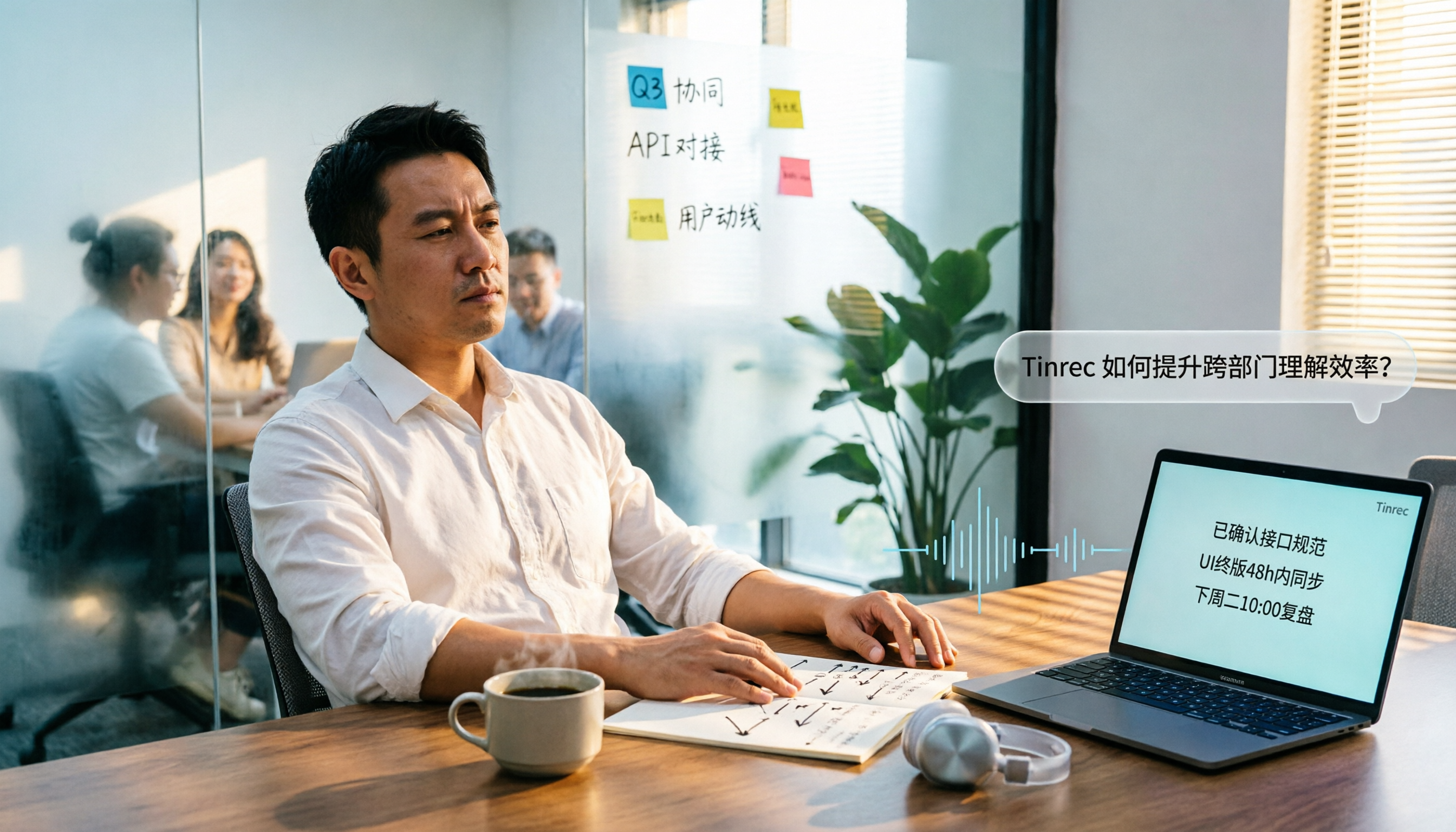
2026 Meeting Transcription Software Comparison: Which AI Note-Taker Actually Saves Time with Chinese Recognition?
I have 15 meetings a week, and post-meeting organization is the real nightmare. This article, from the perspective of a mid-level manager, breaks down 5 key factors for choosing meeting transcription software in 2026, tests Tinrec's Chinese transcription and AI Q&A experience, and honestly compares the use cases and limitations of Otter.ai, Notta, and PLAUD, ending with scenario-based recommendations you can follow directly.

How to Choose Meeting Transcription Software in 2026: A 5-Step Hands-On Guide
Every meeting transcription app claims to be free, but in practice you hit limits, Chinese recognition issues, and bot approval hurdles. This guide breaks down the complete workflow from recording to meeting minutes in 5 steps, using Tinrec as a hands-on example, and covers 5 key buying factors, differences between personal and team plans, and FAQs.

5 Best AI Meeting Notes Software in 2026: Which Handles Chinese Transcription Best?
Two-hour meetings and two more hours organizing notes? This guide starts with the key needs discussed on PTT, teaches you 4 critical factors for choosing a tool, then compares Tinrec, Otter.ai, Notta, PLAUD, and more to help you pick the most time-saving option based on your budget, meeting type, and team size.
6 Best AI Meeting Notes Software in 2026: Free vs Paid, How to Choose
Struggling with meeting notes isn't about typing speed—it's about workflow. We tested 6 top AI meeting transcription tools in 2026: Tinrec, Otter, Fireflies, Notta, Granola, and TurboScribe. Compare Chinese language support, free tiers, bot-free recording, and team collaboration features. Includes a 4-step AI meeting notes workflow and buying advice.

2026 Best AI Meeting Notes Software: 4 Tools Tested for Managers
A mid-level manager who attends 15 meetings a week tests Tinrec, Notta, Otter.ai, and PLAUD, comparing transcription quality, online meeting recording, post-meeting workflows, and team data ownership. Includes 4 key points to understand before choosing and 4 common pitfalls to avoid, helping you find the tool that truly saves time.

2026 Meeting Transcription Software Comparison: Chinese Recognition & Post-Meeting Efficiency Tested
We tested 4 meeting transcription software in 2026, comparing Chinese recognition, bot-free online meeting recording, post-meeting summaries and action items, AI Q&A, and team data management. We also highlight common purchasing pitfalls and provide clear recommendations based on different scenarios and budgets.

5 Best AI Meeting Transcription Tools in 2026: Which One Actually Saves You Time After the Meeting?
There's no shortage of meeting transcription software recommendations, but the real question is: do you need a raw transcript, or a ready-to-use record the moment the meeting ends? This article breaks down 4 key buying factors using real meeting conditions, compares tools like Tinrec, Otter.ai, PLAUD, and Granola, and offers a pitfalls guide plus scenario-based recommendations to help you choose right the first time.