
Turn recordings into transcripts and summaries in minutes
Upload audio or video for multilingual transcription, AI notes, and action items
What Does '2026 Good Tapes' Really Mean? First, Figure Out Which Type You Want
If you type '2026 good tapes' into a search bar, you might actually be thinking of three completely different things.
The first type is audiophiles. Looking for reel-to-reel tapes worth buying in 2026, they typically check The Absolute Sound's annually updated TAS Super Tape List, curated by Jonathan Valin.
The second type is cassette enthusiasts. Looking for cassette releases worth listening to in 2026, like Tabs Out's 'Top 200 Tapes of 2026,' which features experimental music from independent labels such as Strategic Tape Reserve and Orb Tapes.
The third type is live recording collectors. Looking for fan-recorded bootlegs from 2026 shows, such as Flagging Down's 'The 10 Must-Hear Bob Dylan Tapes of 2025,' which names specific dates like April 1 at the Orpheum Theater in Omaha and May 15 in Chula Vista.
There's also a misunderstanding: you might actually be looking for packing tape. That's not relevant here—move along.
The evaluation criteria for these three types of tapes are worlds apart. First confirm which type you are, then read on—if you don't distinguish this step, you'll spend money based on the wrong list.
Before Choosing Tapes, Understand These 4 Key Points
1. Purpose determines the item—don't mix comparisons
Reel-to-reel requires a reel-to-reel deck, cassettes need a cassette deck, and bootlegs are digital files. The equipment costs, budgets, and time investments for these three are completely different. First decide whether you want to 'listen' or 'collect.'
2. Generation of the master tape determines the ceiling of sound quality
The TAS list specifically reminds us: the sound quality of reel-to-reel tapes varies with the generation and condition of the master tape. Copies made directly from first-generation masters usually sound better than those from second- or third-generation production masters (the ones used for pressing records). The price differences within the same list often come from this.
3. Cassette beginners should start with Type I
Common Type I is iron oxide tape—cheap, durable, and playable on most machines. 2025 retail data shows a 5-pack of C-90 Type I blank tapes costs about $10 to $12, which is sufficient for most recording needs. Don't rush into metal tapes.
4. Post-acquisition organization is more often overlooked than what you buy
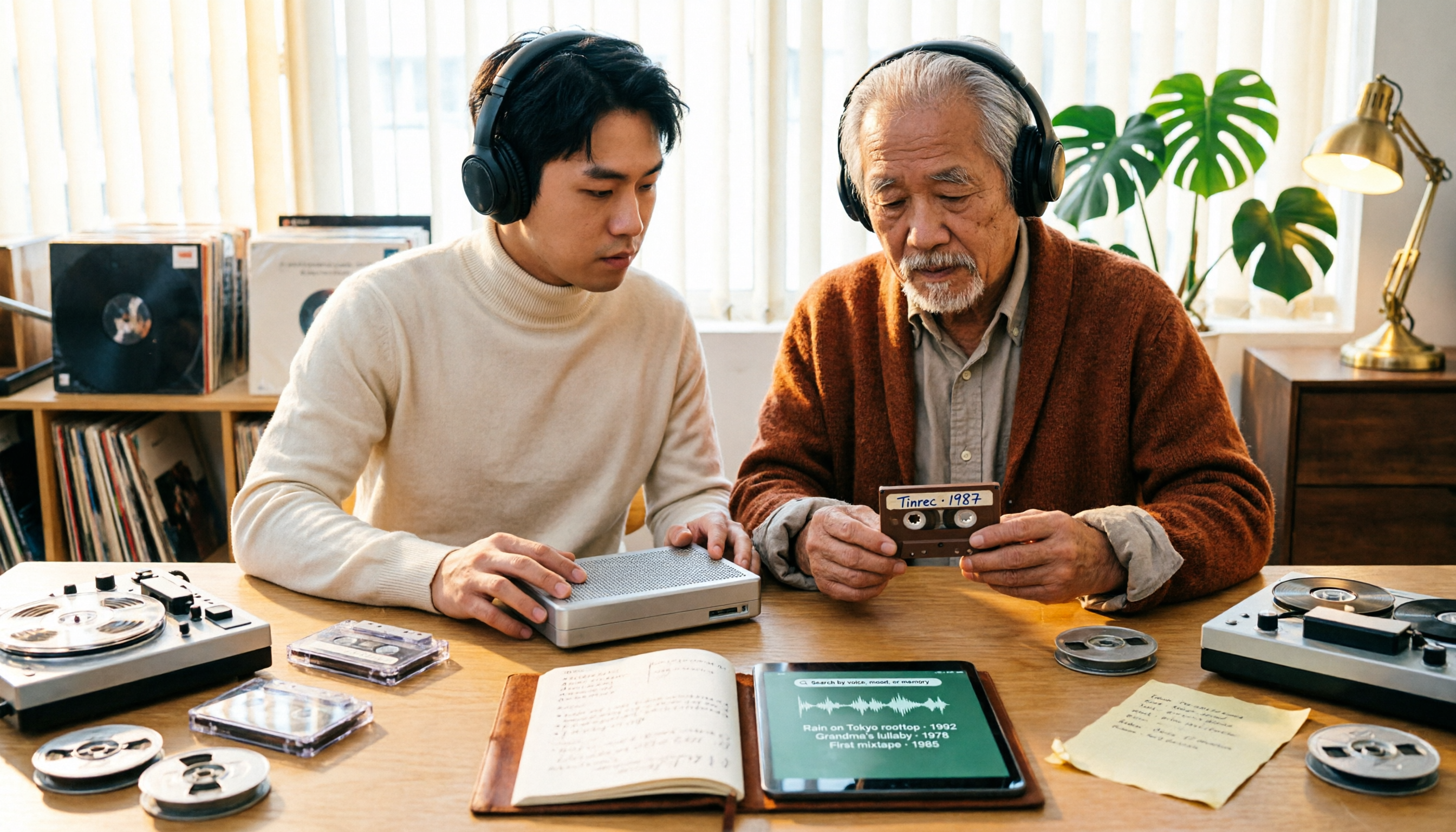
Honestly, this is the question I get most in comments. Buying tapes is fun, but reel-to-reel tapes aren't searchable, cassettes can't be copy-pasted, and bootlegs can run two or three hours. The real cost isn't how much you spend on tapes, but how much time you spend turning their contents into something usable.
Tinrec—The Smoothest Organization Method I've Actually Used After Getting Tapes
Tinrec is an AI meeting notes and collaboration tool for individuals and teams, available on iOS, Android, desktop, and web. It doesn't just convert sound to text—it organizes recordings into searchable, queryable, and further processable data.
First scenario: Digitized files from reel-to-reel and cassettes
First convert tapes to audio files, then upload to Tinrec. It generates transcripts and automatically creates summaries and chapters—for a two-hour interview tape, you don't have to listen from start to finish; just look at the chapters to locate what you need.
Second scenario: AI Q&A—this really saves effort
After recording, you can ask it questions directly, such as 'Which albums did the interviewee mention in this interview?' or 'What was the first song performed at this show?' It doesn't just give you keyword search results—it understands the content semantically and then answers. When organizing bootlegs, this feature is much faster than manually dragging the timeline.
Third scenario: Live interviews and panel discussions
Record in real-time with your phone, transcribing as you go. You can also enable real-time translation during recording, viewing in original, translated, or bilingual mode—very useful for interviewing foreign bands or multilingual panels.
Fourth scenario: Online meetings and remote interviews
Stop organizing recordings by hand
Upload audio or video and automatically get a transcript, summary, and action items
The desktop version directly captures computer system audio, handling meetings on Zoom, Google Meet, Microsoft Teams, Webex, etc., without needing to invite an extra meeting bot. This is crucial for interviews—one less bot makes interviewees much more relaxed.
Fifth scenario: A group doing research together
If you're not working alone but as a team doing oral history, music review databases, or interview research, the team version provides separate spaces rather than sharing one account. You can invite members, assign roles (owner/admin/member), and manage seats. Team data belongs to the team; when a member leaves, their resources must be handed over to other active members—they can't take everything with them. There's also a team glossary for maintaining professional terminology and a 30-day retention audio recycle bin.
Currently, the team version's first eligible trial is 7 days, 1 free seat, and 300 minutes of shared team import quota; monthly payment is USD 29.80 per paid seat per month, annual payment is USD 199 per paid seat per year (about USD 16.58 per month); each paid seat provides 2,000 minutes of shared team import quota per month. Under active plans and active seats, real-time recording currently does not deduct minutes.
Limitations to note
First, Tinrec cannot read tapes directly—you must digitize first. Second, background noise from old tapes, ambient sounds from live audience recordings, and multiple people talking over each other can affect transcription results; for important sections, it's recommended to replay and verify with timestamps. Third, the personal free version has a basic quota; heavy users need to pay—for occasional recording organization, the free version is enough; for short-term intensive interviews, consider a weekly card; for long-term data accumulation, an annual card is suitable.
Besides Tinrec, What Other Options Are There?
Granola is a bot-free AI meeting notes tool that captures system audio on desktop. But note—it doesn't support uploading pre-recorded audio files and doesn't save meeting audio. If you have a bunch of tape digital files to organize, this path won't work; Tinrec retains audio files and supports file import—this is the biggest dividing line between the two.
TurboScribe takes a high-cost-performance document transcription route: free version allows 3 files per day, 30 minutes per file; Unlimited annual payment is USD 120. Suitable for batch work processing large volumes of long files at once. But it's just transcription—no AI Q&A, no team space for data accumulation—which is exactly what Tinrec fills in.
Otter.ai is a veteran choice for English meetings, with Basic free at 300 minutes per month. If all your tapes are English interviews and you don't need a Chinese interface, it's sufficient. Tinrec's differences lie in Chinese and mixed Chinese-English meeting experience, bot-free desktop recording, and post-meeting multi-format export and team data management.
Pitfall Guide: The 4 Most Common Mistakes When Buying Tapes
Pitfall 1: Comparing the three types of tapes together. Using reel-to-reel sound quality standards to evaluate cassettes, or using bootleg prices to disparage original tapes, will only get you stuck. First define the problem you want to solve.
Pitfall 2: Only looking at master generation, ignoring playback equipment. No matter how good a first-generation master copy is, if your reel-to-reel deck isn't in good condition, it's wasted. Equipment and tapes should be evaluated together.
Pitfall 3: Buying without organizing. This is the most common. Tapes sitting for three years are still just tapes; only organized content becomes your data. Establish the habit of 'digitize upon acquisition, then throw into transcription.'
Pitfall 4: Thinking transcription tools can read tapes directly. Currently no pure software tool can skip the digitization step. The order is always: playback equipment → digitization → upload for transcription → summary and Q&A.
Conclusion: How Should You Choose?
In one sentence: 2026 tapes aren't hard to buy—what's hard is how to use them after buying.
- Looking for reel-to-reel tapes → Check the TAS Super Tape List first, pay attention to master generation labeling.
- Following cassette releases → Check Tabs Out's annual list, start with Type I for practice.
- Collecting live recordings → Refer to compilations like Flagging Down; audience tapes have their own atmosphere and aren't necessarily inferior to soundboard recordings.
- Want to use AI to find key points after recording → Tinrec, one of the few tools that combines transcripts, summaries, to-dos, and Q&A.
- Have a bunch of pre-recorded audio files for batch processing → TurboScribe's long-file capability is more suitable.
- Only English meetings, zero budget → Otter.ai's free quota can last a while.
I recommend starting with Tinrec's free version: upload a tape you've digitized yourself and see if the transcription and summary results work for you. If it feels smooth, consider upgrading—there's no need to pay from the start.
References
- 2025 TAS Super Tape List - The Absolute Sound
- Best Packing Tapes in 2025: Tested for Strength and Reliability
- Best Tapes in 2026: Which Type to Choose? We Tested 5 Categories—This One Is the Safest Bet - Official Tinrec Blog
- Top 200 Tapes of 2025 — Tabs Out
- The 10 Must-Hear Bob Dylan Tapes of 2025 - by Ray Padgett
Turn every recording into actionable outcomes
Get 60 free transcription minutes when you sign in. No credit card required.
Related Reading
You might also like

Otter.ai Chinese Review 2026: Traditional Chinese Limitations & Alternative Tools
Is Otter.ai Chinese version actually usable? This article examines three common misconceptions, explains that Otter officially lists only Simplified Chinese and that Otter Chat translation is not the same as transcription, and outlines four key factors for choosing a Chinese meeting tool, testing advice, pitfalls to avoid, and actual pricing. It also compares Tinrec, Otter.ai, Notta, and Granola for different use cases.

4 Meeting Transcription Tools Tested for 2026: Otter Means an Animal, But Which Tool Handles Chinese Meetings?
Otter means a water-loving mammal, but most people searching for it actually want Otter.ai, the meeting transcription tool. This article first clarifies the meaning and pronunciation of 'otter,' then compares Tinrec, Otter.ai, Notta, and TurboScribe for Chinese and Cantonese meetings—covering capture methods, post-meeting organization, and team collaboration—and highlights common pitfalls when choosing a tool.

How to Use Good Tape in 2025: 5-Step Guide to Transcribe Audio to Text
Good Tape is an AI transcription tool built by Danish news organization Zetland. It supports over 40 languages and can output timecoded transcripts and .srt subtitle files. This guide walks you through the 5 steps from uploading audio to exporting the final transcript, while also covering pricing, data retention policies, and limitations. It compares Tinrec, Notta, and TurboScribe to help you decide which tool fits your workflow.

2026 Comparison of 2 Meeting Transcription Tools: Otter Chinese Version vs. Tinrec — Which Is Better for Chinese Meetings?
Many people search for "Otter Chinese version," but what they really want to know is whether it can produce Chinese transcripts and whether the interface can be localized into Chinese. This article compares Otter.ai and Tinrec side by side across Chinese transcription, meeting recording methods, real-time translation, post-meeting organization, team collaboration, and pricing quotas to help you determine which one better fits the Chinese meeting needs of teams in Taiwan.

4 Otter Chinese Tools Tested for 2026: How to Download and Which Handles Traditional Chinese Best
People searching for "how to download Otter Chinese" often fall into three traps: assuming there's a separate Chinese app, downloading APKs from third-party sites, and thinking Chinese works perfectly once installed. This article clarifies Otter.ai's official download channels and Simplified Chinese limitations, then compares Tinrec, Otter.ai, Notta, and TurboScribe across four buying criteria to help you find a solution that truly handles Traditional Chinese meeting notes.

3 Meeting Transcription Tools Tested: How to Use Otter in Chinese and Which Understands Chinese Meetings Best?
People searching for 'otter Chinese' have two different needs: the literal meaning of the animal, and whether Otter.ai can handle Chinese meetings. This article clarifies common misconceptions and compares Otter.ai, Notta, TurboScribe, and Tinrec across four dimensions: Chinese recognition, meeting capture methods, post-meeting outputs, and team governance, to help you decide which tool truly suits Chinese meetings.

Otter in Chinese: Translation Guide, Meanings & 3 Practical Use Cases (2026)
Searching for 'otter in Chinese' returns multiple meanings: otter (水獺), sea otter (海獺), otter fur (水獺皮), and even the brand name Otter.ai. This guide clarifies the translations first, then explains what Chinese-speaking users should know if they're looking for the meeting tool Otter, and how Tinrec performs for Chinese meetings, bot-free recording, and team knowledge retention.

3 Meeting Transcription Apps Tested in 2026: Otter's Chinese Support and Download Options Explained
People searching for 'Otter Chinese how to download' often hit the same wall: the app downloads fine, but it can't produce usable Chinese meeting transcripts. This article first clarifies Otter.ai's download channels and official language support, then compares Tinrec, Otter.ai, Notta, and Granola using 4 key buying criteria, and finally gives clear recommendations based on different scenarios.

2026 Comparison of 3 Audio-to-Text Tools: Good Tape vs. Tinrec — Which Saves More Time on Chinese Transcripts?
People searching for Good Tape usually want more than just converting audio to text. This article compares two approaches—file transcription and meeting organization—and contrasts Good Tape, Tinrec, and Notta on Chinese transcripts, post-meeting summaries, action items, and team collaboration. It also covers quotas, pricing, and data storage considerations to help you choose the tool that fits your workflow.