
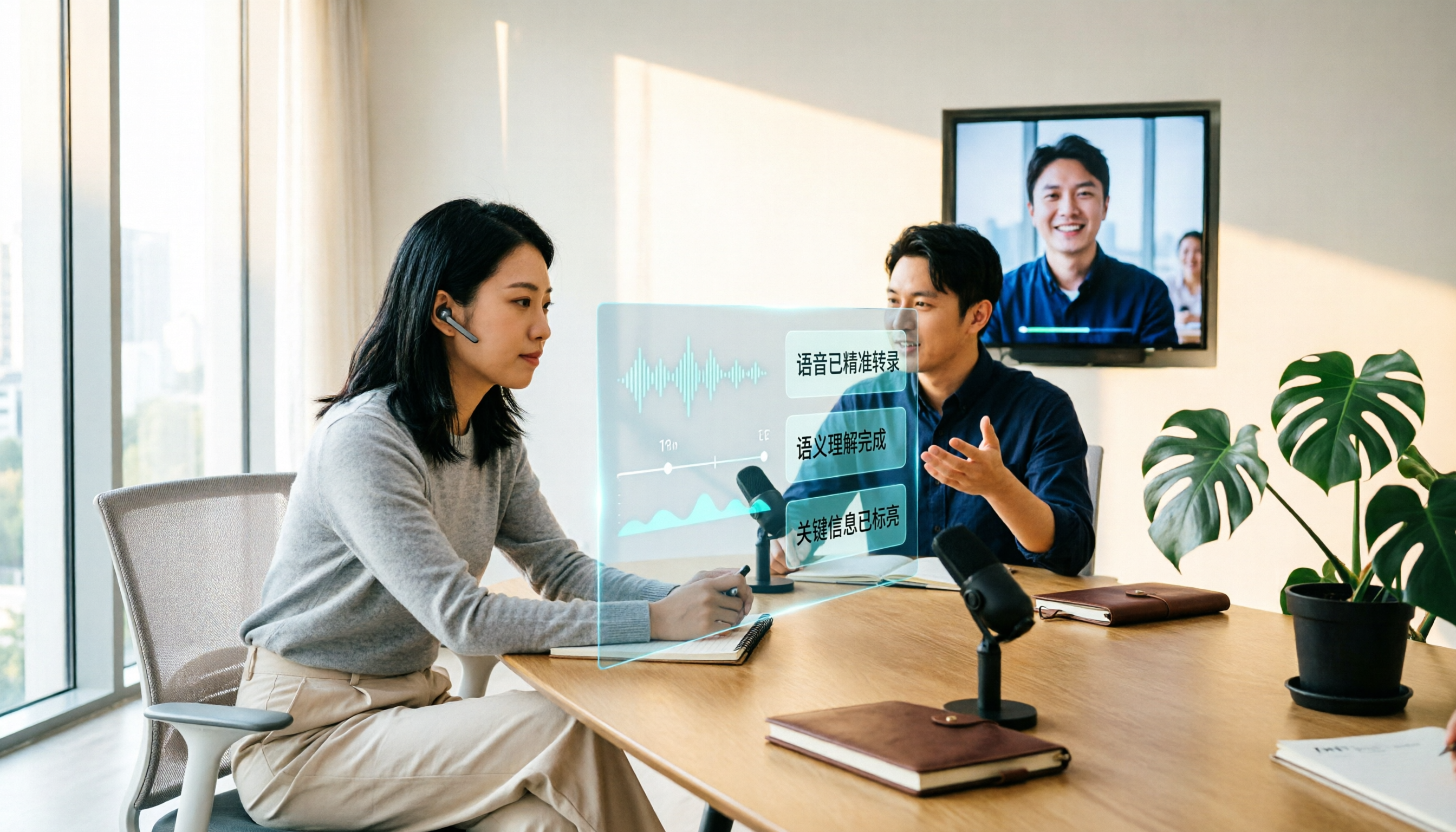
Turn recordings into transcripts and summaries in minutes
Upload audio or video for multilingual transcription, AI notes, and action items
2026 Comparison of 4 Audio/Video Transcription Tools: Which Saves the Most Time for Chinese Meetings and Subtitles?
The meeting is over, but the transcript is just beginning—what's really holding you up is the organizing
Friday afternoon cross-department meeting, 50-minute recording. The manager only asks three things: What was the conclusion? Who is responsible? What day next week will you report back? But you have to listen from the beginning, pausing as you go, and turn spoken language into readable text.
Interviews are even more troublesome. In a one-hour client interview, there may be only five quotable golden lines, but you have to transcribe everything first before you can mark them.
Adding subtitles to videos is another pain. Subtitles aren't just about having text; they also need timing, line breaks, punctuation, and ideally direct export to .srt. This article breaks down "audio/video transcription" into three workflows: meetings, interviews, and video subtitles, to help you decide which tool is worth putting into your daily work.
Before Choosing an Audio/Video Transcription Tool, Understand These 4 Key Points
1. Is your audio source a live meeting or an already-recorded file? Live meetings require recording and transcribing simultaneously, with immediate post-meeting summaries; file transcription depends on upload speed, format support, and batch processing. The needs are different, so don't just look at "how many languages are supported."
2. Is Chinese and Chinese-English mixed content stable enough? Meetings in Taiwan often mix Chinese with English terms, product names, and people's names. Rather than looking at official accuracy claims, try it with a real recording of your own. Actual performance is affected by recording quality, noise, accents, overlapping speakers, and technical terminology.
3. Can you work directly after transcription? With only a transcript, you still have to extract key points yourself. If the tool can generate summaries, chapters, action items, or even let you ask "who mentioned the budget in the last meeting," the organizing time will differ greatly.
4. Where should team data be stored? For personal tools, data usually follows the account; teams need shared spaces, member roles, seats, usage, and audit logs. Rather than scattering files on everyone's computer, choose a solution with team governance design from the start.
I'll Start with Tinrec: Turning Meeting Recordings into Queryable Data
Tinrec is an AI meeting notes and collaboration tool for individuals and teams, supporting live recording, desktop bot-free recording of online meetings, audio/video file import, and some web link imports. It doesn't just convert voice to text; it organizes meeting content into searchable, summarizable, queryable, exportable, and further processable data.
First, online meetings. Tinrec's desktop version directly captures computer system audio, so when handling Zoom, Google Meet, Microsoft Teams, Webex, etc., there's no need to invite a meeting bot. This is practical for external client meetings: you don't need an extra Bot in the participant list, nor explain who it is. Note that you still need to actively open Tinrec to start recording; it's not a bot that automatically joins all calendar meetings.
Next, post-meeting organization. After the meeting, Tinrec can generate summaries, chapters, key points, action items, and mind maps, and you can continue asking questions about the meeting content via AI Q&A. For example, if you directly ask "What is the budget cap the client mentioned?" it will answer based on the meeting content, not just throw keyword search results. When you need to submit a report, you can use Agent post-processing to generate documents, reports, or tables, and export to Notion, Google Docs, OneNote, Dropbox, etc. for further editing. For cross-language meetings, you can view the original text, translation, or bilingual content during recording.
The team version is another level. It provides an independent team space where meeting data belongs to the team, not tied to individual accounts. Management is divided into roles and seats: roles determine who can manage the team, members, audit, and settings; seats determine whether members can record, upload, edit, import/export. Active members without seats can still view, play, and read team data, but cannot perform resource-consuming operations like uploading and editing. The team version also includes shared import quota, usage analysis, team hotwords, audit logs, and audio recycle bin. Currently, the first eligible team trial is 7 days, 1 free seat, 300 minutes of team shared import quota; team monthly payment is USD 29.80/paid seat/month, annual payment USD 199/paid seat/year, about USD 16.58/month, each paid seat provides 2,000 minutes of team shared import quota per month. Under an active team plan and seats, live recording currently does not deduct minutes; file and web imports consume team shared minutes. Prices, currencies, and promotions are subject to the official purchase page.
Stop organizing recordings by hand
Upload audio or video and automatically get a transcript, summary, and action items
Limitations should also be clear. The free version is a basic quota, suitable for running one or two of your own meetings first; file and web imports consume quota; the team version is team-level sharing, not document-level ACL, nor can each file have independent visibility settings. Also, Tinrec does not promise a fixed 98% or 99% accuracy rate; for important content, it's recommended to cross-check with transcript timestamps and recording playback.
Who is it for? If you frequently handle Chinese meetings, mixed Chinese-English discussions, client interviews, and want to directly summarize, Q&A, capture action items, export after recording, and even accumulate data in a team space, Tinrec is a very fitting choice.
Besides Tinrec, What Other Options Are There?
MyEdit: Online file-to-text, subtitles and notes are straightforward. Upload MP3 or recording files to get .txt or .srt, supports 9 languages including Traditional Chinese, English, Japanese, and can be used for commercial subtitles. Daily login points for free trials, Audio Pro 360 points per month. It's suitable for temporary single-file organization; but desktop bot-free recording of online meetings, team spaces, and post-meeting action item tracking are not its main focus.
Otter.ai: Mature English meeting assistant, Chinese teams should evaluate needs. Basic free 300 minutes per month; Pro annual billing equivalent to US$8.49/user/month, including 1,200 minutes of in-app recording and 10 file imports per month. If you mainly have English meetings, it's very mature; but for Chinese meetings, bot-free desktop recording, and team data accumulation, Tinrec is more fitting.
Notta: Complete multilingual transcription and team plans, suitable for file-based needs. Free version 120 minutes per month, max 3 minutes per session; Pro annual billing equivalent to US$8.17/month, 1,800 minutes per month; Business annual billing equivalent to US$16.67/seat/month, including unlimited transcription, role permissions, and usage reports. It has high overlap with Tinrec; the difference is Tinrec emphasizes bot-free online meeting recording, post-meeting AI Q&A, and team spaces.
Pitfall Guide: The 4 Most Common Mistakes When Choosing an Audio/Video Transcription Tool
Pitfall 1: Only looking at the number of languages, not Chinese mixing and accents. Supporting 50 languages doesn't mean your meeting will transcribe well. Test with a real recording containing product names, people's names, and mixed Chinese-English; it's more accurate than looking at spec sheets.
Pitfall 2: Thinking meeting bots are the only solution. Bots joining meetings are convenient, but may not be suitable for external meetings. Desktop capturing system audio is another way; however, remember that such tools usually require you to actively start recording, not automatically record all meetings for you.
Pitfall 3: Stopping after getting the transcript. The transcript is raw material, not the finished product. Summaries, chapters, action items, Q&A, and export are where time is saved. Treating a transcription tool as just a typewriter means using only part of its capabilities.
Pitfall 4: Only looking at per-head price for team versions. Team versions need to distinguish roles, seats, and member relationships. Members without seats can read but cannot upload, edit, import/export; shared quota, whether live recording deducts minutes, audit, and recycle bin should also be considered. Comparing only "how much per person per month" easily leads to wrong purchases.
Conclusion: Which One Should You Choose?
In one sentence: If you want to transcribe Chinese meetings and then continue organizing, querying, and collaborating, Tinrec is the most worth trying first this time.
- Chinese meetings, mixed Chinese-English discussions, client interviews → Tinrec. Summaries, chapters, action items, AI Q&A, and multi-format export are all in one workflow.
- Need to record Zoom, Google Meet, Microsoft Teams, Webex without inviting a meeting bot → Tinrec desktop version. Remember to actively start recording yourself.
- Want to directly ask about meeting content, capture action items, generate reports or tables after meetings → Tinrec. This is the biggest difference from pure transcription tools.
- Team needs to share meeting data, manage seats, view usage and audit → Tinrec team version. First confirm roles, seats, and shared quota rules.
- Pure English meetings, budget-sensitive, only need a mature English meeting assistant → Otter.ai is worth considering. This is one of the few scenarios in this article suitable for diverting to a competitor.
It's recommended to first run through the process with your own real meeting recording to confirm transcription quality, summary usability, and export formats. There is no absolute best tool, only whether it suits your current workflow; but if you're stuck at "spending a lot of time organizing after recording," Tinrec is worth putting in the first round of testing.
References
- Online Speech-to-Text AI, Free MP3 or Recording to Text Transcript - MyEdit
- Yating Transcription
- Convert Audio to Transcript | Transcribe App & Web Editor
- Tested 4 Best Online Speech-to-Text Tools, Free Instant Recording to Transcript
- AI Speech-to-Text Fast Online Recording to Text, Transcript and Video Subtitles - Free Trial - cSubtitle
Turn every recording into actionable outcomes
Get 60 free transcription minutes when you sign in. No credit card required.
Related Reading
You might also like

4 Best M4A to Text Tools in 2026: Free vs Paid Comparison
Recorded a bunch of M4A files but stuck on turning them into transcripts? This side-by-side comparison of 4 M4A to text tools covers free quotas, file size limits, Chinese recognition, post-meeting organization, and team data ownership. Plus, real-world experience with Tinrec for meeting notes and AI follow-up questions.

Tinrec vs Notta 2026: 5-Dimension Comparison for Zoom Meeting Transcription
After a Zoom meeting, how do you turn the recording into a usable transcript, summary, and action items? This article compares Tinrec and Notta across 5 dimensions: capture method, post-meeting processing, Chinese language experience, team governance, and pricing logic, helping you choose the right approach for your team's Zoom meeting transcription needs.

4 Free MP4 to Text Tools in 2026: Free Tiers and Meeting Notes Use Cases Compared
Most people treat MP4 to text as a one-time task, only to find the transcript unusable afterward. This article compares four tools with free plans—Tinrec, Notta, TurboScribe, and Otter.ai—on free quotas, per-file limits, Chinese recognition, and post-transcription workflows, outlining each tool's free conditions, limitations, and best-fit scenarios.

4 Online Meeting Transcription Tools Tested: Free Tiers and Post-Meeting Workflow Compared (2026)
Many people think online meeting transcription is just uploading a file and waiting for the transcript. But the real time sink is post-meeting organization. This article debunks common myths, outlines 4 key factors for choosing a tool, and compares Tinrec, Otter.ai, Notta, and TurboScribe on free tiers, recording methods, post-meeting outputs, and team collaboration. It concludes with selection advice based on use cases.

2026 Comparison of 4 Automatic Meeting Summary Tools: Which Saves the Most Time for Chinese Meetings?
A mid-level manager who holds over a dozen meetings weekly tests 4 automatic meeting summary tools, comparing Chinese meeting recognition, summary usability, AI follow-up, audio retention, and team collaboration. Explains why Tinrec was kept and who Otter.ai, Notta, and Granola are best for, with a buying guide to avoid pitfalls.
4 Automatic Transcription Tools Tested: Which AI Saves the Most Time?
Automatic transcription isn't just about uploading audio. This article addresses common misconceptions, explains why post-transcription organization is key, and compares Tinrec, Notta, cSubtitle, and Yating Transcription in Chinese performance, post-meeting processing, quotas, and team collaboration, with buying tips and pitfalls to avoid.

4 Teams Meeting Transcription Tools Tested: Which Saves the Most Time for Chinese Meetings and Post-Meeting Cleanup in 2026?
After a Teams meeting, do you still have to write the transcript yourself? This article tests 4 ways to transcribe Teams meeting recordings, breaking down capture methods, Chinese recognition, post-meeting organization, and team authorization, plus 4 key points to check before buying and common pitfalls, to help you find the most time-saving workflow.

Tutorial: Tinrec Speaker Summary 2026 – Auto Speaker Separation & One-Click Highlights per Person
Group discussions are chaotic and no one remembers who said what. This practical student guide walks through Tinrec's Speaker Summary feature: how it automatically separates speakers, how to rename 'Speaker 1' to a classmate's name, how to view each speaker's key points, plus 5 buying considerations and FAQs for similar tools.

2026 Audio Summary Tools Compared: Which Is Most Useful After Transcription?
This article compares four audio summary tools—Tinrec, Transcribe, Mapify, and Monica—using the criterion of 'usability after summarization.' It explains selection factors, real-world workflows, plan limitations, and team edition differences to help you find the right way to organize meeting, interview, and learning recordings.