
Turn recordings into transcripts and summaries in minutes
Upload audio or video for multilingual transcription, AI notes, and action items
As a project manager, graduate student, or content creator, have you ever fallen into the endless loop of "one hour of meeting, three hours of notes"? The constant pausing, rewinding, and typing is not only time-consuming but also leads to missed key points due to fatigue. The good news is that with mature AI speech recognition, today's mobile apps can not only accurately transcribe English but also generate meeting summaries and action items.
This article tests and rounds up 5 mainstream voice-to-text tools, comparing them across dimensions like English accuracy, free plan limits, and feature completeness (e.g., speaker diarization, AI key point extraction). If you need a quick conclusion: for strong speaker diarization and team collaboration, consider Vocol.ai; for extracting action items directly from recordings or AI chat queries, Tinrec is a top productivity choice; for privacy-focused transcription, Good Tape stands out.
Why Speech-to-Text Is an Essential Modern Work Skill
Traditional voice recorders or built-in phone recorders have a major pain point: extremely low information density. A 60-minute audio file is an unsearchable black box—you have to listen from start to finish to find key info. New AI speech-to-text apps solve three core problems:
- Visualization and Searchability: Convert speech to text with timestamps, so you can use keywords (Ctrl+F) to locate key points.
- Decision Efficiency: Plain transcripts are still lengthy; AI-powered tools automatically summarize "meeting conclusions" and "action items."
- Multilingual Environments: For international meetings or foreign language classes, AI real-time translation and transcription significantly lower comprehension barriers.
2026 Top 5 Mobile Speech-to-Text Apps: In-Depth Review
Below we select 5 tools suitable for English users based on market popularity and actual performance.
1. Tinrec: From "Record" to "Action" with AI
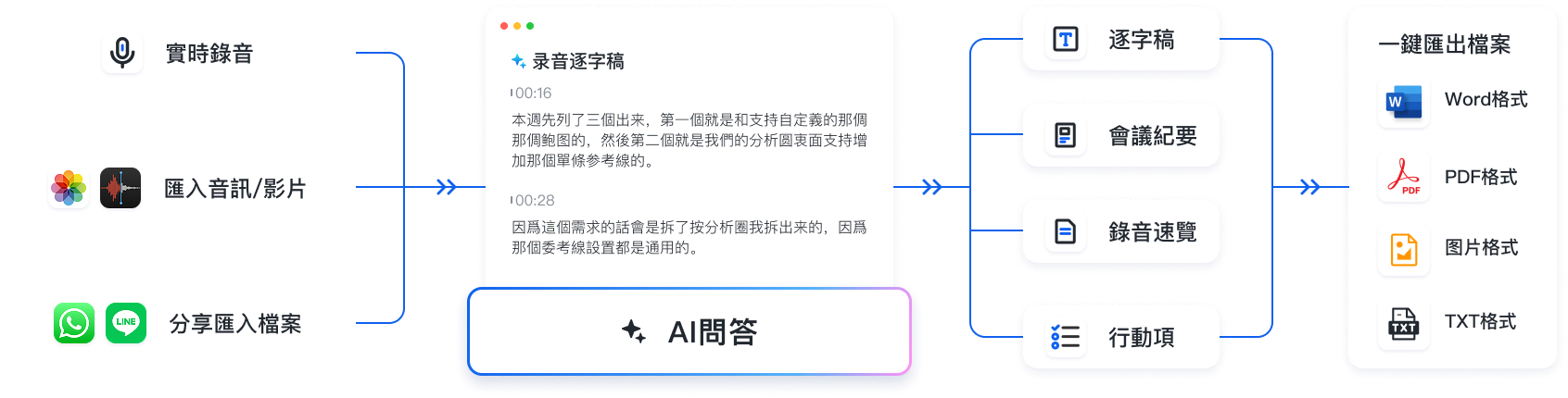
Tinrec's design philosophy goes beyond converting speech to text; it emphasizes a complete workflow from recording to understanding to action. Besides real-time transcription, its standout feature is AI chat queries. You can ask the AI conversationally: "What did David promise in this meeting?" and it answers based on the recording content, saving you from scanning through transcripts.
- Best for: Lecture notes, long meeting recordings, professionals needing quick extraction of to-do lists.
- Free plan: 100 minutes per month.
- Pros: AI chat query for recording content, auto-generated action items, multi-device sync (iOS/Android/Web), supports video link transcription.
- Key differentiator: Compared to tools that only provide transcripts, Tinrec focuses on post-meeting information retrieval efficiency.
2. Vocol.ai: Team Collaboration & Meeting Assistant
Vocol.ai positions itself as an "AI meeting collaboration platform." Beyond transcription, it emphasizes teamwork: it auto-generates meeting summaries and labels different speakers, ideal for teams that need to co-edit meeting notes.
- Best for: Project team meetings, multi-editor scenarios.
- Free plan: One-time 60-minute trial for new users.
- Pros: Free version includes speaker diarization, robust collaboration features.
- Cons: Free quota is one-time; long-term use requires subscription.
3. Good Tape: Privacy Fortress Favored by Journalists
Good Tape is well-regarded in journalist circles for its strong privacy security and clean interface. It uses OpenAI's Whisper model, offering solid accuracy for standard English, and emphasizes that it does not use user data to train AI.
- Best for: Sensitive interview content, privacy-conscious journalists or lawyers.
- Free plan: 3 free transcriptions per month, each up to 30 minutes.
- Pros: Strict privacy compliance (GDPR), minimal interface.
- Cons: Free transcriptions may have wait times, no speaker diarization.
Stop organizing recordings by hand
Upload audio or video and automatically get a transcript, summary, and action items
4. Notta: Generous Monthly Free Minutes for Real-Time Transcription
Notta supports real-time transcription in multiple languages, handy for frequent international meetings. Its free plan offers relatively generous time limits, suitable for regular personal transcription needs.
- Best for: Multilingual meetings, recurring transcription needs.
- Free plan: 120 minutes per month.
- Pros: Stable real-time transcription, strong multilingual support.
- Cons: Free version lacks speaker diarization.
5. Otter.ai: Popular All-Rounder with Live Meeting Notes
Otter.ai is one of the most widely used transcription apps in the US. It offers live meeting notes, speaker identification, and integrates with calendars to auto-join meetings.
- Best for: Business meetings, interviews, lectures.
- Free plan: 300 minutes per month (but per conversation limit may apply).
- Pros: Live transcription, speaker labels, calendar integration.
- Cons: Free plan limited to 30-minute conversations per session; less accurate with heavy accents.
Deep Comparison: Features & Free Plan Limits
To help you choose intuitively, here's a comparison table (as of 2026 info):
| Dimension | Tinrec | Vocol.ai | Good Tape | Notta | Otter.ai |
|---|---|---|---|---|---|
| Core Focus | AI queries & action items | Team collaboration meetings | Privacy & security | Multilingual real-time transcription | Live meeting notes & integration |
| Free Plan | 100 min / month | One-time 60 min | 3x 30 min sessions / month | 120 min / month | 300 min / month (30 min/session) |
| English Optimization | ⭐⭐⭐⭐ | ⭐⭐⭐⭐ | ⭐⭐⭐⭐ | ⭐⭐⭐⭐ | ⭐⭐⭐⭐ |
| Speaker Diarization | ✅ | ✅ (Free includes) | ❌ | ❌ (Paid) | ✅ (Paid for advanced) |
| AI Summary / Action Items | AI chat + action items | Meeting summaries | None | Basic summary | Key points & action items |
| Unique Feature | Video link transcription, AI Q&A | Team shared workspace | GDPR compliance | Screen recording | Calendar & live meeting integration |
How to Use a Mobile App for "Record to Meeting Notes in Seconds"
Once you pick a tool, how to maximize efficiency? Below, using Tinrec (which covers many features) as an example, we demonstrate the standard workflow from recording to generating action items. This workflow works on both iOS and Android.
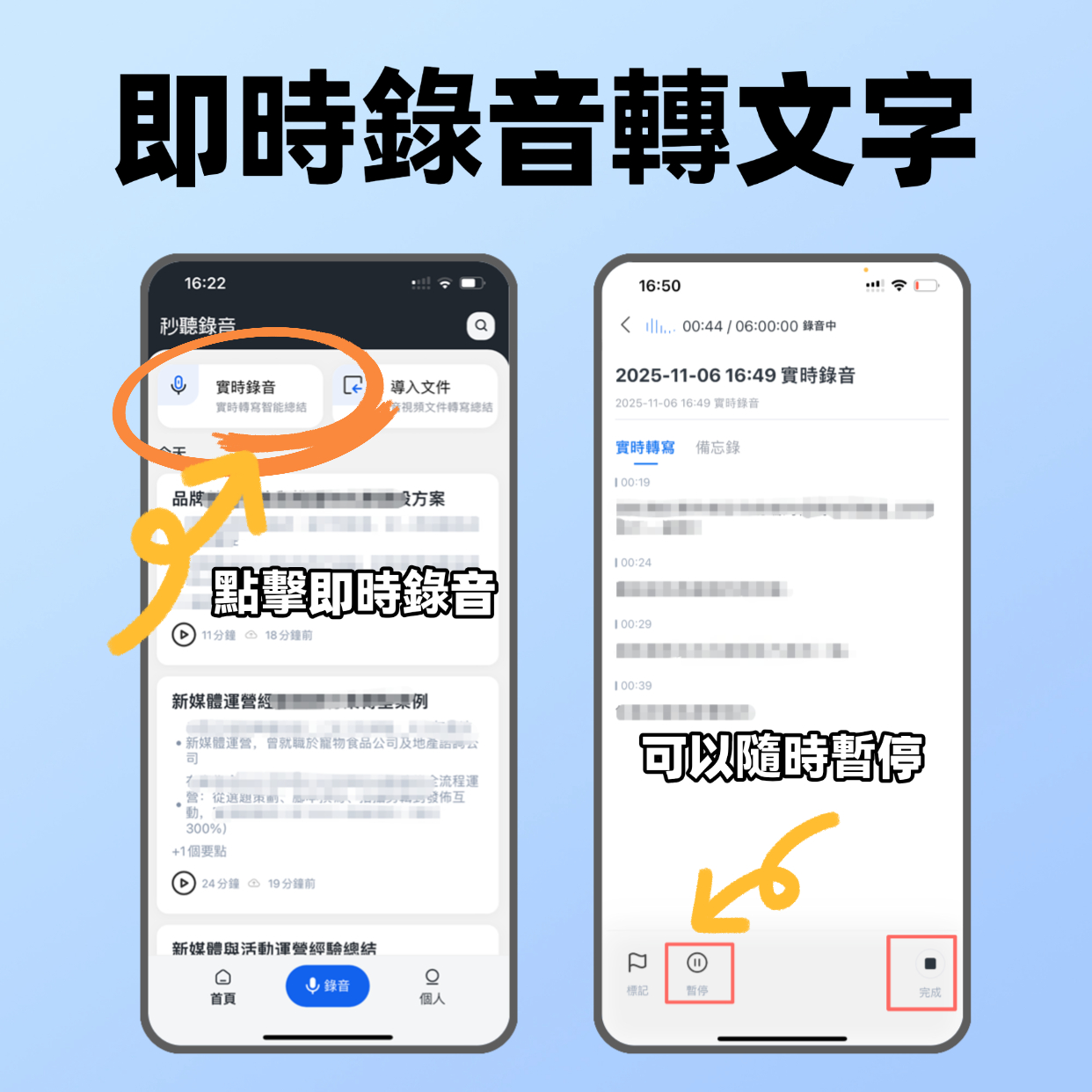
Step 1: Real-Time Recording to Text
When a meeting or class starts, open the app and enter the recording interface. AI performs real-time transcription in the background—no need to watch the screen; focus on the conversation.
- Action: Tap Record & Transcribe in Real Time
- Tip: Place the phone near the speaker(s). In noisy environments, use an external directional microphone for better accuracy.
Step 2: Import External Audio or Video Links
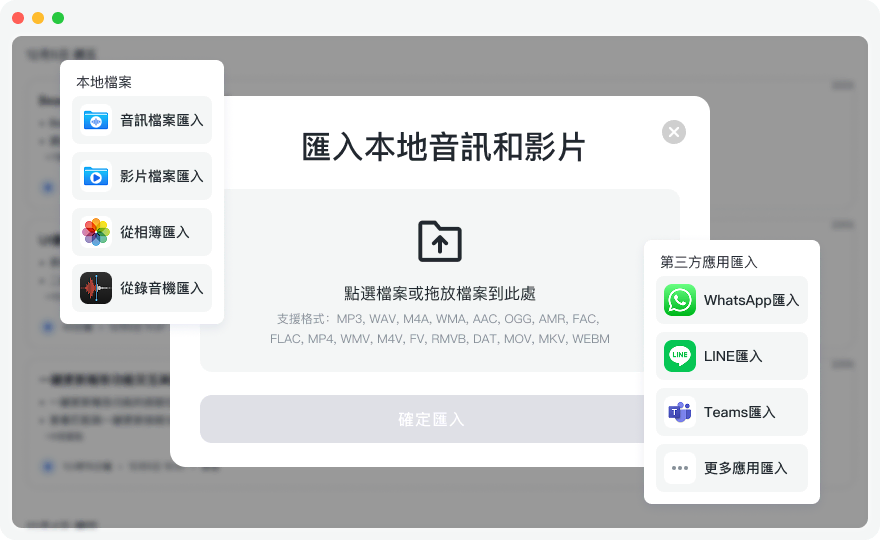
If you already have recorded files or want to transcribe a YouTube tutorial, use the import feature. Tinrec supports parsing web video links directly into text—very useful for online courses.

- Action:
- Upload audio: Audio File to Text
- Video link: Podcast/Web Video to Text
Step 3: Use AI to Extract Action Items & Summary
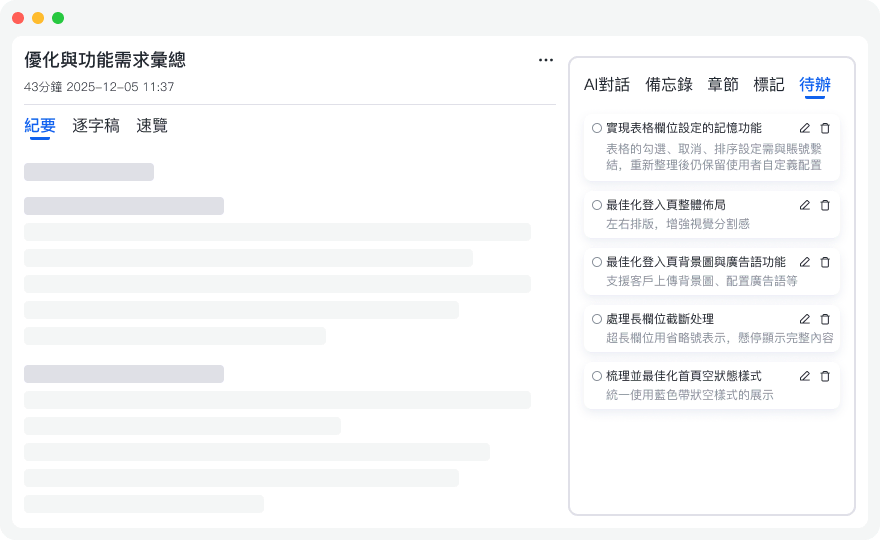
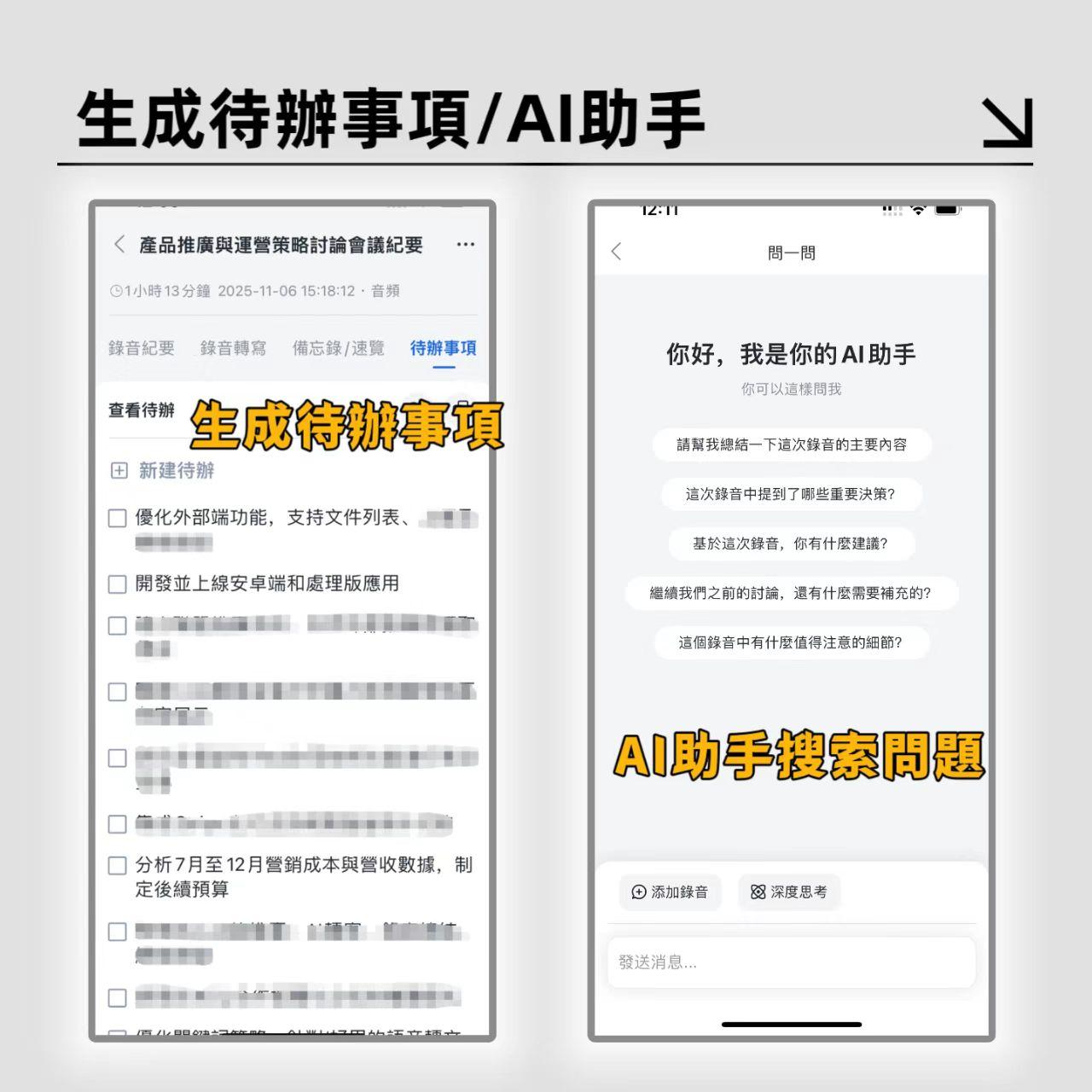
After recording ends, don't just read the transcript. Tap the AI analysis feature—the system automatically generates meeting minutes and to-do action items.
Step 4: Use AI Chat to Find Missed Details
This is an advanced organization trick. If you forget a detail, instead of replaying the audio, use the AI Chat Query feature. For example, ask: "What were the key exam points the teacher mentioned in this class?" The system searches the semantics and summarizes for you.
Frequently Asked Questions
Q1: Do these apps support recording phone calls from apps like Zoom or FaceTime? Due to OS privacy restrictions (especially iOS), most apps cannot directly record audio from other apps in the background. Workaround: use speakerphone mode, or use dedicated call recording hardware.
Q2: What most affects transcription accuracy? Background noise and microphone distance. In a quiet meeting room with the phone close to the speaker, accuracy can reach 90%+; in a noisy café, accuracy drops significantly.
Q3: What happens when free minutes run out? Strategies vary. Tinrec and Notta reset minutes monthly. If you have high volume, choose tools with monthly resets, or upgrade to a paid plan.
Q4: Is my data safe in the cloud? Tools like Good Tape are GDPR compliant; Tinrec and Vocol.ai have enterprise-level data protection. For highly confidential business secrets, check if the tool supports deleting original files or offers on-premises deployment.
Q5: Does it matter if the app is optimized for American English vs. British English? Yes. Choose tools that explicitly support your variant (US or UK) to avoid spelling and terminology differences (e.g., "color" vs. "colour", "apartment" vs. "flat"). Tinrec and Otter.ai generally handle US English well.
Choosing the right speech-to-text tool frees you from tedious typing. We recommend starting with apps that offer free trials to find the one that fits you best, turning AI into your ultimate meeting secretary!
Turn every recording into actionable outcomes
Get 60 free transcription minutes when you sign in. No credit card required.
Related Reading
You might also like

4 Meeting Transcription Apps Tested in 2026: Which One Lets You Skip Overtime?
Spending two hours in a meeting and another two organizing notes? We tested 4 AI meeting transcription tools, focusing on bot-free recording, AI summaries, and team collaboration. Verdict: Tinrec is the best fit for Hong Kong professionals.

4 Best Speech-to-Text Tools Tested in 2026: Take Meeting Notes Without a Bot
Turning meetings, interviews, and lectures into transcripts can save hours if you use the right tool. This hands-on comparison of Tinrec, Notta, Otter, and Granola highlights key selection criteria and step-by-step usage, helping you find the best speech-to-text solution for Chinese meetings.

2026 AI Meeting Recorder Comparison: Tinrec vs Otter.ai – Which Is Better for Chinese Speakers?
Choosing the right meeting transcription tool in 2026? This hands-on comparison of Tinrec and Otter.ai covers 5 key dimensions: Chinese transcription, bot-free recording, post-meeting organization, team collaboration, and file import – helping you find the best fit for your meeting notes needs.

How to Convert Meeting Recordings to Chinese Subtitles in 2026? 5-Step Tinrec Tutorial: A Notta User's Switch Story
A hands-on tutorial on converting meeting recordings to Chinese subtitles, comparing Tinrec and Notta, with 5 steps to use Tinrec for recording, transcribing, translating, and organizing meeting notes—perfect for Hong Kong professionals.

Tinrec vs Otter.ai in 2026: A 5-Dimension Comparison for Effortless Chinese Meeting Notes
Choosing the right meeting transcription tool in 2026? This article compares Tinrec and Otter.ai across 5 dimensions—Chinese recognition, bot-free recording, file import, AI Q&A, and team data management—to help you find the best meeting notes solution for users in Taiwan.

5 Best AI Meeting Note Tools Tested in 2026: Can You Take Accurate Chinese Meeting Minutes Without a Bot?
Meetings are tiring enough; taking minutes afterward is even more so. This hands-on comparison of 5 AI meeting note tools, including Tinrec, Granola, Otter.ai, and Notta, shows you how to choose and use them to turn Chinese meetings into searchable, collaborative action items—no meeting bot required.

How to Use AI Meeting Notes in 2026: 5 Steps from Recording to AI Summary
Still typing meeting minutes by hand? This article tests Tinrec to show you how to complete recording-to-text, AI summary, and to-do organization in 5 steps, and compares it with Notta and other tools to explain why Tinrec is better suited for Hong Kong professionals.

2026 Meeting Transcription Comparison: Tinrec's Bot-Free Recording, AI Summaries, and Team Collaboration
How to choose a meeting transcription tool in 2026? This article focuses on Tinrec, comparing Otter, Notta, and Granola, and explains bot-free recording, AI summaries, team collaboration, and key pitfalls to avoid.
How to Download Speech-to-Text in 2026? A Complete 5-Step Guide
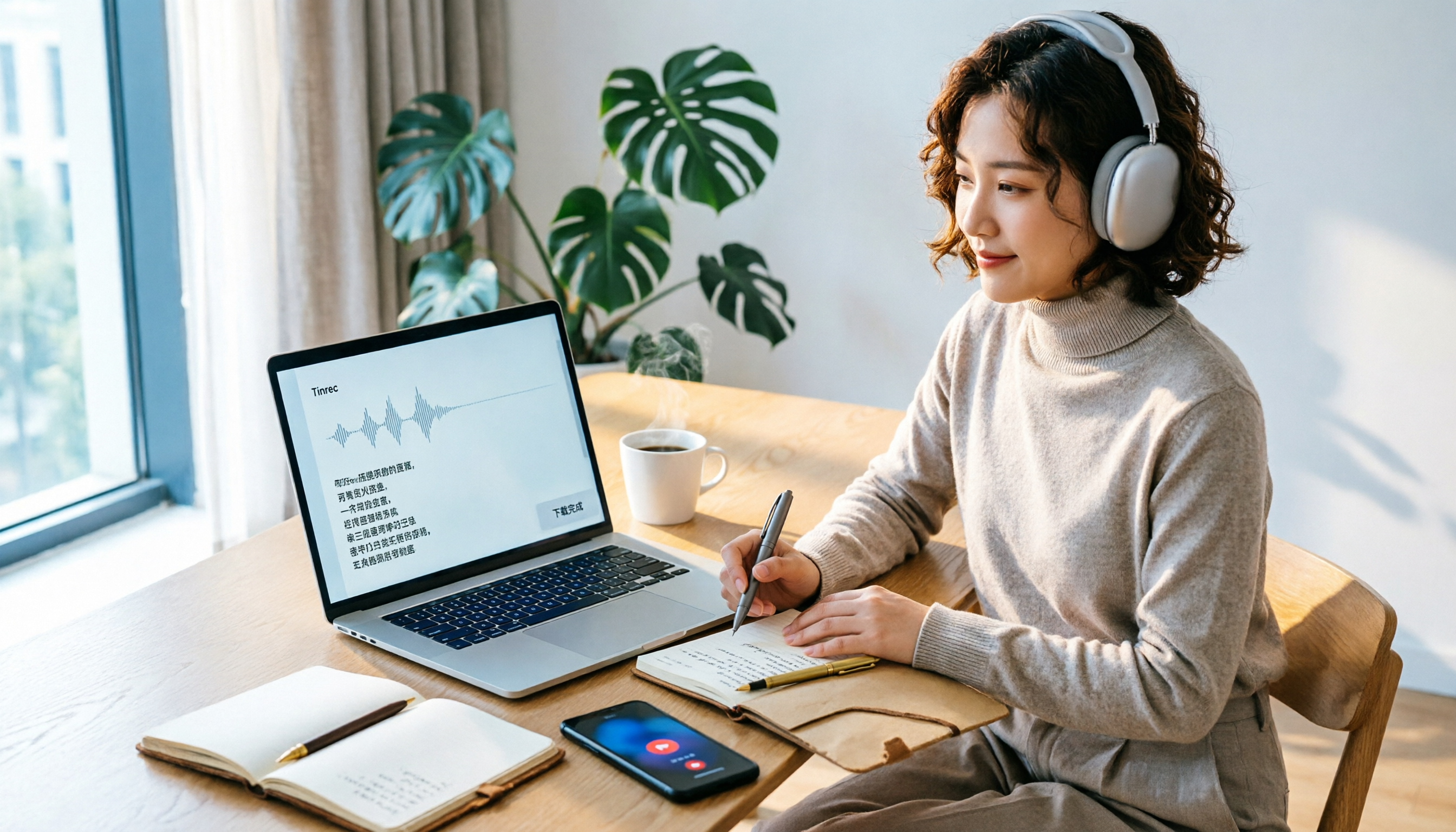
Looking for a speech-to-text tool in 2026? Tinrec helps you convert recordings to text and download transcripts in 5 steps, with buying tips and FAQs. A must-read for professionals.