
Turn recordings into transcripts and summaries in minutes
Upload audio or video for multilingual transcription, AI notes, and action items
What You Need Isn't Another Recording Tool, But a Way to Actually Organize Information
Recently in productivity courses, one of the most common questions from students is:
“Teacher, I recorded a bunch of meetings and courses, but I never have time to re-listen, let alone organize them. What should I do?”
This is indeed a real dilemma for many knowledge workers.
Recording audio itself is simple—just press a button on your phone.
But what happens after recording? That audio file sits in your phone, becoming a “data black hole” that never gets opened again.
What's even more troublesome is Chinese content.
Many tools handle English transcription well, but when it comes to Chinese meetings or courses, accuracy plummets. The resulting transcripts are full of errors, and you end up having to re-listen and correct them yourself.
If you've encountered this situation, then this article is written for you.
I spent two weeks hands-on testing three highly-discussed AI recording & transcription tools: Tinrec, Notta, and Fireflies. I used the same Chinese meeting recordings, course audio, and online video to see which one could truly turn recordings into “usable knowledge.”
Before Choosing an AI Recording Tool, Understand These 3 Key Points
Don't just look at “transcription minutes” or “price” when choosing a tool—that's only the first step.
What really determines whether you save effort later are these three critical dimensions.
1. Accuracy: Don't just look at marketing claims; consider your actual recording conditions
Many tools claim 98% accuracy, but that's usually measured under ideal conditions.
Real conference rooms have air conditioning noise, keyboard sounds, multiple speakers; online courses may have background noise—these are your daily reality.
My tests used these “imperfect” real recordings: a Chinese product meeting (3-person discussion), an online course audio (teacher explaining with slide switching sounds), and a YouTube Chinese educational video.
In this scenario, performance differences between tools became immediately apparent—and Tinrec's Chinese transcription error rate was significantly lower, especially for proper nouns and numbers.
2. AI Organization: Transcription is just the beginning; making content smart is the key
If you only convert recordings to verbatim transcripts, you've solved only 30% of the problem.
You also need summaries, key points, action items, and even the ability to ask in Chinese: “Who was responsible for the budget in the last meeting?”
That's real time-saving.
All three tools I tested have AI summaries, but their depth is completely different. Some just provide simple condensation; others can extract action items and allow conversational queries.
Tinrec surprised me the most in this regard—details later.
3. Source Support: Not just meetings; your recording sources are more diverse than you think
You don't just need to record meetings.
You also have course recordings, interview audios, learning videos on YouTube or Bilibili, and old audio files.
If a tool only supports live meetings or only allows uploading local files, you'll have to switch between different tools.
My ideal scenario: one tool that handles all audio/video sources—meetings, files, web links—and outputs organized results in a unified format.
That's also why I ultimately chose to stick with Tinrec.
Tinrec (Miaoting Recording) – My Hands-On Core Organization Powerhouse
It supports iOS, Android, and web version, so cross-platform usage is no problem.
(Screenshot here: Tinrec's interface on iOS, Android, and web, showing cross-platform consistency)
Here are a few scenarios from my actual use, showing how it fits into the workflow.
Live Meetings: Real-time transcription, meeting minutes and action items ready when the meeting ends
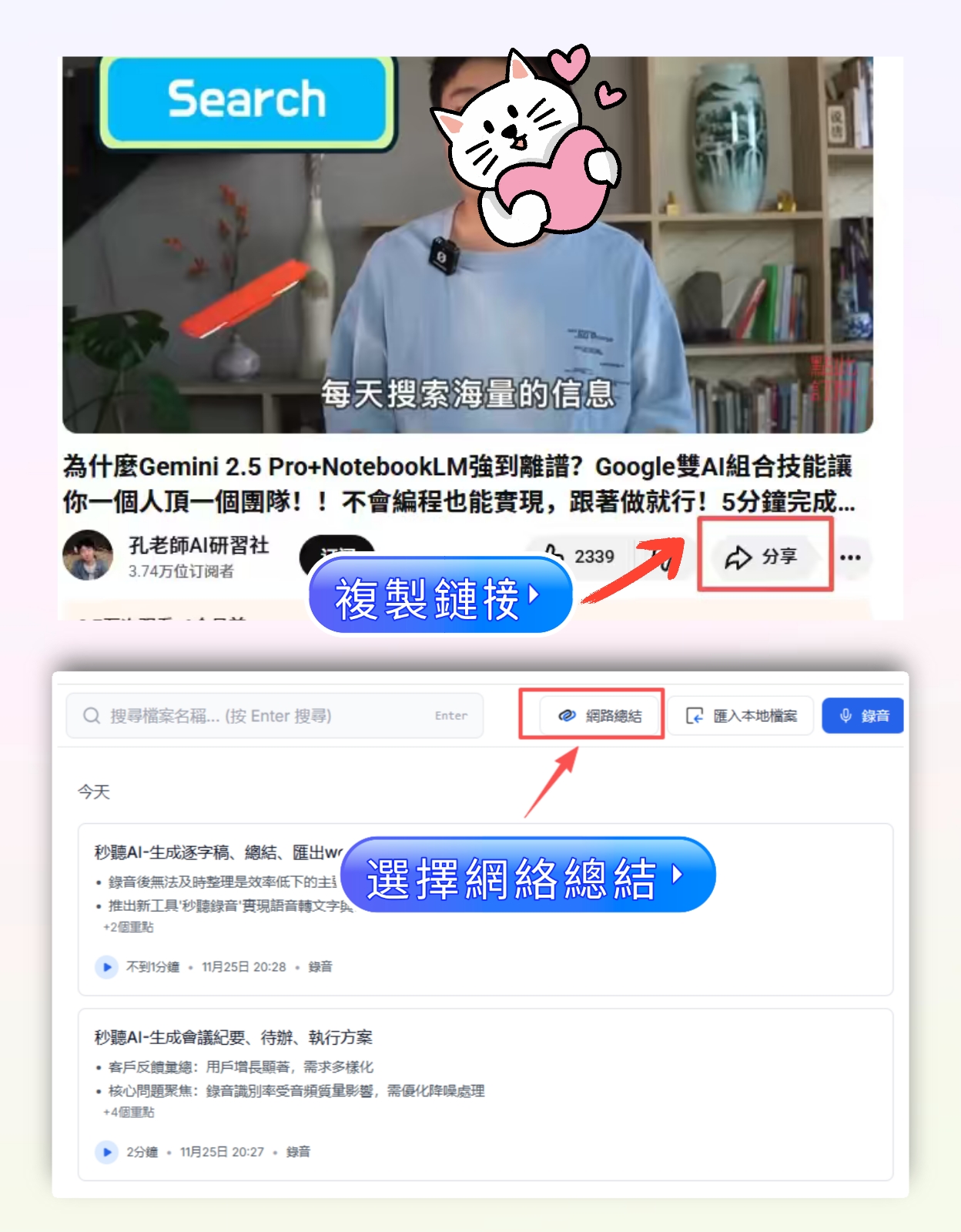
Open Tinrec and tap record; it will transcribe speech to text in real time on the screen.
During the meeting, I can directly mark key points or manually insert bookmarks.
After the recording ends, AI automatically generates a summary, chapters, and action items.
The summary isn't just the first three sentences; it actually captures the core conclusions of the discussion and next steps.
It can even extract “who is responsible for what and by when” from the conversation.
(Screenshot here: real-time recording interface, arrows pointing to real-time transcript and markup buttons)
AI Chat Query: Ask your recordings directly like asking a colleague
This is the feature I use most often, and most competitors don't have it yet.
After recording, I don't scroll through long transcripts.
Stop organizing recordings by hand
Upload audio or video and automatically get a transcript, summary, and action items
Instead, I type directly in the chat bar at the bottom: “What was the conclusion about the marketing budget in the last meeting?”
Tinrec doesn't just keyword search for paragraphs containing “budget.”
It understands my question and gives me a well-organized answer, citing relevant conversation segments.
This is incredibly convenient for quickly retrieving historical meeting details.
(Screenshot here: AI chat query interface, showing precise answer with source citations after entering a question)
Online Video Links: Drop a YouTube link, get study notes
Before, when watching YouTube tutorials, I had to manually screenshot and type notes.
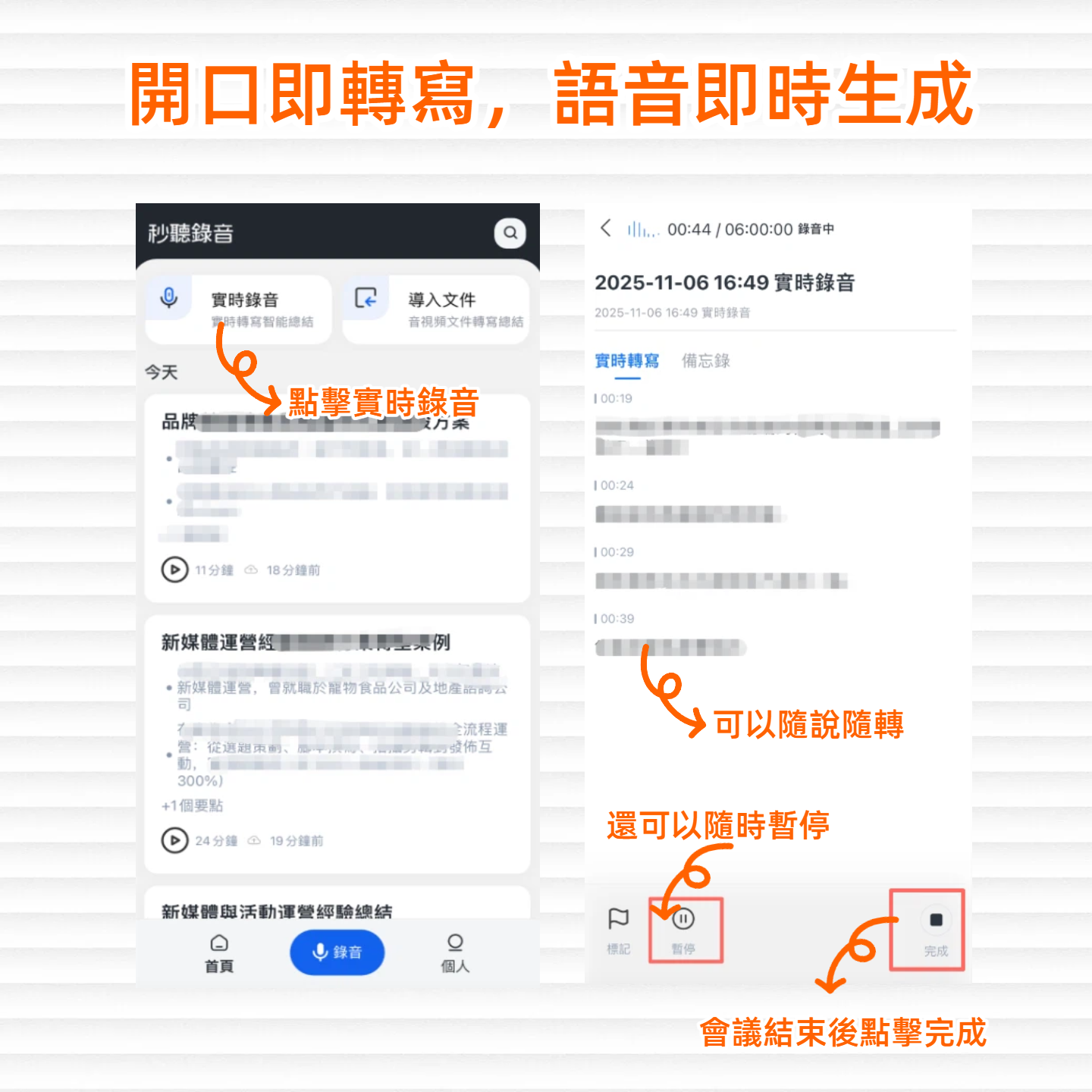
Now I paste the link into Tinrec; within minutes it transcribes the full text, automatically splits into chapters, and generates a summary.
I can even directly copy paragraph notes into my knowledge base.
What's even better: it supports major Chinese-language platforms, not just YouTube.
(Screenshot here: generated transcript and chapter list after pasting a YouTube link)
Multi-format Export: Bring organized results into your existing workflow
No matter how well organized, if exporting is cumbersome, it's useless.
Tinrec can export transcripts, summaries, and action items as text, PDF, Word, or even sync directly to Notion.
I'm used to exporting meeting notes to Notion for long-term knowledge base, and course notes to Google Docs for further processing.
This lets me keep my original organization habits.
(Screenshot here: multi-format export options including text, PDF, Notion, etc.)
A few honest limitations
The free plan offers a basic monthly transcription quota (about 100 minutes); heavy users need to pay.
But for those who have 2-3 meetings per week and occasionally organize courses, the free version already allows you to experience core features.
Also, while the AI summary is powerful, it occasionally misses certain details. For important decisions, I still quickly cross-check with the original transcript—it only takes a couple of minutes.
Who is it for?
If you frequently need to organize Chinese meetings, courses, interviews, or online videos; want to directly ask AI for key points after recording without re-listening; and switch between phone and computer—then Tinrec is my top recommendation.
Besides Tinrec, What Other Options Are There?
Of course, people with different needs may consider other options. The following two are also popular choices, but they have clear differences compared to Tinrec.
Notta: Stable transcription, but lacks deep organization and multi-source support
Notta is a mature transcription tool with decent Chinese accuracy, and the paid version offers generous minutes.
However, it leans more toward “transcription + subtitles” and has limited support for online video links.
Moreover, it lacks an AI chat query feature like Tinrec's—after recording, you can only manually search keywords, which results in a significant efficiency gap for long recordings.
If you only need quick transcription of files or meetings and don't care about subsequent Q&A, Notta can be a backup; but if you want to further organize content, it falls short.
Fireflies.ai: Unlimited transcription is attractive, but Chinese experience and scenario breadth are lacking
Fireflies focuses on online meeting bots that automatically join Zoom and Google Meet recordings, and the free version claims unlimited transcription.
But its strongest suit remains English business meetings.
I tested the same Chinese meeting; Fireflies had a higher transcription error rate and couldn't handle online video links.
Its AI Q&A (AskFred) works well in English, but its Chinese comprehension is mediocre.
If most of your meetings are in English and you need unlimited minutes, Fireflies is worth considering; but if you mainly handle Chinese content or multi-source material, Tinrec is more balanced.
Pitfall Guide: 3 Most Common Mistakes When Choosing an AI Recording Tool
Pitfall 1: Chasing Unlimited Transcription, Ignoring Organization Quality
Many tools emphasize “unlimited minutes,” but give you a massive unorganized transcript.
You end up spending more time reading and finding key points yourself; you only save typing time, not comprehension time.
Better to choose a tool like Tinrec where, even though you need to plan minutes, the organized output is ready to use.
Pitfall 2: Overlooking Cross-Platform and Source Limitations
Can't sync and edit recordings made on your phone on your computer? Can only record but not process existing audio files or online videos?
This will be very disruptive to your workflow.
Before purchasing, confirm: does it support all input sources you'll use? Can it be used seamlessly across all your devices?
Pitfall 3: Buying AI Tools But Only Using Them for Recording
If you only use these tools as “recording-to-transcript,” you're using only one-third of their capability.
Features like Tinrec's AI chat query, automatic action item extraction, and online video organization are the real key to jumping from “recording” to “action.”
Try asking it directly after your next meeting: “What are the conclusions from this meeting and my next actions?” You'll realize how much time you wasted before.
Summary: Which One Should You Choose?
After three rounds of testing, Tinrec is the choice that best fits a “Chinese knowledge workflow” in my opinion.
Its advantage isn't a single outstanding feature, but that it scores high on all three key dimensions: stable Chinese accuracy, deep AI organization (especially chat query), and the widest source support (meetings + files + web links).
Here are direct recommendations based on different scenarios:
- Need full support for Chinese meetings, courses, and online videos → Tinrec, cross-platform with the most comprehensive organization.
- Only record English meetings and need unlimited transcription → Fireflies is an option, but Chinese content will disappoint.
- Occasional file transcription, don't care about AI Q&A and online videos → Notta can be used lightly, but if you need more, it's better to go directly with Tinrec.
I suggest first downloading the free version of Tinrec—the monthly basic quota is enough for 2-3 meetings or a few videos. Experience the feeling of recordings becoming usable material directly. Only consider upgrading if you really need it; no need to pay upfront.
Only by finding the right organization method can you turn those recording black holes into a knowledge base you can query anytime.
Turn every recording into actionable outcomes
Get 60 free transcription minutes when you sign in. No credit card required.
Related Reading
You might also like

5 Best AI Meeting Recorders Tested in 2026: Which One Works Best for Chinese Meetings and Team Collaboration?
Struggling with meeting notes and post-meeting cleanup? This hands-on comparison of 5 AI meeting note tools, led by Tinrec, covers bot-free recording, Chinese transcription, AI summaries, and team collaboration to help you decide which one is worth it.

2026 Tinrec Smart Meeting Minutes Review: Cantonese Transcription, AI Auto-Generated To-Dos
Tired of spending hours after meetings transcribing recordings? We tested Tinrec, a smart meeting minutes app that uses AI to save you overtime. It supports Cantonese transcription, auto-generates to-dos, and can record online meetings without a bot.

2026 Smart Meeting Minutes Tools Compared: Hands-On Test of 5, Why Tinrec Is Our Top Pick
Spending two hours in a meeting and another two hours writing up the minutes? This article evaluates Tinrec, Otter.ai, Notta, PLAUD Note, and others based on practical criteria like bot-free recording, Chinese transcription, AI post-processing, and team collaboration, to tell you which one is most worth using.

The Complete Guide to AI Meeting Notes Apps in 2026: Auto-Generated Summaries, Action Items, and Team Collaboration
This guide starts by addressing common pitfalls, helps you understand the key factors in choosing an AI meeting notes app, and shares hands-on experience with Tinrec (秒听录音) on how it uses bot-free recording, AI summaries, and team collaboration to save you time after meetings.

2026 Review of 5 Online AI Meeting Minutes Tools: Which Free Version Is Most Useful?
This hands-on comparison, focusing on Tinrec, breaks down the core features, real-world use cases, buying considerations, and FAQs of online AI meeting minutes software to help you decide if the free version is sufficient.

What Is AI Meeting Minutes in 2026? A 4-Step Comparison of Tinrec vs. Otter
AI meeting minutes go beyond speech-to-text, turning meetings into searchable, queryable, and collaborative assets. This article compares Tinrec and Otter across four key dimensions to help you understand the core features of AI meeting minutes and choose the right AI meeting tool for your needs.
5 Best AI Meeting Note Apps Tested in 2026: No-Bot Recording, Chinese Meetings & Team Collaboration
Tired of manually writing meeting minutes? This article tests Tinrec (秒听录音) as the main focus, covering no-bot recording, Chinese meeting transcription, AI summaries, and team collaboration. It provides buying tips and FAQs to help you find a truly time-saving AI meeting notes tool.
How to Create Smart Meeting Minutes in 2026: 5 Steps to Choose the Right Software for Automatic Transcripts and Summaries
A practical guide for mid-level managers and professionals on using AI meeting minutes software to automatically generate transcripts, summaries, and action items. It highlights hands-on testing of Tinrec (秒听录音), briefly reviews Notta, Otter.ai, and Plaud Note, and offers tips to avoid common pitfalls and make the right choice.
2026 Smart Meeting Recorder Alternatives: 5 Tested Advantages of Tinrec
Still considering buying a smart meeting recorder? This article tests Tinrec, an AI meeting notes tool, comparing it with hardware voice recorders. From bot-free online meeting recording, AI summaries, team collaboration to cost, find out why a software solution is better for most office workers.