

Turn recordings into transcripts and summaries in minutes
Upload audio or video for multilingual transcription, AI notes, and action items
Every time you share your screen on Google Meet for a presentation or project meeting, the most tiring part isn't the talking—it's chasing down transcripts and key points afterward. You might have recordings and screenshots, but scattered meeting content still requires manual assembly. And when your boss asks, "What was the conclusion from last time? Who is responsible for what?" going back to listen to two hours of audio is enough to make anyone崩溃.
This article introduces a smarter way: using Tinrec to automatically capture important information from your Google Meet sessions, so you never have to stay up late organizing meeting notes again.
Why Are People Starting to Look for Alternatives to Google Meet?
Google Meet itself is a mature video conferencing tool—screen sharing, hand-raising, and breakout rooms all work smoothly. But once the meeting ends, its built-in note-taking features feel pretty basic. While you can save recordings, it's hard to quickly search for key points, let alone automatically generate structured summaries and action items.
Many managers, project leads, and startup teams have realized: what they need isn't another video tool, but an assistant that can truly turn meeting content into reusable data. If this sounds familiar, Tinrec is worth five minutes of your time.
Tinrec vs. Google Meet: What's Different in Core Experience?
This isn't about comparing Tinrec and Google Meet on video smoothness or screen-sharing latency—it's about the "post-meeting organization" perspective and where the two differ.
Language Support Flexibility
Google Meet's live captions and transcription services are primarily English-focused and less accurate for Chinese meetings. If your team often mixes Chinese and English, or if client meetings include Cantonese or Taiwanese, accuracy suffers. Tinrec supports 14 languages and is optimized for Chinese (including Traditional Chinese), handling mixed-language business conversations much more smoothly.
AI Processing Depth
After recording, Google Meet generates a simple text transcript, but it's fairly rigid and doesn't proactively extract key points. Tinrec, on the other hand, converts the entire meeting into a transcript and then automatically produces summaries, chapters, and action items, even turning conclusions into structured reports. You don't need to manually sift through two hours of conversation—just ask Tinrec, "What was the budget conclusion from the last discussion?" and it will immediately give you the answer.
Cross-Platform Storage and Export
Google Meet's records are often locked within the Google ecosystem, making it cumbersome to export or share with colleagues who don't have a Google account. Tinrec supports direct export to Notion, Google Docs, TXT, and other formats, turning meeting data into a portable document that's easy to edit, archive, or integrate into project management tools.
Free Plan Usage
Google Meet's transcription feature requires a specific paid Google Workspace plan. Tinrec's free version offers 100 minutes of transcription per month, including AI summaries and action item extraction, making it low-barrier for occasional meeting note-taking needs.
Simply put, Google Meet ensures smooth meetings, while Tinrec ensures meeting content becomes actionable data—they complement each other. But if you have higher demands for post-meeting organization, Tinrec is a key differentiator.
Stop organizing recordings by hand
Upload audio or video and automatically get a transcript, summary, and action items
Tinrec's Core Features at a Glance
Real-Time Audio-to-Text: While you're on a Google Meet, Tinrec records in the background and transcribes in real time. By the time the meeting ends, half the transcript is already done, with less than a second of delay.
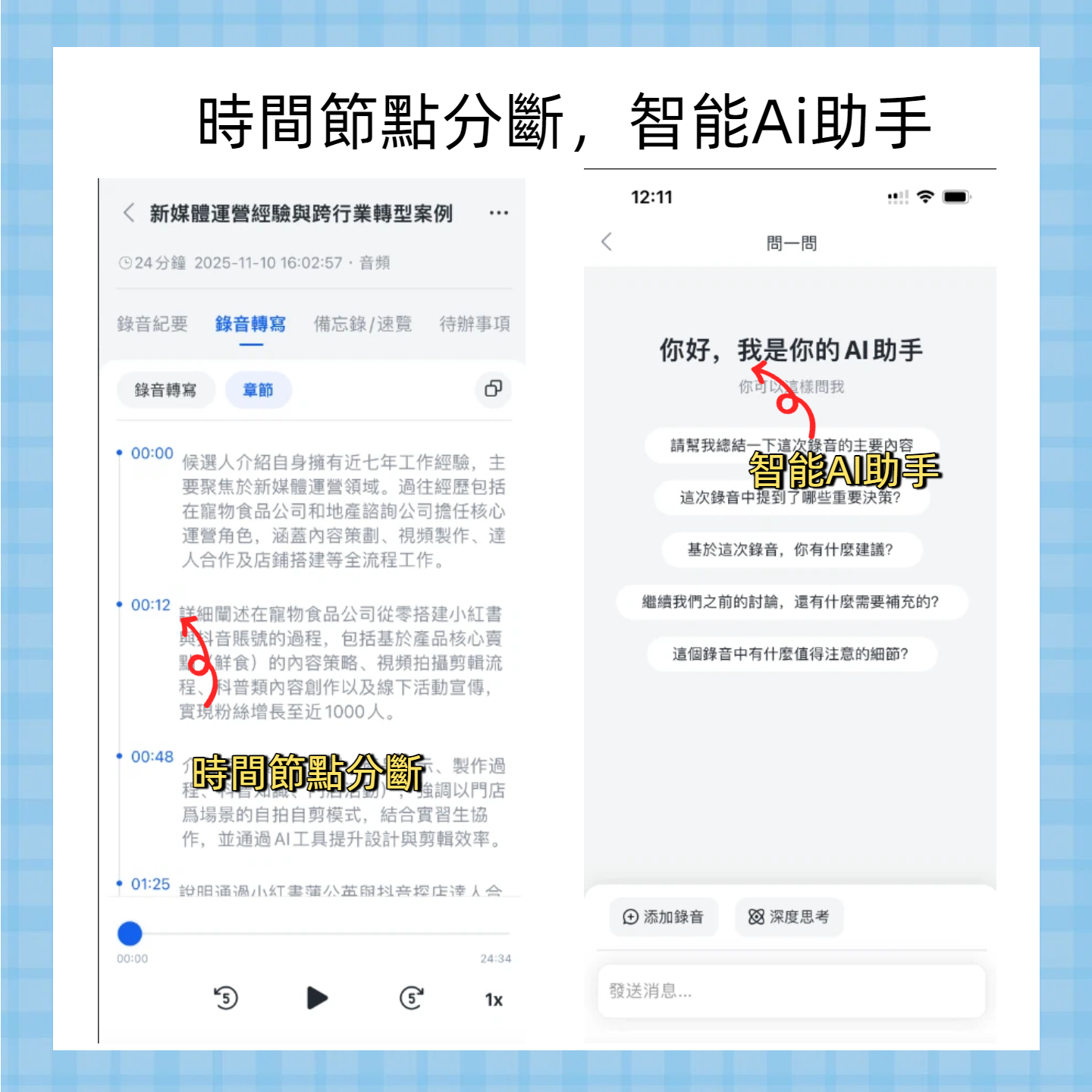
AI Summaries and Chapter Splitting: For a one-hour meeting, Tinrec automatically splits the conversation into chapters like "Project Status Update," "Budget Discussion," and "Action Plan," giving you a brief summary for each so you can grasp the whole picture in three minutes.
Action Item Extraction: "Ming handles vendor communication, Ya sends the quote by Friday"—responsibilities scattered throughout the conversation are automatically extracted into a to-do list that you can copy directly into your task management software.
AI Conversation Query: Recording isn't the end—Tinrec acts as your personal meeting database. You can ask it questions like "What were the three requirements the client mentioned last time?" or "Was the key reason for the project delay mentioned?" It searches the conversation semantically to find answers.
Multi-Format Export: Meeting notes can be exported as documents, presentation outlines, or tables, and directly placed into Google Docs or Notion for further editing—no more copy-pasting.
Practical Use Cases
Scenario 1: Google Meet Project Meetings
You share your screen on Google Meet to review project progress with your team. Before the meeting, start Tinrec's desktop recording feature to capture the entire discussion. Afterward, you get a note with summaries, action items, and a full transcript, ready to send to all attendees—no manual note-taking needed.
Scenario 2: Online Course Learning
You attend an online lecture via Google Meet, and the speaker shares many key points. Record the audio with Tinrec, then use the AI summary to review quickly. You can even extract the book list and tool list mentioned by the speaker, saving you time from manual note-taking.
Scenario 3: Client Interviews or Requirements Gathering
You discuss new project requirements with a client over Google Meet, and the conversation is full of details. After Tinrec records it, you can ask it directly: "What are the three most important features for the client?" or "Was the budget range mentioned?" This turns what would be a two-hour listen into a five-minute exportable requirements document.
Scenario 4: Personal Knowledge Management
You record weekly team meetings, external lectures, and even brainstorming sessions, but over time, all those audio files just sit on your hard drive. Import these historical recordings into Tinrec, and everything becomes a searchable, queryable database—essentially building a digital brain that never forgets.
What to Look for When Choosing an Audio-to-Text Tool
Language Coverage and Accuracy
First, check how well the tool supports the languages you commonly use. Some services focus only on English and struggle with Chinese-English mixing. Tinrec has special optimizations for Chinese (including Traditional Chinese), making it more suitable for teams in Taiwan.
AI Processing After Transcription
The era of just getting a transcript is over. What you really need are summaries, key points, and action items—those are the real time-savers. Tinrec offers conversation queries and report generation after transcription, turning meeting notes directly into working documents.
Export and Integration Flexibility
If the processed data is locked inside the app, its usefulness is halved. Check whether the tool can export to formats you're used to, and whether it syncs with Notion or Google Docs. This determines if it fits into your existing workflow.
Cross-Platform and Recording Sources
Make sure the tool supports mobile, desktop, and web versions, so you can record the same way whether you're in a meeting room, on the subway, or using a laptop. Tinrec has iOS, Android, and web versions fully covered—no worries about switching devices.
Free Plan Sufficiency
If you only need to organize meeting notes occasionally, start with a free plan. Tinrec offers 100 minutes of transcription per month, including AI summaries and action items, perfect for trying before committing.
Final Thoughts: Is Tinrec Worth Trying?
If you're tired of organizing notes after every Google Meet, Tinrec is one of the few tools on the market that completes the entire "record → organize → act" process in one go. It not only saves you time from replaying recordings and manually typing transcripts but also lets you query and track past discussions anytime, ensuring no meeting point is missed.
Especially for teams with many Chinese meetings, needing cross-device recording, or wanting a ready-to-use action list after meetings, Tinrec is far more effective than relying solely on Google Meet's built-in features. I suggest you download the free version of Tinrec and test it on your next Google Meet—seeing is believing; five minutes will show you the difference.
Turn every recording into actionable outcomes
Get 60 free transcription minutes when you sign in. No credit card required.
Related Reading
You might also like

2026 Tinrec vs Google Meet: A 5-Dimension Comparison – Which Is the Top Choice for Student Meeting Recording?
Searching for whether Google Meet or Zoom is cheaper? A student's real-world test shows price isn't the key – meeting notes and organization efficiency are what really matter. Tinrec not only transcribes audio to text but also auto-generates summaries, to-do lists, and AI Q&A, far surpassing built-in transcription features.

2026 Google Meet vs Teams: A 5-Dimension Comparison, Tinrec Tops for Meeting Notes
Google Meet and Microsoft Teams offer similar features, but the real pain point is post-meeting note organization. After hands-on testing of both platforms, this article recommends a more efficient speech-to-text workflow centered on Tinrec, with side-by-side comparisons to Otter.ai and Notta, plus a pitfall avoidance guide and selection tips.

How to Record Google Meet Meetings and Convert to Text in 2026: Real-Time Transcription & AI Summary Generation
After recording a Google Meet meeting, how can you quickly organize it into text and key points? This tutorial tests two popular tools, telling you which is best for Chinese meetings, whose AI summaries are most accurate, and whether the free plans are sufficient.

2026 Hands-on Review of Two Online Meeting Tools: Google Meet vs Teams – Tinrec Essential for Student Note-Taking
A senior student tests Google Meet and Microsoft Teams to see which is better for online classes and group discussions, plus how Tinrec simplifies meeting notes with its free version.

2026 Google Meet & Zoom Meeting Notes Alternative: Why I Switched to Tinrec?
A middle manager with 15 meetings per week shares real experience: from Google Meet's built-in transcription to Zoom meeting notes, finally choosing Tinrec. It handles not only meetings but also online videos and audio files in one place.

2026 Google Meet vs Microsoft Teams Complete Guide: Comprehensive Comparison of Features, Integrations, and Pricing
Which is better for Hong Kong office workers, Google Meet or Microsoft Teams? We break it down across five dimensions: meeting features, ecosystem integration, pricing, security, and ease of use, so you can stop worrying.
Google Meet Time Limits 2026: AI Recording & Note-Taking Tips for Students
Google Meet's free version only allows 60-minute sessions. This guide shares my experience using AI recording tools to bypass the time limit, from free options to cost-effective upgrades, helping you record lectures, get transcripts, and create summaries without the hassle.
Google Meet vs FaceTime: Which is Better? 2026 Real-World Test with Tinrec for Complete Meeting Notes
Are you torn between Google Meet and FaceTime for online meetings? This article tests both across 5 dimensions—transcription, AI summaries, to-do lists, and more—and shows why adding Tinrec makes meeting notes more complete, boosting team productivity.

2026 Google Meet vs WhatsApp: A 5-Dimension Showdown for Better Meeting Notes
Tired of spending hours transcribing meeting recordings? This article compares built-in features of Google Meet and WhatsApp for note-taking, then introduces Tinrec, a professional AI-powered audio/video organizer, to help you find the ideal workflow.