

Turn recordings into transcripts and summaries in minutes
Upload audio or video for multilingual transcription, AI notes, and action items
Two hours on Google Meet, another two hours organizing notes? Time for a change.
In my last Google Meet, we discussed progress on three projects. After it ended, I stared at the recording file and felt a sinking feeling—another afternoon spent replaying, typing, and extracting key points.
Worse, some discussions happened in the chat as text, so the recording didn't capture them at all. Relying solely on the video would mean missing crucial information.
If you've been through this, this article is for you.
Before transcribing Google Meet, understand these 3 key points
Key 1: Transcription is just the beginning; organizing is the real pain
Many people think a transcription tool solves everything, but after getting a long transcript, you still have to read it and find the highlights. What really saves time is a tool that automatically summarizes, extracts action items, and lets you ask questions after transcribing.
Key 2: Cross-platform matters
Today you join Google Meet on your laptop; tomorrow you might quickly review a recording on your phone. If the tool only works on a computer, that's a problem.
Key 3: Accuracy for Chinese content
Not all transcription tools handle Chinese well, especially mixed Chinese and English in business meetings. Choose one with strong Chinese support to avoid garbled text.
Tinrec (MiaoTing) — My hands-on experience using it to organize Google Meet meetings
Tinrec is an AI recording and audio/video organization tool available on iOS, Android, and web, supporting 14 languages including Chinese and Cantonese. It's not just a meeting recorder; it's like a post-meeting organizer.
My Google Meet recording flow
Before a Google Meet, I open the Tinrec web app on my computer or use the mobile app. When the meeting starts, I tap "Record."
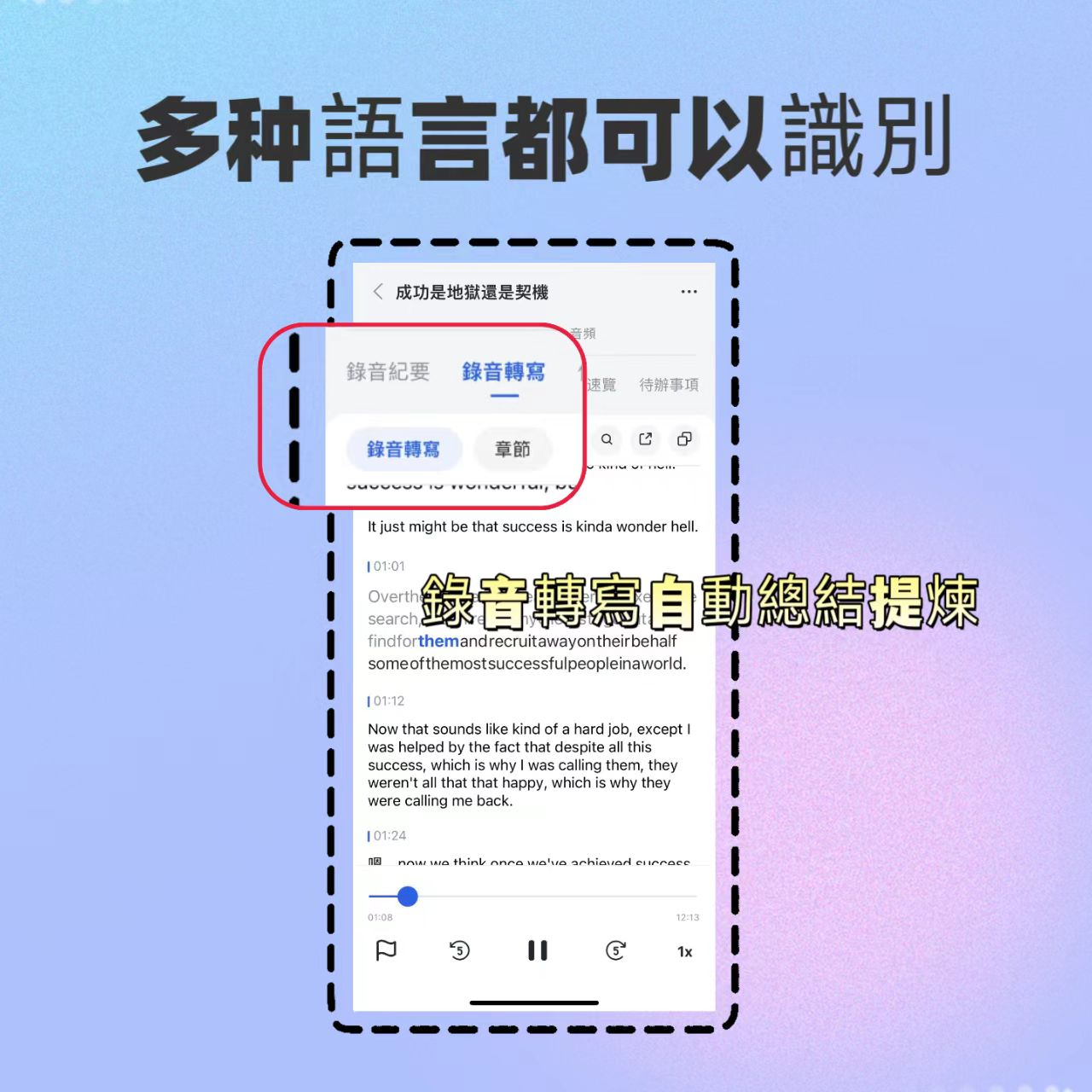
It transcribes speech to text in real-time, displaying the transcript on screen. If someone mentions an important decision, I can tap "Mark" to have Tinrec save the moment.
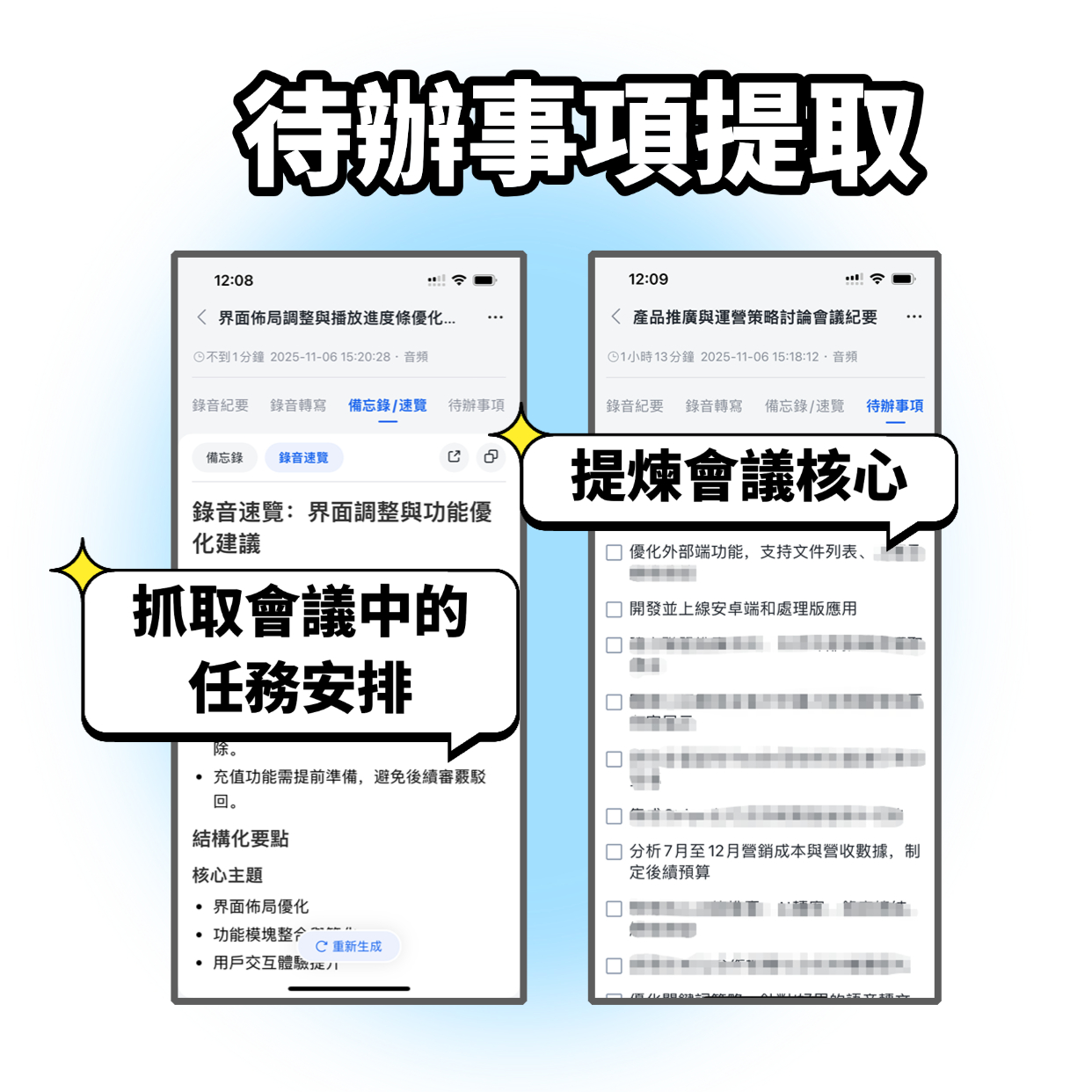
After the meeting, no need to replay the video. I open the recording and Tinrec has already generated a summary, chapters, and action items.
Using AI chat to mine meeting gold
The AI chat feature amazed me most. I can type questions like: "Who proposed the budget change in the last meeting? What did they say?"
Tinrec doesn't just return keyword search results; it understands the context and directly answers. No competitor at this price point offers this.
Prompt templates: Try asking Tinrec like this
Copy these questions and paste them into Tinrec's AI chat:
- "Find all parts mentioning 'delay' and summarize the reasons."
- "List today's decisions, each with the responsible person."
- "What are the main topics in this meeting? How much time was spent on each?"
Stop organizing recordings by hand
Upload audio or video and automatically get a transcript, summary, and action items
Tinrec's limitations
The free plan offers 100 minutes per month. Heavy meeting users may need Pro, but for most people with 2–3 Google Meets per week, it's sufficient.
If you need automatic multi-participant joining with speaker labeling, that's still manual (team features are in development). But in my experience, post-meeting AI Q&A is actually more flexible than real-time labeling.
Alternatives to Tinrec
Google Meet built-in transcription
Google Meet has live captions and transcription, but accuracy is average, and it doesn't generate summaries or action items. If you just need to see captions, it works; but if you want a ready-to-use record after the meeting, Tinrec is more complete. Also, Google Meet's built-in notes don't support semantic Q&A.
Otter.ai
Otter is a powerhouse for English meetings, with 300 minutes free. But it doesn't support Chinese—if your Google Meet is primarily in Chinese, Otter isn't suitable. The only scenario where I'd recommend Otter: purely English meetings with no need for AI chat queries.
Notta
Notta also offers multi-language transcription and meeting notes with a similar interface. However, Notta's strength is translation and captions; for post-meeting organization, Tinrec's AI summaries and task extraction are more intuitive, and its direct AI chat queries are something Notta lacks.
Pitfall guide: 3 common mistakes when choosing a Google Meet note-taking tool
Pitfall 1: Focusing only on free minutes, ignoring organization features
Many tools boast hundreds of free minutes but only give you a transcript. You still have to read it yourself. What really saves time are features like automatic summaries and action items, which Tinrec offers.
Pitfall 2: Overlooking cross-platform needs
Today you join Google Meet on a laptop; tomorrow you might review a recording on your phone. Choose a tool available on iOS, Android, and web so you're not tied down. Tinrec has all three.
Pitfall 3: Misunderstanding AI chat as just a search function
Some people underestimate AI chat thinking it's just keyword search. But it understands semantics—ask "What were the meeting conclusions?" and it gives you a summary, saving you half an hour of manual transcript scrolling. Remember to use prompt templates.
Conclusion: Which tool should you use for Google Meet?
If your Google Meet is primarily in Chinese and you want instant summaries, action items, and the ability to query meeting content like an assistant, Tinrec is the best choice right now.
- Need auto-summary + action items → Tinrec
- Need AI chat to extract key points → Tinrec
- Need cross-platform (mobile + desktop) → Tinrec
- Pure English meetings, only need transcription without organization → Otter.ai
- Just want live captions → Google Meet built-in
I recommend trying Tinrec's free version (100 minutes per month) to experience AI-powered meeting organization. Upgrade only if you find it useful; no need to rush.
Quick start guide: 6 steps to handle Google Meet meetings with Tinrec
- Sign up for Tinrec: Register a free account via the mobile app or web.
- Start recording: Before your Google Meet, open Tinrec and tap record (or upload a recording file after the meeting).
- Mark while meeting: Tap "Mark" or add comments when you hear important points.
- Get AI summary: Right after the meeting, view the auto-generated summary and action items.
- Use AI chat to dig deeper: Enter prompt questions to extract specific conclusions or details.
- Export and share: Export the summary and action items as PDF, Word, or sync to Notion.
Test step by step, and you'll master this easier way to handle meeting notes.
Turn every recording into actionable outcomes
Get 60 free transcription minutes when you sign in. No credit card required.
Related Reading
You might also like

2026 Comparison of 4 AI Meeting Summarizers: From Free to Pro, All You Need to Know
Tired of spending hours after meetings to write notes? AI tools can now auto-generate summaries and action items. This article compares 4 popular AI meeting summarizers—from free tiers to core features and use cases—to help you find the perfect assistant.

2026 AI Meeting Notes Tools: The Complete Guide – Our Top Pick After Testing Saves 50% Note-Taking Time
As a mid-level manager attending 15 meetings a week, I tested several AI meeting notes tools and recommend Tinrec (Instant Recording) as the top choice. This article starts from real workplace pain points, helps you understand selection criteria, dives into Tinrec's core features, and compares other options and common mistakes, to help you find a solution that truly saves time on meeting notes.

Free Speech-to-Text Solutions for 2026: 5 Tools Compared
Struggling with post-meeting transcripts? Find the right tool is key. This article reviews 5 speech-to-text apps, spotlighting why Tinrec is our top pick, along with comparisons of other free options.

The Complete Guide to Audio-to-Text in 2026: Features, Steps, and Tinrec vs Notta Comparison
Want to convert audio recordings to text? This article compares Tinrec and Notta in real-world tests, covering transcription quality, AI features, pricing, and cross-platform support to help you choose the best speech-to-text tool.

2026 Tinrec vs Notta: A 5-Dimension Showdown – Which One Boosts Chinese Meeting Efficiency?
Struggling to keep up with meeting notes? This article compares two major AI meeting efficiency tools, Tinrec and Notta, across five dimensions: core features, Chinese language support, post-processing, pricing, and real-world applications. Find out which tool best boosts your meeting productivity.

Tutorial: AI Agent Structured Output in 2026 – Generate Meeting Minutes and To-Do Lists Automatically with Tinrec
Still manually compiling meeting notes and to-do lists? This article introduces AI Agent structured output, using Tinrec voice recording as an example to show you how to generate meeting minutes, action items, tables, and other deliverables with one click, saving you time.

2026 AI Meeting Assistant Comparison: Tinrec, Otter.ai, Fireflies.ai, Notta – Which Saves You the Most Effort?
The most time-consuming part of meetings isn't the meeting itself, but the post-meeting cleanup—organizing notes and extracting action items. This article tests four AI meeting efficiency tools: Tinrec, Otter.ai, Fireflies.ai, and Notta, comparing transcription accuracy, AI summaries, cross-platform support, and more. Find out which free version is sufficient and how to avoid common pitfalls when choosing.
A Complete Guide to AI Agent Step-by-Step Processing in 2026: Features, Use Cases, and Tool Selection
A curated list of 5 AI Agent tools to help you process recordings, videos, and meetings step by step—from transcription to summaries—with selection recommendations.
2026 Comparison of 3 AI Agent Recording Tools: Which One Turns Audio into Action Items?
It's not just about converting speech to text—it's about AI that helps you organize key points, to-dos, and even generate meeting minutes and reports. Esor tests three tools and shares why he chose Tinrec.