

Turn recordings into transcripts and summaries in minutes
Upload audio or video for multilingual transcription, AI notes, and action items
I've noticed recently that more and more people in team meetings are using Google Meet's Companion Mode.
Everyone opens the meeting on their own laptop but doesn't join the audio—instead, they use the conference room microphone and speakers. This way, the screen is clear, and there's no echo.
But here's the problem: after the meeting ends, who organizes the content?
The recording sits on your phone, untouched for months.
Even if you want to listen again, a one-hour meeting takes that long again to find the key points, and in the end, you'll ask a colleague, "What was that decision we made last time?"
So I started thinking: can we use a method to transform meetings in Companion Mode from "listen and forget" to "actionable after the meeting"?
Below is a workflow I put together after testing, along with tool recommendations, so you can turn meeting content into truly usable information with minimal effort.
Why You Need Recording & Organization When Using Google Meet Companion Mode
Companion Mode solves the conflict between conference room hardware and personal devices, but it doesn't handle recording.
Decisions, action items, and ideas from meetings—if you don't type them out on the spot—tend to vanish with the sound.
To make matters worse, modern meetings aren't limited to just one platform. Besides Google Meet, you might have client interviews on Zoom, online course discussions on Teams, or even need to review public lectures on YouTube.
That's why I've picked out several recording-transcription tools with different focuses, from AI meeting assistants to hardware voice recorders, to help you find the best fit.
Option 1|Tinrec (Seconds Recorder) – The Most Complete AI Recording Assistant
If you're like me and often accumulate audio/video material across different platforms and scenarios, Tinrec is the tool that can best help you sort through the chaos.
It's not just a recording app; it's more like an "audio/video workspace."
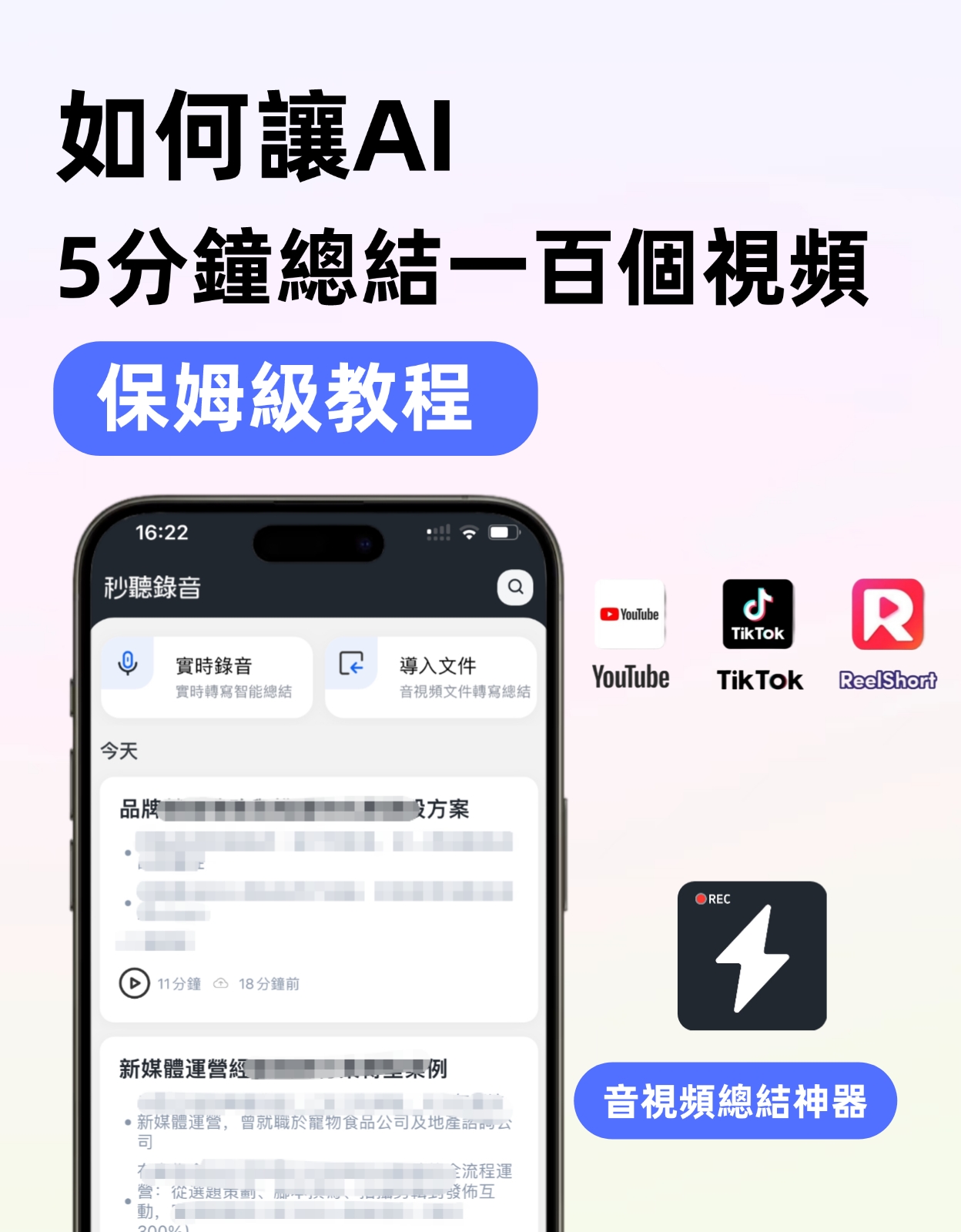
(Screenshot: Tinrec main interface showing real-time recording, file import, URL pasting, with arrows pointing to multiple input sources)
Real-time speech-to-text: During a meeting, open Tinrec and it will transcribe in real time while recording—Companion Mode audio is captured clearly.
Direct organization of online videos: What impressed me most is that you can paste links from YouTube or Xiaohongshu, and it will automatically grab the audio, transcribe it, and generate a summary. This is very useful for people who need to digest large amounts of information.
(Screenshot: After pasting a YouTube link, auto-generated summary and chapters, with arrows pointing to "AI Summary" and "Chapters")
AI conversation queries: Transcription is just the first step. Tinrec allows you to ask questions about the recording, like asking a colleague: "What are the three key points about the budget adjustment mentioned in the last meeting?" It will find the answers directly from the recording.
(Screenshot: AI Q&A interface showing a question and relevant paragraph responses, with arrow pointing to the question box)
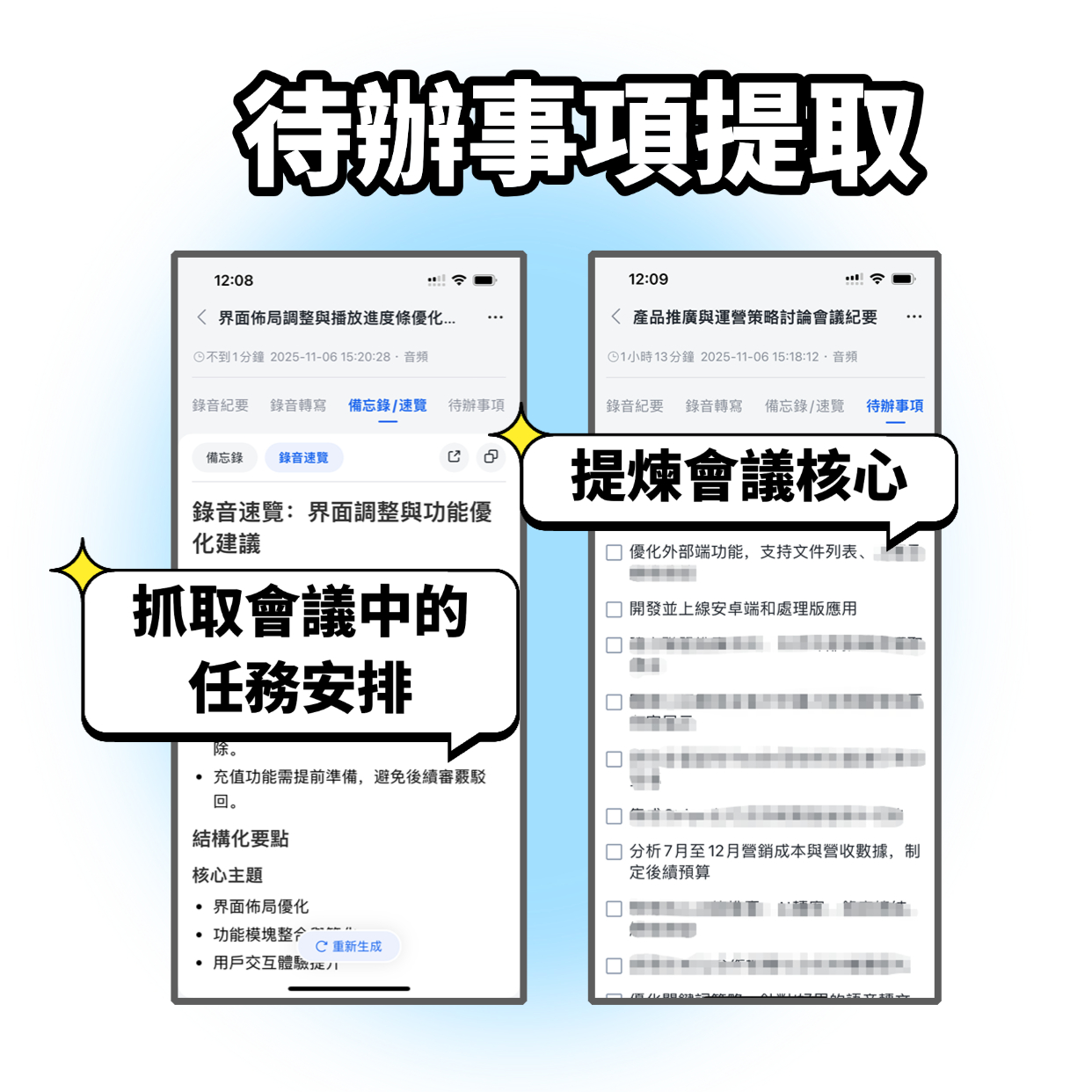
Comprehensive export: Summaries, to-do lists, even meeting minutes—all can be exported to documents or synced to Notion, Google Docs with one click.
(Screenshot: Export menu showing TXT, DOCX, PDF options, with arrow pointing to "Export")
In terms of pricing, Tinrec offers a free version for trial. For higher minute quotas or AI features, there are weekly, monthly, and annual plans. It's suitable for meetings, classes, interviews, content creation, and any scenario where you need to turn audio/video into actionable information.
Stop organizing recordings by hand
Upload audio or video and automatically get a transcript, summary, and action items
Option 2|Otter.ai – The Classic Choice for English Meeting Notes
Otter.ai is a long-established online meeting note taker, strong in automatically joining Google Meet and Zoom, with real-time transcription and speaker identification.
Compared to Tinrec, Otter is more focused on the "pure meeting" scenario, with excellent English recognition, but for Chinese content organization, it's not as thorough as Tinrec.
Core features include meeting summaries, action items, and team collaboration. The free plan offers 300 minutes per month. Pro costs about $8.33/month billed annually. Suitable for teams that primarily have English business meetings.
Option 3|Notta – A Flexible Solution for Multilingual Transcription
Notta's positioning is quite similar to Tinrec: it supports multi-device recording and audio file transcription, with a standout translation feature.
However, Notta leans more towards "quick transcription and subtitles." If you only need verbatim transcripts and basic summaries, it does the job well. But Tinrec goes further in post-transcription knowledge organization, such as AI conversation queries and cross-source database concepts, which Notta lacks.
The free plan offers 120 minutes per month. Pro costs about $8.17/month billed annually. Suitable for those who frequently need multilingual transcription but with simpler organization needs.
Option 4|Fireflies.ai – The Bot That Automatically Joins Meetings
Fireflies.ai is like a meeting bot that automatically joins your Google Meet, Teams, etc., to transcribe and summarize, even highlighting action items.
Its strength lies in automation and claims of unlimited transcription, but the organized content is harder to freely query or reprocess. In contrast, Tinrec feels more like your personal audio/video knowledge base, not just a meeting recorder.
The free plan has basic features. Pro costs $10/month billed annually. Suitable for teams that rely heavily on meeting automation and often use CRM or other business integrations, like sales teams.
Option 5|Google Meet Built-in Transcription – Zero-Budget Basic Option
If you only use Google Meet and your needs are very simple, you can try the built-in live captions and transcription feature.
No extra installs needed; you can see captions during the meeting and get a text transcript afterward. But this feature is limited to Google Meet meetings—you cannot import other audio files or online videos, and there are almost no organization tools.
It's free, but best used as an "emergency" memo.
With So Many Options, How Do You Choose?
• For the most complete AI features (transcription + AI conversation queries + auto-minutes) → Tinrec (the only tool that handles meetings, files, and online videos, and lets you query content)
• For Chinese meeting organization and cross-device use → Tinrec (works on iOS, Android, and web; summaries and to-dos are especially practical in Chinese contexts)
• Zero budget, occasional transcription needs → Google Meet built-in transcription (but only for your own meetings)
• iPhone-only, need a portable hardware recorder → PLAUD NotePin (no AI conversation queries, requires separate purchase)
• English-first, team collaboration priority → Otter.ai or Fireflies.ai (but be aware of limited Chinese organization)
3 Things to Know Before Using Recording-Transcription Tools
1. Recording quality determines transcription quality
Companion Mode reduces echo, but in a noisy meeting room or with multiple conversations, the text may still have errors. Use Tinrec's real-time transcription to monitor, and move closer to the audio source if needed.
2. AI summaries are summaries, not verdicts
AI can quickly catch key points, but for critical decisions, you should still double-check the original content. Tinrec's AI Q&A can help you verify—don't treat summaries as the only truth.
3. The tool should integrate into your workflow, not be another app
When choosing a tool, first ask: "What will I do with the transcription?" Tinrec's export and post-processing features are designed to solve the "transcribe and forget" problem.
Summary
Google Meet Companion Mode makes meetings smoother, but only with the right organization tool can you turn meeting content into your knowledge asset.
Among the tools I tested, Tinrec comes closest to my vision of an "audio/video workspace," especially for people like me who need cross-platform, cross-source capabilities and want to keep digging into content after the meeting.
Test step by step, and you'll gradually master this method.
Quick Start Checklist:
- Confirm your main meeting platform and recording needs (pure meetings? or including courses and videos?)
- Start with Tinrec's free plan; transcribe one meeting to experience the workflow
- Try pasting a YouTube link into Tinrec to experience online video parsing
- Learn to ask questions about the recording to find the key points you need
- Set an export destination to automatically sync data to your preferred note or document tool
Turn every recording into actionable outcomes
Get 60 free transcription minutes when you sign in. No credit card required.
Related Reading
You might also like
3 Best Recording-to-Text Apps for Students in 2026: Which One Rules for Online Class Notes & Podcast Summaries?
Struggling to choose a recording-to-text app for lectures, online classes, or podcast notes? This article compares 3 top tools from real study scenarios and dives into how Tinrec turns recordings into real learning assets.

Tinrec vs Otter 2026: A 5-Dimensional Comparison – Which Is the Best Free Recording Tool for Students?
A senior MIS student tests Tinrec and Otter in 5 key areas—classroom recording, Chinese speech recognition, cross-platform support, and more—to find the best free recording app for students.

Tinrec vs Otter.ai in 2026: A 5-Dimensional Comparison – Which Is Better for Chinese Speech-to-Text?
Choosing the best speech-to-text software in 2026? This article provides a hands-on comparison between Tinrec and Otter.ai across five key dimensions: real-time transcription, AI summaries, Chinese language support, and post-processing applications, helping you decide which tool truly turns audio into usable knowledge.

Tutorial: 2026 Speech-to-Text Tools with AI Query & Auto To-Do – Say Goodbye to Overtime for Meeting Notes
Tested 5 speech-to-text tools from a mid-level manager's perspective to show how AI recording assistants save meeting cleanup time. This article deeply analyzes Tinrec's core features, pros/cons, and competitor comparisons, plus buying tips and pitfalls to avoid.

2026 Complete Guide to Meeting Note Apps for College Students: Easily Handle Class Notes and Group Discussions with AI Voice-to-Text
College students need to efficiently organize class highlights and meeting notes? This guide shares hands-on experience on how AI meeting note apps save time and boost learning efficiency, using Tinrec as an example to illustrate real-world applications and key buying tips.
2026 Real-World Test: Hardware Voice Recorder vs. Mobile App – Which Is Better for Taking Notes?
Who says students have to buy a voice recorder? We compare PLAUD NOTE and Tinrec in real-world tests, covering cost, features, portability, Chinese transcription, and post-class organization, showing you why using an app is actually more cost-effective.
2026 Free Speech-to-Text Plans for Students: A Side-by-Side Comparison of 2 Tools
Which free speech-to-text tool is best for students? This article compares Tinrec and Notta across online video transcription, AI Q&A, output richness, and Chinese language optimization to help you find the best free plan for classes, lectures, and self-study.

How to Turn Meeting Recordings into Documents in 2026? 5-Step AI Transcription Tutorial
Tired of meetings all day and then working overtime on meeting minutes? Use Tinrec, an AI transcription tool that automatically turns live recordings, files, and online videos into transcripts, summaries, and to-do lists. Learn 5 steps from recording to a complete meeting document, saving 90% of your time!

2026 Tinrec vs Notta: A Deep 4-Dimension Comparison – Which One is Worth Choosing?
Looking for a speech-to-text tool but feel like Notta is missing something? This comparison breaks down the two from four dimensions—input sources, AI organization, Chinese optimization, and free plans—to help you decide which is the better fit for US users in 2026.