
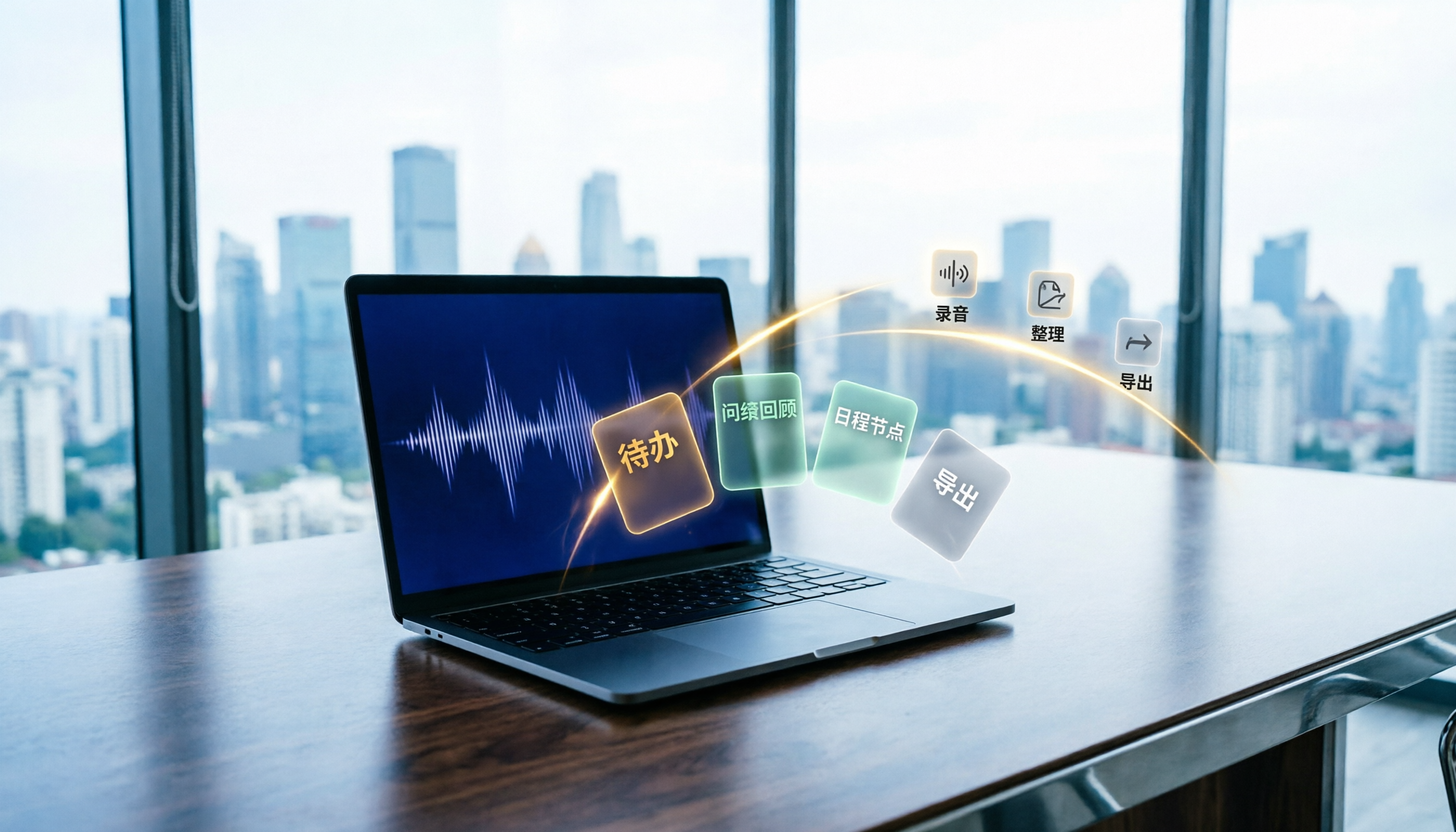
Turn recordings into transcripts and summaries in minutes
Upload audio or video for multilingual transcription, AI notes, and action items
Have you ever had this experience: a meeting ends, you feel like you took good notes, but three days later you open your notebook and can't understand what you wrote. Worse, you've completely forgotten the action items you promised.
I used to be the same. I'd scribble furiously during meetings, then set the notes aside. By the next meeting, I'd realize many things never got done.
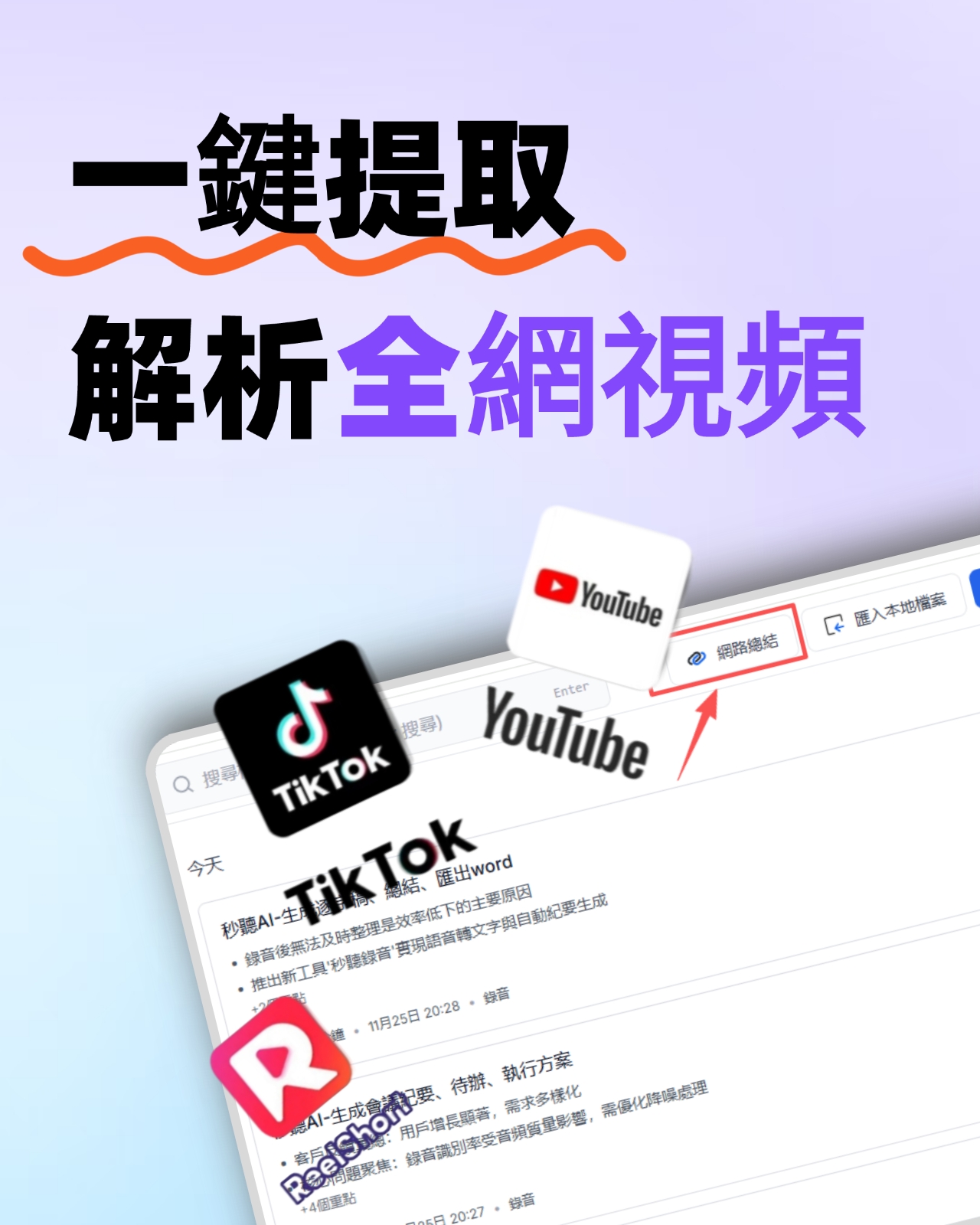
Later, I started researching how to use AI for meeting follow-ups. Not just converting recordings to text, but having AI automatically organize to-dos and key points, and being able to ask questions like "What was the decision we discussed last time?"
In this article, I'll share a four-step meeting follow-up method, along with insights from testing two AI recording tools I've been using recently—Tinrec (秒聽錄音) and PLAUD Note.
But first, a disclaimer: this isn't a feature comparison. Rather, if you want to solve the pain point of post-meeting follow-ups, it's about which tool fits your workflow better.
Tinrec vs PLAUD Note: Quick Overview
Both tools focus on recording-to-text and AI organization, but their design philosophies are completely different.
- PLAUD Note: A standalone AI recording hardware device. You start recording with a physical button, then process and organize via the mobile app after recording.
- Tinrec: A pure software tool that works on phone, computer, and web. It turns recordings, online meetings, and even web videos into organized text data.
Price-wise, PLAUD Note Pro hardware pre-order is about $179 USD, including 300 minutes of transcription per month. Additional minutes require an annual subscription. Tinrec has a free trial, and its Pro monthly/yearly plans are suitable for long-term users—no hardware purchase needed.
Next, I'll compare their real-world performance across four steps.
Step 1: Record Smart
The first hurdle in meeting follow-up is the recording itself. If recording is a hassle, nothing else matters.
PLAUD Note: Portable Hardware, Press to Record
PLAUD Note's strength is the hardware experience. It's slim and light, clips onto your notebook or hangs around your neck. Press the button before a meeting and it starts recording. Battery life is long, so you won't worry about it dying mid-meeting.
But its problem also comes from hardware: you have to remember to bring it and charge it. I've arrived at the meeting room only to realize I left it at home multiple times. And for online meetings, you still need to record on your phone or computer, making PLAUD an extra device.
Tinrec: No Extra Gadgets Needed
Tinrec doesn't rely on hardware. Open the mobile app and start recording; desktop web version works the same. Crucially, it can capture system audio directly, so online meetings (Zoom, Google Meet, Teams) don't need additional cables.
This makes a big difference in continuity for meeting follow-ups—you just start recording, and when you're done, everything stays in the same platform for organization. No need to transfer files from hardware.
(Screenshot: Tinrec's real-time recording and transcription interface, with text appearing as you record)
Verdict: Tinrec is more flexible—no hardware to buy, one-click start for both in-person and online meetings.
Step 2: Auto-organize To-dos and Key Points, Not Just a Transcript
Recording is just the first step. The real pain is sorting out "who needs to do what" after the meeting. This is where AI shines.
PLAUD Note: Summaries and Templates, But To-dos Require Manual Extraction
PLAUD Note's app generates AI summaries and offers a few meeting templates. But the output is usually chunks of text, not directly extracted action items.
That means you still need to read the summary and write down action items yourself. That's a gap from my goal of having AI directly produce a to-do list.
Stop organizing recordings by hand
Upload audio or video and automatically get a transcript, summary, and action items
Tinrec: Directly Extracts To-dos, with One-click Tagging
After transcription, Tinrec gives you a "Tasks" page in addition to summaries and sections. It automatically pulls tasks from the conversation, tagging responsible people and timestamps.
I tested it on a 30-minute project meeting. Tinrec extracted 8 tasks with high accuracy. I could check them off or edit them right there, without switching to another note app.
(Screenshot: Tinrec's task list, with arrows pointing to auto-extracted action items)
Verdict: Tinrec is clearly better for this, because extracting actions is a core feature, not an add-on to summaries.
Step 3: Ask Questions About Meeting Content Later, No More Fuzzy Memories
The biggest fear in meeting follow-up is vague memories of decisions after a week. An AI knowledge base you can query is invaluable.
PLAUD Note: Q&A Feature, But Limited to Single Recordings
PLAUD Note's app also has AI Q&A for the current recording. But it's designed for that single recording. If you have multiple meetings or want to cross-reference topics, you have to switch manually.
And its answers tend to be brief, not great for summarizing long-term trends.
Tinrec: Like a Growing Meeting Knowledge Base
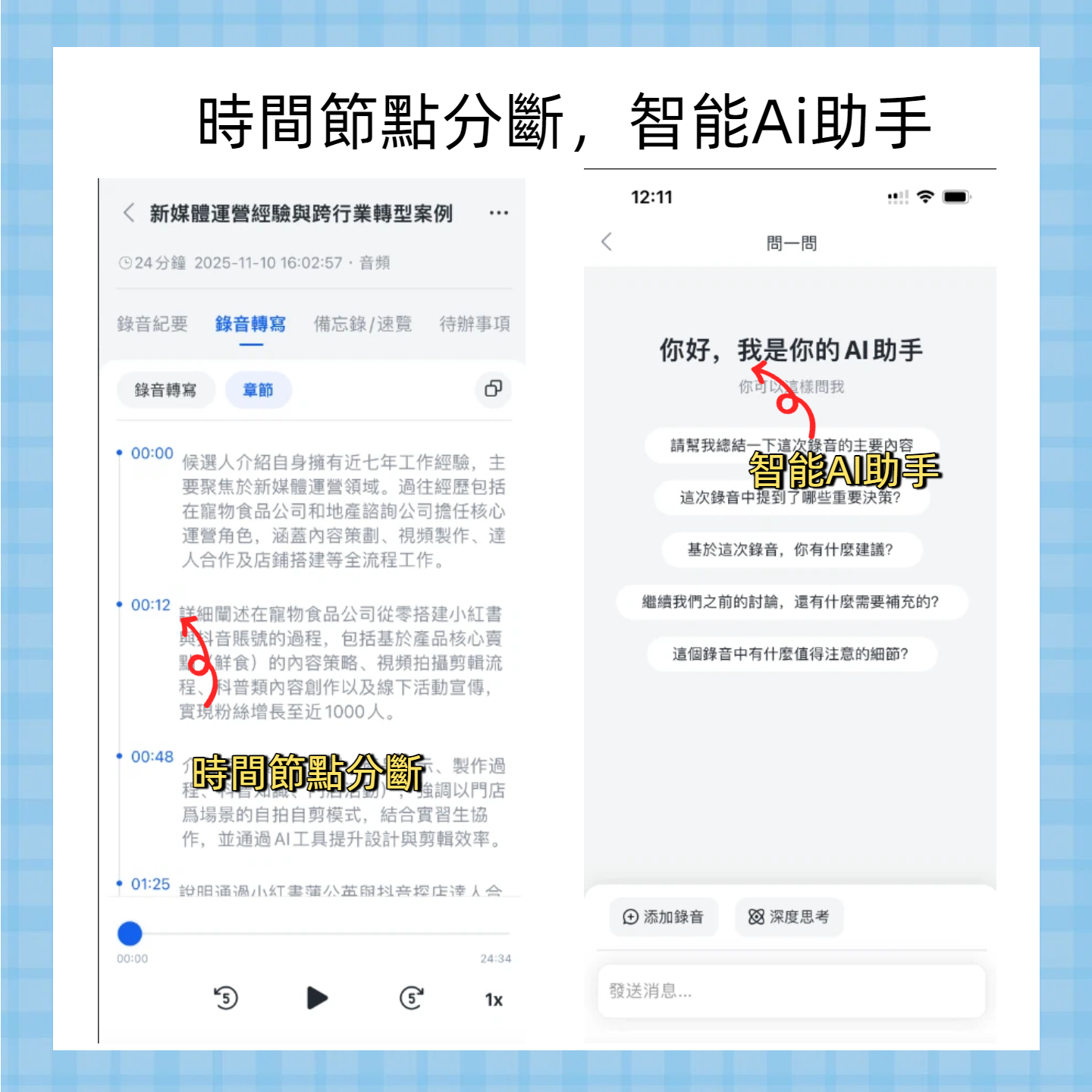
Tinrec's "AI Chat" can query a single recording or cross-reference all your historical recordings. For example, I asked: "From these weeks of meetings, what was the final decision about the product launch?" It compiled context from different recordings.
This is extremely useful for those tracking multiple projects over time. You don't need to flip through transcripts—just ask.
(Screenshot: Tinrec's AI Q&A interface, with a query "What was the marketing timeline discussed last time?" and the answer)
Verdict: Tinrec wins here—its cross-recording query capability makes meeting follow-up a continuous process, not isolated events.
Step 4: Export Results to Other Tools, Integrating Your Workflow
Even if AI organizes well, many people still manage tasks in Notion, Google Docs, or calendars. So export smoothness determines if this method gets adopted.
PLAUD Note: Export Text, But Manual Processing Needed
PLAUD Note can export transcripts and summaries, mostly as text files or PDFs. To turn them into to-do lists or calendar events, you'll have to copy and paste manually.
Tinrec: Multi-format Export, Plus To-do Sync into Your System
Tinrec supports export in Markdown, Word, and plain text. More importantly, it can connect to third-party services. You can set tasks to sync directly to Notion or Google Docs, automating follow-up.
It can even generate more comprehensive meeting notes, reports, or tables, turning them into deliverable documents.
(Screenshot: Tinrec's multi-format export interface, with options including Markdown, Word, etc.)
Verdict: Tinrec is clearly stronger—export isn't the end; it's the start of integrating into your workflow.
Unique Advantages of Each
Tinrec's Unique Strengths
- Unified processing for meetings, courses, and videos: Not just meeting recordings—web videos and audio files can all be organized with the same workflow, increasing the value of your knowledge base.
- Auto-extraction and tracking of tasks: Pull action items directly from recordings, significantly reducing manual post-meeting work.
- Cross-platform, no hardware burden: Works on phone, computer, and web, with easy integration for online meetings.
- Long-term knowledge Q&A: Turns your historical meetings into a searchable knowledge base, ideal for multi-project managers.
PLAUD Note's Unique Strengths
- Great hardware feel and long battery life: If you like a dedicated recording device, you'll appreciate its slim build and quick start.
- Reliable offline recording: Works without a phone or computer nearby—just clip it on and record.
Summary: Which One Should You Choose?
- If you want no extra device to carry and hate realizing you forgot it → Tinrec (software, cross-platform)
- If you want a to-do list ready right after the meeting instead of reading summaries → Tinrec
- If you need to query past decisions across multiple meetings and build a personal or team knowledge base → Tinrec
- If you value the tactile feel of a physical button and you always remember to bring and charge it → PLAUD Note has its place
In a nutshell: For most people who really want to follow up on meetings, Tinrec is the more complete choice. No hardware purchase needed—start with the free plan, run a meeting recording through these four steps, and you'll feel much less post-meeting stress.
Your Quick Start
- Install Tinrec on your phone or computer, and record one meeting.
- After recording, check the generated summary and tasks; verify accuracy.
- Try asking a question about that meeting's recording to test the AI's context.
- Export the tasks to your preferred note or task management tool.
Try it once or twice, and you'll gradually master this meeting follow-up method.
Turn every recording into actionable outcomes
Get 60 free transcription minutes when you sign in. No credit card required.
Related Reading
You might also like

How to Create AI Meeting Minutes in a Word Template (2026 Guide): 5 Steps
Don't want to spend time organizing meeting minutes after a meeting? Use Tinrec's instant voice recording to convert meeting audio into structured Word meeting minutes in 5 steps, automatically extracting action items and key summaries, and export as a Word document. Supports iOS, Android, and web. Free version offers 100 minutes per month to get started easily.

2026 AI Meeting Report Tool Buying Guide: 5 Tested and Recommendations
I tested 5 AI meeting note tools, from free to paid, to help you find the best option for summarizing meetings, classes, interviews, and video content. Who says AI meeting reports are only for meetings? Tinrec might be closer to what you need.
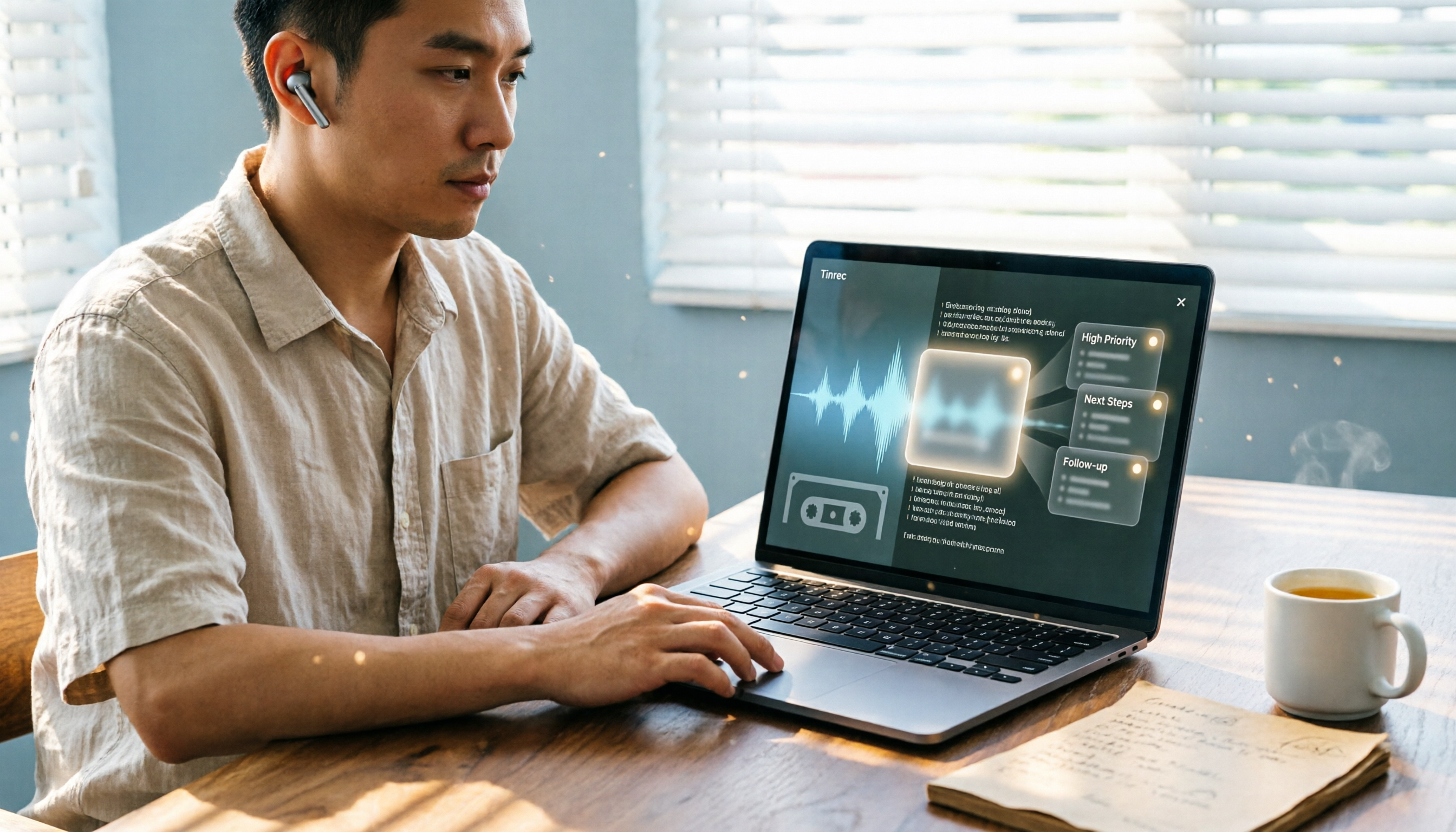
2026 AI Meeting Workflow: 4 Steps to Turn Meeting Recordings into Actionable Knowledge
Spending two hours every time organizing meeting notes? Tried AI tools but found them even messier? This article shares the most effective AI meeting workflow I've tested, from recording, transcription, summary to action management. Step by step, learn how to use Tinrec to turn meeting content into truly usable assets.

2026 Comparison of 3 AI Meeting Note Apps: Which Saves the Most Time with Summaries, Tasks, and Follow-ups?
Two hours in a meeting, another two hours organizing the notes? We tested three AI meeting note tools – Tinrec, Otter.ai, and Notta – on transcription accuracy, AI summary quality, task extraction, and material preparation for follow-up PPTs, to find the best time-saver.

2026 Hands-On Comparison of 5 AI Meeting Management Tools: Which Free Version Is Most Capable?
In 2026, AI meeting management tools are increasing, but which free version is best? This article tests 5 popular tools, comparing features, pricing, Chinese support, and use cases to help you find the best meeting note assistant.

2026 Comparison of 5 AI Meeting Minutes Tools: From Free to Paid, All You Need to Know
This article compares 5 popular AI meeting minutes tools in 2026, including Tinrec, Otter.ai, Fireflies.ai, Notta, and TurboScribe, covering free plans, core features, use cases, and pricing, to help you find the best fit for your meeting and audio/video transcription needs.

2026 Complete Guide to AI-Generated Meeting Minutes: Auto Summaries, Action Items, and Word Export
Still manually taking meeting notes? This article shows you how to use AI tools to automatically generate meeting minutes and export them to Word documents, saving time and effort. From selection criteria to hands-on recommendations, get the full picture.

2026 Meeting Minutes to Word Export Tools Comparison: Which Saves You the Most Time?
Spending hours after meetings formatting Word documents? We tested 4 top meeting minutes tools—transcription, AI summaries, Word export, and cross-platform support—to find the best option for you.

Tutorial: Generate Meeting PPT with AI in 2026 - Tinrec Voice-to-Text + Auto Summarize, Save 2 Hours of Overtime
Still spending time writing meeting minutes and creating PPT after meetings? Use Tinrec to quickly transcribe recordings, automatically generate summaries and to-dos in 5 steps, and pair with AI presentation tools to create a polished presentation in 10 minutes. A must-see for office workers in Central!