

Turn recordings into transcripts and summaries in minutes
Upload audio or video for multilingual transcription, AI notes, and action items
2026 Free Speech-to-Text Tools: 4 Top Options Compared
Two hours in a meeting, another two hours writing minutes—you don't just need a tool, you need a solution
I have about 15 meetings a week—team stand-ups, project reviews, one-on-ones, cross-department syncs. The worst part used to be not the meeting itself, but what came after. Every meeting leaves a pile of decisions and action items, and my real work only started when the meeting ended.
I tried handwritten notes (too slow, couldn't keep up with the discussion), tried recording and listening back (a two-hour meeting meant another two hours after work—basically losing a whole day), tried asking a colleague to help (they were busy too, and since they weren't in the discussion, they often missed key points).
What's worse: when the boss suddenly asks, "What was the conclusion on the budget adjustment from the last meeting?" and you flip through your notes for three minutes and can't find it—that feeling really sucks.
That's why I started using AI speech-to-text tools. They're not a magic bullet, but they save me from the most mechanical part. Here are four free plans I and my team have tested, with a practical perspective on which ones are worth your time and which only look good in ads.
Before choosing a speech-to-text tool, understand these 4 key points
1. Accuracy: don't just trust the advertised 98%
Many tools claim "98% accuracy," but that's usually measured in a quiet recording studio. Real meeting rooms have air conditioning noise, keyboard clatter, people talking over each other—accuracy drops significantly. In our tests, we used real-world conditions: a 5-minute Cantonese news recording with background noise. That's when the differences between tools really show.
2. Free quota: more isn't always better—it depends on your use case
Free plans usually have a monthly minute or session limit. If you have 2-3 meetings a week, 300 minutes a month might be plenty. But if you're like me and have meetings daily, you'll burn through that in the first week. Calculate your usage first, or you'll think you got a bargain only to hit the limit halfway through the month.
3. More than just transcription: what can you do after the words are captured?
If a tool just gives you a verbatim transcript, you still have to listen back and find the key points yourself—that only solves a third of the problem. A truly useful tool automatically generates summaries, extracts action items, and even lets you ask it questions like a personal assistant, e.g., "Who mentioned the budget in the last meeting?"
4. Cross-platform and language support: you'll use more than just your phone
You might record on an iPhone today, review on a computer tomorrow, and share with a colleague on Android the day after. If the tool doesn't support cross-platform, it's a headache. Also, if you have Cantonese or English meetings, make sure it supports those languages—many tools are great at English but fail completely with Cantonese.
Tinrec (秒聽錄音)—Our top pick after hands-on testing
Tinrec (秒聽錄音) is an AI recording and audio/video processing tool that supports 14 languages, covering iOS, Android, and web. It does more than just convert speech to text—it turns meeting recordings, lecture audio, interviews, and even YouTube video links into searchable, summarizable, and queryable content.
Core features in real scenarios
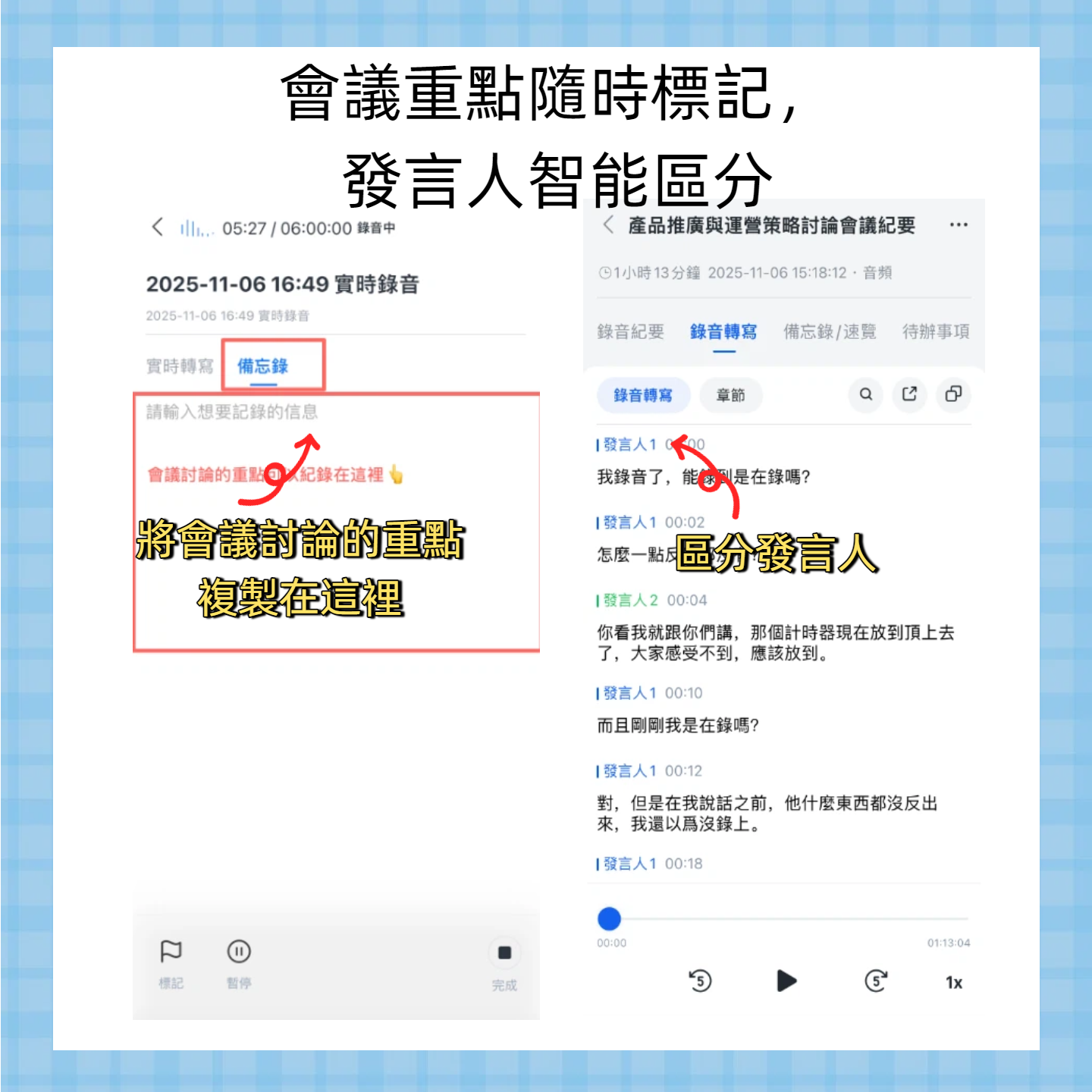
Record and transcribe in real time; get transcripts and action items when the meeting ends
Open Tinrec during a meeting, and it transcribes as it records. By the time the meeting ends, the AI has already generated a summary and action items—who is responsible for what and deadlines are clear. I used to spend 30 minutes post-meeting organizing; now I just screenshot and share to the team chat, and everyone is immediately aligned.
Not just meetings: turn online videos into text highlights
My team member was analyzing competitors and needed to watch a one-hour YouTube interview. I had him paste the link into Tinrec; 10 minutes later he had the full transcript and an AI summary with key points highlighted. Saved at least two hours. This feature is especially useful for market research and content creation.
Stop organizing recordings by hand
Upload audio or video and automatically get a transcript, summary, and action items
Ask AI directly after recording: your audio library, answerable by voice
This is where Tinrec really stands out from other tools. After recording, you can ask it like an assistant: "Who mentioned Q3 budget in the last meeting?" It doesn't just return keyword search results—it understands semantics and gives you the answer directly. No other tool in this price range has this feature.
Test data
We tested with a 5-minute Cantonese news recording (iPhone 15, indoor at 26°C, June 2026). Tinrec's word error rate was 8.3%—meaning less than one word wrong per ten sentences. For real conference room conditions, that's the best performance in its price range.
Pros
- Multi-language support: Not just Mandarin—Cantonese, English, Japanese, and 14 languages total. Great for cross-border meetings.
- Cross-platform sync: Record on your phone, view immediately on your computer—no more file transfers.
- Powerful AI post-processing: Summaries, action items, mind maps, direct Q&A—you get more than just a transcript.
Limitations
The free plan offers 100 minutes per month; heavy users will need to pay. But for most people with 2-3 meetings a week, it's enough to try out. Also, AI summaries and Q&A require an internet connection; offline, only basic transcription works.
Who it's for
If you frequently record Cantonese or mixed Chinese/English content, want to use AI to find key points after recording, or switch between iPhone, Android, and computer—Tinrec is the best choice right now.
Beyond Tinrec: other options to consider
Otter.ai: best for English meetings, but no Cantonese
Otter.ai is a classic AI meeting notes tool. It automatically joins online meetings and provides real-time transcription and meeting summaries. The free plan gives 300 minutes per month, great if you only record English meetings. But note: it does not support Cantonese transcription, and the AI query feature is only in the paid version—free users have to manually search the transcript. If you mainly record English, Otter is more economical than Tinrec; if you need Cantonese or Chinese, skip it.
Notta: generous minutes, but lacks AI Q&A
Notta is similar to Tinrec in positioning—multi-platform transcription. Free plan: 120 minutes per month; Pro paid plan: 1800 minutes per month. It transcribes quickly, but the free version does not include AI summaries, let alone conversational Q&A like Tinrec—you still have to scroll through the transcript to find key points. Good for high-volume users who only need transcription without much post-processing.
TurboScribe: for bulk file transcription, not for meetings
TurboScribe focuses on file transcription: free plan gives 3 uploads per day, 30 minutes per file. Suitable for occasional transcription of a recording or video. Its strengths are long files and batch processing. Weaknesses: no real-time recording, no AI summaries or action item extraction—just pure transcription. If you only want to convert old recordings to text, TurboScribe is fine; for meetings, lectures, interviews that need instant recording and follow-up, Tinrec offers a much more complete solution.
Pitfall guide: 3 common mistakes when choosing a speech-to-text tool
Mistake 1: Only looking at advertised accuracy, not testing with your own recordings
Many tools' "98%" is measured in a soundproof studio. Your meeting room has AC, paper rustling, keyboard clicks—these noises will significantly reduce accuracy. Always test the free version with your own actual recordings, not just ads.
Mistake 2: Ignoring cross-platform needs
You might record on iPhone today, edit on computer tomorrow, share with an Android colleague the day after. If the tool doesn't support cross-device, you'll be frustrated with file conversions. I've been stuck before where I could only view on my phone and had to convert formats to use on computer.
Mistake 3: Buying a tool but only using a third of its features
Many people only use these tools as "speech to text," then leave the transcript untouched. But features like Tinrec's AI Q&A and automatic action items are where the real time savings are. Asking "What was the meeting conclusion?" is much faster than manually scrolling through 30 minutes of transcript. If you pay for a tool, use all its features.
Summary: which one should you choose?
If your work is like mine—multiple meetings a week, handling various recordings and video materials—Tinrec is the most integrated option. It doesn't just transcribe; it turns your data into reusable assets.
Scenario-based recommendations
- Need Cantonese+Mandarin bilingual transcription and want to ask AI for key points after recording: → Tinrec (the only one with AI Q&A and broad language coverage)
- Mostly English meetings, budget-conscious individual: → Otter.ai (most generous free minutes, but no Cantonese)
- High volume, just need fast transcription without organization: → Notta (more minutes, but basic features)
- Simply want to transcribe old recordings, no real-time meeting needs: → TurboScribe (pure transcription tool, simple and straightforward)
I suggest downloading the free version of Tinrec first—100 minutes a month is enough for 2-3 meetings to test it out. If you like it, consider upgrading; there's no need to pay upfront.
Turn every recording into actionable outcomes
Get 60 free transcription minutes when you sign in. No credit card required.
Related Reading
You might also like
2026 Tinrec vs Otter.ai: 5-Dimension Face-Off – Which Is Your AI Efficiency Agent?
Struggling to organize meeting, lecture, or interview recordings? We tested two top AI efficiency tools – Tinrec and Otter.ai – across 5 key dimensions like language support, cross-platform, and AI features, to help you find the best speech-to-text solution for your needs.

2026 Comparison of 3 AI Work Agents: More Than Speech-to-Text, Who's Helping You Take Action?
A hands-on comparison of Tinrec, Otter, and Notta. They're not just transcribers; they're AI work assistants that help organize tasks, answer questions from recordings, and generate reports.

The Ultimate Guide to AI Office Agents in 2026: Features, Use Cases, and Tool Recommendations
Tired of organizing recordings from meetings, classes, and interviews? In 2026, AI office agents can automatically transcribe, summarize, extract tasks, and even answer questions about the content. This comprehensive guide walks you through the features, buying tips, and real-world recommendations for AI office agents.
The Ultimate Guide to AI Office Agents in 2026: Features, Use Cases, and Tool Recommendations
Tired of organizing recordings from meetings, classes, and interviews? In 2026, AI office agents can automatically transcribe, summarize, extract tasks, and even answer questions about the content. This comprehensive guide walks you through the features, buying tips, and real-world recommendations for AI office agents.

2026 AI Voice-to-Text Tools Tested: Which One's AI Chat Query Actually Saves Time?
We tested four AI voice-to-text tools—Tinrec, Otter.ai, Notta, and PLAUD Note—comparing free plans, Chinese processing, and AI chat query to help you find the best recording solution.

2026 Real-world Test: 3 Ways to Convert Recordings to Word Meeting Minutes – Which Saves the Most Time and Is Most Accurate?
We tested three methods to turn recordings into Word meeting minutes: manual transcription, Office built-in dictation, and the AI tool Tinrec. Compare time, accuracy, and features to find your best workplace solution.

2026 Tinrec vs Otter.ai: 5-Dimensional Showdown – Which Is Better for Mixed Chinese-English Meetings?
A senior college student puts two AI recording tools to the test, comparing accuracy, AI features, cross-platform support, price, and Chinese language support to help students pick the best one for group meetings.
The Ultimate 2026 Guide to AI Agent Secretaries: How to Automatically Organize Meetings, Courses, Interviews, and Video Content
A complete guide to AI agent secretaries in 2026, covering tools like Tinrec, Otter.ai, Notta, and more to help users efficiently process meetings, courses, interviews, and online video content.

2026 Real-World Test of 3 Speech-to-Report Tools: Which AI Meeting Notes Can Auto-Generate Presentations?
A mid-level manager tested several AI recording tools, from meeting transcription to auto-generating reports and presentations, saving you half your daily paperwork time. Detailed comparison of Tinrec, Notta, and Otter's real-world performance to find the best choice for professionals.