

Turn recordings into transcripts and summaries in minutes
Upload audio or video for multilingual transcription, AI notes, and action items
Two hours in a meeting, then two more hours organizing meeting notes and making a presentation? You need a tool that directly produces presentation-ready material
I attend about 15 meetings a week—weekly meetings, project status updates, one-on-ones, cross-department coordination. What used to frustrate me most wasn't the meetings themselves, but what came after. Because each meeting involves a bunch of decisions and action items to organize, and if I need to report to my boss, I have to turn all that into a presentation, meaning my work only starts after the meeting ends. I've tried handwritten notes (too slow), tried recording and listening back (too time-consuming), tried asking my subordinates to sort things out (they're also busy). In the end, I realized: instead of spending time typing and formatting, it's better to use a tool that directly converts recordings into usable text material and quickly creates presentations. This article shares the hands-on experience of my team, showing how we use Tinrec to turn meeting recordings into presentation material, saving at least half of our documentation time.
Before Choosing a Recording-to-Text Tool, Understand These 3 Key Points
There are many recording-to-text tools on the market, but if, like me, your ultimate goal is to produce presentations or reports, simply looking at "transcription accuracy" is not enough. After testing, I've summarized three key points:
1. AI Summarization and Key Point Extraction: Getting a transcript is just the first step. What you need is "what are the key points of this recording." A good tool will automatically generate summaries, chapters, and action items that you can directly copy into your presentation, instead of manually sifting through thousands of words of transcript.
2. Multi-source Input Support: You won't always be meeting in a conference room. There might be online meetings, course recordings, interview audio, or even YouTube videos. If a tool only handles one source, you'll still have to organize manually. Tinrec supports live recording, audio file uploads, and online video links, covering almost all scenarios.
3. Cross-platform and Export Capabilities: I often record on my phone and then create presentations on my computer. If the tool doesn't sync across platforms, transferring data is a pain. Tinrec has iOS, Android, and web versions, and can export results in multiple formats. This is very important.
Tinrec (Instant Transcription) — Our Team's Top Pick After Testing
Tinrec is an AI recording and audio/video organization tool. It not only converts audio to text but also organizes it into searchable, summable, and queryable data. I've been using it for six months, and now I have it on for every meeting—I can't go back.
Scenario 1: Presentation Material Ready When the Meeting Ends
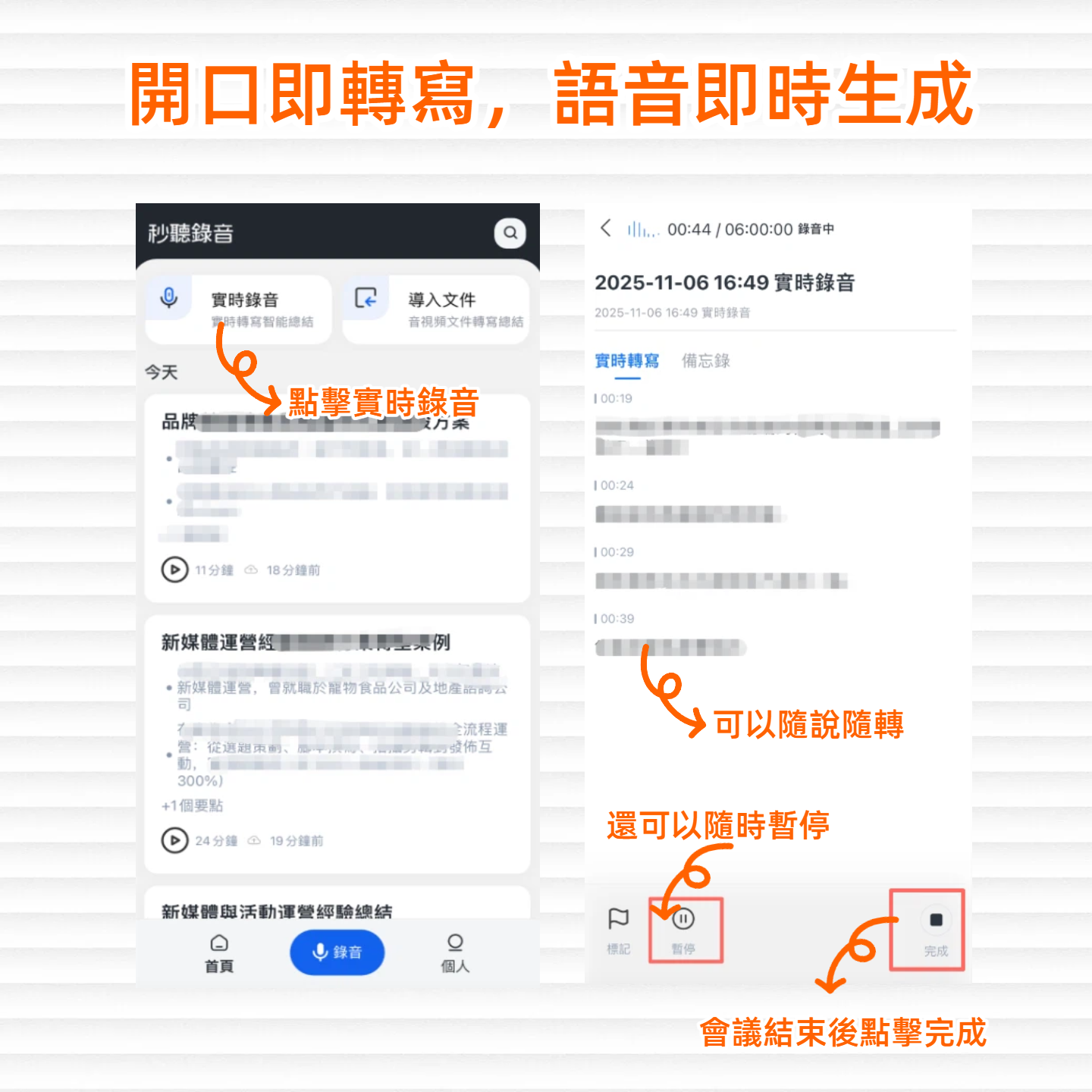
During a meeting, open Tinrec. It transcribes in real-time while AI generates summaries and action items in the background. When the meeting ends, I go directly to "Meeting Highlights," copy key conclusions and action items into a presentation template, and within ten minutes I have a report ready for my boss. Before, listening back and transcribing wasted at least half an hour.
Stop organizing recordings by hand
Upload audio or video and automatically get a transcript, summary, and action items
Scenario 2: Historical Recordings Become a Searchable Knowledge Base
My team has accumulated many project discussion recordings. I never bothered to revisit them. Now, I dump them all into Tinrec. After transcription, I can use AI to ask: "Who mentioned the budget issue last time?" It tells the answer directly—no file flipping needed. It's especially handy when you need to reference past decisions in a presentation.
Scenario 3: Online Videos Can Also Become Presentation Material
Sometimes I see a competitor's product launch on YouTube and want to extract key points for my strategy presentation. Just paste the link into Tinrec, and it will transcribe and summarize. I can directly use the data and arguments without having to watch and type.
Hands-on Experience: We tested with a 5-minute Cantonese meeting recording (with background AC noise). The transcription was largely accurate, with only a few homophone errors that didn't affect understanding. Mixed Chinese and English content was handled well. The AI's ability to extract key points is strong—almost ready to serve as a presentation outline.
Pros:
- Not just transcription—also summarizes and extracts action items, making presentation creation very fast
- Multi-source support: live recording, file upload, online video links
- Cross-platform and export features complete, workflow uninterrupted
- AI Q&A turns historical recordings into a database, no more searching for a needle in a haystack
Cons:
- Free tier: 100 minutes per month; heavy users need to pay (Pro plan costs about two Starbucks drinks a month)
- Currently no direct PPT file generation; you still need to paste text into presentation software (but at least you don't have to transcribe and organize highlights yourself)
Who It's For: If, like me, you have more than 5 meetings a week, or need to organize content from recordings and videos for presentations and reports, Tinrec will save you a ton of time. It's also useful for students preparing class presentations and researchers organizing interviews.
Alternatives to Tinrec (Not Recommended)
Honestly, if you don't want to use Tinrec, there are other options, but I've tried them all and the results are far inferior:
Manual Note-taking + Transcribing Yourself: This is the most traditional method, but for a 1-hour meeting, typing, organizing highlights, and creating a presentation might take 3 hours. If your time isn't valuable, go ahead.
Using Basic Transcription Tools: Some tools only provide transcription without AI summaries or action item extraction. You'll get a huge transcript and then have to read and organize it slowly. Creating a presentation is still tiring. Also, many don't support online videos, so their versatility is low.
Just Report Orally Without Slides: If your company culture allows it, maybe, but most bosses still want to see slides. So, better to have a tool ready.
Pitfall Guide: 3 Common Mistakes When Using Recording Tools for Presentations
Mistake 1: Thinking a Transcript Is Enough
Getting a transcript is just the starting point. You still need to organize it into a logical presentation. Without AI summarization, you've only completed 30% of the work. Make sure to choose a tool with auto-summarization and key point extraction, like Tinrec.
Mistake 2: Ignoring Cross-platform Sync
After recording on your phone, you can only view it on the phone. To transfer it to your computer, you have to email it to yourself—very clunky. When selecting a tool, check for multi-device sync and a web version. Tinrec does this well.
Mistake 3: Only Transcribing, Not Asking Questions
Many people just transcribe and leave it. In fact, you can proactively ask the AI: "What's the conclusion of this meeting?" "Who is responsible for what?" Tinrec's AI chat query feature acts like an assistant that organizes for you. Ask a few questions before making your presentation, and the outline will emerge.
Summary: 3 Steps to Conquer Meeting Presentations with Tinrec
After six months of hands-on testing, here's my fixed workflow:
- Open Tinrec during the meeting to record → Real-time transcription with AI generating summaries and action items simultaneously.
- Review highlights right after the meeting → Copy key conclusions and action items, paste into your presentation template.
- Ask AI if you have questions → Confirm details or review past meetings to make your presentation more complete.
If you're also fed up with post-meeting organization hell, I recommend downloading the free version of Tinrec first. The monthly 100-minute quota is enough for two or three meetings to experience the effect. If you like it, consider upgrading; no need to spend money upfront. Use the time saved to grab a coffee.
Turn every recording into actionable outcomes
Get 60 free transcription minutes when you sign in. No credit card required.
Related Reading
You might also like

3 AI Recording Tools Compared in 2026: From Portable Hardware to Meeting Collaboration, Which One Fits You Best?
Still debating whether to buy a Plaud voice recorder? The key to choosing a recording tool isn't about hardware weight, but the complete workflow from recording to organizing and collaborating. Based on hands-on experience, this article compares Plaud Note, Otter.ai, and Tinrec side by side to help you find the most effective way to boost productivity.

Best AI Voice Recorders in 2026: Tinrec vs Plaud vs Otter – No Extra Hardware Needed for Office Workers
Are Plaud voice recorders any good? We tested Plaud, Tinrec, and Otter to see which is best for office workers in Hong Kong, helping you skip overtime for meeting notes. Tinrec requires no extra hardware and excels in Cantonese transcription, AI Q&A, and team collaboration.

What Is the 2026 Plaud Recorder? 5 Steps to Understand AI Recording Cards and Find a Better Meeting Notes Tool
From a mid-level manager's practical perspective, this article explains what the Plaud recording card is, how to manage recording files, and compares AI meeting notes tools like Tinrec to help you choose the most time-saving solution.

Which Plaud Voice Recorder Is Best? 2026 Hands-On Test of 2 Options: Tinrec Is the Lightweight Choice Without Hardware
Thinking about buying a Plaud voice recorder? This article hands-on tests two AI recording tools, Plaud and Tinrec, comparing hardware requirements, online meetings, team collaboration, and more to help you find a better meeting notes solution.

How to Choose Speech-to-Text in 2026? Compare Yating Transcriber and Tinrec in 5 Steps
Still deciding between the latest Yating Transcriber and Tinrec? This article walks you through 5 steps to evaluate post-transcription processing, AI Q&A, and team collaboration, helping you make a truly time-saving choice.

2026 Hands-On Comparison of 2 AI Speech-to-Text Tools: Tinrec vs Yating, Which Is Right for You?
A 2026 comparison of Tinrec and Yating (Yating Transcript) across 5 dimensions: AI features, free tier, cross-platform support, team collaboration, and post-processing, to help you decide which is better for meeting notes in Taiwan.

2026 AI Voice Recorder Comparison: Plaud Note vs Tinrec vs Otter – Which Is Right for You?
Thinking about buying an AI voice recorder but worried about picking the wrong one? This hands-on comparison reviews Plaud Note, Tinrec, and Otter across recording methods, transcription quotas, Chinese language support, and team features. We also walk through a complete recording-to-export workflow using Tinrec to help you choose the right tool.

2026 Plaud Recording Free Plans Compared: 3 Options at a Glance
Struggling to organize recordings from your Plaud voice recorder? This hands-on comparison of Tinrec, Plaud, and Otter's free plans helps you find the most time-saving transcription tool.

2026 Hands-On Comparison of 5 AI Recording Tools: Beyond Plaud, Which Offers the Most Complete Transcription and Organization?
Thinking about buying a Plaud recorder? Hold on. This article compares 5 mainstream AI recording tools—Tinrec, Plaud, Otter, Notta, and TurboScribe—from a real workflow perspective to help you find the best recording and organization solution.