

Turn recordings into transcripts and summaries in minutes
Upload audio or video for multilingual transcription, AI notes, and action items
Two hours in a meeting, another two hours organizing notes—and ideas slip away in a blink
Ever struggle to keep up with lecture notes, miss key decisions after a lively meeting, or lose a brilliant idea because it struck in the shower, while driving, or in the middle of the night? That's the daily grind for many professionals and creators: spending time on "recording" instead of "thinking."
Traditional methods: typing into a phone memo never keeps up with your thoughts; using a voice recorder leaves you scrubbing through audio later to find key points. You need more than just a recording tool—you need something that instantly turns speech into text and helps you organize the highlights.
In this article, we test 4 mainstream voice-to-text tools from the perspective of "capturing ideas" to help you find the choice that turns thoughts into notes and makes review effortless.
Before choosing a voice-to-text tool, understand these 4 key factors
Longer recording time isn't always better, and a claimed 98% accuracy isn't guaranteed. Based on real-world usage, here are 4 dimensions you must consider:
Accuracy: Don't trust lab numbers; real environments are the real test
Many tools boast "98% accuracy," but that's often measured in a soundproof lab. In a café, outdoors, or during a multi-speaker meeting, accuracy drops significantly. Our tests deliberately include background noise and two-person conversations to see who performs reliably in realistic conditions. Especially if you need to transcribe Cantonese or mixed Chinese-English content, always test the tool in your typical scenarios.
AI features: Just a transcript, or can it "understand" the content?
Transcription is just the first step. What really saves time is automatic summaries, action items, and even the ability to "query" your recordings conversationally—like asking, "Who mentioned the budget in the last meeting?" If a tool only lets you Ctrl+F for keywords, you'll still be manually sifting through pages of text.
Cross-platform support: Ideas come on any device, and your tool should too
If you record on your phone today and want to edit on your computer tomorrow, seamless sync is essential. iOS, Android, and web versions are all necessary—otherwise, you'll be tied to a single device.
Output: More than just text—actionable data
You need something you can paste into a report, convert into a to-do list, or export to Notion for further editing. A good tool should offer multiple export formats and even generate meeting minutes or article drafts directly.
Tinrec (Second Listening) — Our top pick for both ideas and meetings
Tinrec is an AI recording and audio/video organization tool supporting 14 languages, available on iOS, Android, and web. It goes beyond transcription to turn voice data into searchable, queryable, and reusable knowledge. For those who need to capture ideas quickly and also handle lots of meetings and classes, Tinrec is the standout performer in our tests.
Scenario 1: Inspiration strikes—record instantly, get text instantly
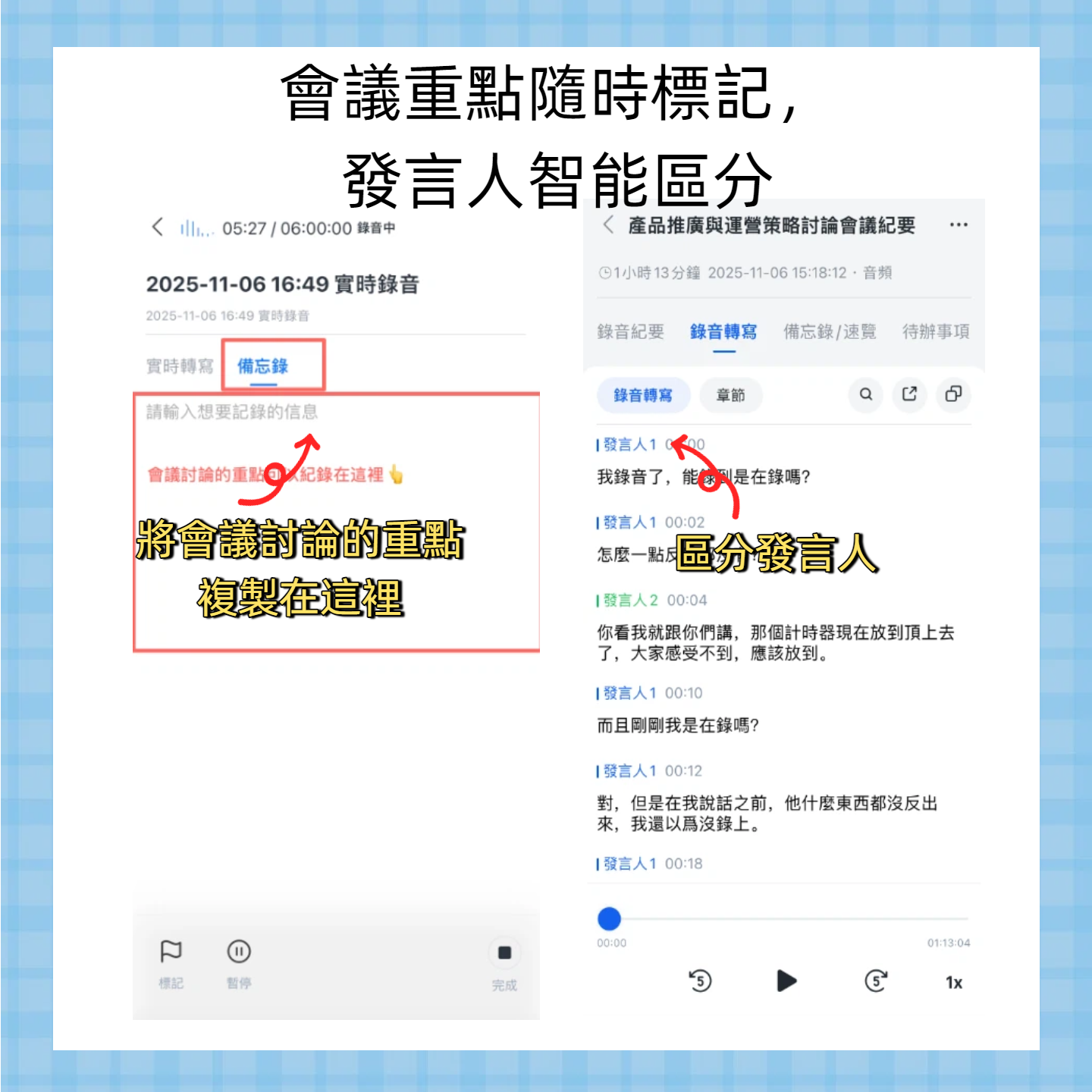
Driving or walking and a great idea pops up? Open Tinrec, hit record, and speak. It displays live transcription, so by the time you're free, your speech is already polished text. Even more useful: the AI summary automatically pulls out core concepts—record 10 minutes of rambling and grasp the key points in 10 seconds.
Scenario 2: Meeting ends, action items and decisions appear automatically
During a meeting, use Tinrec for live recording. Besides a full transcript, it automatically separates chapters and labels speakers. Crucially, the AI action-item extraction—"Manager Chen said submit the report next Friday, Designer Wang is responsible for graphics"—turns these into a clear list. No need to replay the recording to know who does what.
Scenario 3: Past recordings become a conversational database
Stop organizing recordings by hand
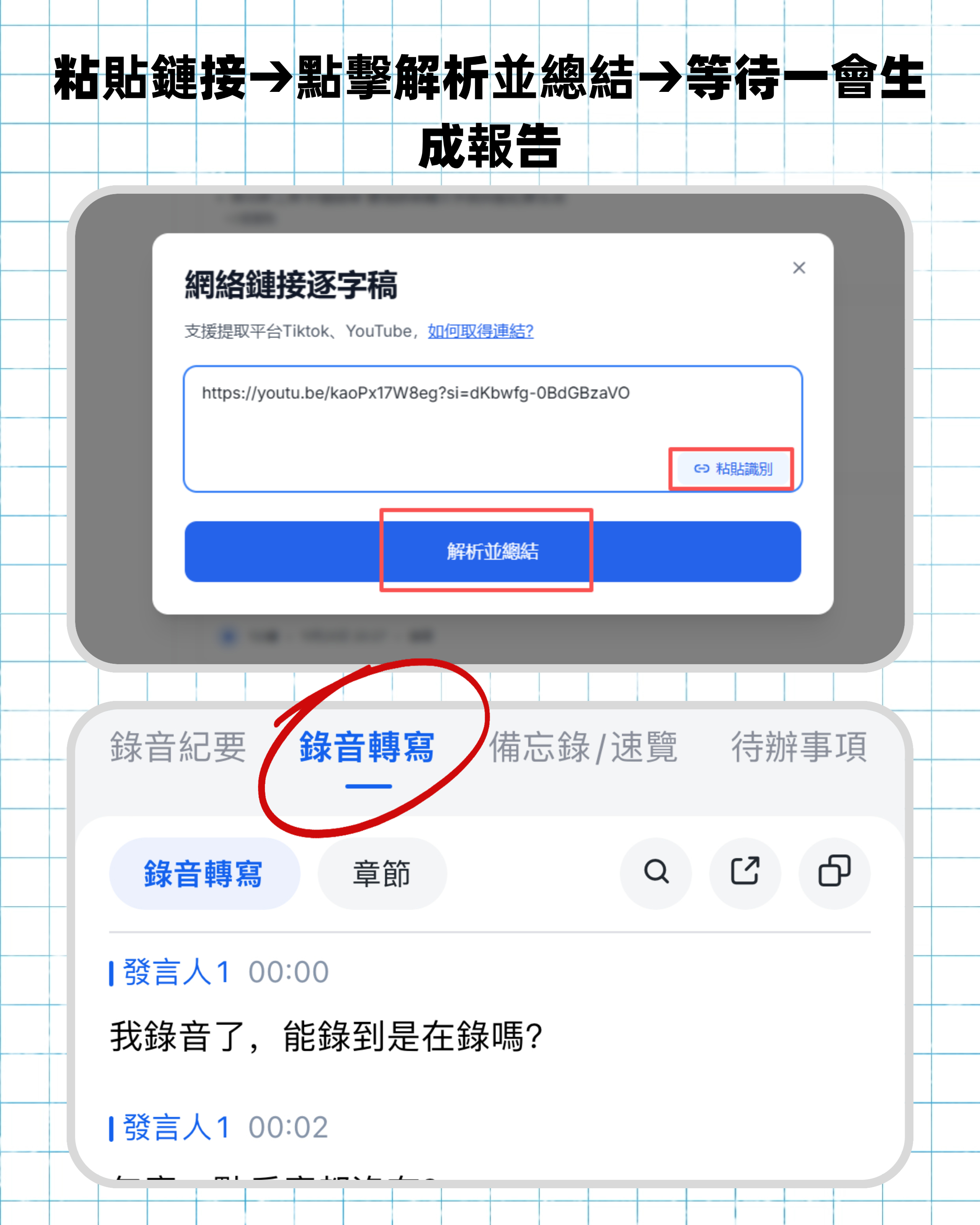
Upload audio or video and automatically get a transcript, summary, and action items
Tinrec's AI conversational query is its killer feature. We uploaded half a year's worth of interview recordings and asked, "Which interviewees mentioned 'price sensitivity'?" Instead of keyword results, it directly named specific people and the relevant sections. Currently, no competitor in the same price range offers this.
Our test experience
We tested with a 5-minute Chinese meeting recording (two speakers, light keyboard clicks, recorded on iPhone 15). Tinrec's transcription readability was significantly better than alternatives, especially for names, numbers, and technical terms—almost no errors. AI summary generation took about 8 seconds, and action-item extraction was impressively accurate—it even pulled "need to reassess suppliers" as a potential action from a complaint.
Pros
- Not just transcription, but organization: AI summary, chapters, action items—ready to use immediately after recording.
- Multiple input sources: besides phone recording, supports uploading audio files and pasting links from YouTube, Bilibili, etc. Great for content creators.
- AI conversational query: turns your voice library into a personal assistant—ask and find key points, saving hours of replaying audio.
Cons
- Free plan has 100 minutes per month; heavy users need to pay. But for 2-3 meetings a week plus occasional idea recording, it's enough to experience full features.
- Mobile recording requires app to stay in foreground; switching apps stops recording (iOS background recording is being improved).
Who it's for If you often record ideas on the go and need to organize meetings and lectures without spending extra time on post-processing, Tinrec is the most complete solution. Especially suitable for Chinese and Cantonese speakers and cross-platform workers.
Alternatives to Tinrec
Plaud Note: premium hardware recording, limited convenience Plaud Note is a standalone AI recording device for those who prioritize one-tap recording. But you need to carry an extra gadget, and it only connects via Bluetooth or cable to your phone—no cross-platform app. When you want to edit on a computer, the workflow becomes fragmented. In contrast, Tinrec does everything directly on your phone and computer, syncs across devices, and has AI conversational query—Plaud currently lacks that, leaving you to manually search transcripts.
Otter.ai: best for English meetings, but think twice for Chinese Otter.ai excels at English recognition and meeting bots, with 300 free minutes per month. However, our tests show weak support for Chinese (especially Cantonese), high error rates, and no Chinese AI summary or conversational query. If you mainly handle English meetings and notes, Otter.ai is more cost-effective than Tinrec. But for Chinese users recording Chinese ideas or meetings, Otter.ai falls short while Tinrec delivers perfectly.
Notta: good transcription and translation, but lacks "understanding" Notta does well in transcription and live translation with an intuitive interface. However, its core is "text output": no AI conversational query, so you can't mine recording content through Q&A. After recording, you still have to read through the transcript slowly. Also, Notta's free plan offers 120 minutes/month—slightly more than Tinrec, but considering Tinrec's AI organization saves you time, that minute difference is negligible.
Pitfall guide: 3 common mistakes when choosing a voice-to-text tool
Pitfall 1: Believing official accuracy claims Many tools advertise 98%, but in your actual environment, it might be below 80%. Never rely solely on ads; always try the free version with your own recordings. Our tests showed accuracy differences of over 15% for the same meeting recording across tools—directly affecting how much time you'll spend proofreading.
Pitfall 2: Ignoring cross-platform needs You record an idea on your phone today, then want to edit on your computer tomorrow—only to find the tool is iOS-only or doesn't sync. Being stuck on one device disrupts your recording habit. Choose a tool available on iPhone, Android, and web to avoid bottlenecks.
Pitfall 3: Treating the tool as just "voice-to-text" If you only use it for transcription, you're using only a third of its potential. Tinrec's AI conversational query—asking "What's the meeting conclusion?"—is 10x faster than scrolling through 30 minutes of transcript. Features like auto-generated meeting minutes, action lists, and even paper summaries are the real time-savers.
Conclusion: Which one should you choose?
Back to the core: If you need a tool that instantly captures ideas and ends the nightmare of meeting organization, Tinrec is our top pick after testing. It integrates recording, transcription, AI understanding, and export most smoothly, especially for Chinese speakers and cross-device workers.
Scenario recommendations
- Need accurate bilingual (Chinese + Cantonese) transcription and want AI to find key points after recording → Tinrec (the only option with full AI conversational query)
- Often switch between phone and computer to organize ideas → Tinrec (seamless iOS, Android, web integration)
- Primarily handle English meetings and need a bot to join online meetings → Otter.ai (the only scenario where we recommend an alternative)
- Zero budget, only occasional short transcriptions → Otter.ai or Tinrec free version. Otter.ai offers 300 min/month but English only; Tinrec offers 100 min/month with Chinese support. Choose based on your primary language.
We recommend starting with Tinrec's free plan—100 minutes per month is enough for several meetings and idea snippets. Experience the AI workflow firsthand; if you find it useful, consider upgrading. Recording and organizing should make you freer, not busier.
Turn every recording into actionable outcomes
Get 60 free transcription minutes when you sign in. No credit card required.
Related Reading
You might also like

How to Choose an Interview Recorder in 2026? 5 Steps from Recording to AI Summary - Recommended List
Interview recorders are not just hardware; AI transcription tools help you quickly organize transcripts and summaries. This article reviews 5 recommended solutions, from free to professional, from a middle manager's testing perspective, guiding you to choose the right interview organization tool, saving time for decision-making.

2026 Tinrec vs Notta: 5-Dimension Showdown: Which is Better for Chinese Speech-to-Text?
Compare two major speech-to-text tools, Tinrec and Notta, in a deep 5-dimensional analysis covering core features, input sources, organization, Chinese experience, and pricing. Also includes Otter.ai, Fireflies.ai, TurboScribe, and more to help you find the best speech-to-text tool.

2026 Comparison of 3 Must-Have Interview Transcription Tools for Journalists: From Recording to Publishing in One Go
Still manually transcribing interviews? This article compares different transcription solutions, using Tinrec as an example, showing how to quickly turn interview recordings into searchable, quotable text material—from recording to publishing in one go.
![[Tutorial] 2026 Screenwriter Recording to Text: AI Chat Search + Auto-Organize Interview Materials](https://record-img.tos-accelerate.volces.com/images/2026/07/24/1784906635885412776.png)
[Tutorial] 2026 Screenwriter Recording to Text: AI Chat Search + Auto-Organize Interview Materials
Quickly organize screenwriter interviews, fieldwork recordings, and inspiration materials. A hands-on test of 5 recording-to-text tools, from free to professional solutions.
![[Tutorial] Tinrec Interview Transcription 2026: Real-Time Transcription, AI Summaries & Q&A](https://record-img.tos-accelerate.volces.com/images/2026/07/24/1784906660573545479.png)
[Tutorial] Tinrec Interview Transcription 2026: Real-Time Transcription, AI Summaries & Q&A
This article compares Tinrec and Plaud Note for interview recording management, covering recording sources, transcription capabilities, organization features, and pricing plans, helping you choose the right interview tool.

Tinrec Audio to Text Tutorial 2026: Supports Cantonese, AI Auto-Organizes Medical Meeting Notes
Hong Kong healthcare professionals often deal with a large number of audio recordings? This Tinrec tutorial teaches you how to use your phone or computer to quickly transcribe medical recordings and meeting discussions into text, with AI automatically organizing summaries and key points, saving you plenty of time.

Which Speech-to-Text App is Best? 2026 Hands-on Test of 4 Apps – This One is Perfect for Bloggers
As a blogger, you often need to edit videos and organize interview recordings, so finding an accurate and convenient speech-to-text app is crucial. After testing 4 tools, I found that Tinrec not only transcribes but also offers AI summaries and task extraction, perfect for content creation. Find out why it's the top choice for bloggers!
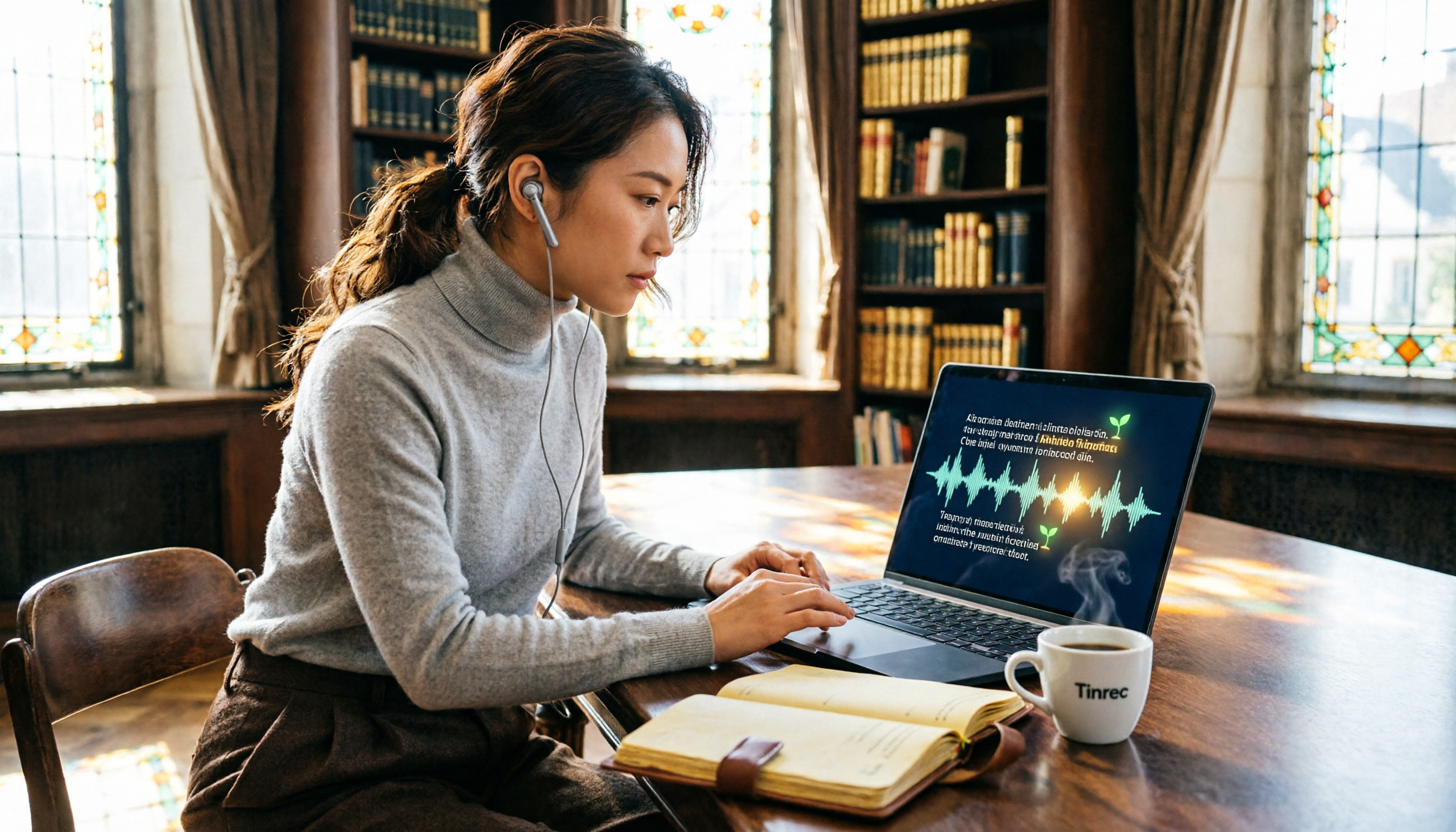
Tutorial: Use Tinrec in 2026 to Efficiently Organize Academic Conference Notes – Real-time Transcription, AI-Generated Summaries & To-Dos
The biggest pain about academic conferences isn't understanding the talks – it's failing to take notes and not wanting to re-listen to recordings. With Tinrec, I turned three days of international conference recordings into structured summaries, searchable transcripts, and actionable checklists. This article shares how I used one app to transform audio files into truly usable data.
Tinrec vs Notta in 2026: A 4-Dimensional Comparison, the Best Tool for Clinical Notes
Physicians face lengthy dialogues daily, and manual or post-visit note-taking is time-consuming. This article tests two AI speech-to-text tools, Tinrec and Notta, comparing accuracy, AI post-processing, privacy, and cross-platform usability to help you find the best solution for clinical documentation.