

Turn recordings into transcripts and summaries in minutes
Upload audio or video for multilingual transcription, AI notes, and action items
Tinrec vs Google Meet in 2026: A 4-Dimension Comparison for Student Online Class Note-Taking
Last semester, I had a class that was fully remote on Google Meet. The professor talked super fast, and the slides flipped even faster. I turned on Meet's live captions, hoping to catch what I missed while scribbling—but the captions lagged by several seconds and only showed in real time, leaving nothing after class. I missed a key point the professor added during the midterm report, and my grade dropped a whole letter—almost failed. Later, a senior recommended Tinrec. Since then, I've used it to automatically record every Google Meet class, get transcripts, and even have it summarize key points. In this post, I'll share my real experience over a semester and explain why Tinrec is way more practical for students than Google Meet's built-in features.
What Can AI Meeting Notes Do for You?
First, let me explain why you need AI meeting notes instead of just relying on the platform's live captions. For students, online classes usually come with three pain points:
- Can't take notes fast enough in class: Professors throw out exam tips, case studies, and assignment requirements in passing—and they're gone in a blink. Google Meet's captions only show in real time; you can't go back and there's no archive.
- Can't find key points when reviewing after class: You might record the lecture, but rewatching a two-hour video is way too time-consuming, yet skipping it risks missing exam material.
- No one remembers group discussion conclusions: During Google Meet breakout sessions, everyone talks over each other, and by the end nobody recalls what was decided. You end up in the group chat saying, "Just to confirm, what we said earlier was…"
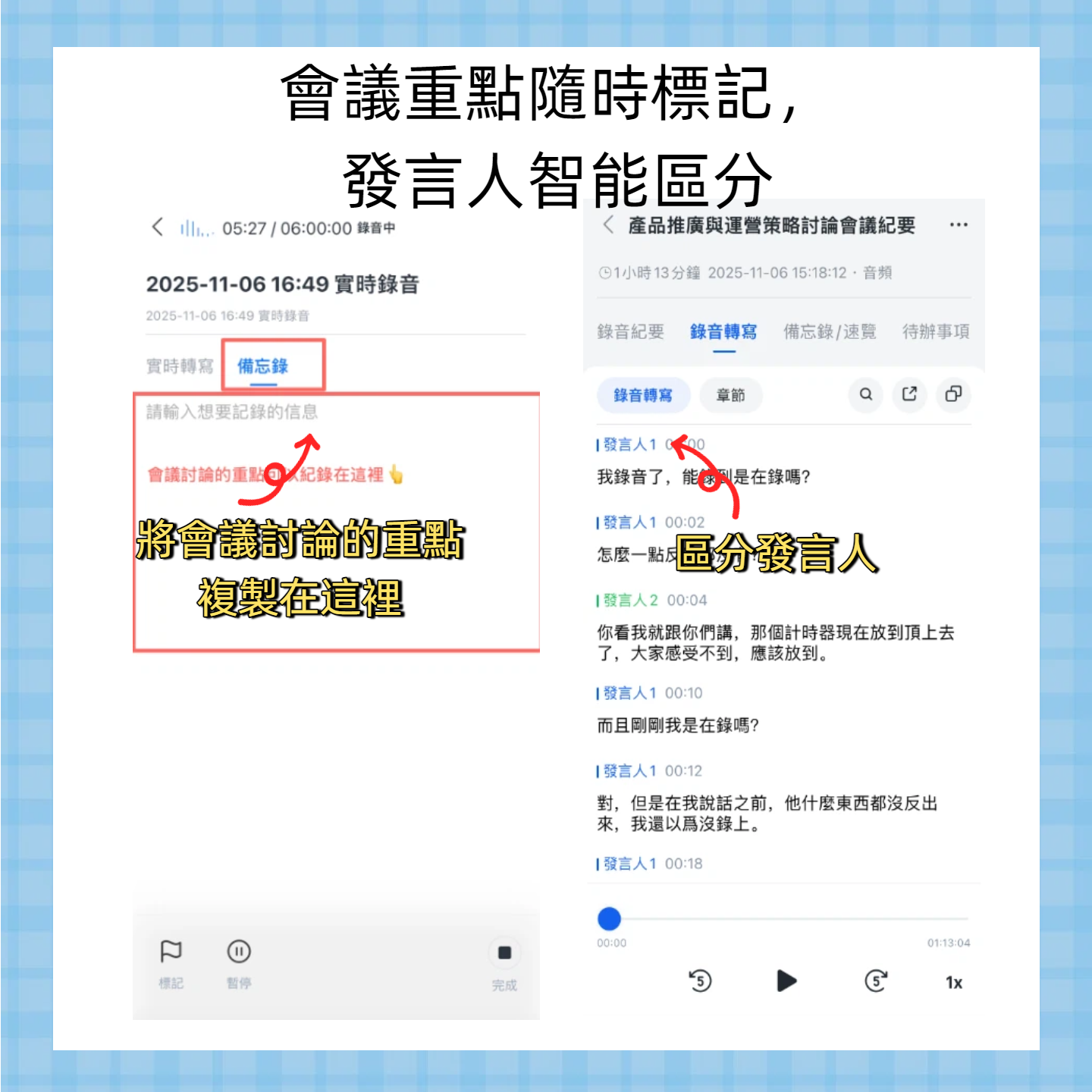
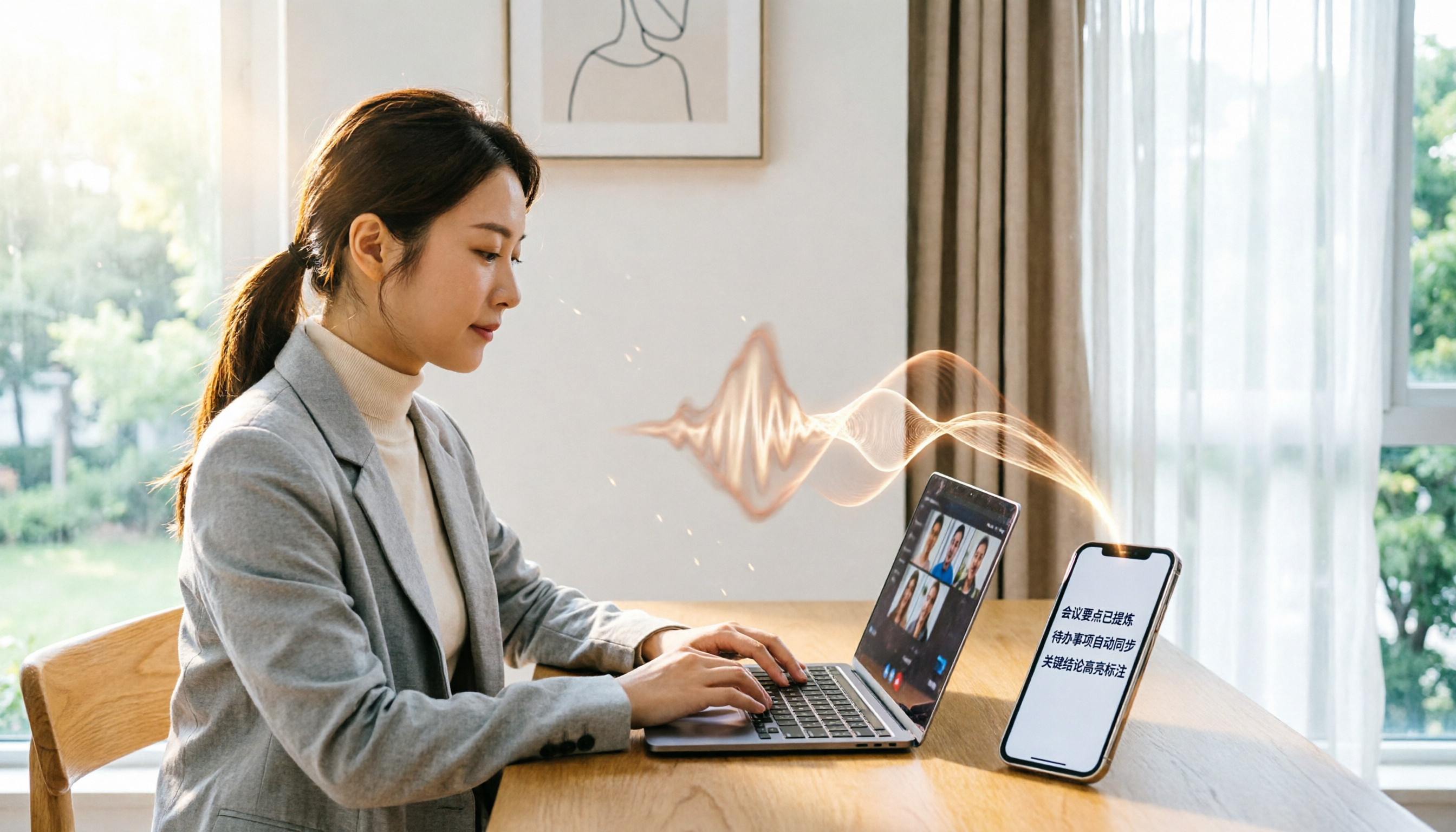
That's where an AI transcription tool like Tinrec becomes a lifesaver. Here's how I use it: before class, I open Tinrec's "Live Recording" and it records the entire lecture in the background while converting it to text in real time. After class, AI has already generated summaries, key sections, and even extracted action items from discussions. I don't need to re-listen to the audio; I just read the organized notes.
What Are Tinrec's Core Capabilities?
Compared to Google Meet's built-in "Live Captions," Tinrec doesn't just record—it helps you understand the class content. Here are four core capabilities I found most useful after a semester:
- Real-time speech-to-text with permanent storage: Google Meet's captions are "one-time"—they disappear when the meeting ends. Tinrec records the entire class audio, converts it to text in real time, and saves it to your account. You can go back anytime, search keywords, and never worry about missing the professor's extra explanations.
- AI semantic summaries and chapter organization: Instead of just compressing the transcript into one long paragraph, Tinrec structures it—listing the class topic, discussion points, conclusions, and assignments in bullet points. Before finals, I used these chapters to quickly scan key points from each class—way more useful than my messy handwritten notes.
- AI Q&A – ask about key points directly: After uploading a recording, you can ask Tinrec questions like, "Did the professor mention the midterm exam chapters?" or "What's the assignment due date?" It answers based on semantic understanding, so you don't have to dig through the whole transcript.
- Automatic extraction of action items: For group project discussions, Tinrec automatically identifies who needs to do what and deadlines. In my capstone project, I'd just drop the recording in after each meeting, then copy the action items from Tinrec into Notion—no more "Wait, I was supposed to do that?" moments.
Stop organizing recordings by hand
Upload audio or video and automatically get a transcript, summary, and action items
Google Meet's built-in features can't do any of this. It doesn't even offer post-meeting transcription—if you need a proper meeting record, you'll have to use a third-party tool.
Real-World Use Cases
Here are the three scenarios I use most often, each where Google Meet falls short:
Scenario 1: Record an entire remote class and turn it into notes afterward
Before class, I open Tinrec's live recording and let it run. After class, I open the recording, and AI has already split the two-hour lecture into 4–5 chapters, each with a title and brief summary. I can jump straight to the "Midterm Report Instructions" section and read the text—no need to scrub through the audio from start to finish. Google Meet's live captions have zero post-class utility.
Scenario 2: Online group discussions with automatic action items after the meeting
Our group used to have hour-long Google Meet discussions and then no one would summarize. I suggested, "Let me record with Tinrec during the meeting." Afterward, I'd paste the AI summary and action items into the group chat—clear who's responsible for what and by when. My teammates went from skeptical to all installing the free version.
Scenario 3: Recording interviews or online seminars
I once attended an online interview workshop via Google Meet and wanted to review it, but there was no recording or notes. Later, I used Tinrec's "Computer Meeting Recording" feature to capture the system audio and the speaker's voice directly on my laptop. Right after the session, I had a transcript and key points. Same Google Meet activity—adding Tinrec gave me my own personal archive.
4 Things to Consider When Choosing an AI Meeting Notes Tool
If you're a student on a tight budget, here's what you'll care about:
- Post-transcription organization: It's not enough to just have a transcript—what matters is how much it helps you understand the content. Tinrec's summaries, chapters, action items, and AI Q&A save me tons of review time. Google Meet's built-in feature only provides real-time display, with no post-class organization.
- Free plan limits: This is a student's lifeline. Tinrec's free plan offers a base monthly transcription time. I did the math: a 2-hour class, about 8 classes per month. If I only record key classes or group discussions, the free plan is plenty. If I need to record everything, the Pro plan costs less than two late-night snacks; Google Meet doesn't have its own transcription service—you'd need to bundle other tools, which adds extra cost.
- Language and Chinese support: Some tools have poor Chinese transcription accuracy. Tinrec handles Chinese content quite well, especially mixed Chinese-English courses (common in my department) and correctly identifies technical terms. Google Meet's captions support only some languages; Chinese occasionally drops characters, and you can't edit or export after class.
- Cross-platform availability and convenience: Tinrec has iOS, Android, and web versions. While attending Google Meet on my laptop, I can record with Tinrec on my phone or use the desktop app to capture system audio. Google Meet's captions are confined to Meet itself—gone once you leave.
FAQ
Q: Can Tinrec automatically join a Google Meet meeting?
A: Currently, Tinrec records via a recording device or computer audio source. You can have it capture the entire Google Meet system audio and your own microphone, just like sitting in the meeting taking real-time notes. Compared to tools that require a bot to join, this approach is more privacy-friendly and eliminates the worry of the bot not entering.
Q: If I use Tinrec to record a Google Meet, will classmates know?
A: Tinrec is an independent recording app—it doesn't show any notification within Google Meet. The other participants won't know you're recording. However, please follow school regulations and respect others' privacy.
Q: Is the free plan enough?
A: If you're a light user recording just one or two key classes per week, the free plan is sufficient. If you record every class or frequently do group discussions, consider the Pro plan—it costs less than a few bubble teas a month.
Q: How accurate is the transcription?
A> In my experience, when the professor speaks clearly with minimal background noise, the Chinese accuracy is about 90% or higher. Of course, if multiple people talk at once, there's a strong accent, or specialized academic terms, it's best to cross-check with the original audio. But it's still way more complete than handwritten notes.
Summary
If you have weekly Google Meet online classes, group discussions, or seminars, relying solely on Meet's built-in captions isn't enough—they're only useful in the moment and leave nothing afterward. Tinrec is like having a personal teaching assistant for every online class: it not only records and transcribes but also organizes key points, action items, and lets you ask questions after class.
After one semester, I can't imagine online learning without Tinrec. I recommend downloading the free version and turning on live recording during your next class—see what AI-organized notes look like. Trust me, you won't be disappointed.
Turn every recording into actionable outcomes
Get 60 free transcription minutes when you sign in. No credit card required.
Related Reading
You might also like
2026 Tinrec Desktop Audio-to-Text: Chinese Optimized + Cross-Platform AI Organization
Want to convert audio to text on your computer and also need subsequent organization, summaries, or even Q&A? This article compares two desktop audio-to-text tools, Tinrec and Otter.ai, across 5 dimensions including Chinese recognition, supported sources, and AI features, helping you find the best choice for Traditional Chinese users.
![[Tutorial] 2026 Free Recording-to-Text Software: Organize Meeting Minutes with AI Auto-Summarization](https://record-img.tos-accelerate.volces.com/images/2026/07/26/1785076429989611602.png)
[Tutorial] 2026 Free Recording-to-Text Software: Organize Meeting Minutes with AI Auto-Summarization
A mid-level manager tests 5 free recording-to-text solutions, from AI conversational queries to purely free options, helping you choose the best meeting note tool and save 1 hour of paperwork daily.

Free iOS Speech-to-Text Apps in 2026: Two Options Compared
Looking for a speech-to-text app for iPhone without spending money? We tested two free iOS solutions: Tinrec and Otter.ai, comparing Cantonese recognition, AI summarization, and cross-platform support to see which one saves Hong Kong workers the most time.
2026 Free Speech-to-Text Transcription Tools: 4 Options Compared
Hands-on review of 4 free speech-to-text tools: Tinrec, Otter.ai, Notta, and Yating. Compare free plan limits, pros and cons, and find the best option for Chinese speakers.

How to Choose Real-Time Transcription Tools in 2026: A 5-Step Comparison Guide
Hands-on comparison of Tinrec and Otter.ai for real-time transcription, covering accuracy, input sources, AI post-processing, and pricing. 5 steps to help you pick the best solution for Chinese meetings and multi-scenario use.
2026 Free Google Meet Transcription for Mac: 2 Options Compared
Need a more complete speech-to-text tool for Google Meet on Mac? This article compares Google Meet's built-in captions with the free version of Tinrec, analyzing differences in cross-platform support, AI summaries, and multi-source organization to help you find the best solution.

2026 Side-by-Side Comparison of 2 Google Meet Recording Tools: Auto-Generated Meeting Minutes, No More Overtime
Tired of manually writing meeting minutes after Google Meet? We put two AI recording and transcription tools—Tinrec and Otter.ai—to the test, comparing them across five key dimensions: Cantonese recognition, cross-platform support, AI Q&A, online video transcription, and pricing. Find the best time-saving solution for busy professionals.

2026 Hands-On Comparison of 3 Meeting Note Tools: Beyond Virtual Backgrounds, Meeting Organization Is Key
Google Meet has virtual backgrounds, but who helps you organize key points after the meeting? A mid-level manager's hands-on test, from built-in transcription to AI meeting notes, tells you why Tinrec is the more time-saving choice.

Best Google Meet Alternatives 2026: Turn Your Meeting Notes into Actionable Data with Tinrec
Still searching for a Google Meet APK? What you really need isn't just a meeting tool—it's a solution that turns meeting recordings and audio/video files into searchable highlights and to-dos. From a mid-level manager's perspective, this article tests how Tinrec can save you 50% of meeting recap time.