

Turn recordings into transcripts and summaries in minutes
Upload audio or video for multilingual transcription, AI notes, and action items
Whether working remotely or in a hybrid setup, Google Meet has become a daily meeting tool for many professionals. However, after the meeting ends, quickly organizing complete records, action items, and key takeaways remains a common headache. Currently, there are three common solutions: using Google Meet's built-in captions and recording features, manually typing notes while meeting, or leveraging professional AI recording and organizing tools like Tinrec.
In this article, we take Tinrec as an example, guiding you step by step through recording, transcribing, summarizing, and exporting your Google Meet meetings. We'll also briefly compare the pros and cons of the three solutions to help you find the best workflow for your needs.
Before You Start | What You Need to Prepare
- A computer or smartphone that can run Google Meet (whether for screen sharing, presenting, or simply attending).
- Install the Tinrec app or open the web version (supports iOS, Android, and web; you can register for free with a Google or Apple ID).
- Make sure your Google Meet meeting allows recording (if the meeting is hosted by someone else, it's recommended to get the host's consent).
- A stable internet connection (real-time transcription requires internet; you can download language packs for offline use).
- A meeting recording ready to be processed (can be recorded live or a saved Meet recording file).
Step 1 | Set Up Google Meet Recording and Sync with Tinrec
The goal of this step is to ensure clean audio input into Tinrec, avoiding echo or background noise that could affect transcription.
When joining a Google Meet on your computer, it's recommended to use headphones and let Tinrec capture audio through your computer's built-in microphone. It's simple: open Tinrec's 'Live Recording' feature, select the appropriate language (Traditional Chinese for Taiwan), then tap the record button. At this point, it will capture the meeting audio from your speakers, while headphones let you hear the discussion clearly without feedback.
Why set it up this way? Because directly using a phone microphone to record computer speakers picks up ambient noise and echo, reducing transcription quality. If you're joining Meet on your phone, you can open Tinrec recording on the same phone, but it's recommended to use wired headphones and disable speakerphone for better audio capture.
Once done, you'll see Tinrec transcribe speech to text in real time, appearing sentence by sentence.
Step 2 | Let Tinrec Automatically Generate a Transcript
After the meeting recording is complete, the next step is to get a full transcript. Tinrec starts transcribing during the recording and automatically generates a timestamped transcript after it ends, without needing to upload or wait.
You can find the meeting record in 'My Files'; tap it to see the full text from start to finish. If multiple people speak during the recording, Tinrec can distinguish between speakers (marked as 'Speaker A / B') for easy review.
This step is almost fully automatic; just confirm the language setting is correct and let AI handle the rest. For a 30-minute meeting, the transcript is ready within seconds after recording ends, with excellent accuracy in standard meeting environments.
(Illustration: An online meeting screen with Google Meet window on the left and Tinrec's real-time transcript on the right, with speaker labels.)
Step 3 | Quickly Proofread the Transcript and Mark Key Points
Once you have the transcript, you don't need to read it all. Tinrec highlights potential key sections; you can play the recording and proofread against the text simultaneously.
Suggested workflow: Open the transcript on the web version, click any sentence to jump to that segment of the recording and listen synchronously. For especially important discussions, you can use the 'Memo' feature to mark them, or manually add notes to quote later when organizing minutes.
Why do this? Because AI transcription may have errors due to accents, jargon, or overlapping speech; spending 5 minutes proofreading greatly improves the quality of subsequent summaries and avoids obvious mistakes in shared records.
After proofreading, you'll have a clean transcript with marked key points, ready for future reference.
Stop organizing recordings by hand
Upload audio or video and automatically get a transcript, summary, and action items
(Illustration: Transcript editing screen with highlighted text marked as memos, and corresponding recording timeline on the right.)
Step 4 | Let AI Generate Meeting Minutes and Action Items
This is Tinrec's core value – not just a transcript, but a well-organized meeting summary.
On the recording file page, click 'AI Summary' or 'Meeting Minutes'; the system automatically analyzes the content and produces a structured summary including meeting topic, discussion points, decisions, and action items. You can also manually adjust the desired length (brief summary or full minutes) or highlight specific sections.
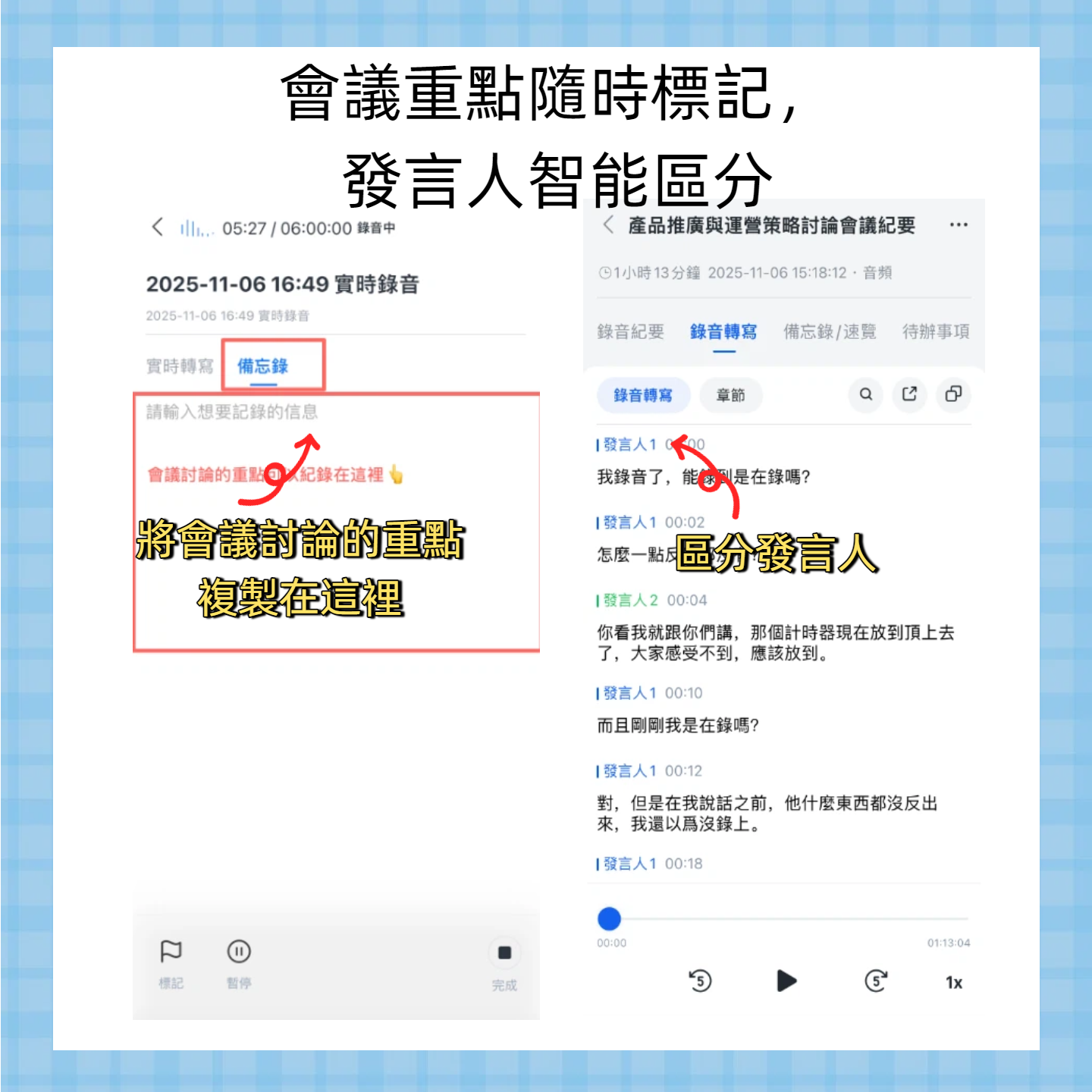
Another useful feature is 'AI Q&A': you can ask Tinrec 'What was the budget conclusion?' or 'Who is responsible for contacting the vendor?' and it answers based on the recording content, effectively giving you a conversational meeting database.
This step completely saves you the time of listening again or writing manual notes, turning discussions into actionable lists.
(Illustration: AI-generated meeting minutes card with date, participants, summary, key points, and action items.)
Step 5 | Export and Share with Your Team
Finally, export the organized data in your preferred format. Tinrec supports exporting as plain text, Word, PDF, Markdown, etc. You can also share a link directly with colleagues or send to tools like Notion, Google Docs, OneNote via integrations.
If you prefer using Google Docs for meeting records, choose 'Export to Google Docs'; all key points and action items will be automatically formatted and saved as official meeting minutes.
For those who frequently communicate across departments, this workflow saves a lot of copy-pasting time.
(Illustration: Export menu showing available formats and third-party tool icons.)
Frequently Asked Questions and Troubleshooting
Q: What's the difference between Google Meet's built-in transcription and Tinrec? A: Google Meet's live captions are mainly for real-time assistance; they don't save a full transcript after the meeting, nor do they offer automatic summaries or action item extraction. Tinrec, on the other hand, transforms recordings into searchable, editable, and reusable resources, ideal for archiving and tracking progress.
Q: What if I notice delays or missed sentences in the transcription during recording? A: This is usually related to network stability or multiple people talking simultaneously. Ensure a stable Wi-Fi connection and enable 'Smart Noise Reduction' in Tinrec settings. If you find errors later, click the text to play that segment for correction.
Q: Is the free version sufficient? A: The free version provides a basic monthly transcription allowance, enough for 3-5 meetings per month for occasional users. If you have multiple meetings weekly, consider the Pro plan, which costs about the price of a cup of coffee per month for unlimited organization.
Q: Is transcription accurate if the meeting mixes Chinese and English? A: Tinrec handles mixed Chinese and English well, but accuracy may be affected by accents and speech speed. We recommend setting the main language to 'Chinese' and relying on the system to correctly transcribe proper nouns or English words. If errors occur, use the transcript's quick jump feature to manually correct.
Q: Where are the recordings stored? Is it secure? A: All recordings and transcriptions are encrypted and stored in the cloud, accessible only by your account. You can delete any files you no longer want at any time.
Advanced Tips | 3 Ways to Double Tinrec's Efficiency
1. Use 'Web Video Analysis' to Directly Process YouTube Meeting Recordings
If your team uploads Google Meet recordings to YouTube (set to unlisted), you can paste the video link into Tinrec's 'Web Link Analysis' to extract the audio and convert it to text and summaries. This feature is currently unsupported by most competitors, making it great for post-meeting processing.
2. Cross-Meeting AI Q&A for a Personal Meeting Knowledge Base
As you accumulate more meeting recordings, you can directly enter keywords (e.g., 'Q3 budget') in Tinrec's search bar, and it will find relevant segments across all past recordings. Unlike Otter or Fireflies, which focus on single-meeting chats, Tinrec is more like a conversational long-term database, ideal for those who need to trace decision-making history.
3. Use 'Agent Post-Processing' to Automatically Generate Weekly Reports
If you need to summarize multiple meetings each week, try Tinrec's 'Agent Post-Processing' feature (currently in beta). Just select all recordings from the week, and AI will automatically generate a draft weekly report, condensing discussions, decisions, and action items. You can fine-tune and send it out, greatly reducing weekend overtime.
If You Don't Use Tinrec, Here Are Other Options
- Google Meet built-in recording + transcription: Suitable for users who only need simple playback without detailed text records. However, it lacks summarizing and exporting features, and cannot search past meeting content.
- Manual note-taking + note apps: Suitable for those with very few meetings and who prefer organizing their own notes. The downside is distraction during meetings and the need to spend time re-listening to fill gaps.
Overall, if you want automated meeting records and need complete, searchable, and trackable data, Tinrec is currently a highly integrated option.
Conclusion
By mastering the 5 steps above, you can now use Tinrec to turn Google Meet meetings into structured data with transcripts, summaries, and action items, and even search across meetings and automatically generate reports. We recommend trying the free version next time you have a meeting – the monthly basic allowance is enough for a few meetings to experience the difference from 'forgetting after the meeting' to 'every meeting leads to actionable output'.
Turn every recording into actionable outcomes
Get 60 free transcription minutes when you sign in. No credit card required.
Related Reading
You might also like

Best Google Meet Recording to Text Tools? 2026 Test of 3 Options, Tinrec Most Comprehensive
If Google Meet's built-in transcription isn't enough, this article tests 3 meeting note solutions, compares features and use cases, and shows why Tinrec is a more comprehensive audio/video organization tool.

Which Google Meet Block Notification Alternative is Best? 2026 Hands-On Test of 5 Tools, the Most Comprehensive One Is This
Worried about missing important calls after blocking someone on Google Meet? This article tests 5 tools to help you keep track of meetings, auto-record content, and never miss key messages.

The Complete Guide to Google Meet Link Expiration 2026: Permanently Save Meeting Content with Tinrec
Do Google Meet links expire? Yes, but you can record meetings instantly with Tinrec and save them forever. This guide shows you how to use Tinrec to transcribe audio to text, auto-generate summaries and tasks, so you never lose your meeting notes.

2026 Comparison of 2 iPad Meeting Recording-to-Text Tools: Hand Over Google Meet Minutes to Tinrec
A hands-on test of Google Meet on iPad and a comparison of two recording-to-text tools, recommending Tinrec as an efficient meeting minutes solution.

Is Google Meet Encrypted in 2026? 5 Steps to Record Safely and Use Tinrec for Meeting Notes
Is Google Meet really encrypted? Will recording affect security? This article by a tech journalist breaks down the encryption mechanism, then tests Tinrec and Otter.ai for recording-to-text, AI summaries, and privacy protection, showing you how to organize meeting notes safely and efficiently.

5 Google Meet Alternatives in 2026: Which One Has the Smartest Meeting Notes?
Think Google Meet's built-in recording isn't enough? This article rounds up 5 AI tools to replace or enhance Google Meet meeting notes, including Tinrec, Otter.ai, and more. From free to paid plans, find the best meeting assistant for you.
Can't Use Google Meet in 2026? 3 Steps to Use Tinrec to Record and Transcribe as a Workaround
When Google Meet video fails, the meeting can't stop. This article teaches you how to use Tinrec for real-time recording, transcription, and key point extraction, turning unexpected issues into a productive meeting with records and conclusions.

Which Google Meet Recording Tool is Best? 2026 Hands-on Test of 4 Tools, Free Version Saves the Most Time
Google Meet calls are free, but recording and organizing meeting notes requires third-party tools. We tested several popular AI meeting note apps to see which one works best for busy professionals, so you can finish work faster without overtime.
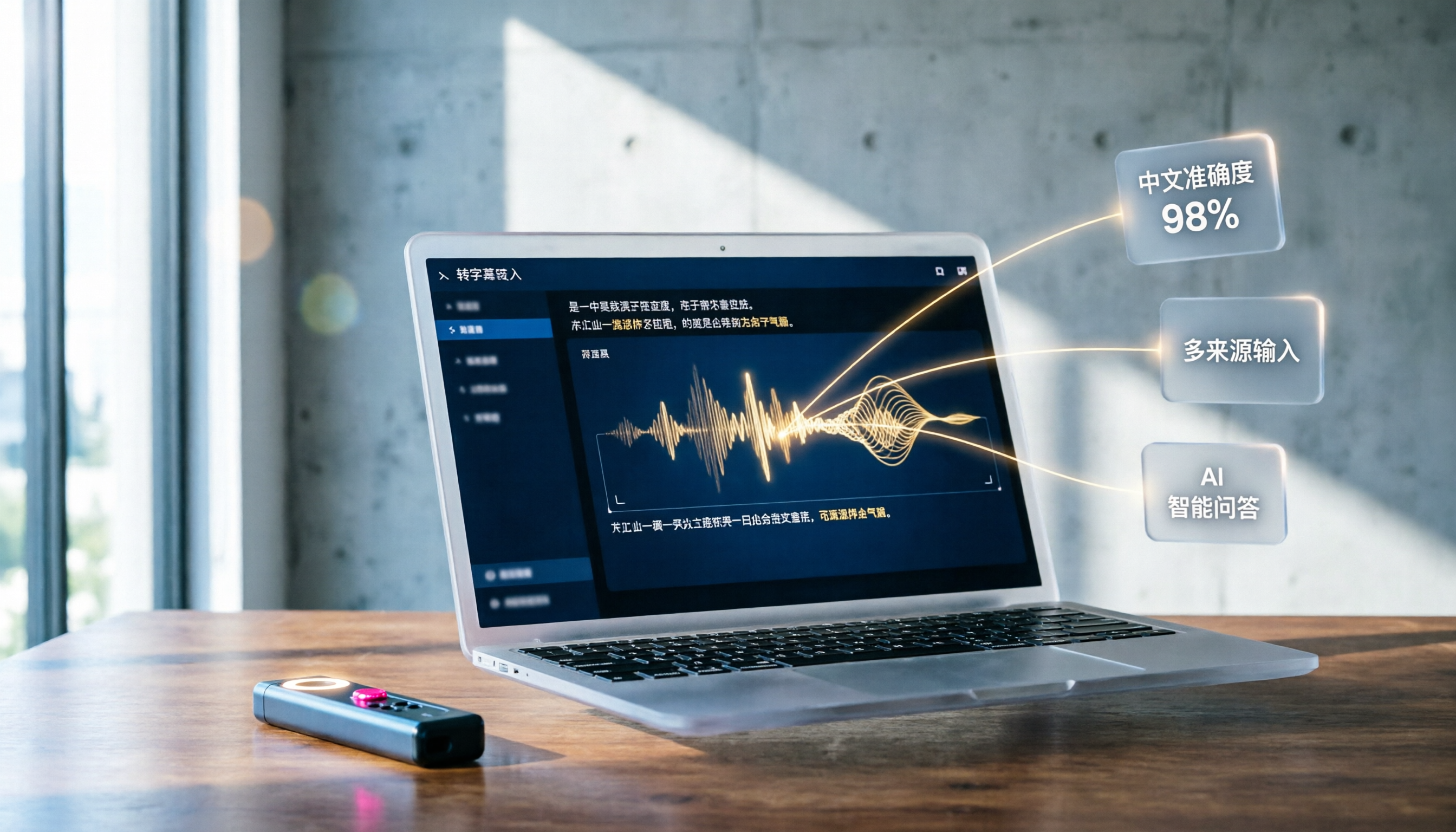
Which Audio-to-Text Tool is Best? We Tested 2 in 2026, and This One is the Most Comprehensive
A complete comparison of Tinrec vs Otter.ai across 5 key dimensions: Chinese accuracy, input sources, AI Q&A, pricing, and more — helping users who need audio-to-text transcription choose the right tool.