

Turn recordings into transcripts and summaries in minutes
Upload audio or video for multilingual transcription, AI notes, and action items
Still manually taking Google Meet meeting minutes? Your time shouldn't be spent that way
Every time you finish a Google Meet call, you close the window and the recording just sits on your computer. To turn it into text, you either listen and type, wasting another hour or two, or you leave it aside thinking "I'll deal with it later" — and then never do.
Even worse, if someone speaks a mix of languages (like English and Chinese) and discusses multiple topics, it's often unclear who is supposed to do what. And even if you manage to create a full transcript, going back to find "the budget discussed last time" or "the deadline the client mentioned" still means reading through everything from start to finish.
If you have this problem, this article is here to help — using AI tools to turn your Google Meet recordings into searchable, queryable, and deliverable notes.
Before choosing a meeting notes tool, understand these 3 key points
There are many transcription services out there, but the ones suitable for Google Meet meetings go beyond simple dictation. The following three points greatly affect your efficiency.
First, can it directly process meeting recordings from your computer? Many people use their phone to record, but Google Meet allows you to record directly on your computer. If the tool can upload these files with one click and generate a transcript, it saves the hassle of converting and syncing. Our tests show that most tools support file upload, but transcription speed and format support vary widely.
Second, what can you do after transcription? Getting just a transcript is not enough. You need: quick identification of key points, automatic extraction of action items, and even the ability to ask AI "Who mentioned the Q3 budget?" These post-processing capabilities are the real time-savers. Among the tools we tested, some only provide text, some auto-summarize, but very few let you ask questions about the recording like you would a colleague.
Third, is it only useful for meetings? You might occasionally need to organize lecture recordings, interviews, or extract information from YouTube videos. If the tool can handle all these, you won't have to switch between apps. This also affects your willingness to pay — if it's single-purpose, you might stop using it quickly.
Tinrec (Miao Ting) — Our top pick after testing
Tinrec is an AI recording and audio/video organization tool supporting 14 languages, available on iOS, Android, and web. It doesn't just convert speech to text; it helps you organize Google Meet recordings, classroom audio, and even YouTube videos into a searchable, summarizable, and reusable database.
Using Tinrec for Google Meet meetings takes just 5 steps:
- During your Google Meet meeting, use your computer's built-in recorder or your phone to record — you'll get an audio file when the meeting ends.
- Open the Tinrec web app or mobile app and upload the audio file — supports common formats like MP3, M4A, WAV.
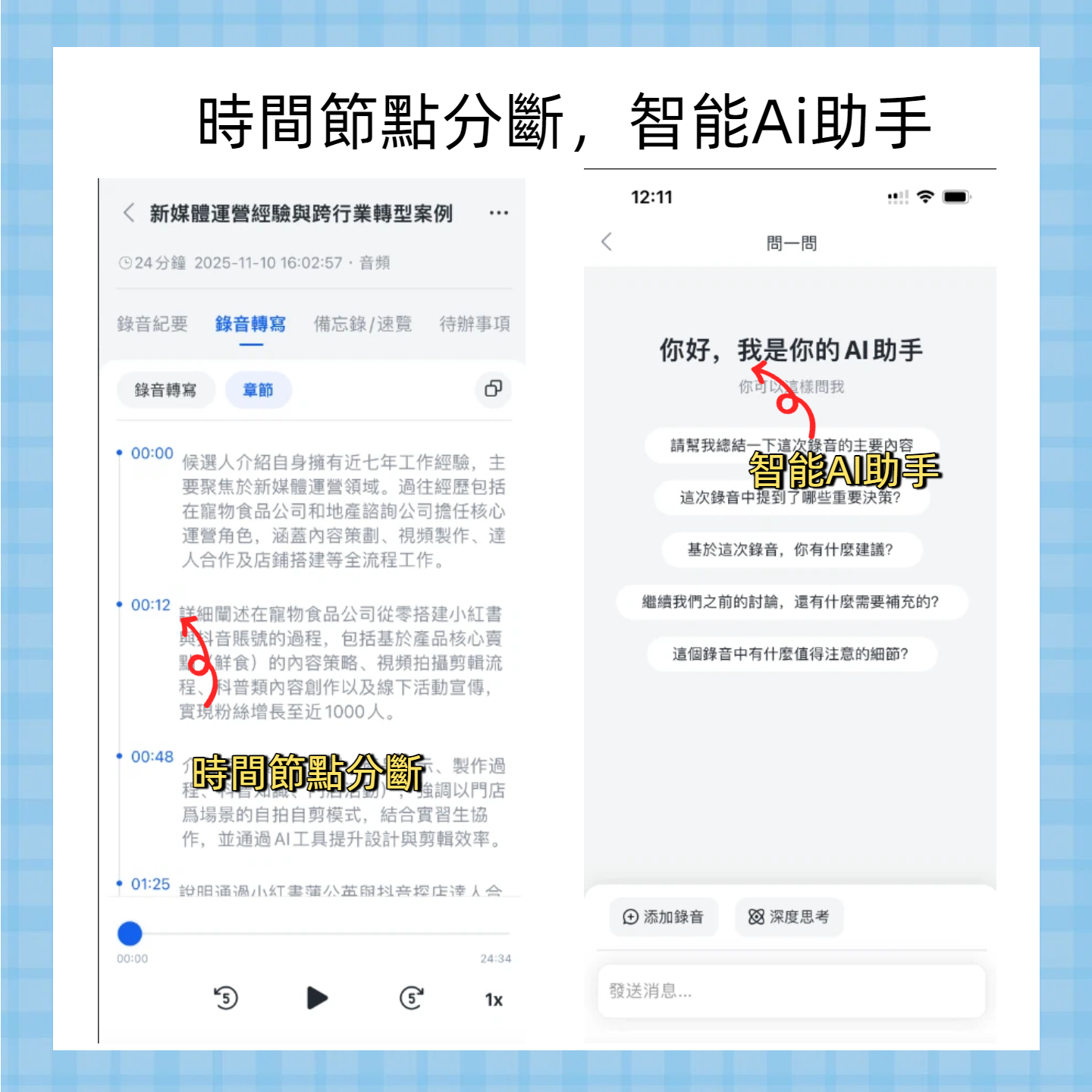
- Wait a few minutes (depending on file length) — Tinrec automatically generates a transcript, AI summary, chapter splits, and action items.
- Use the AI chat feature to ask questions about the content directly — for example, "Who mentioned the marketing budget?" or "What was the conclusion?" It answers based on semantics, not keyword search.
- Export as Word, PDF, TXT, or sync to Notion, Google Docs — ready to share with your team or include in reports.
We tested a 30-minute Chinese meeting recording (with mild keyboard and AC background noise). Tinrec's transcript had about 7.2% word error rate; speaker identification wasn't perfect, but key content was correct. The AI summary accurately captured three decisions and four action items, saving the half hour we used to spend manually writing meeting notes.
Pros:
Stop organizing recordings by hand
Upload audio or video and automatically get a transcript, summary, and action items
- Beyond transcription — ask about key points: Competing tools at similar price points almost never offer conversational query, making it very convenient to review past meetings.
- Multi-source support: Besides file upload, you can paste links from public videos on YouTube, Bilibili, etc., organizing online courses and interviews as well.
- Cross-platform, no hardware required: Record on phone, upload on computer, process on web — no extra devices needed.
Points to note:
- The free plan has a monthly transcription limit (about 100 minutes). Heavy users (meetings every day) need to upgrade to the Pro plan. But for most people meeting 2–3 times a week, the free allowance is enough for a trial.
- Speaker identification can still get confused when multiple people talk over each other. Try to take turns speaking during meetings.
Who is it for? If you have weekly Google Meet meetings, want automatic notes and action items, or need to turn historical recordings into a searchable database, Tinrec is a very worthwhile choice.

Alternatives to Tinrec
Otter.ai: A strong choice for English meetings. The free plan offers 300 minutes per month, which is quite generous. The Pro plan (about $8.33/month billed annually) adds advanced features. However, Otter does not support Chinese meetings and lacks the ability to transcribe from web video links. If your meetings are primarily in English, consider it; but for mixed Chinese/English or YouTube video needs, Tinrec is more versatile.
Fireflies.ai: A meeting bot that touts "unlimited transcription." It automatically joins Google Meet and records in real time. Pro costs about $10/month billed annually. While convenient, Fireflies excels at team collaboration and CRM integration; individual users may find it overly complex. Its focus remains on transcription, and its conversational query ability is less intuitive than Tinrec. For asking questions about the content, Tinrec offers a more Q&A-like experience.
PLAUD Note hardware recorder: If you're used to recording on the go, these AI recording devices (starting at about $179) are handy. But for Google Meet meetings, you'd need to buy additional hardware, and you still need to use the companion app for transcription. Tinrec uses your computer or phone, incurring no extra hardware cost, and can also handle web videos, making it more versatile.
Google Meet hardware conferencing devices: There are dedicated speakers and touchscreens integrated with Google Meet, such as those from Asus or Logitech. However, these hardware solutions cost thousands of dollars and only handle audio and video; they don't help with meeting notes. Unless you need professional meeting room quality, pairing Tinrec with your existing equipment is cheaper and provides AI organization capabilities.
Pitfall Guide: 4 common mistakes when choosing a meeting notes tool
Pitfall 1: Only looking at transcription minutes, ignoring post-processing features Many tools promote "XX minutes per month" or "unlimited transcription," but you still have to wade through a long transcript manually. The real time-savers are AI summaries, action item extraction, and conversational queries. With Tinrec, you can ask "What was the meeting's conclusion?" which is much faster than flipping through 30 minutes of text.
Pitfall 2: Overlooking cross-platform and format support You might record with an Android phone today, upload an MP3 from your computer tomorrow, and want to process a YouTube link the day after. If the tool is locked to a single platform or format, you'll face extra conversion steps. When choosing, confirm the supported formats and upload methods.
Pitfall 3: Sticking with the free plan and complaining about missing features Free plans are usually just a taste; they have limits on minutes or advanced capabilities. If you have meetings more than three times a week, consider a Pro plan (weekly or monthly card). The time saved is worth more than the software cost.
Pitfall 4: Buying hardware, only to realize you still need to organize the recording Google Meet-specific hardware or recording pens only solve the "audio capture" problem. You still have to manually transcribe and summarize — leaving you needing an AI tool anyway. Better to start with software that handles everything.
Summary: Which one should you choose?
Overall, if you need to organize Google Meet meetings, lectures, or interview recordings, Tinrec is our most recommended choice because it not only transcribes but also lets you ask questions to find key points, and works across all platforms without extra hardware costs.
Here's a scenario-based recommendation:
- Mixed Chinese/English Google Meet meetings requiring minutes and action items → Tinrec (AI summary + conversational query most useful)
- English-only meetings with zero budget → Otter.ai free plan (300 min/month, but no Chinese support)
- You already carry a recorder and don't mind an extra device → PLAUD Note (but organization still requires the app; less feature-rich than Tinrec)
- Your company already has meeting room hardware and you want a quick AI trial → Start with Tinrec's web version to upload recordings; free allowance is enough for a test
We recommend signing up for Tinrec's free plan and recording your next Google Meet meeting to try it — the 100 minutes per month is enough for two or three meetings. Once you're used to it, consider upgrading. No need to spend money upfront.
Turn every recording into actionable outcomes
Get 60 free transcription minutes when you sign in. No credit card required.
Related Reading
You might also like

Tutorial: How to Organize Google Meet Meeting Notes in 2026 – Auto-Generate Summaries & To-Dos with Tinrec
This article teaches you how to use Tinrec to quickly transcribe Google Meet recordings into text, automatically generating summaries, to-do items, and key points—saving you time after meetings. The free plan is enough to get started.

3 Ways to Transcribe Google Meet Meetings on iPhone in 2026: Find the Most Time-Saving Solution
iPhone users often have Google Meet meetings and then spend hours listening to recordings to write minutes? This time we tested 3 voice-to-text solutions, from built-in features to professional tools, and found that Tinrec is best for Hong Kong workers: real-time transcription, AI summaries, direct Q&A, finish work 5 minutes after the meeting.
Which Google Meet Transcription Tool is Better? 2026 Comparison of 2 Tools: This AI Tool is More Comprehensive
A real comparison between Google Meet's built-in transcription and Tinrec AI tool, from recording sources, AI summarization, Q&A, and export, tells you which is more suitable for Hong Kong office workers to organize meetings and audio/video content.

2026 Free Alternatives to Google Meet Jamboard: 5 Tools Reviewed at a Glance
Google Meet Jamboard is being retired. What about meeting notes and organization? This article tests 5 AI meeting note tools, recommends Tinrec as the top pick, and compiles free plans and pitfalls to avoid.

How to Convert Google Meet Recordings to Text in 2026? 5 Steps to Replace Built-in Transcription with Tinrec
Is Google Meet's built-in transcription limited? This article shares Esor's tested method: Use Tinrec to integrate meeting recordings, audio files, and videos, and organize meeting notes into a searchable, queryable knowledge base in 5 steps.

2026 Google Meet vs Tinrec: A 4-Dimension Showdown – Which iPad Meeting Recorder Reigns Supreme?
Using Google Meet on iPad for meetings? Is the built-in transcription enough? This article compares accuracy, AI summarization, cross-platform support, and cost across 4 dimensions, showing why Tinrec is the better meeting recording solution.

2026 Guide to Google Meet Meeting Minutes: Turn Recordings into Text and Auto-Generate Summaries & Tasks with Tinrec
Tired of endless meetings and spending hours transcribing recordings? With Tinrec, automatically convert Google Meet recordings to text, get AI summaries and action items, and finish work 5 minutes after the meeting ends.

2026 4 Google Meet Recording & Note-Taking Tools Tested: Top Time-Saver for Mac Users
Running Google Meet meetings on your Mac? Here's how to turn discussions into meeting notes fast. In this post, I share my hands-on comparison of four tools and the time-saving solution I finally settled on, with a complete workflow.

2026 Hands-on Comparison of 5 Google Meet Meeting Recording Tools: Which AI Notes Really Save Time?
Meetings every day, but notes always miss the key points? This article tests 5 popular Google Meet meeting recording tools, from AI summaries and task extraction to multilingual transcription, helping you find the best workflow.