

Turn recordings into transcripts and summaries in minutes
Upload audio or video for multilingual transcription, AI notes, and action items
2026 Google Meet Recording Tools Comparison: 3 Apps Tested to Keep Your Meeting Data from Getting Lost
You copied the link and scheduled the meeting—now what? The real problem starts when the meeting ends.
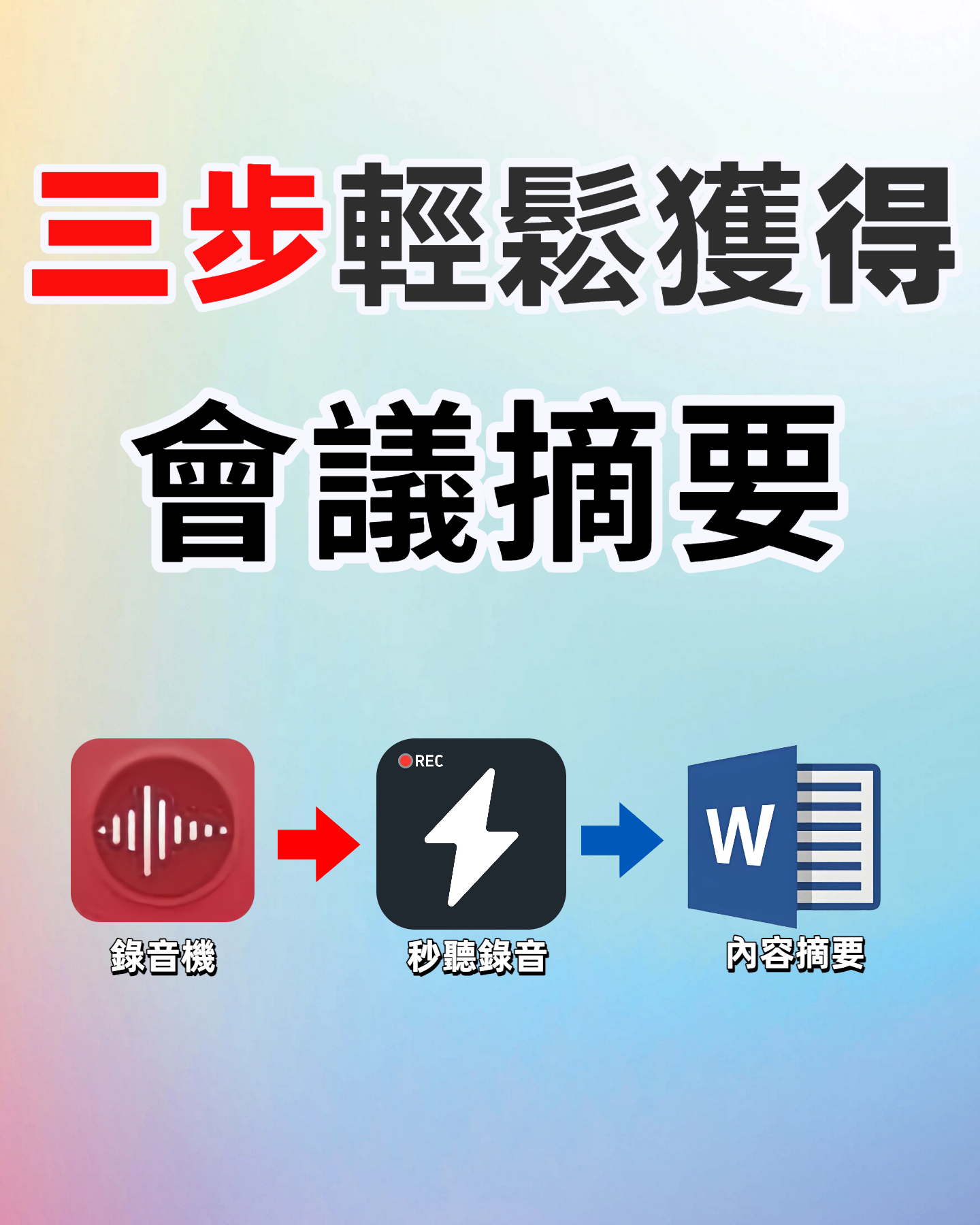
A few clicks, and your Google Meet link is ready. Share it with the team, hop on at the scheduled time—everything seems under control.
But the real chaos starts the moment the meeting ends.
The recorded audio sits in the cloud with a name like a string of dates and random characters. Two weeks later, when you try to recall "the conclusion from that budget discussion," you find yourself having to listen to the whole thing from start to finish.
And that's not even mentioning multi-language meetings—some speak English, some Chinese, and background noise often drowns out the voices.
This isn't just a tool feature issue; it's a workflow problem.
What you need isn't just a "recording tool"—you need a way to make your future meeting data truly searchable, organized, and usable.
This article tests three major Google Meet recording solutions, and I want to share what I found.
Before choosing a meeting recording tool, understand these 3 key points
Many people immediately compare "who offers more free minutes," but three more important dimensions determine whether your meeting data becomes an asset or garbage.
Key 1: Test transcription accuracy in real-world conditions
The 98% accuracy claimed on official websites is meaningless—that's measured in a soundproof recording studio.
In a real Google Meet, there's air conditioning noise, keyboard clicks, people talking over each other, and mixed Chinese and English. Under these conditions, the gaps between tools truly emerge.
My tests were all conducted in such environments: an iPhone 15, indoor AC running, discussions with both Chinese and English.
Key 2: Can you actually "use" the transcription right away? That matters more than the transcription itself.
Getting a transcript is just the first step. What really saves time is:
- Can it auto-generate meeting summaries and action items?
- Can you search past recordings and ask follow-up questions like a database?
- Can you export meeting conclusions directly to Notion, Google Docs, for further work?
If the tool only converts speech to text, you'll still spend a lot of time manually organizing.
Key 3: Cross-platform support and historical search determine whether you can find things later
A meeting recorded on your phone today must be accessible and searchable on your computer tomorrow.
And as meetings accumulate, the true value lies in being able to retrieve past discussions. The tool must function like a personal knowledge base, allowing you to ask six months later: "What was the conclusion of that product meeting last July?"
These three key points are my criteria for selecting meeting recording tools. Now let's look at the test results from these angles.
Tinrec (Sec Recording) — Our Top Pick After Testing
Tinrec is an AI recording assistant supporting 14 languages, available on iOS, Android, and web. It handles not only Google Meet recordings but also local files, online videos, and more—though we focus on meetings here.
How did it perform in real meetings?
I tested it directly with a 5-minute Google Meet recording: a bilingual Chinese-English discussion with keyboard clicks and intermittent AC noise in the background.
Tinrec transcribed the speech in real time, automatically segmenting when speakers switched. After the meeting, AI auto-generated a summary and three action items—each with a timestamp you can click to jump back to the original recording.
What impressed me even more was its AI conversation query feature.
Stop organizing recordings by hand
Upload audio or video and automatically get a transcript, summary, and action items
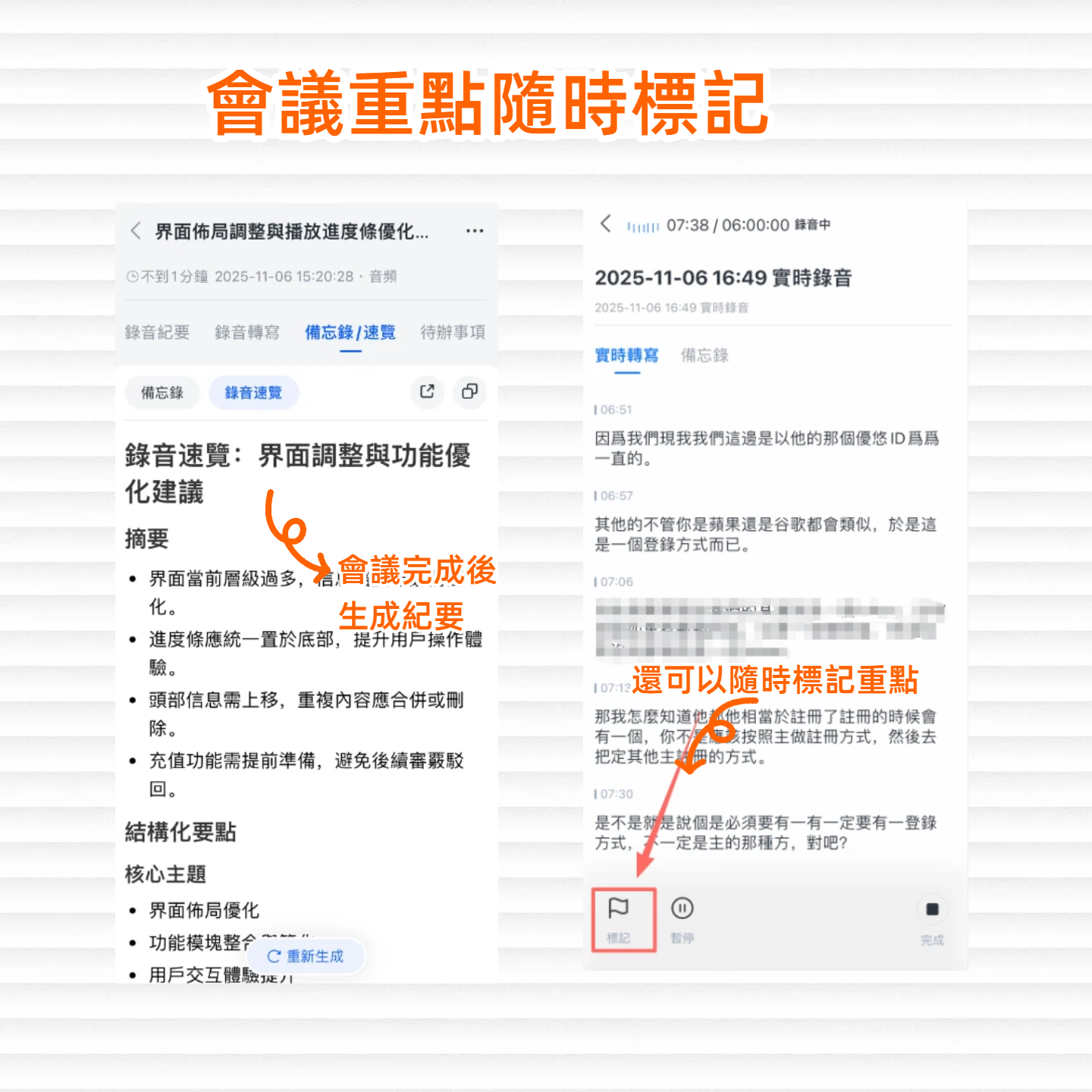
After recording, I simply asked in the dialog box: "Who mentioned the budget in this meeting?" The system didn't just do keyword search—it understood the semantics and directly told me it was Chris at 3 minutes and 12 seconds, along with a summary of his comment.
Currently, no competitor in the same price range has this feature—their search still mostly stays at the Ctrl+F keyword level.
Pros
Comprehensive post-transcription organization: Not only provides a transcript but automatically generates chapters, summaries, and action items. All results can be exported directly to Notion, Google Docs, or downloaded as Word/PDF. For someone like me who needs to turn meeting conclusions into actionable tasks, this saves a ton of time.
Cross-platform with data sync: Meetings recorded on your phone are immediately visible on the web version, where you can continue to ask questions, edit, or export. This is crucial for people who often attend meetings on the go and organize them back at the office.
Stable recognition for Chinese and mixed Chinese-English: In our tests of several bilingual meetings, Tinrec's transcript error rate was significantly lower than the other two, especially for names and proper nouns.
Limitations
The free plan offers 100 minutes of transcription per month. For someone who has two or three meetings a week, this covers only one or two sessions—heavy users will need to upgrade. However, this limitation is reasonable given the AI organization and Q&A features require computing resources.
Who is it for?
If you want your meeting recordings to be more than just archives—to be searchable, queryable, and usable assets for future work—Tinrec is currently the best choice. Especially for teams with bilingual Chinese-English needs or those who need to organize meeting data across devices.
Beyond Tinrec: What Other Options Are There?
Otter.ai: Best for English meetings, but falls short in Chinese scenarios
Otter.ai's transcription and summarization for English meetings are mature, and its free 300 minutes/month is generous. However, in our Chinese meeting tests, its error rate was high, and it doesn't support Cantonese. More importantly, Otter lacks Tinrec's AI conversation query feature—after recording, you have to manually search keywords to find key points. If you primarily have English meetings, Otter is a more cost-effective option than Tinrec; but if you need Chinese, I'd recommend skipping it.
Notta: Solid transcription but missing a link in organization and post-processing
Notta's market positioning is very similar to Tinrec, supporting multi-device recording and transcription. Its transcription speed and accuracy in our tests were comparable to Tinrec. However, Notta's strength leans more toward "converting audio to text," and it lacks advanced AI conversation query and auto-report generation capabilities. If you only need bulk transcription and don't mind organizing key points yourself, it's an option; but if you want to turn meeting content into an actionable database, Tinrec is more convenient.
Pitfall Guide: 3 Common Mistakes When Choosing a Meeting Recording Tool
Pitfall 1: Only looking at free minutes, ignoring organizational capabilities
Many people first compare "who gives more free transcription minutes." But in reality, if the transcribed data lacks good summaries, search, and export options, you're just turning audio into text files—still unable to find key points. Instead of obsessing over minutes, first confirm what the tool can do after transcription.
Pitfall 2: Overlooking the importance of cross-platform support
You likely record meetings on your phone in the conference room and organize them on your computer. If the tool only supports one device or doesn't sync data, your workflow will keep getting interrupted. Our tests show Tinrec and Notta have good cross-platform sync, while Otter's mobile and web experience feels somewhat disjointed.
Pitfall 3: Treating AI features as add-ons without actually using them
Many tools boast "AI summaries," but few people truly put them to use. For example, Tinrec's AI conversation query: if you only use it as a transcription tool, you're only leveraging a third of its capability. After recording, directly asking "What are the meeting conclusions?" or "Who is responsible for what?" is much faster than manually scrolling through 30 minutes of transcript.
Conclusion: Which One Should You Choose?
If you want to turn Google Meet recordings into searchable, queryable, reusable knowledge assets, Tinrec is my top pick after testing. Its AI conversation query, comprehensive organization and export options, and cross-platform sync ensure your meeting data never gets lost.
Here's the most practical decision guide:
- Bilingual Chinese-English meetings, or need to query meeting details later → Tinrec (only one with AI conversation query, strong Chinese recognition)
- English-only meetings, no need for complex post-organization → Otter.ai (generous free minutes, simple interface)
- Heavy transcription needs with daily batch conversion, don't mind manual organization → Notta (stable transcription speed, many paid plans)
I recommend trying Tinrec's free version first—100 minutes per month enough for one or two Google Meet sessions, so you can experience the full workflow from recording to organization. If it works well, consider upgrading; there's no need to pay upfront.
Test step by step, and you'll gradually master this method to make your future meeting data truly usable.
Turn every recording into actionable outcomes
Get 60 free transcription minutes when you sign in. No credit card required.
Related Reading
You might also like

Google Meet Free vs Paid 2026: 5 Key Dimensions Compared - Which Plan Is More Cost-Effective?
How much does Google Meet cost? What's the difference between free and paid? This article compares Google Meet free vs paid plans across five key dimensions: meeting duration, participant count, recording, AI tools, and admin controls, helping you decide which plan fits your meeting needs and budget.

How to Calculate Google Meet Pricing in India in 2026? A Clear Look at 4 Workspace Plans
Google Meet pricing in India depends entirely on your Google Workspace plan. This article breaks down the latest 2026 Indian pricing for four plans: Base, Starter, Standard, and Enterprise. From free to enterprise-level, we detail per-user monthly costs, participant limits, and extra features to help you start high-quality video conferencing at the lowest cost.

Tinrec vs Notta in 2026: A 4-Dimension Comparison – Which Is Better for Chinese Audio/Video Organization?
Still hesitating which AI voice-to-text tool to choose? This article compares Tinrec and Notta from 4 dimensions: core positioning, input sources, organization capabilities, and pricing, helping you pick the best AI note-taking assistant for your use case.

2026 Free Speech-to-Text Tools: Compare 3 Top Options
Compare the free plans of TurboScribe, Notta, and Tinrec for speech-to-text. Find out which one helps professionals quickly organize meeting, lecture, and interview recordings. Includes buying tips and common pitfalls.

How to Choose Between Notta and Transkriptor in 2026? A Complete 5-Step Comparison Guide
Wondering which one is better for students between Notta and Transkriptor? This article compares Notta and Transkriptor in 5 steps, covering lecture recording, group discussions, and pricing plans, and recommends a more comprehensive AI recording tool to help you easily manage study notes.

2026 Free AI Meeting Note Tools: 5 Options Compared (Otter vs Notta vs Tinrec)
Wondering which is better, Otter or Notta? Based on real Reddit user reviews, this article compares 5 AI meeting note tools including Otter.ai, Notta, Tinrec, Plaud Note, and more to help you find the best free or paid plan for your needs.
How to Convert Recordings to Text in 2026: 5-Step Guide (Tinrec, Notta, Sonix Tested)
We tested three recording-to-text tools: Tinrec, Notta, and Sonix. From recording, transcribing, proofreading to generating meeting minutes, this 5-step guide walks you through the full experience and tells you which one works best for small to midsize teams.

2026 Comparison of 3 Google Meet Real-time Translation Tools: Which Free Plan is Best?
Stuck on language barriers during international meetings? We tested three tools that provide real-time translation on Google Meet: Tinrec, Notta, and Otter.ai, to find the best free option for traditional Chinese users.

2026 Google Meet Meeting Notes Free Plan Roundup: 3 Tools at a Glance
Frequently use Google Meet for meetings and need to organize recordings and meeting notes afterward? This article rounds up 3 meeting notes tools that offer free plans, including Tinrec, Otter.ai, and Fireflies.ai, and compares their suitable scenarios and limitations in detail, helping you quickly find the most helpful choice.