

Turn recordings into transcripts and summaries in minutes
Upload audio or video for multilingual transcription, AI notes, and action items
Opening: The Full Value of an Online Meeting Goes Beyond Just the Call
As a content operator or someone who frequently collaborates across departments, you've definitely been in this situation: you need to start a last-minute Google Meet discussion, but you can never quite remember the quick steps to create a new meeting. More frustratingly, after the meeting, you have a pile of recordings sitting in the cloud, but no time to listen and organize them. This article will help you connect these two tasks: showing you step by step how to start a new meeting from various entry points, and then use an AI tool to convert the meeting recording into reusable text assets.
Step 1: Choose Your Preferred Entry Point to Create a New Meeting
Google Meet offers multiple ways to create a new meeting. Choose the one that fits your workflow best:
Start directly from meet.google.com
Open meet.google.com in your browser, click the "New meeting" button on the left, and you'll see three options:- Start an instant meeting: Immediately generates a meeting link and enters the meeting room—great for discussions that need to happen right away.
- Create a meeting for later: Produces a permanent meeting code and link that you can copy and share with participants later.
- Schedule in Google Calendar: Automatically redirects to Google Calendar to create a new event with the Meet link pre‑added—ideal for formal meetings where you need to confirm a time and send invitations.
Quick start from the Gmail sidebar
If you work in Gmail all day, the "Meet" section on the left is the fastest route. Click "New meeting" to start an instant call or copy a link to share. This is especially handy when an email discussion turns into an impromptu face‑to‑face conversation.Automatically add a Google Meet link when creating an event in Google Calendar
When creating a new event on calendar.google.com, click "Add Google Meet video conferencing," and a link will be generated automatically. You can add an agenda in the event description and invite participants—everyone will receive an invitation with the meeting link.
Pro tip: If you need to set up a livestream or adjust access permissions, click the dropdown arrow next to "Join Google Meet" before creating the meeting for more detailed settings.
Step 2: Take Notes and Record During the Meeting
Once you're in the meeting, aside from the discussion itself, make sure to do the following to make later organization much easier:
- Use the built-in recording feature: Google Meet's recording saves the meeting to the organizer's Google Drive. Note that this feature is only available to Workspace paid users. If you're using a personal account, consider using a phone recording app or your laptop's built-in recorder.
- Manually note key timestamps: For example, when important decisions or action items occur, note the time so you can quickly locate them in the recording later.
Step 3: Turn the Meeting Recording into Editable Text
After the meeting, the real heavy lifting begins. Here we use Tinrec (Miao Ting Lu Yin) as an example to show you how to save time relistening to recordings.
Stop organizing recordings by hand
Upload audio or video and automatically get a transcript, summary, and action items
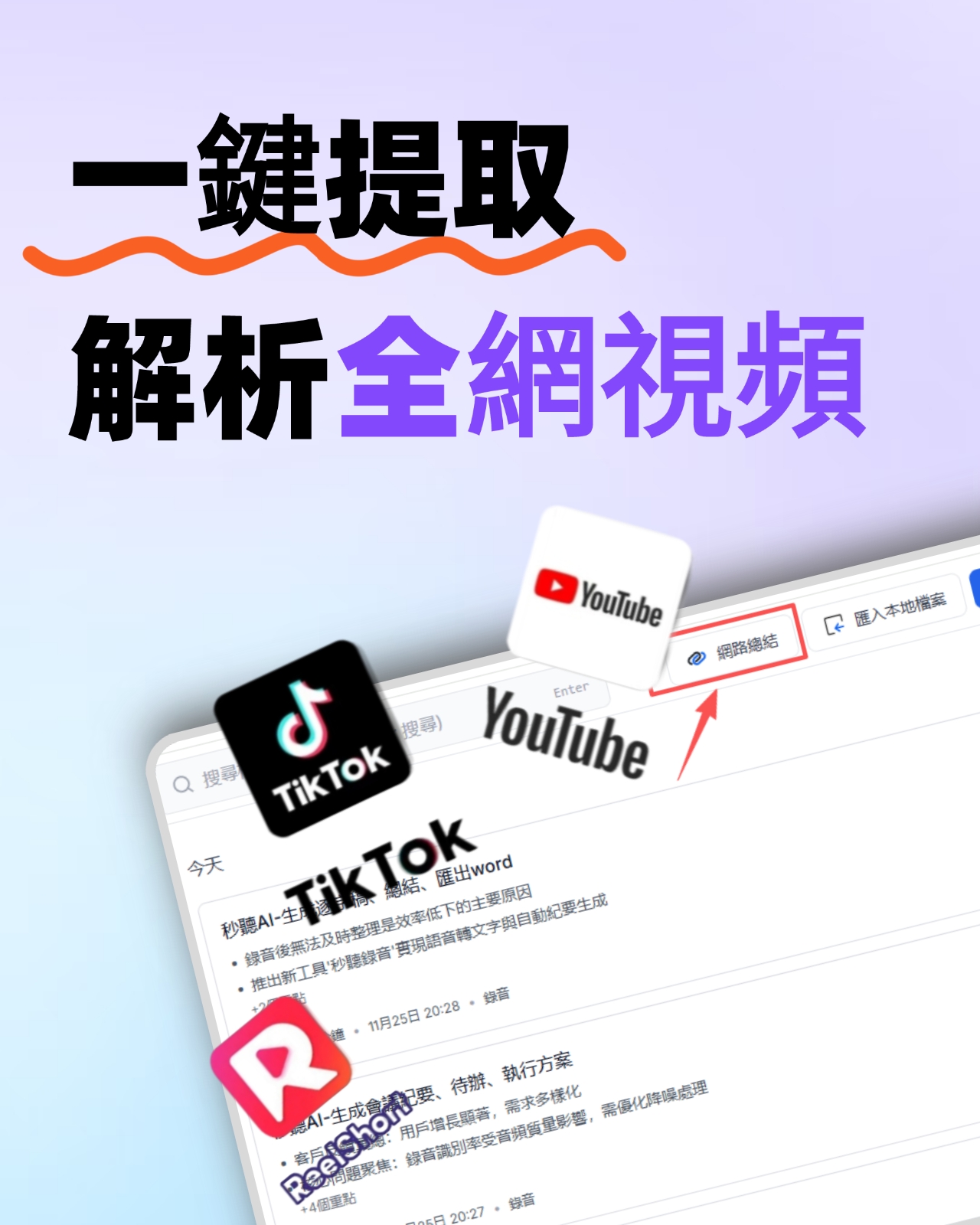
Upload the audio file or paste the Google Meet recording link directly
Tinrec supports multiple sources: you can upload audio files (MP3, M4A, WAV, etc.) from your phone or computer, or directly parse a Google Drive recording link or even an unlisted YouTube video. This step kicks off the full transcription process, producing a verbatim transcript.Review the basic transcript
Once transcription is complete, the system displays a timestamped transcript. Quickly scan it to confirm:- Speaker names and titles are correct (if the recording is clear, Tinrec can automatically distinguish different speakers).
- Proper nouns, product names, or numbers are not obviously wrong.
- If any sections are confusing, go back to that timestamp to relisten and manually correct them.
One-click generation of summary, chapters, and action items
This is where AI truly saves time. In Tinrec, click "AI Summary," and the system will organize the discussion into:- Structured chapters: Breaks the long meeting into sections like opening, agenda items, and conclusions.
- Key summary: Summarizes what was discussed in 3–5 bullet points.
- Action items: Automatically extracts "who needs to do what by when" and formats it as a to-do list.
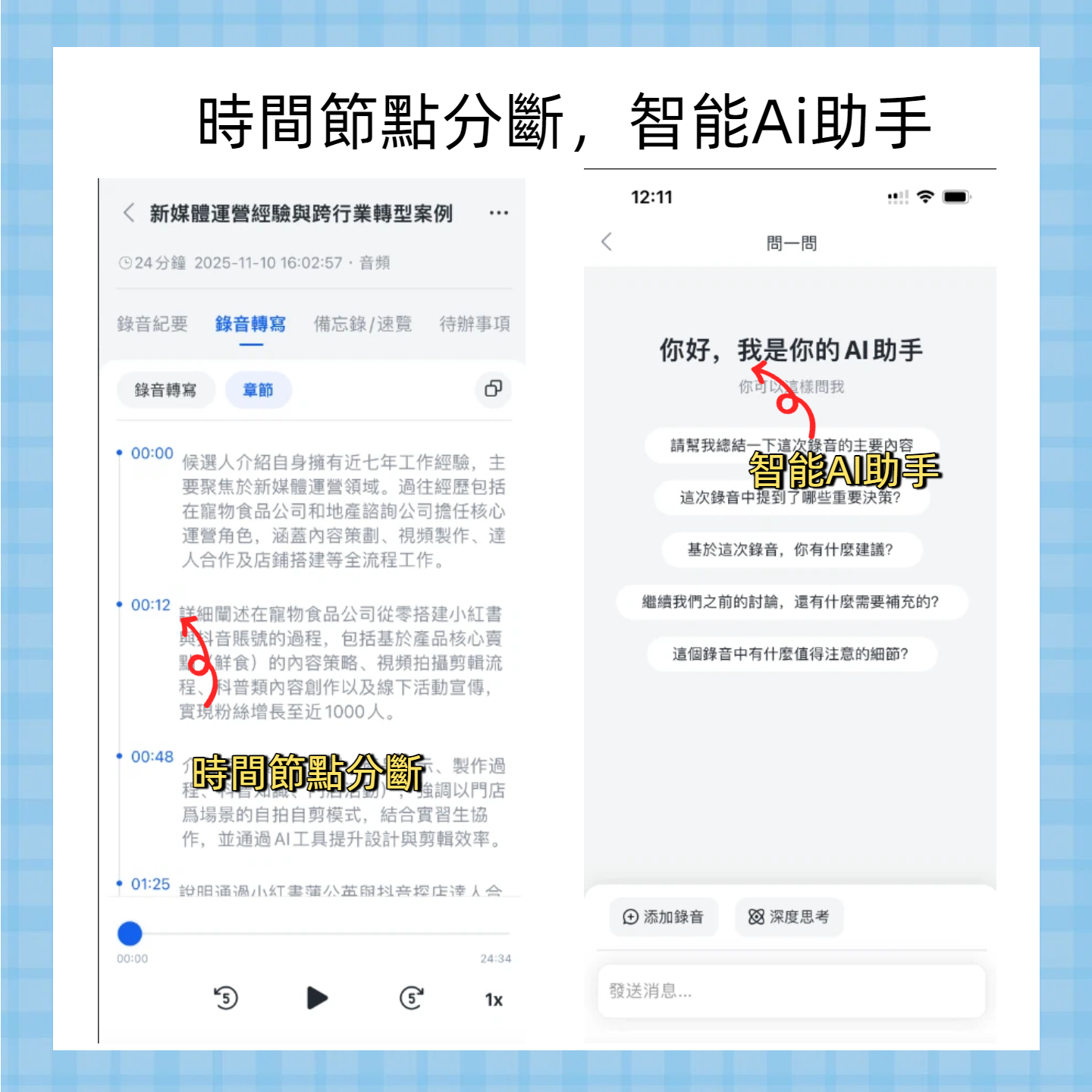
- Use AI Q&A to dig deeper into content
If you can't recall the discussion behind a certain decision, ask directly in Tinrec's chat box—for example, "What was the final budget number we decided?" or "What was David's specific opinion on the design changes?" The AI will answer based on the recording content, citing timestamps. This is incredibly useful for organizing large cross‑department meetings.
Step 4: Review and Export—Making Meeting Materials Truly Useful
AI summaries are convenient, but we recommend two additional steps to ensure information isn't distorted:
- Compare the transcript and summary: Especially for deadlines, amounts, names, and titles—always verify against the original transcript.
- Adjust the tone and format for your audience: For executives, emphasize decisions and risks; for team to‑dos, clearly assign owners.
After verification, Tinrec offers multiple export options:
- Export as TXT, MD, PDF, etc.—save to your company's shared drive or send via email.
- Sync to Notion, Google Docs—if your team collaborates on these platforms, you can seamlessly integrate.
- Generate subtitle files (SRT)—especially useful if the meeting recording needs to be uploaded to an internal training platform.
Frequently Asked Questions
Q1: Can I record meetings with the free version of Google Meet?
Free personal accounts do not have built-in recording. You can use third-party recording tools or screen recording software. Then upload the audio file to Tinrec for transcription.
Q2: Can it accurately transcribe multi‑speaker meetings with mixed Chinese and English?
Tinrec handles mixed Chinese (both simplified and traditional) and English content well, but accuracy may drop in noisy backgrounds or when multiple people speak at once. We recommend using an external microphone and quickly proofreading key sections after the meeting.
Q3: Are there privacy concerns with meeting recordings?
Uploaded files are encrypted and used only to generate text and summaries. Tinrec does not use your recordings for any other purpose. Still, we recommend checking your company's internal security policies.
Q4: Is the free version sufficient? How do I choose a plan?
Tinrec's free plan offers 60 minutes of transcription per month, with a maximum of 30 minutes per file—suitable for occasional meeting summaries. If you have weekly meetings or need to process longer recordings, consider the Pro plan (1,200 minutes per month, up to 5 hours per file), which also unlocks all export formats.
Conclusion: Turn Google Meet Meetings from One‑Time Conversations into Knowledge Assets
Quickly starting a new Google Meet is just the first step. What truly boosts team efficiency is turning those discussions into searchable, reviewable, and repurposable text materials. Next time you finish a meeting, don't just leave the recording in the cloud—try using Tinrec to automatically condense a 30‑minute conversation into a one‑page summary. You'll find that meeting notes can be surprisingly simple.
References
Turn every recording into actionable outcomes
Get 60 free transcription minutes when you sign in. No credit card required.
Related Reading
You might also like

Which Auto-Captioning Tool is Best? 2026 Review of 3 Tools, This One Has the Most Complete AI Features
We tested three auto-captioning tools, evaluating Chinese accuracy, AI features, and export convenience to find which ones really save you time. Top pick: Tinrec, because it not only transcribes but also lets you ask AI questions and generate summaries.

2026 Tinrec vs Plaud Note: A 5-Dimension Comparison for Audio/Video Organization
What's the real difference between the audio transcription app Tinrec and the AI recording hardware Plaud Note? This article compares them across five dimensions—Cantonese accuracy, cross-platform support, AI query capabilities, input source diversity, and long-term cost—to help you decide which is better for organizing meetings, courses, and online videos.

2026 Video Subtitling AI Complete Guide: How to Choose Automatic Video Captioning Tools? Tinrec vs Plaud Note In-Depth Comparison
Want to quickly add subtitles to your videos but unsure which AI tool to pick? This article takes a purchasing decision perspective, deeply comparing Tinrec and Plaud Note across video sources, real-time captions, accuracy, cross-platform support, and pricing, so you can see at a glance which one fits you better.

2026 Comparison of 4 Video-to-Text Tools: Which One Generates the Most Accurate and Fastest Subtitles?
Tested multiple video-to-text apps, from free to paid. Which one supports Cantonese and produces the fastest, most accurate subtitles? Tinrec (Instant Voice Recording) stands out with AI features. Check out the review!

2026 Comparison: Two Top Subtitle Generator Apps for Chinese Video Creators
This article compares Tinrec and Otter.ai, two AI subtitle generation tools, analyzing input sources, Chinese recognition, post-processing capabilities, and pricing to help you quickly decide which one is better for video subtitles.

How to Stay Focused While on a Mobile Meeting? Complete Guide to Google Meet On-the-Go Mode and Meeting Notes Tips
This guide walks you through setting up Google Meet On-the-Go mode to join meetings smoothly while commuting, walking, or moving, and explains how to use recording tools to quickly convert meeting content into transcripts, summaries, and action items.

2026 Comparison of 3 Google Meet Recording and Transcription Tools: Which Free Plan for Windows Users Is Best?
Using Google Meet on Windows has no built-in recording feature, making meeting notes cumbersome. This article tests 3 recording and transcription tools, showing how to pair them with PWA for efficiency and find the best free plan for Chinese users.

4 Google Meet Transcription Tools Compared in 2026: Which AI Summary Saves You the Most Time?
Struggling to record Google Meet meetings on your TV? This article tests Tinrec, Otter.ai, Notta, and Yating transcript, comparing cross-platform support, Chinese accuracy, and AI summarization to help you find the best meeting recording tool.

2026 Comparison of 4 Auto Video Captioning Tools: Which Free Plan Is Most Useful?
Tested multiple auto video captioning tools, analyzed free version limitations and real-world experience, and recommend the best solution for Taiwan users that supports Chinese and has sufficient free quota.