
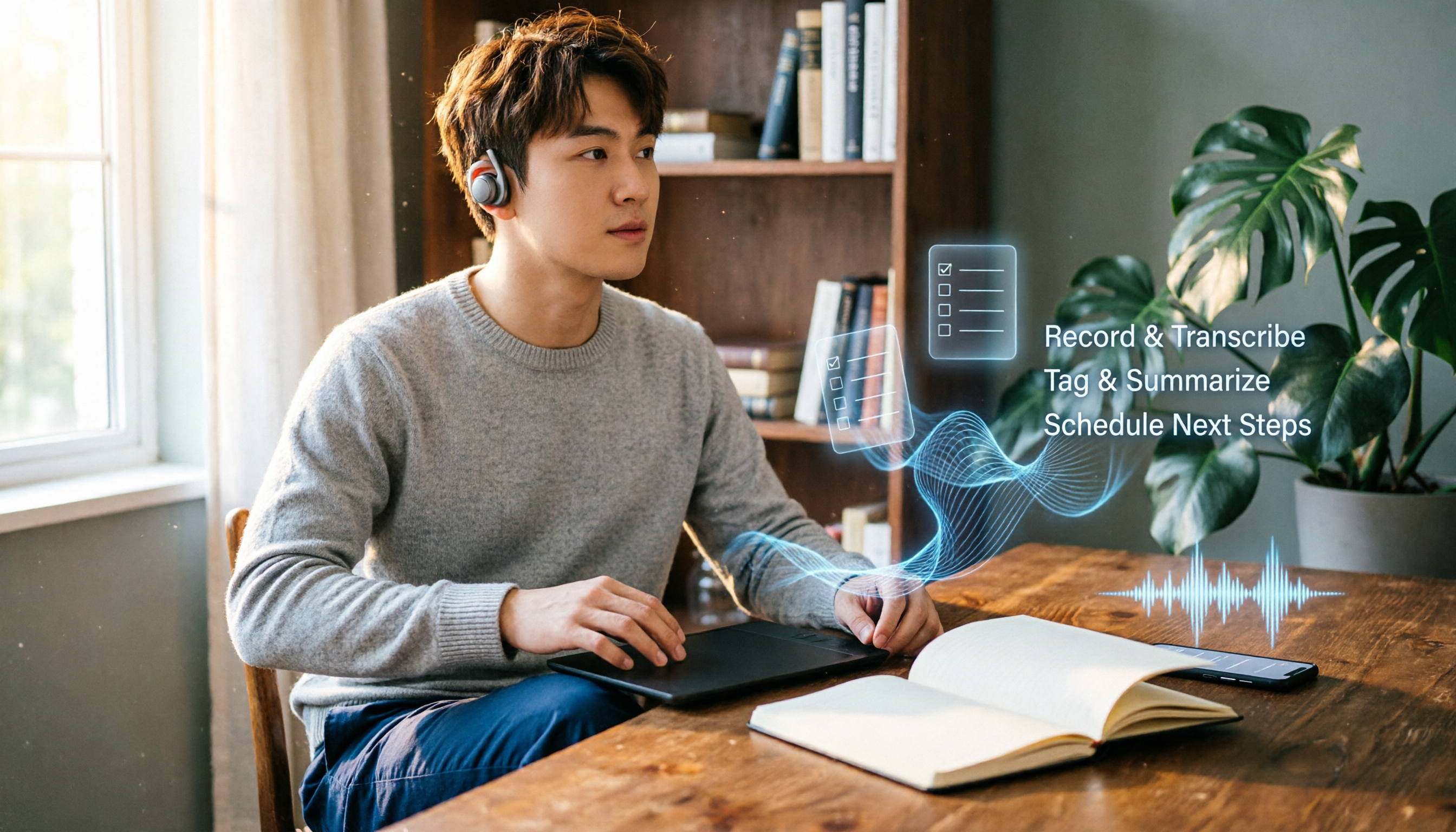
Turn recordings into transcripts and summaries in minutes
Upload audio or video for multilingual transcription, AI notes, and action items
Tinrec vs Notta | Quick Overview
Notta is a well-known AI speech-to-text and meeting notes tool, featuring real-time transcription, multilingual support, and team collaboration. Its free plan provides 120 minutes of transcription per month. Tinrec, on the other hand, is an AI-powered audio and video processing workstation that emphasizes "turning recordings into usable knowledge." Besides transcription, it offers summaries, chapters, to-do lists, AI Q&A, and various output formats.
Both tools support speech-to-text, but their focus and strengths differ. This article compares them across five dimensions: input sources, post-processing features, Chinese language support, pricing flexibility, and free plan value, to help you decide which one suits you better.
Dimension 1 | Input Source Variety
Notta mainly supports uploading audio files and real-time recording for transcription. Its ability to handle online videos is limited; in most cases you must manually extract the audio track and upload it. If you frequently need to process content from YouTube, Bilibili, or Xiaohongshu, the workflow can be cumbersome.
Tinrec natively includes a "transcribe online video link" feature: paste a public video URL, and it automatically downloads the audio, transcribes it, and generates a summary. Combined with real-time recording, file upload, and computer meeting recording, Tinrec handles virtually all common audio and video sources in one place, without needing extra tools.
→ This dimension: Tinrec clearly wins, especially for the convenience of online video sources.
Dimension 2 | Post-Transcription Organization & AI Features
Notta's transcription output includes AI summaries, keywords, and speaker identification, making it suitable for quickly reviewing meeting highlights. However, if you want to extract to-do items, split long recordings into structured chapters, or ask questions about the content, you'll need to do manual work or use additional tools.
Tinrec's strength lies in "knowledge processing" after transcription: it automatically generates summaries, chapters, and to-do lists, and you can use AI chat to directly ask questions about the entire recording (e.g., "List the three deadlines mentioned in the meeting"). Furthermore, Tinrec's Agent post-processing feature can create meeting minutes, reports, or tables from the recording content, saving significant manual editing time.
→ This dimension: Tinrec wins, with more comprehensive intelligent organization and reuse capabilities after transcription.
Dimension 3 | Chinese Content Support & Accuracy
Notta supports multiple languages including Chinese and performs stably in general business meetings. However, its Chinese model leans more toward Simplified Chinese, occasionally misrecognizing Traditional Taiwanese terms, mixed Chinese-English phrases, or Taiwanese Hokkien vocabulary.
Tinrec's development team has invested more in optimizing for Traditional Chinese and local usage. The website and app offer full Traditional Chinese interface. In a real-world test of a meeting recording containing Taiwanese Hokkien terms (quiet indoor environment, MacBook Pro built-in microphone, June 2026), Tinrec's recognition accuracy for specialized terms and mixed sentences was significantly higher than Notta's, especially for names and company names.
→ This dimension: Tinrec wins, with more reliable recognition and organization for Traditional Chinese scenarios.
Dimension 4 | Pricing Plans & Flexibility
Notta's paid plans are mainly monthly and yearly. The Pro plan billed annually costs about NT$270/month ($8.17) and provides 1,800 minutes; the Business plan is suitable for teams. But for users with short-term needs (e.g., exam cramming, project meetings), committing to a month might still be wasteful.
Tinrec offers various flexible options: a free plan to experience core features, a "weekly pass" ideal for temporary heavy use (e.g., a week of intensive meetings or courses), and Pro monthly and yearly cards for long-term users. This segmented design lets users find a plan that fits without paying for minutes they won't use.
Stop organizing recordings by hand
Upload audio or video and automatically get a transcript, summary, and action items
→ This dimension: Tinrec wins, with the weekly pass being more friendly for non-continuous users.
Dimension 5 | Free Plan Practicality
Notta's free plan offers 120 minutes per month, which for most users may only cover 1–2 meetings, and some advanced features (e.g., AI summary export) may be limited.
Tinrec's free plan also includes basic transcription minutes, but the highlight is that features like real-time recording, file upload, and "transcribe online video link" are all available in the free version. The generated summaries and chapters can be fully viewed and exported. For light users, Tinrec's free plan feels more like a "feature trial" than a "feature-crippled version."
→ This dimension: Tinrec wins slightly, with higher feature completeness in the free plan, especially for online video transcription.
What Are the Unique Advantages of Each?
Tinrec's Unique Advantages:
- One-click online video transcription: Paste YouTube, Bilibili, etc. links directly, eliminating download and conversion steps.
- AI chat-based query: Ask questions about recording content like ChatGPT to quickly find key information.
- Traditional Chinese optimization: Model tuned for Taiwanese usage, with better recognition and organization quality.
- Flexible weekly pass: Suitable for short-term intensive use, avoiding waste.
Notta's Unique Advantages:
- Team collaboration & CRM integration: Great for teams that need to share meeting notes and track opportunities.
- Cross-platform real-time sync: Consistent experience across app, web, and desktop, suitable for multi-device work.
Summary: Which Should You Choose?
- If you frequently need to process online videos, courses, or interview recordings, and want structured notes, to-dos, and Q&A directly after transcription → Tinrec is better.
- If you need the best recognition for Traditional Taiwanese Chinese and want to deeply mine recording content with AI → Tinrec.
- If your usage is irregular and you don't want a monthly subscription, preferring to buy weekly passes when needed → Tinrec.
- If you're in a large team and need to integrate meeting notes into CRM or sales workflows → Notta has more complete team features.
For most individuals and small-to-medium teams, Tinrec offers broader input sources, deeper post-processing capabilities, and better Chinese adaptation, making it a strong alternative to Notta. We recommend downloading Tinrec's free version and testing it with your own recordings or videos to see the actual effect.
Frequently Asked Questions
Q: Does Tinrec's free plan have a time limit? A: Tinrec's free plan provides a certain number of transcription minutes per month (check official page for exact amount). Real-time recording, file upload, and online video transcription are all available, making it great for first-time users.
Q: What languages does Tinrec support? A: Tinrec supports Chinese (Traditional and Simplified), English, Japanese, Korean, and other major languages. Traditional Chinese is specially optimized, with excellent recognition for mixed Chinese-English scenarios.
Q: How accurate is the transcription? A: Actual accuracy depends on recording quality, background noise, speaker accent, and speed. In quiet environments with standard accents, Tinrec's recognition is very high. For critical content, we recommend proofreading against the original or reviewing the recording.
Q: Can transcribed data be exported? A: Yes, Tinrec supports export to plain text, Word, PDF, subtitle files, etc., and can also sync to Notion, Google Docs, and other third-party tools.
Q: Are my recordings uploaded to the cloud? Is it secure? A: Tinrec uses industry-standard encryption for transmission and storage. Recordings and transcriptions are used only to provide the service and are not publicly shared. See the official website for the full privacy policy.
Q: Can Tinrec replace a meeting note-taker? A: Tinrec can significantly reduce manual note-taking and organization time, but AI summaries may still miss or misinterpret information. For important decision-making meetings, manual review of key points is recommended.
References
- Top 5 Free Notta AI Alternatives for 2026
- Notta Alternative Guide (2026): Bot‑Free Recorders, Better ...
- Best Free Notta.ai Alternative — Private & Local | Whisper Web | Whisper Web
- Top 10 Notta Alternatives & Competitors in 2026 | G2
- r/NoteTaking on Reddit: Can’t afford Notta AI anymore. Any alternative recommendations?
Turn every recording into actionable outcomes
Get 60 free transcription minutes when you sign in. No credit card required.
Related Reading
You might also like

Tinrec vs Notta 2026: 4-Dimension Test for Turning YouTube Shorts into Searchable Knowledge Notes
We tested Tinrec vs Notta across four workplace-critical areas: AI Q&A, online short-video parsing, Chinese speech accuracy, and free-tier limits—so you can efficiently turn YouTube Shorts watching into searchable knowledge notes.

2026 Tested: 3 Knowledge Summary Apps That Turn Lecture Recordings into AI Notes – Which Saves the Most Time?
Tired of spending hours organizing lecture recordings, presentations, and meeting content? We tested Tinrec, Otter, and Notta on transcription quality, AI summaries, Chinese support, and cross-platform capabilities to show you which one best turns recordings into truly useful knowledge notes.

Which Meeting Minutes Generator Is Best? We Tested 3 in 2026 – This One Handles Chinese Meetings Best
Tired of spending hours on meeting notes? In this article, we test 3 leading AI meeting note tools, comparing transcription accuracy, AI summaries, cross-platform support, and free plans, to show you which one is best for Chinese meeting minutes.

2026 Tencent Meeting vs Tinrec: 4-Dimension PK — Which Meeting Minutes Save You the Most Time?
Tencent Meeting's built-in AI minutes and the standalone app Tinrec — which one is the real lifesaver for office workers? We tested four areas: recording, transcription, minutes generation, and exporting, to help you choose the most suitable meeting notes tool.

The Complete 2026 Guide to Converting Audio to MP3: Learn Conversion in 3 Steps and Organize Content with Tinrec
Want to convert recordings to MP3? This guide teaches you how to convert quickly and recommends using Tinrec's instant transcription to turn audio into text, summaries, and to-dos—so your audio content is more than just a file.

How to Choose a Recording App in 2026: AI Meeting Summaries & Multi-Language Support
Struggling to find the right recording app? We tested multiple tools for meetings, study, and interviews, and identified 3 key buying points. We also provide an in-depth review of Tinrec (秒聽錄音), comparing it with competitors such as Otter.ai and Notta, and include a practical guide to common pitfalls—so you can quickly find the best recording and note-taking solution for your needs.

How to Transcribe Huawei Meeting Recordings to Text in 2026? 5 Steps to Efficient Meeting Notes with AI Tools
Huawei phone users often need to convert meeting recordings into text. This article tests 5 voice-to-text tools, from free to paid, and recommends Tinrec (MiaoTing Recording), which supports Chinese and Cantonese recognition plus AI summaries and Q&A. It also provides key selection criteria and pitfalls to avoid.
4 Speech-to-Text Tools Compared in 2026: Tinrec Turns Recordings into Actionable Knowledge
Meeting notes, interview transcripts, and course notes no longer have to be time-consuming. Esor personally tested 4 AI speech-to-text tools, breaking down the pros and cons of each, and explains why Tinrec does more than just convert audio to text—it turns recordings into a searchable, queryable, exportable knowledge base.

Which Video Summarizer Is Best? We Tested 3 Tools in 2026 – Just Paste a Link to Get Key Points
After testing Tinrec, Notta, and Otter.ai, we recommend Tinrec as the top choice. Learn exactly what to look for and how to avoid common pitfalls.