

Turn recordings into transcripts and summaries in minutes
Upload audio or video for multilingual transcription, AI notes, and action items
After three meetings, still organizing transcripts at 8 PM—you need more than just subtitle extraction
I attend about 15 meetings a week—weekly stand-ups, project progress meetings, one-on-ones, cross-department coordination. What used to frustrate me wasn't the meetings themselves, but what came after. Every meeting generates a ton of decisions and action items to organize, not to mention when your boss suddenly asks you to find "that quote" from a meeting recording two months ago—it's a terrible feeling.
It's not just meetings. My team often needs to extract key points from competitor videos or course recordings. I've tried manual transcription (too slow), free transcription tools (terrible accuracy), and delegating to subordinates (they're busy too). Then I discovered AI tools that can directly convert audio and video to text and even summarize everything. Finally, I no longer waste my youth on replaying and typing.
This article comes from my real pain points as a manager, comparing two popular subtitle extraction tools on the market: Tinrec and Notta. I won't use marketing jargon—just the real feelings after my team's rigorous testing.
Before choosing a subtitle extraction tool, understand these 4 key points
Many people think subtitle extraction is just "turning sound into text," but the gap between tools can directly impact your daily work hours. I evaluate tools based on four dimensions:
1. Input Sources: Can it only handle meetings, or anything?
If you're like me and need to process not just meeting recordings but also online videos, course recordings, and even old phone recordings, the tool's input flexibility is crucial. Some tools are tied to online meetings only and can't handle local files or YouTube links, forcing you to find another solution.
2. Output Results: Just a transcript, or something immediately usable?
My boss wants conclusions and action items, not a dense pile of chat logs. If the tool can auto-generate summaries, chapters, and even export as report formats, it saves a ton of effort for managing upward.
3. Chinese Experience: How well does it handle Traditional Chinese, Cantonese, and mixed Chinese-English?
Our team frequently deals with clients from Taiwan and Hong Kong, and mixed Chinese-English in videos is the norm. If a tool can't even accurately transcribe a sentence like "OK, this deadline we need to confirm by next Wednesday," it's better not to use it.
4. AI Post-processing: What else can it do after transcription?
This is the key differentiator. Some tools just produce a transcript and stop. But if you can directly ask the AI, "Who mentioned the budget in the last meeting?" or "What's the core argument of this video?", it's like having a database secretary.
Next, I'll compare Tinrec and Notta using these four dimensions.
Tinrec — My team's top pick after hands-on testing
Tinrec is an AI audio and video organization tool that supports iOS, Android, and web versions. What sets it apart from typical transcription tools is: It not only extracts subtitles from videos but also turns messy audio-video content into workable data.
Core Features in Action
Last Friday, I had an intern use Tinrec to process a 20-minute competitor launch video from YouTube. Steps were simple: paste the link, the system automatically transcribed it, and simultaneously generated chapters, summaries, and key points—all in under 5 minutes. In the meeting, I directly used that summary to report to my boss without scrubbing through the timeline.
What's even more critical is the AI query feature. I had a 90-minute meeting recording and wanted to confirm "whether Supplier B's quote includes shipping." I just typed the question into Tinrec's chat box, and based on semantic understanding, it gave me the answer in 3 seconds, complete with timestamps for me to cross-check. Notta currently lacks this capability—you can only manually search keywords and slowly sift through mountains of text.
Stop organizing recordings by hand
Upload audio or video and automatically get a transcript, summary, and action items
Real-world Test
In a typical office environment (with keyboard clatter and air conditioning), we used an iPhone to record a 5-minute meeting discussion in Taiwanese Mandarin, including phrases like "The launch timeline might be delayed to Q4" and "Make sure to sync that UI kit with the design department." Tinrec's transcript was almost flawless, with correct transcription of names and jargon. Only "user journey" was transcribed as "使用者履歷" (user resume), which was a quick manual fix. Overall, it's more than adequate as a meeting memo draft.
Pros
- Multiple Input Sources: Handles meeting recordings, phone recordings, YouTube/Bilibili video links, and local audio/video files—no need to switch between tools.
- More Than a Transcript: Automatically extracts summaries, chapters, and action items. Output ready right after recording, saving me 40% of post-production time.
- Cross-Platform Cloud Sync: Record on your phone, then continue editing on your computer via the web—perfect for someone like me who's always on the go.
Limitations
The free plan offers 100 minutes per month. For heavy meeting users like me, a paid plan is necessary, but it's reasonable—the time saved translates to hourly wages, and the monthly subscription costs less than two Starbucks coffees. Also, for recordings with strong accents or highly specialized terms, manual proofreading is still needed, but no current AI tool achieves 100% accuracy.
Who It's For
If you frequently extract subtitles from videos, organize meeting recordings, or turn course/interview content into notes, and you want AI to help you find key points after recording, Tinrec is the most suitable choice for our team right now.
Alternatives to Tinrec
Notta: Accurate transcription, but lacks AI post-processing
Notta is also a mature transcription tool that supports real-time voice-to-text, file transcription, meeting templates, and team plans. Its Chinese transcription quality is good, and the interface is intuitive. However, compared to Tinrec, there are two notable gaps:
- AI Q&A: Notta can generate summaries, but you can't freely ask questions about the recording content later like you can with Tinrec. For professionals who need quick recall of historical data, this is a major efficiency difference.
- Post-output Application: Tinrec can further generate meeting minutes, reports, tables, and even export to Notion and Google Docs. Notta's output is mainly transcripts and subtitle files, leaving further processing to you.
If your main need is "large volume file transcription and translation," Notta's 1,800 minutes per month (Pro plan) might be more cost-effective. But if you're like me and need to continue organizing and cross-referencing after transcription, Tinrec offers a more complete solution.
Pitfall Guide: 3 Common Mistakes When Choosing a Subtitle Extraction Tool
Mistake 1: Only looking at price and minutes
Some tools offer generous free quotas but only support English or Japanese, with terrible Chinese recognition. Or they only provide transcripts without summaries or chapters, leaving you with the same amount of time to organize manually. First, confirm the languages it supports and the output format, then compare prices.
Mistake 2: Ignoring cross-platform needs
You might record on an iPhone today but want to edit subtitles on a Windows PC tomorrow. If the tool lacks a web version or cloud sync, you'll end up transferring files endlessly. Both Tinrec and Notta support multiple platforms, but some competitors are mobile-only—watch out for that.
Mistake 3: Treating AI as infallible, skipping verification
No matter how powerful the tool, it can still make mistakes with overlapping speech or noisy recordings. For important decisions, I always ask my team to cross-check against the original recording. That's not a tool issue—it's basic workplace professionalism.
Conclusion: Which One Should You Choose?
If in 2026 you need a tool that quickly extracts subtitles from videos, meetings, courses, and interviews, and turns them into truly usable data, Tinrec is our team's top pick after hands-on testing.
Scenario-based Recommendations
- Need to process meeting recordings + online videos + old files, and want AI Q&A to find key points later → Tinrec (best multi-source integration)
- Primarily handle pure meeting transcription with low need for AI post-query → Notta (decent transcription, but lacks AI interaction)
- Zero budget and only record English content → Otter.ai (generous 300 free minutes, but no Chinese support)
First, try Tinrec's free version—100 minutes per month is enough for a couple of meetings or a few short videos. If you really feel it saves you time, consider upgrading. No need to pay upfront.
References
- How to Use a Subtitle Extractor: 4 Useful Solutions
- Free AI Subtitle Extractor, Easy to Use - Zeemo
- Video-subtitle-extractor Hard Subtitle Extractor 2.2.0 CPU Version for Windows (Free) - Softking
- Subtitle Extractor: Quickly Separate, Extract, and Edit Video Subtitles - Filmora
- Free Embedded Subtitle Extraction Tool: Based on Image Recognition, One-Click to Export SRT Subtitles with Timestamps - YouTube
Turn every recording into actionable outcomes
Get 60 free transcription minutes when you sign in. No credit card required.
Related Reading
You might also like

2026 Two Voice-to-Text Apps Real-World Test: Which Cantonese Transcription Saves You the Most Time?
Tired of back-to-back meetings and overtime for meeting notes? We tested two popular voice-to-text tools, Tinrec and Plaud Note, comparing Cantonese accuracy, AI post-processing, pricing, and cross-platform support to find the ultimate time-saver for Hong Kong office workers.
2026 Cantonese Speech-to-Text Tool Buying Guide: 3 Products Tested & Recommended
Looking for a free and reliable Cantonese speech-to-text tool? This guide tests three popular options—Tinrec, GGLOT, and Subanana—comparing features, accuracy, and pricing to help Hong Kong users find the best fit.
How to Convert Audio to Text in 2026? Complete 5-Step AI Tutorial
How to turn meeting recordings and lecture recordings into text? Unwire reporters tested Tinrec instant recording transcription and teach you 5 steps to convert audio to text, with AI help to create meeting minutes and summaries, no more overtime typing transcripts!

2026 Tinrec Instant Transcription: Long Video to Text, AI Summary & Q&A
This article introduces Tinrec, an AI tool that quickly transcribes long videos to text, generates summaries, and supports AI Q&A. It also compares other transcription tools to help you choose the best solution for long video transcription.
2026 Review of 5 Audio-to-Text Tools: Legal Recording & AI Organization Picks
Want to keep a record of conversations but worried about breaking the law? This article clarifies the legal boundaries of recording, tests 5 audio-to-text tools, helps you legally preserve key content, and uses AI summaries and Q&A to turn audio files into truly usable data.

The Complete Guide to Speech-to-Text in 2026: From Methods to Tool Recommendations
Struggling to transcribe meeting recordings? We tested multiple tools and highlight Tinrec, showing how it helps quickly organize meeting minutes, lecture notes, and even features an AI conversation search so you no longer have to work overtime on manual transcripts.
2026 Comparison of 4 PDF to Text Tools: Audio to Text Is the Real Time-Saver
PDF to text tools can handle document scanning and content extraction, but most people face audio-to-text issues like meeting minutes and lecture recordings. This article uses Tinrec as an example to explain the core capabilities, real-world applications, and purchasing tips for audio-to-text tools, helping you choose the right transcription tool.
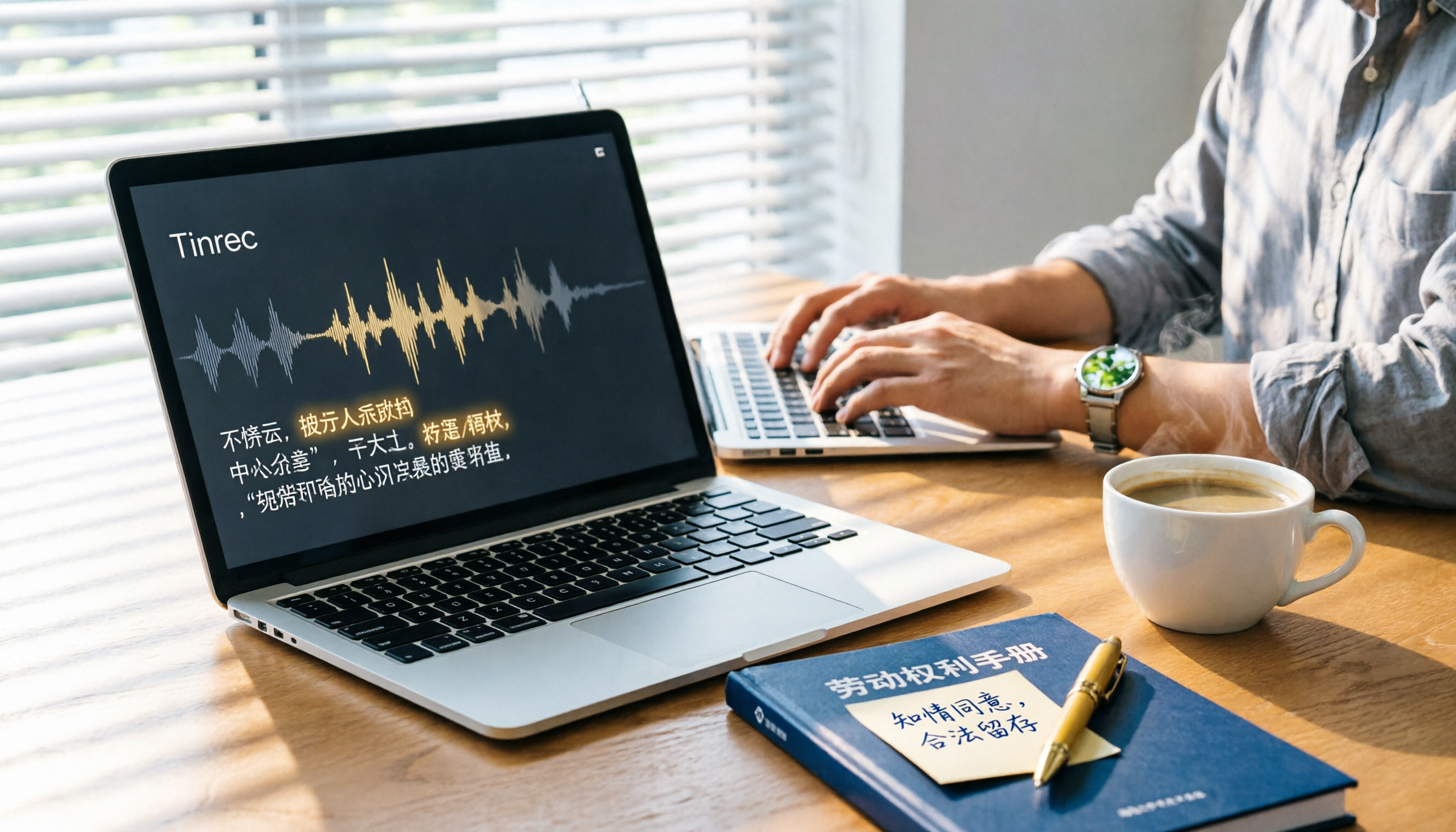
Is It Legal to Record at Work? 2026 Hands-On Comparison of 2 Recording Tools: How to Protect Yourself
Can recording conversations at work get you in legal trouble? This article clarifies the legal boundaries of workplace recording and compares two popular recording tools—Tinrec and PLAUD Note—across key dimensions like core positioning, input sources, post-processing, Chinese experience, and cost-effectiveness, helping you choose the best solution for gathering evidence in the workplace.
2026 Free Speech-to-Text Tools Recommended: We Tested 5, and Tinrec's AI Summarization Shines
Still manually transcribing? This article tests 5 free speech-to-text tools, comparing accuracy, AI summarization, cross-platform support, and free tiers. Tinrec not only transcribes but also auto-summarizes, creates chapters, and offers AI Q&A, turning meeting, lecture, and interview recordings into usable assets.