

Turn recordings into transcripts and summaries in minutes
Upload audio or video for multilingual transcription, AI notes, and action items
There are more and more meeting voice-to-text tools on the market, but should you choose software or hardware? This time, I hands-on tested two highly discussed options: Tinrec and PLAUD Note, comparing them across five key dimensions to help you decide in the shortest amount of time.
Tinrec vs PLAUD Note: Quick Overview
Tinrec is a software-centric AI recording and audio/video organization tool that emphasizes “turning recordings into usable knowledge.” PLAUD Note, on the other hand, is a standalone AI recording device that focuses on one-touch recording on the go, long battery life, and a premium hardware feel.
| Item | Tinrec | PLAUD Note |
|---|---|---|
| Type | Software (App/Web) | Hardware voice recorder |
| Price | Free tier + paid plans (weekly/monthly/yearly) | Hardware starts at around NT$5,000, plus a subscription to unlock more transcription minutes |
| Main input | Live recording, audio file upload, web video links, online meetings | Hardware recording, then upload and transcribe via the app |
| Core difference | Multi-source organization + AI post-processing | Physical buttons, long battery life, standalone microphone |
I’ll compare these five dimensions: input sources, output capabilities, Chinese content organization, long-term cost, and portability—then wrap up with a recommendation for which one might suit you best.
Dimension 1: Input Source Variety
PLAUD Note’s recording relies primarily on the hardware itself. While you can upload recordings to the app for transcription, if you want to work with YouTube videos, local audio files, or online meetings, you’ll need to find extra ways to transfer the audio to your phone or computer and then import it into the PLAUD app. It’s a roundabout workflow.
Tinrec natively supports live recording, audio/video file uploads, direct transcription from pasted web video links, and integration with online meeting tools like Zoom, Google Meet, and Teams. Whether it’s meetings, lectures, interviews, or web videos, everything can be organized within the same workflow.
→ In this dimension, Tinrec is clearly more flexible and saves you the hassle of moving sources around.
Dimension 2: Output and Post-Processing Capabilities
The PLAUD Note app provides templates for AI summaries, meeting notes, and to-do lists, which is sufficient for simple meeting records. However, these templates are fairly fixed. If you want to ask deeper questions about the recording, generate reports in custom formats, or export results to tools like Notion or Google Docs for further editing, PLAUD’s options are limited.
In addition to basic transcripts, AI summaries, chapters, and to-do lists, Tinrec includes an AI Q&A feature that lets you query the recording like a database. It also exports results in multiple formats and can even use Agent post-processing to automatically generate deliverables such as meeting minutes, reports, and tables. This makes it more like an “audio/video data workbench.”
→ In this dimension, Tinrec clearly wins on post-processing and output richness.
Dimension 3: Chinese Content Processing
PLAUD Note supports multiple languages, but the official materials don’t emphasize Chinese-specific tuning. From hands-on testing and community feedback, its Chinese transcription quality is stable, but it can still make some errors when faced with mixed Chinese-English text or Taiwan colloquialisms.
Tinrec’s product pages and messaging are clearly designed for Chinese-language scenarios, including Traditional Chinese, Simplified Chinese, and mixed Chinese-English content. It’s more friendly to Taiwanese users for meetings, lectures, and interviews. From my own tests, with the same Chinese meeting recording, Tinrec produced more natural keyword recognition and punctuation.
→ In this dimension, if you primarily work with Chinese content, Tinrec is a more reliable choice.
Dimension 4: Price and Long-Term Cost
PLAUD Note’s hardware costs start at around NT$5,000 (depending on the version). To get a higher monthly transcription minute allowance, you’ll also need a yearly subscription (for example, the Pro Plan is about NT$2,000 per year). For occasional users, the initial investment is relatively high.
Stop organizing recordings by hand
Upload audio or video and automatically get a transcript, summary, and action items
Tinrec’s free plan includes a basic transcription allowance, so you can try it out before deciding to pay. Its paid options include weekly, monthly, and yearly passes, suitable for short-term bursts and long-term steady use. With no hardware cost, the barrier to entry is lower.
→ In this dimension, Tinrec offers more flexible pricing and a lower barrier to entry.
Dimension 5: Portability and Use Cases
PLAUD Note’s strength is that it’s a standalone device—press a button and it starts recording, with long battery life. It suits situations where you need to start recording quickly without pulling out your phone. The downside is that you might forget to bring it, and you still need to upload files through the mobile app to transcribe them afterward.
Tinrec can be used as long as you have your phone or computer nearby, so most people don’t need to carry an extra device. For users who are already used to handling meetings and course notes on their phones, you can simply open the app and get everything done.
→ In this dimension, each has its merits. If you really value the physical feel of one-touch recording, PLAUD has an edge. Otherwise, Tinrec is just as convenient and you don’t have to worry about forgetting the hardware.
What Unique Advantages Does Each Offer?
Tinrec’s Unique Advantages
- Multi-source input: Handles live recording, audio file upload, web video links, and online meetings—one tool for all audio/video organization.
- AI Q&A and post-processing: Ask questions about the recording and automatically generate meeting minutes, reports, and tables, not just transcription.
- Optimized for Chinese: More natural recognition and organization of Traditional Chinese and mixed Chinese-English content, ideal for Taiwanese users.
- Flexible payment: Free tier to try, plus weekly, monthly, and yearly plans to fit different usage frequencies, no hardware lock-in.
PLAUD Note’s Unique Advantages
- Physical one-touch recording: A dedicated button lets you start recording quickly during meetings or interviews without unlocking your phone.
- Battery life and build quality: A long-lasting design for lengthy meetings or full-day classes, and a metal body that feels premium to carry.
Summary: Which Should You Choose?
- If you need to organize meetings, lectures, interviews, and web videos, and you want powerful AI post-processing → Tinrec is more comprehensive.
- If you mainly work with Chinese content and care about transcription quality and downstream use → Tinrec is a better fit.
- If you’re on a tight budget and don’t want to spend thousands of dollars on hardware first → Tinrec’s free tier is enough to get started.
- If you often need to record at the press of a button, don’t want to use your phone, and don’t mind the hardware investment → PLAUD Note is worth considering.
In one sentence: For most Taiwan-based users, Tinrec is a more tailored and flexible meeting voice-to-text solution. I’d suggest downloading the Tinrec free version first and testing it with your own recordings to see how it works.
Frequently Asked Questions
Can speech-to-text tools achieve 100% accuracy?
No. Every AI tool is affected by recording quality, background noise, accents, and overlapping speakers. Tinrec performs well in clear Chinese settings, but you should still verify important content against the original audio.
Do I need to buy hardware to turn meeting recordings into text?
No. Software tools like Tinrec let you record and transcribe directly on your phone or computer—no extra hardware required.
Is the free plan enough?
Tinrec’s free plan provides a basic transcription allowance, which is enough for people who occasionally organize meetings or lectures. If you need it every week, consider the Pro plan for better value.
Can PLAUD Note and Tinrec be used together?
Yes. If you already own a PLAUD device, you can use it to record and then import the audio into Tinrec for organization and richer post-processing.
Many meetings in Taiwan use a mix of Chinese and English. Which tool is more accurate?
Based on my testing, Tinrec handles mixed Chinese-English recognition and punctuation more naturally in line with Chinese habits. PLAUD Note’s multilingual recognition is okay, but it occasionally produces run-together words or awkward sentence breaks.
Can I export transcribed text to other note-taking apps?
Tinrec supports exporting in multiple formats and can integrate with tools like Notion and Google Docs, making it easy to continue editing or archiving.
References
- Meeting Ink – 2026 AI Meeting Notes Tools Hands-On: 8 Speech-to-Text and Summarization Tools Compared | Meeting Ink – AI Meeting Notes Assistant, Auto-Transcribe & Summarize
- AI Voice Notes: 5 Recommended AI-to-Text Tools to Generate Transcripts and Meeting Highlights – Free vs. Subscription | 104 Career Development
- No Time Limit! 3 Free AI Transcript Tools Worth Using: AI Voice Notes to Generate Meeting Notes, Presentations, and Mind Maps | 104 Career Development
- 2026 Recommended 6 Speech-to-Text Tools: Free Online Audio-to-Text Conversion!
- Audio to Text – Free Voice-to-Text Tool
Turn every recording into actionable outcomes
Get 60 free transcription minutes when you sign in. No credit card required.
Related Reading
You might also like

How to Convert EPUB to PDF in 2026: Free Online Tools + Full Tutorial
This tutorial explains how to convert EPUB ebooks to PDF format, covering multiple free online tools and step-by-step instructions to help you read and share on any device.

4 Speech-to-Text Tools Compared in 2026: Which One Handles Chinese Transcription Best?
How do you choose a speech-to-text tool? This article puts Tencent Cloud Speech Recognition, Yating Transcript, MyEdit, and Tinrec to the test, comparing accuracy, AI post-processing, and free plans to help you find the best fit for Taiwanese users.

Tutorial: 2026 Video Link to Text – No Install, AI-Generated Transcripts & Summary
Want to quickly convert YouTube videos or meeting recordings into text? This article introduces 5 online video-to-text tools, including Tinrec, VEED.IO, etc., that automatically generate transcripts, summaries, and subtitles without installation, and provides a selection guide and FAQs.

How to Extract Subtitles from Videos in 2026: A Complete 5-Step Guide
No subtitles for meeting recordings, tutorial videos, or online courses? This guide explains the difference between hard and soft subtitles, walks you through 5 steps to pick the right video subtitle extraction tool, and tests Tinrec, VLC, Video-subtitle-extractor, and more—so you can quickly turn video content into searchable, editable text.

2026 Hands-On Comparison of 2 Recording Summary Apps: Tinrec vs Otter – Which One Is Smarter at Organizing Chinese?
Are you exhausted from manually transcribing meeting minutes, class notes, and interviews? This hands-on test compares Tinrec and Otter.ai across audio-to-text transcription, AI summaries, multi-source organization, and Chinese recognition to help you find the best recording summarization tool.

3 Best Speech-to-Text Tools in 2026 Review: Which AI Meeting Notes Really Save You Time?
We tested Tinrec, Otter.ai, and Notta to compare accuracy, AI summarization features, free tiers, and cross-platform support—helping you find the best efficiency solution for meeting minutes, lecture notes, and interview transcripts.

2026 Tinrec Online Text Converter: Supports Cantonese & Auto-Generated AI Meeting Minutes – Tutorial
Tired of working overtime to write meeting minutes? This tutorial shows how Tinrec instantly transcribes recordings—not just converting audio to text, but also auto-generating summaries, to-do lists, and meeting minutes. Even Cantonese transcription works great!
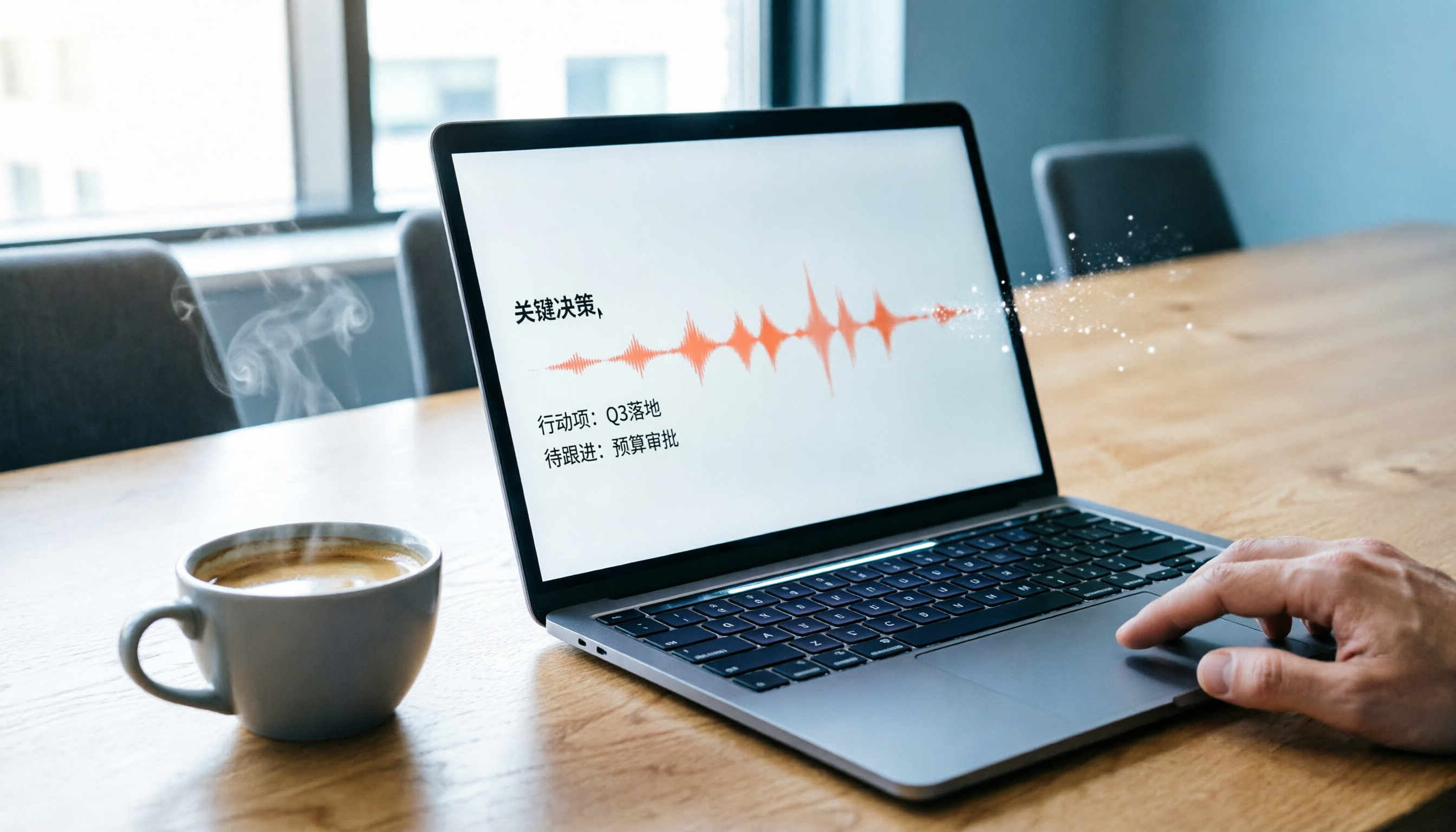
How to Choose Meeting Minutes Software in 2026: A Complete 5-Step Buying Guide
Tired of missing key points in meeting notes? This article reviews five AI meeting notes tools in 2026, from speech-to-text, smart summaries to multi-scenario applicability, and uses 5 steps to help you find the best option, so you'll never scramble during meetings again.

2026 Tinrec Voice-to-Text Review: Cantonese Recognition + AI Chat Query
Looking for a voice-to-text app? This article compares Tinrec voice recorder with Plaud Note, analyzing Cantonese recognition, AI features, cross-platform support, and pricing to help you decide which fits your needs. Full comparison and buying guide included.