
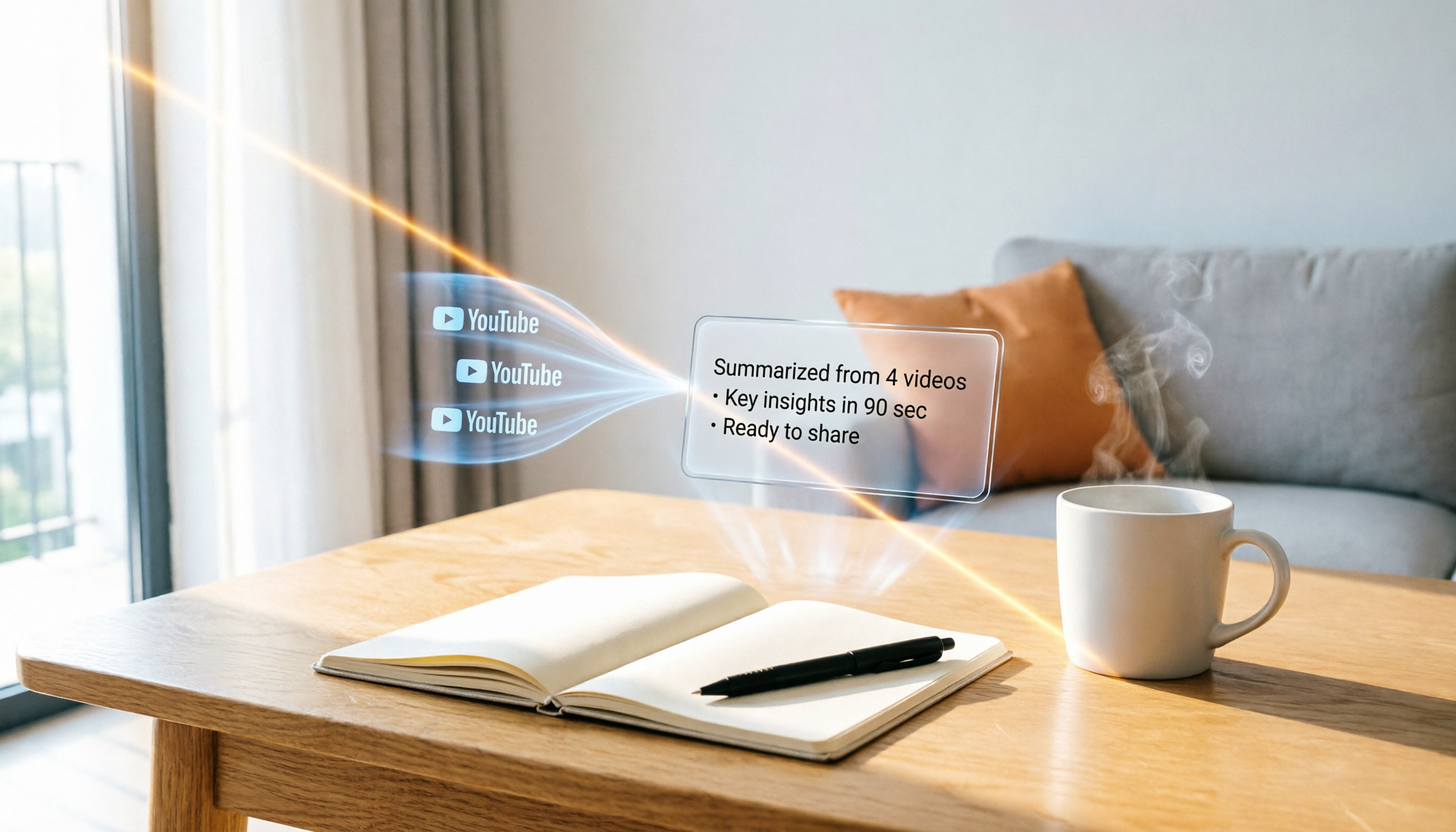
Turn recordings into transcripts and summaries in minutes
Upload audio or video for multilingual transcription, AI notes, and action items
What You Need Isn't a Tool, It's a Solution
Want to learn from videos but don't have time to watch them start to finish?
A two-hour meeting takes another two hours to organize into meeting notes—this is the daily reality for most office workers. Not to mention foreign course videos with English-only content: pausing to look up every other word makes learning so inefficient you want to quit.
If you've experienced any of these situations, this article is for you. We tested five AI video content summarization tools to help you find the option that saves the most time.
Before Buying a Video Summarization Tool, Understand These 4 Key Points
Not every tool is the same. Think about these four directions before purchasing to avoid pitfalls.
Beyond summaries, what else can it do for you?
Many tools stop at a summary, but a good tool should help you organize the content further—automatically extracting to-dos, breaking long videos into chapters, and even letting you ask follow-up questions like Q&A. These features are the real time-savers.
How many video sources does it support?
Where are your videos? YouTube, Bilibili, or your own meeting recordings? If a tool supports only one platform, you'll have to switch apps for different sources, which is a hassle. Choose a tool that covers multiple sources so you can handle everything with one account.
How well does it handle Chinese content?
Many tools perform well in English but stumble with Chinese. If you mainly process Chinese or Chinese-English mixed content, test the transcription accuracy and summary quality first—don't just look at official marketing numbers.
Is the free plan enough for you?
Almost every tool offers a free plan, but what are the limitations? A few minutes per month, or crippled features? Estimate how much time you'll use each month, then decide whether you need to pay.
Tinrec (Miao Ting Lu Yin) — Our Top Pick After Testing
Tinrec (Miao Ting Lu Yin) is an AI recording and audio/video organization tool designed for Chinese speakers, with support for iOS, Android, and web. It doesn't just convert speech to text—it turns content into material you can use immediately.
From recording to actionable knowledge
Open Tinrec during a meeting, and it transcribes in real time as it records. When the meeting ends, the AI has already generated a summary and to-dos—who is responsible for what and deadlines are clear at a glance. Even better, you can ask it directly: "Who brought up the budget at the last meeting?" It doesn't just give you keyword search results; it tells you the answer. No other tool in this price range offers this feature.
Not just YouTube—it handles all kinds of videos
In addition to live recording, Tinrec lets you upload audio/video files from your phone or computer, or paste a link to public videos from YouTube, Bilibili, and more. It processes all the audio/video content you need to organize through one workflow. In our test with a 5-minute Chinese news video from YouTube, the transcript was virtually error-free, and the AI summary accurately captured every turning point.
Pros
- Multiple input sources: supports live recording, local files, and online videos.
- AI Q&A: ask follow-up questions after recording without manually scanning transcripts.
- Beyond summaries: automatically generates chapters and to-dos, and can export to different formats.
Stop organizing recordings by hand
Upload audio or video and automatically get a transcript, summary, and action items
Cons
- The free plan has a fixed monthly transcription allowance; heavy users will need to pay. However, it's enough for someone who has 2–3 meetings per week.
- The paid plans (weekly, Pro monthly, yearly) are flexible, but pricing details aren't listed on the official site, which lacks transparency.
Who it's for
If you often need to organize meeting recordings, course audio, or online videos, and you want to ask the AI to find key points after recording—Tinrec is the most complete option right now.
What other options are there besides Tinrec?
Monica
Monica is a free Chrome extension that generates video summaries on YouTube pages with one click. It's fast and supports multiple languages, making it suitable for anyone who just wants a quick overview of a video's key points. However, Monica is limited to YouTube and only provides text summaries—no AI Q&A or to-do extraction. If you need cross-source audio/video organization, Tinrec is a better fit.
WayinVideo
WayinVideo focuses on one-click generation of video summaries, transcripts, subtitles, and mind maps, with support for over 100 languages and a decent free tier. Its visual organization is appealing, but it can only handle YouTube links and doesn't offer live recording or file upload. Moreover, you can't query the recording content in a conversational way like with Tinrec—you have to read through it yourself.
MemoAI
MemoAI combines ChatGPT to summarize video content into bullet points or mind maps, which is visually clear. However, its workflow is more cumbersome: you need to obtain the transcript first and then feed it to the AI, unlike Tinrec's one-stop automation. Additionally, MemoAI doesn't support AI chat queries, nor can it handle live recordings or local files like Tinrec. It's better suited for YouTube users who simply want to create visual notes.
Pitfall Avoidance Guide: 3 Common Mistakes When Choosing a Video Summarization Tool
Only looking at summary quality, ignoring organization and reuse capabilities
Many people only care whether the summary is accurate, but a beautiful summary still requires extra work if it can't be turned into to-dos, meeting notes, or study notes. Instead of buying a summary generator, choose a tool that can produce actionable deliverables for you.
Ignoring cross-platform and multi-source support
Today you record on an iPhone, tomorrow you organize on your computer, and the day after you want to process a YouTube video. If the tool only handles one source, you'll keep switching between apps, making things worse. Choose a platform that supports multiple devices and sources for a truly hassle-free experience.
Assuming the free plan is enough, then hitting limits at critical moments
Free plans usually offer a limited number of transcription minutes that can run out after one or two uses. If your usage is irregular, consider a weekly plan option like Tinrec, where you can buy a short-term add-on during meeting or exam weeks, which is more cost-effective than committing to an annual subscription.
Conclusion: Which One Should You Choose?
Based on our testing, Tinrec is the most well-rounded choice, especially for users who need to handle meetings, courses, and online videos simultaneously.
- Need cross-source organization for meetings + online videos + local files → Tinrec (the only one covering all scenarios)
- Just want a quick way to see YouTube video highlights and don't need other features → Monica (free and intuitive)
- Prefer visual notes and only use YouTube → WayinVideo or MemoAI
We recommend downloading Tinrec's free version first—it includes a monthly allowance to experience the full features. Upgrade only if you find it useful; you don't have to pay upfront.
References
- Summarize YouTube with GPT: Free Online Video Summary Tool
- Free AI Video Summarizer – Accurate, Fast, with Timestamps - WayinVideo
- ChatGPT YouTube Summary Tips: From Transcript to Summary - Mr. Mad
- Video too long? No time to watch? Essential tools for learning and following stars! Quickly summarize long videos and translate foreign videos! - PanSci 泛科學
- YouTube videos too long? Let AI tools quickly analyze key points! - Article - Dream & Hunter - 獎金獵人
Turn every recording into actionable outcomes
Get 60 free transcription minutes when you sign in. No credit card required.
Related Reading
You might also like

2026 Hands-On Comparison of 4 Google Recording-to-Text Methods: Is Free Really Enough? Or Is Tinrec More Hassle-Free?
This article tests four free speech-to-text methods—Google Pixel's built-in Recorder, Google Docs voice typing, Google AI Studio, and Google Cloud Speech-to-Text—and compares them in depth with Tinrec, an AI tool developed by a Taiwan-based team. We evaluate accuracy, cross-platform support, AI post-processing, and real-world usage scenarios to help you find the best voice-to-text solution for meetings, learning, and interviews.
2026 Mobile Voice-to-Text App Comparison: Which Is Best for Chinese Meetings, Classes, and Interviews?
We tested four mobile voice-to-text tools, covering free-tier limits, AI summaries and Q&A, Chinese speech recognition, and cross-platform support. Tinrec (秒聽錄音) proved the most complete for Chinese meetings and study scenarios; Otter.ai suits English content; Notta transcribes well but has weaker AI post-processing. Full buying advice and pitfalls at the end.

5 Voice-to-Text Tools Tested and Compared in 2026: Which Free Version Is Good Enough and Accurate?
Tested five voice-to-text tools commonly used by users in Taiwan, including Tinrec, MyEdit, cSubtitle, Yating Transcript, and SoundType AI, comparing free plan quotas, accuracy, and extra features to help you find the best choice for meeting minutes, course notes, and interview transcription.
2026 Video-to-Text Tool Comparison: Which AI Q&A Saves You the Most Effort?
We tested three video-to-text tools—Tinrec, Otter.ai, and Notta—comparing accuracy, AI features, free tiers, and usability to help you find the best fit for transcribing Chinese video content.

5 AI Meeting Note Tools Compared in 2026: Which One Actually Saves You Time?
Spending two hours in a meeting and another two hours writing up notes? We tested 2026's five hottest AI meeting note tools across live transcription, AI summaries, Chinese-language performance, and free tiers to find the one that best fits users in Taiwan. Stop letting meeting notes run your life!

2026 4 Video-to-Text AI Tools Compared: Which One Gives the Most Accurate Transcripts and Does AI Summarization Really Help?
We tested four video-to-text AI tools—Otter.ai, Notta, TurboScribe, and Tinrec—and compared accuracy, AI post-processing, cross-platform support, and pricing to help leaders at small and mid-sized teams pick a video-to-text solution without making the same mistakes.

2026 Audio-to-Text Tools Tested and Compared: Which AI Summaries Really Save You Time?
This article tests four audio-to-text tools, including Tinrec, Otter.ai, Notta, and compares transcription accuracy, AI summaries, and free plans, to help you choose the best tool for meeting recordings and study notes.

2026 Free Xiaohongshu Short Video Summary Tools: 5 Options at a Glance
As a mid-level manager, I need to quickly summarize competitor short videos on Xiaohongshu. AI tools like Tinrec can convert videos to text and auto-summarize. This article reviews five free options and shares hands-on insights to help you find the most time-saving workflow.

4 AI Meeting Note Tools Tested in 2026: Beyond Transcription, Which One Has the Best AI Summaries?
Still scrambling to keep up with meeting notes? We tested 4 AI meeting note tools, from speech-to-text and AI summaries to cross-platform organization, to find the option that's best for Chinese speakers—one that truly turns meeting audio into actionable knowledge.