
Turn recordings into transcripts and summaries in minutes
Upload audio or video for multilingual transcription, AI notes, and action items
Meeting recordings, lecture notes, video organization—you need more than just a 'transcription' tool
A two-hour meeting can mean another hour spent transcribing. After listening to a lecture recording, you still have to search for the key points from the start. And when you find a YouTube video whose content you want to save, you're stuck typing it out or taking screenshots.
These scenarios are all too familiar for Windows users. There are plenty of recording-to-text tools on the market—some are free but basic, while others offer high accuracy at a steep price.
If you're constantly struggling with turning recordings into text, this article is for you. We've selected several practical Windows solutions and compared them from a real-world usage perspective, so you don't have to trial-and-error your way through every option.
Before Choosing a Recording-to-Text Tool, Keep These 4 Key Points in Mind
1. Accuracy: Don't Just Trust the Marketing Numbers
Many tools claim '98% accuracy,' but that's usually measured in a quiet recording studio with standard accents. In a real meeting room, with air conditioning hum, keyboard clicks, and people talking over each other, accuracy drops significantly.
We recommend testing with your own actual recordings rather than relying on spec sheets. In the hands-on test section below, we'll share our experience in typical environments.
2. AI Features: After Transcription, What Then?
If a tool only gives you a transcript, you still have to organize it yourself. Today, some tools can automatically summarize, highlight key points, extract action items, and even let you ask questions about the recording conversationally.
These AI post-processing capabilities can cut organization time from an hour to five minutes, making them a crucial factor to consider.
3. Cross-Device and Cross-Platform Support: Do You Only Work at Your Computer?
You might record a meeting on your phone and then organize it at your computer, or suddenly need to check a previous record while out and about. If a tool is limited to a single Windows machine, your flexibility is restricted.
Solutions with a web version or cross-platform sync are more practical in the long run.
4. Is the Free Tier Enough?
Free versions are nice, but many come with monthly minute caps or file length limits. If you have regular weekly meetings or a heavy course recording workload, you might burn through the free allowance quickly.
Estimate your weekly recording hours first, then decide between free and paid plans.
Tinrec (秒聽錄音)—Our Top Pick After Testing, Turning Recording into Usable Knowledge
Tinrec is an AI recording and audio/video organizing tool that works primarily through a web version on Windows—no installation needed, just open your browser and start. It supports real-time recording-to-text, uploading audio or video files for transcription, and even lets you paste public video links like YouTube to generate transcripts and summaries instantly.
Now let's look at what Tinrec can do in real-world scenarios.
Meetings: Transcribe in Real Time, Get Organized Notes as Soon as It Ends
Open Tinrec when a meeting starts, and it will transcribe the spoken words on screen in real time. As soon as the meeting ends, the AI will have automatically organized summaries, key points, and action items—who is responsible for what, and when it's due, all clearly laid out.
You can also ask questions against the recording, like, 'What was the budget mentioned in the last meeting?' Tinrec doesn't just search keywords—it understands the meaning and gives you a direct answer. This is incredibly useful when you need a quick review.
Learning: No More Listening to Lecture Recordings Multiple Times
With lecture or talk recordings, Tinrec automatically breaks the transcription into chapters and key points. You can jump straight to the section you want to review instead of playing through the entire recording. It can also generate a mind map to help you structure your knowledge.
Content Creation: Turn Videos into Text Material and Save Hours
When you come across a useful YouTube video, copy the URL and paste it into Tinrec to instantly get the full transcript and summary. For content creators, this eliminates manual transcription whether you need it for reference material or to repurpose into an article.
Advantage 1: More Than Transcription—It Helps You Understand the Content
Most transcription tools simply hand you a transcript and call it done. Tinrec goes further with summaries, chapters, action items, and Q&A. This turns your pile of recordings into a searchable, revisitable, reusable knowledge base.
Advantage 2: Multiple Input Sources
Unlike some tools that focus only on meetings, Tinrec supports real-time recording, local audio/video files, web video links, and can even handle online meeting recordings. No matter where your content comes from, it flows into the same organizing pipeline.
Advantage 3: Flexible Output Options
Beyond transcripts, Tinrec can export meeting minutes, reports, mind maps, or sync to tools like Notion and Google Docs. This ensures your results integrate seamlessly into your existing workflow.
Stop organizing recordings by hand
Upload audio or video and automatically get a transcript, summary, and action items
Hands-On Experience
We tested Tinrec with a roughly 10-minute Chinese meeting recording that included two people talking and occasional paper rustling. The transcription speed was fast, and the content was largely accurate, with reasonable recognition of names and proper nouns. The AI summary's highlighted points were very close to what we would have marked ourselves, and the Q&A feature indeed found specific information quickly.
Of course, if the recording has excessive background noise or speakers have very heavy accents, accuracy will suffer—that's a common limitation for any transcription tool.
Limitations and Pricing
- Free plan: Includes a monthly transcription allowance, ideal for those who want to try it out.
- Paid plans: Choose from weekly, monthly, or annual cards based on how often you use it. For users with regular meetings or classes, the Pro plan is more cost-effective; for short-term heavy needs, start with a weekly card.
Who Is It For?
- People who frequently need to organize key points from meetings, classes, or interviews.
- Those who want to summarize, ask questions, and cut down on manual organization right after transcription.
- Windows users who work across devices (record on phone, review on computer) or need to process web video content.
What Other Options Are There on Windows Besides Tinrec?
Windows Built-in Dictation (Win + H)
Windows 10 and 11 have built-in dictation that activates with Win + H, instantly converting voice from your microphone into text. It's completely free and requires no installation.
However, it only supports live dictation—it can't process pre-recorded files, and it lacks summaries or Q&A. It's fine for quick notes or text input, but for organizing a one- or two-hour meeting recording, its help is limited.
In addition to real-time dictation, Tinrec can import files, process web videos, and use AI to automatically organize key points—things the built-in tool can't do.
Microsoft Store: "Recording to Text - Speech to Text Assistant"
This app is available on Microsoft Store and focuses on one-click transcription of audio and video files, claiming accuracy as high as 98.8%. The free version has limitations, and you'll need to pay for longer durations.
In our real-world test, uploading a Chinese interview recording was indeed fast, but the subsequent organization still had to be done manually. It has no AI summaries, question asking, or action item generation, and it can't transcribe from a pasted web video link. If you only need occasional recording transcription, this one can fill in, but if you want to truly save organization time, Tinrec's AI post-processing is more efficient.
Microsoft Store: "Transcribe"
Another Store app, 'Transcribe,' focuses on AI speech-to-text, supporting over 98 languages, speaker identification, and built-in translation. After a free trial, you need to pay to unlock the full features.
Its speaker identification is a plus in multi-speaker meetings, but it similarly lacks web video link transcription and AI conversation query features. After recording, you still have to go through the transcript to find the important parts.
By contrast, Tinrec lets you ask 'What was the meeting conclusion?' directly, saving you from digging through the text—something a plain transcription tool can't compete with.
Pitfall Guide: 3 Common Mistakes When Choosing a Recording-to-Text Tool
Pitfall 1: Focusing Only on Transcription Speed and Ignoring Post-Processing Time
Many tools transcribe quickly, but their job ends once they hand you a long transcript. You still have to spend time reading, highlighting, and organizing it into meeting minutes.
The right approach: choose a tool with AI summaries, Q&A, and action item extraction, so the software handles the repetitive organizing. Tinrec's question feature, for example, lets you find key information conversationally, much faster than reading the entire transcript.
Pitfall 2: Overlooking the Impact of Recording Quality on Accuracy
'Why does the ad say 98% accuracy, but my transcription is full of errors?' The recording environment and equipment have a huge impact. Background noise, distance, and multiple people speaking at once all reduce recognition accuracy.
The right approach: get as close to the sound source as possible and minimize background noise when recording. When choosing a tool, don't just look at official numbers—test with your own files for the most accurate picture.
Pitfall 3: Paying for the Full Product but Only Using Basic Features
Many people buy the full package but only use it for transcription, never turning on the AI summaries or Q&A. That's like paying for an upgrade and getting only half the value.
The right approach: once you get a new tool, take time to try every feature. AI-related capabilities especially are often the key to getting twice the results with half the effort.
Summary: Which One Should You Choose?
If you only occasionally need to transcribe a short clip, Windows built-in dictation is sufficient. But if you regularly handle meetings, classes, interviews, or web videos, and don't want to spend hours on manual organization every time, Tinrec is the solution we recommend most after our hands-on tests.
- Need free, fast real-time dictation: Windows built-in dictation (Win+H)
- Just transcribe audio files with no further organizing: "Recording to Text - Speech to Text Assistant" works in a pinch
- Need multi-speaker meeting support with speaker identification: Consider "Transcribe" from Microsoft Store
- Want an all-in-one solution to save organization time: Tinrec is the top choice
- Regularly collect material from YouTube videos: Only Tinrec supports transcription via direct link
We suggest opening your browser to try Tinrec's free plan first—the monthly base allowance is enough for a few meetings or video transcriptions. Once you see it really saves you time, then consider a paid plan based on how often you use it.
References
- Recording to Text - Speech to Text Assistant - Download and Install for Free on Windows | Microsoft Store
- 10 Windows Speech-to-Text Software/Tools Recommended by Wondershare Filmora
- Recording to Text, Speech to Text Assistant - Download and Install for Free on Windows | Microsoft Store
- Transcribe - Convert Speech to Text - Download and Install on Windows | Microsoft Store
- 5 Best Tools for Easily Converting Speech to Text on Windows
Turn every recording into actionable outcomes
Get 60 free transcription minutes when you sign in. No credit card required.
Related Reading
You might also like

2026 Comparison of 4 Mac Voice-to-Text Apps: Tinrec AI Chat Saves the Most Time
We tested 4 Mac voice-to-text apps, and Tinrec (秒聽錄音) stood out with its Cantonese transcription and AI conversation search, making it the best time-saver for Hong Kong office workers.
2026 Samsung Voice Recorder vs Tinrec: A 4-Dimension Comparison — Which One Saves You Time and Keeps You From Working Overtime?
Is the built-in voice-to-text feature on Samsung phones enough? Is Tinrec really better suited for Hong Kong professionals? We tested and compared both tools across four dimensions—accuracy, AI features, cross-platform support, and real-world use cases—to help you pick the most time-saving recording-to-text tool.

2026 Apple Watch Voice-to-Text: Tinrec vs Otter.ai 5-Dimension Showdown – Which One Is Better for Chinese Users?
How do you quickly turn an Apple Watch recording into organized text? This hands-on comparison of Tinrec vs. Otter.ai evaluates accuracy, AI features, language support, cross-platform compatibility, and pricing to find the best voice-to-text solution for Chinese speakers.

2026 Android Free Voice-to-Text App Buying Guide: 4 Tested Tools and Recommendations
How do you choose an Android free voice-to-text app? We tested four tools—Tinrec, Google Live Transcribe, Atter, and Otter.ai—and compared accuracy, AI features, cross-platform support, and free allowances to help you find the best solution for meetings, studying, and content organization.
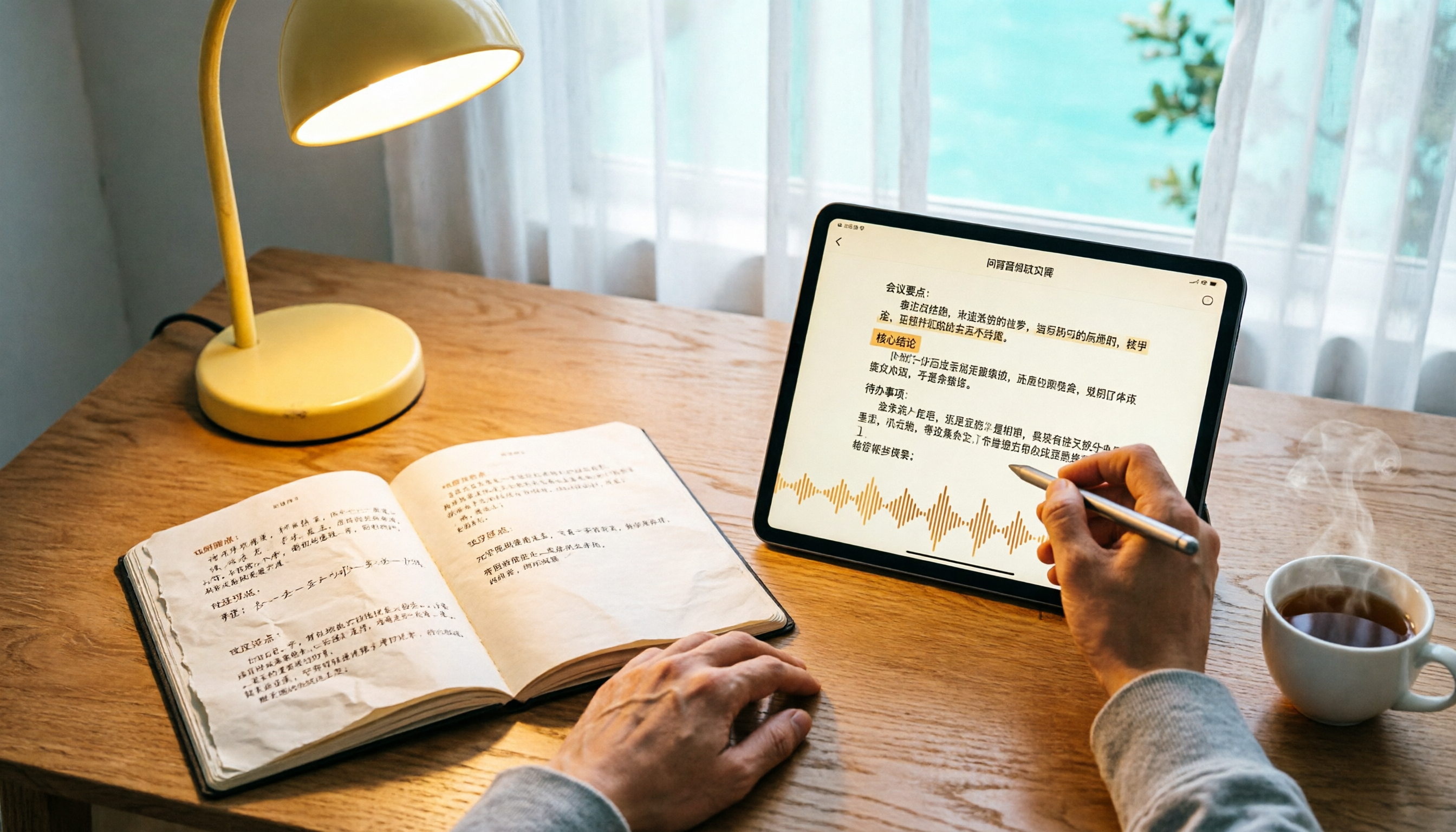
2026 iPad Voice-to-Text Apps Tested & Compared: 4 Apps for Note-Taking, Which Saves the Most Time?
Need to turn iPad recordings into text for notes? Is Apple's built-in Notes enough? We tested Tinrec, Apple Notes, Otter.ai, and Transcribe against each other, comparing accuracy, AI note organization, language support, and free plans to help you choose the best voice-to-text app for note-taking.
4 Best Speech-to-Text Apps for Deaf and Hard of Hearing People in 2026: Which Live Caption Tool Is Most Accurate?
We put four speech-to-text apps to the test, focusing on the live captioning features that deaf and hard of hearing users need most, and compared accuracy, free plans, cross-platform support, and AI assist features. Tinrec came out as the most complete option, but others have their own strengths.

2026 Hands-On Comparison of 4 AI Recording Tools for Academic Conferences: Tinrec Is the Top Pick for Chinese Transcription & Organization
Struggling with the time-consuming process of organizing recordings after an academic conference? This article hands-on tests 4 AI speech-to-text tools, comparing Chinese transcription accuracy, AI summaries, and organizing features. It finds that Tinrec (秒聽錄音) is the best fit for Chinese-language conferences, and its free tier already offers a sufficient monthly quota—making it the go-to choice for graduate students and scholars.

5 Best Lecture Recording Tools for Study Abroad in 2026: Tested & Compared – Take Notes Without Relistening
Struggling to understand lectures abroad? This article tests 5 lecture recording and translation tools, including Tinrec, Otter, Notta, and more, to help you organize class notes quickly, get real-time translated subtitles, and double your learning efficiency.

2026 Hands-On Comparison of 2 Real-Time Meeting Caption Tools: Which One Handles Chinese Recognition Best?
This hands-on comparison of Tinrec and Otter.ai evaluates two popular real-time meeting caption tools—covering Chinese recognition accuracy, latency, multi-source support, and pricing—to see which one better suits users in Taiwan.