

Turn recordings into transcripts and summaries in minutes
Upload audio or video for multilingual transcription, AI notes, and action items
2026 Review: 5 Free Cantonese Audio-to-Text Tools Compared – Which Free Plan Is Worth It?
Why Do You Need a Cantonese Audio-to-Text Tool?
Recorded a two-hour meeting on your phone but need to replay it all to type up minutes? Want to turn lecture recordings into notes but transcribing word-for-word takes forever? With advances in AI, many tools can now automatically turn Cantonese recordings into text, and even help you organize key points and action items. This article reviews 5 free tools that support Cantonese transcription, so you can decide which one fits you best.
Tinrec (秒聽錄音) – The Most Complete AI Recording Assistant
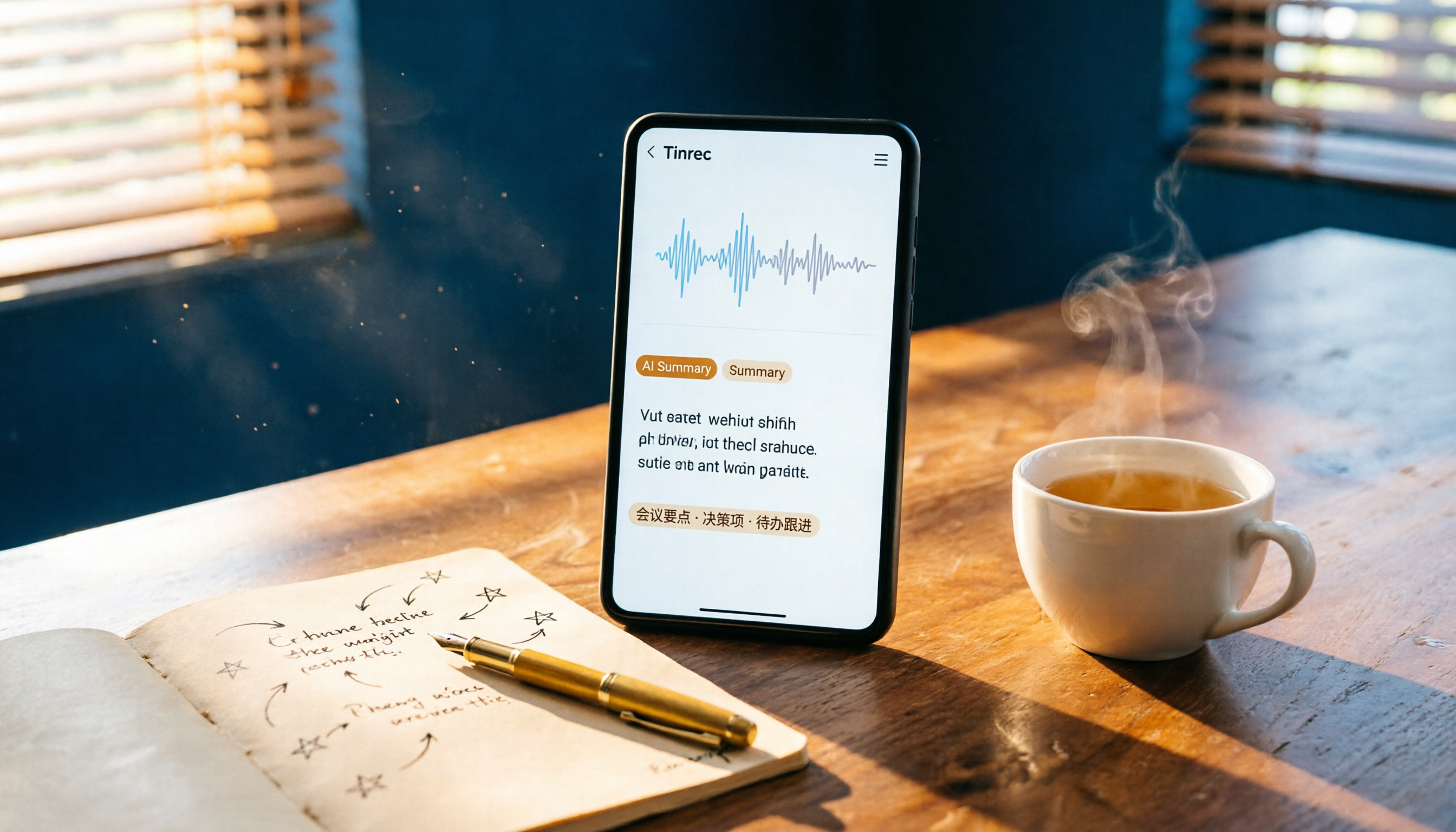
Tinrec is a full-featured AI recording and audio/video organization tool. It doesn't just convert live recordings, audio/video files, and online video links to text—it also auto-generates summaries, chapters, and to-do lists, and even supports AI Q&A where you can ask it about details in the recording. The free plan gives you 100 minutes of transcription per month, which is plenty for occasional users. It works on iOS, Android, and the web, so you can use it anywhere. If you need to process meetings, classes, interviews, or online videos, Tinrec is the most complete free starting point. Just keep in mind that once your free transcription minutes run out, you'll need to upgrade.
Google AI Studio (Gemini) – A Completely Free AI Transcription Tool
If you're comfortable with tech, Google AI Studio offers a completely free option. You can use Gemini models to transcribe audio, with good Cantonese recognition, and even ask Gemini to help summarize the content. The workflow is: upload an audio file, then prompt it with something like "Please transcribe this recording to text," and you'll get a transcript. Since it's free, it's great for users with heavy transcription needs, but it has a learning curve and isn't the easiest for everyone.
cSubtitle – An Easy-to-Use Online Transcription Tool
cSubtitle is an online speech-to-text platform that supports Cantonese. Upload an audio or video file and it will automatically transcribe it, usually within a few minutes. The free plan allows quick transcription of up to 3 minutes, which works for short clips or brief recordings. Paid plans handle longer content and can export subtitle files. For users who only need to transcribe a short segment occasionally, cSubtitle is a fast, convenient choice.
Speechnotes – A Free Real-Time Voice Typing Tool
Speechnotes is a free online voice typing platform that supports Cantonese. You can turn on your microphone during meetings or classes and it will transcribe speech in real time, making it ideal for live dictation. However, it doesn't support uploading existing audio files, so if you already have a recording you want to transcribe, you'll need another tool. The free version offers basic features but no AI summarization.
Stop organizing recordings by hand
Upload audio or video and automatically get a transcript, summary, and action items
Google Docs Voice Typing – A Built-In Free Option
If you just need to convert speech to text, Google Docs' built-in voice typing is the simplest option. It's completely free and supports Cantonese. Just open a Google Doc, go to "Tools" > "Voice typing," and start dictating. But it's only suited for short sentences and real-time input—you can't upload recordings or differentiate speakers, so long recordings are impractical.
With So Many Options, How Should You Choose?
• Want the most complete AI features (transcription + summaries + to-dos + AI Q&A) → Tinrec (the only one with all these features in one place) • Need post-transcription content organization and don't mind a bit of technical setup → Google AI Studio (completely free, strong AI post-processing) • Only occasionally need to transcribe a short clip and want something simple and fast → cSubtitle (the free 3-minute limit is enough) • Mainly need live dictation and don't need to process existing recordings → Speechnotes (convenient real-time transcription) • Just need simple voice input for notes and don't want to install anything → Google Docs (built-in and free) Overall, if you have a limited budget but want the best all-around organization features, start with Tinrec's free plan—100 minutes per month is a great way to get started.
FAQ
Q: How accurate are these tools for Cantonese? A: Accuracy depends on recording quality, background noise, and accent. With clear recordings, you can generally expect 85–90% or higher. We recommend reviewing important content one more time.
Q: Do the free plans hide any charges? A: The tools listed here are genuinely free, but some have usage limits (e.g., Tinrec's 100 minutes/month and cSubtitle's 3 minutes per session). Going over those limits requires a paid upgrade.
Q: Which tools support uploading existing audio files? A: Tinrec, Google AI Studio, and cSubtitle all support uploading audio files like MP3; Speechnotes and Google Docs only support real-time dictation.
Q: Can I export the transcribed text to Word or PDF? A: Tinrec supports exporting in multiple formats, including Word. Other tools may require manual copy and paste.
Q: I have recordings with mixed Chinese and English. Which tool is best? A: Tinrec and Google AI Studio handle mixed Chinese-English speech better. We suggest trying these two.
Summary
There are plenty of free Cantonese audio-to-text tools available today. If you want the most feature-complete solution that goes beyond transcribing to help you organize content, Tinrec (秒聽錄音) is a great place to start—the free plan gives you enough minutes to try it out. If this sounds useful, sign up and give it a try to turn your recordings into genuinely useful material.
References
- Online AI Speech, Video, and Audio Transcription – Free Trial – cSubtitle
- 《 Free + Cantonese OK: How to Use Google AI Studio to Transcribe Your Recordings》 Finding a good transcript app is painful; maybe you've tried different transcription apps—some are fake free, charge you after the first few minutes; some support English only, not Cantonese; some require API setup before you can use them. // Recently I discovered Google Gemini is world-class at this: - 【Really free】 No subscription after a few uses - 【Cantonese friendly】 Gemini is accurate
- 2026 Latest 4 Cantonese Audio-to-Text Tools Recommended: Solving Mixed Chinese-English and Meeting Notes Pain Points – Tinrec Blog
- Free AI Meeting Notes Tool | Cantonese Meeting Recording Tutorial
- Hong Kong's Top 5 Voice-to-Text Tools: Accurate Cantonese Recognition, Boosting Meeting and Interview Efficiency!
Turn every recording into actionable outcomes
Get 60 free transcription minutes when you sign in. No credit card required.
Related Reading
You might also like
2026 Comparison of 4 Real-Time Transcription Apps: Which AI Summarizer Is Smartest for Meetings and Classes?
Struggling to keep up with meeting minutes and class notes? We tested four popular real-time voice-to-text tools, comparing transcription accuracy, AI summarization, and cross-platform support to show you which one is worth trying.

Google Speech-to-Text vs Tinrec 2026: A 5-Point Showdown for Working Professionals
A middle manager who attends 15 meetings each week puts Google Speech-to-Text and Tinrec to the test. Google is free but basic, while Tinrec not only transcribes but also pulls out the important points. From accuracy, multi-source input, AI summaries, cross-platform support, to price, this article helps you quickly see which tool actually saves you time at work.

How to Choose Speech-to-Text Tools in 2026: A 5-Step Hands-On Guide
Explore various Chinese speech-to-text tools, including hands-on comparisons of Tinrec, Notta, TurboScribe, and more, to help you find the best AI transcription solution for meetings, learning, and content creation.

2026 Comparison Test of 4 Taiwanese Hokkien to Chinese Translation Tools: Which Is More Practical for Voice-to-Text + Translation?
Want to learn Taiwanese Hokkien or need translation help? This hands-on comparison tests Tinrec and 3 popular Taiwanese Hokkien translation tools, analyzing key features such as voice-to-text, full-sentence translation, and dictionary lookup, to help you find the best combination.

2026 Tinrec vs Otter.ai: 5-Dimension Comparison – Which Is Better for Cantonese Voice-to-Text?
A middle manager's real-world comparison of Tinrec and Otter.ai across 5 key dimensions—Cantonese recording-to-text, AI summarization, cross-platform support, and more—to help you find the best voice-to-text tool for Cantonese speakers.

2025 Review: 4 Taiwanese Hokkien Translator Apps Compared — Which Has the Most Accurate Speech Recognition and Most Natural Translations?
Taiwanese Hokkien translation tools are multiplying, with options ranging from apps to web pages. This article tests 4 Taiwanese Hokkien translation apps, comparing speech input, translation accuracy, multilingual support, and practicality to help you find the best Taiwanese Hokkien translator for your needs.

3 Cantonese Translation Tools Tested in 2026: Using AI Voice-to-Text First Is Far More Accurate
Searching for "Cantonese translation" but getting poor results? We tested 3 methods and found that converting audio to text with AI before translating beats direct voice translation. Pseric recommends Tinrec as the top choice and shares a full workflow.

2026 iPhone Voice-to-Text Apps Compared: Is the Free Built-In Transcription Really Enough?
Is iPhone’s built-in voice-to-text feature enough? This hands-on comparison of 4 solutions—including Tinrec, Otter.ai, and more—breaks down the differences between free and paid plans so you can find the best recording-to-text tool for your needs.

2026 Comparison of 4 Online Chinese Speech-to-Text Tools: Which Free Version Is Most Useful?
We tested Speecher, Google Cloud Speech-to-Text, TurboScribe, and Tinrec, four online Chinese speech-to-text tools, evaluating free quotas, accuracy, organization features, and export options to help you find the best free solution for meetings, studying, and content organization.