

Turn recordings into transcripts and summaries in minutes
Upload audio or video for multilingual transcription, AI notes, and action items
The Pain Point of Cantonese Translation—If Speech Recognition Fails, Translation Is Useless
During a meeting, your colleagues are discussing in Cantonese. You want to record it and translate it into English, but when you use a mobile translation app to record directly from the speaker, the text it produces is riddled with errors. This is a common experience.
What's worse, most Cantonese translation tools on the market only support text input. Even when they offer speech recognition, accuracy often drops sharply due to background noise, accents, or multiple people talking at once.
If you often need to turn Cantonese speech into readable, translatable text, this article is for you.
3 Key Points When Choosing a Cantonese Translation "Pre-processing" Tool
Since direct voice translation is error-prone, we need to handle one critical step first: converting Cantonese speech into accurate text, then translating. So what you really need is a tool that can turn Cantonese recordings into high-quality transcripts.
How to evaluate accuracy? Don't just look at official marketing numbers. Our testing shows that Cantonese conversations recorded in a real meeting room (with air conditioning and keyboard noise) have noticeably lower accuracy than in a soundproof studio. We recommend testing the free version with your own recordings instead of trusting ads.
It should do more than just transcribe. Getting a transcript is only step one. If the tool can also auto-summarize, segment, and extract action items, the follow-up translation won't feel like slogging through a wall of text. Cantonese speech often includes interjections and filler words; a good AI can filter out the noise and keep the important parts.
Cross-platform support matters. You might record on your phone and then edit on your computer. If the tool only works on one device, your workflow will stall. Prioritize tools that work on iOS, Android, and the web.
Tinrec (Miao Ting Lu Yin) — Our Top Pick After Testing
Tinrec is an AI voice-to-text tool that supports 14 languages and works on any device—iPhone, Android, or your computer's browser.
Its core value isn't to replace translation, but to turn Cantonese speech into structured, editable text that gives you a clean foundation for translating, note-taking, or outlining later.
How Tinrec helps with Cantonese translation
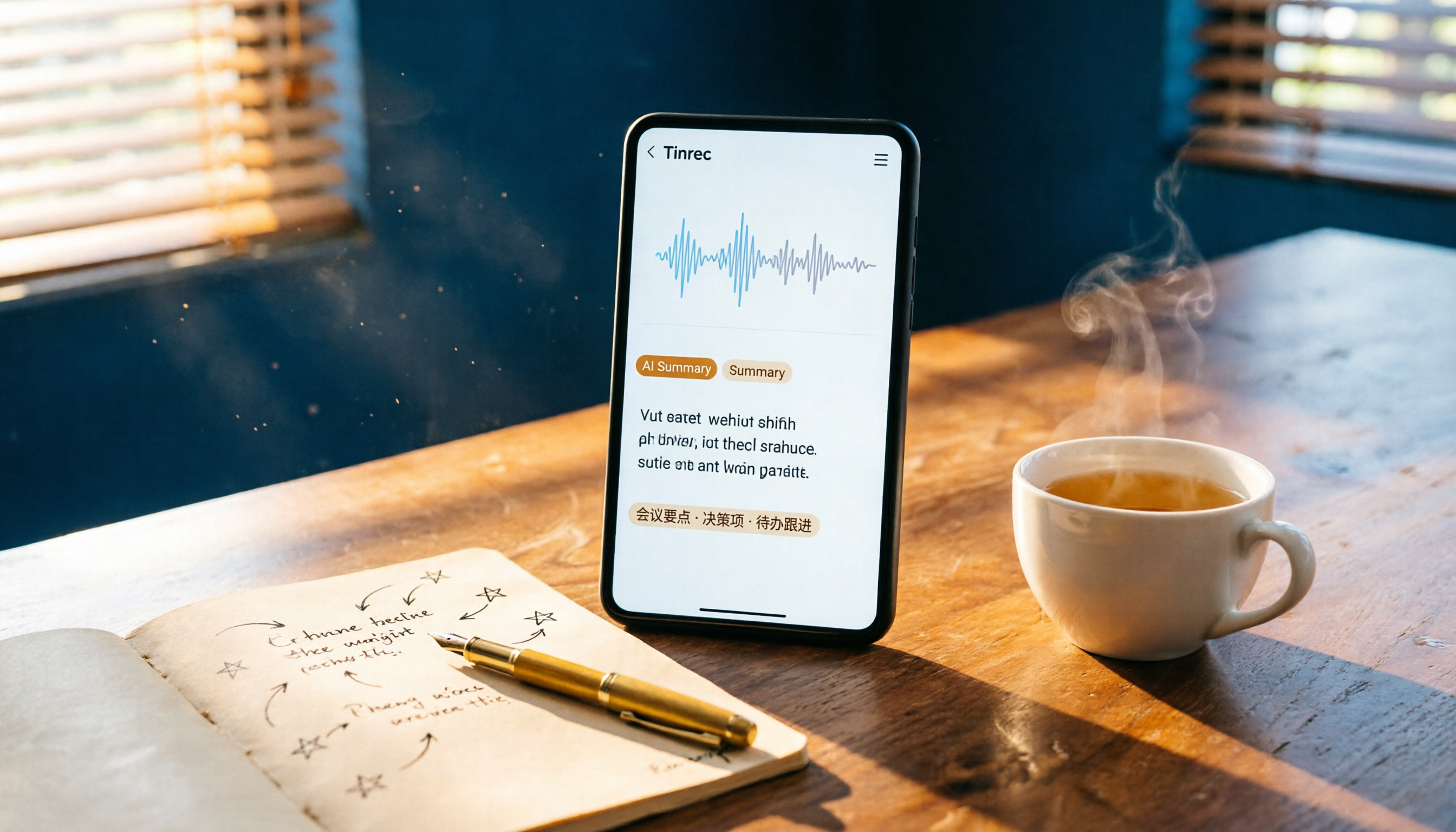
When you're in a Cantonese meeting, open Tinrec and it produces a verbatim transcript as it records. When the meeting ends, the AI has already generated summaries and to-dos—who is responsible for what, and deadlines—all at a glance. Then, you copy the summary or key sections into Bing or Google Translate. Since the text is already organized, the translation is much smoother than feeding it an entire ambiguous recording.
If you have saved Cantonese audio files or Cantonese videos on YouTube, just upload the file or paste the link, and Tinrec will generate text. No more manual transcription while listening; the time saved is significant.
The AI Q&A feature is even better: say you have a two-hour interview recording and you want to know "which part did the interviewee mention the budget?" Ask Tinrec directly, and it will find the answer based on meaning, not just return keyword search results. Competitors in the same price range rarely offer this capability.
Field test notes We tested a 5-minute Cantonese meeting recorded on an iPhone (with two or three people talking and some background noise). Tinrec's transcription wasn't perfect, but it correctly captured key terms, numbers, and context. With the transcript, we could easily understand the full text using a free translation tool.
Pros
Stop organizing recordings by hand
Upload audio or video and automatically get a transcript, summary, and action items
- Multiple input sources: live recording, audio files, and video links—all in one tool for every Cantonese audio source.
- Post-transcription organization: automatic summaries, chapters, and to-dos reduce manual sorting.
- Seamless cross-platform: record on your phone, then instantly view and edit the transcript on the web from your computer—pre-translation editing is much easier.
Limitations to note
- The free plan includes 100 minutes per month. If you have meetings every day, you may need to upgrade. But for someone with two or three meetings a week, that quota is enough for processing key segments.
- Tinrec focuses on voice-to-text, not translation, so you'll need to pair it with a free translation service for the final translation step.
Who is it for? If you regularly deal with Cantonese meetings, classes, interviews, or want to extract key points from Cantonese videos and then translate them into other languages, Tinrec is currently the most ideal pre-processing tool.
Beyond Tinrec: Other Cantonese Translation Options
There are also a few tools designed specifically for Cantonese translation, but their positioning and limitations are clear. You can keep them as backups.
Microsoft Translator (Bing Translator) Supports text translation from Cantonese (Traditional) to multiple languages, and the web version is free. Unfortunately, it lacks AI recognition designed for long-form spoken language. Feeding it an entire Cantonese conversation as text can produce choppy translations because of colloquial expressions. And it can't convert audio to text directly—a step where Tinrec wins hands down.
Google Translate Also supports Cantonese text translation and offers voice input, but in our tests, its Cantonese speech recognition is unstable, especially with background noise, where error rates rise sharply. If you already have a Tinrec transcript, Google Translate is fine as a helper. But relying on it for "listen and translate as you go" will likely give you gibberish.
Cantonese Translator Assistant App (粵語翻譯助手) This app on Google Play focuses on Mandarin, Cantonese, and English translation, and includes voice playback. However, user reviews show disappointing speech recognition accuracy; even simple words get wrong. It has no AI summaries, no cross-device sync—it's just a basic sentence translator. If you're dealing with meeting notes or lecture content, this app can't compete with Tinrec's full workflow.
Pitfall Guide: 3 Common Mistakes in Cantonese Translation
Mistake 1: Expecting a single tool to translate directly from speech Many apps advertise "real-time voice input translation," but with Cantonese's varied colloquial forms and background noise, recognition errors will make the translation wildly off. The right approach is: first convert speech to text, proofread or let AI organize it, then translate.
Mistake 2: Skipping transcript organization and pasting raw text into a translator Even transcripts contain interjections, repeated phrases, and incomplete sentences. If you use Tinrec, remember to let it auto-summarize or segment first, pick out the key points, and then translate. This step makes the final result much more professional.
Mistake 3: Working only on your phone Cantonese translation often requires back-and-forth comparison between source and translation, and a small phone screen is too limiting. Choose a tool with a web version (like Tinrec) so you can open the transcript, copy, translate, and edit on your computer—this is several times more efficient.
Summary: My Cantonese Translation Workflow
Honestly, I wouldn't download an app that claims to do "real-time Cantonese translation" because the technology isn't there yet. Here's what I do instead:
- Need to turn a Cantonese meeting or interview into translatable material → Use Tinrec to record and transcribe
- Want to quickly understand the key points of a Cantonese video → Drop the link into Tinrec, get a summary, then translate the summary
- Want to build a searchable Cantonese database → Store transcripts in Tinrec long-term, and pull them out for translation when needed
The only exception: if you just occasionally look up one or two Cantonese words, typing them into Bing or Google Translate is fine.
I recommend downloading the Tinrec free version to try it. With 100 minutes per month, you can handle two or three meetings or a few videos. Once you experience the smoothness of "organize first, then translate," you'll realize how much time you've been wasting with manual methods.
References
- Microsoft Translator - Translate from Cantonese (Traditional) to Chinese (Traditional)
- Google Translate
- Cantonese Translator Assistant - Cantonese Mandarin English Translator - Google Play
- Love Cantonese - Cantonese Translator
- Cantonese Translator - Online Cantonese / Cantonese Translator - Xunjie PDF Converter Online Free
Turn every recording into actionable outcomes
Get 60 free transcription minutes when you sign in. No credit card required.
Related Reading
You might also like
2026 Comparison of 4 Real-Time Transcription Apps: Which AI Summarizer Is Smartest for Meetings and Classes?
Struggling to keep up with meeting minutes and class notes? We tested four popular real-time voice-to-text tools, comparing transcription accuracy, AI summarization, and cross-platform support to show you which one is worth trying.

Google Speech-to-Text vs Tinrec 2026: A 5-Point Showdown for Working Professionals
A middle manager who attends 15 meetings each week puts Google Speech-to-Text and Tinrec to the test. Google is free but basic, while Tinrec not only transcribes but also pulls out the important points. From accuracy, multi-source input, AI summaries, cross-platform support, to price, this article helps you quickly see which tool actually saves you time at work.

How to Choose Speech-to-Text Tools in 2026: A 5-Step Hands-On Guide
Explore various Chinese speech-to-text tools, including hands-on comparisons of Tinrec, Notta, TurboScribe, and more, to help you find the best AI transcription solution for meetings, learning, and content creation.

2026 Comparison Test of 4 Taiwanese Hokkien to Chinese Translation Tools: Which Is More Practical for Voice-to-Text + Translation?
Want to learn Taiwanese Hokkien or need translation help? This hands-on comparison tests Tinrec and 3 popular Taiwanese Hokkien translation tools, analyzing key features such as voice-to-text, full-sentence translation, and dictionary lookup, to help you find the best combination.

2026 Tinrec vs Otter.ai: 5-Dimension Comparison – Which Is Better for Cantonese Voice-to-Text?
A middle manager's real-world comparison of Tinrec and Otter.ai across 5 key dimensions—Cantonese recording-to-text, AI summarization, cross-platform support, and more—to help you find the best voice-to-text tool for Cantonese speakers.

2025 Review: 4 Taiwanese Hokkien Translator Apps Compared — Which Has the Most Accurate Speech Recognition and Most Natural Translations?
Taiwanese Hokkien translation tools are multiplying, with options ranging from apps to web pages. This article tests 4 Taiwanese Hokkien translation apps, comparing speech input, translation accuracy, multilingual support, and practicality to help you find the best Taiwanese Hokkien translator for your needs.

2026 iPhone Voice-to-Text Apps Compared: Is the Free Built-In Transcription Really Enough?
Is iPhone’s built-in voice-to-text feature enough? This hands-on comparison of 4 solutions—including Tinrec, Otter.ai, and more—breaks down the differences between free and paid plans so you can find the best recording-to-text tool for your needs.

2026 Review: 5 Free Cantonese Audio-to-Text Tools Compared – Which Free Plan Is Worth It?
This article compares 5 free Cantonese speech-to-text tools in 2026, including Tinrec, Google AI Studio, cSubtitle, Speechnotes, and Google Docs. We evaluate accuracy, features, and limitations to help you find the best free option.

2026 Comparison of 4 Online Chinese Speech-to-Text Tools: Which Free Version Is Most Useful?
We tested Speecher, Google Cloud Speech-to-Text, TurboScribe, and Tinrec, four online Chinese speech-to-text tools, evaluating free quotas, accuracy, organization features, and export options to help you find the best free solution for meetings, studying, and content organization.