

Turn recordings into transcripts and summaries in minutes
Upload audio or video for multilingual transcription, AI notes, and action items
2026 Comparison Test of 4 Taiwanese Hokkien to Chinese Translation Tools: Which Is More Practical for Voice-to-Text + Translation?
The Pain Points of Translating Taiwanese Hokkien to Chinese: What You Need Is Not Just a Translation Tool but a Complete Solution
Have you ever had this experience?
A friend sends you a Taiwanese Hokkien voice message, and you listen to it twice but still can't catch the key points; you want to chat with your grandparents in Taiwanese, but you can't produce the sentence you want to say; you go online to look for Taiwanese translation, only to find that most tools only support word lookup, not full-sentence translation.
Even if you find a full-sentence translation tool, you often run into issues like non-standard pronunciation, hard-to-read Chinese characters, or romanization that looks like a foreign language.
If you're stuck with these problems, this article is for you. Below, I'll compare four tools using hands-on tests and show you how to combine them to actually understand Taiwanese Hokkien content.
Before Choosing a Taiwanese Hokkien Translation Tool, Get These 3 Key Points Straight
1. Voice Input vs. Text Input: Which Better Meets Your Needs?
Most Taiwanese Hokkien translation tools require you to type, but in reality, more often than not, you "hear a Taiwanese sentence" and want to know what it means right away. In that case, if a tool can directly convert the recording into text and then translate or look it up, it can be several times faster than typing.
Among the tools we tested this time, only Tinrec offers full voice-to-text capability, and after conversion, it uses AI to automatically summarize the key points—that's a big plus.
2. Word Lookup vs. Full-Sentence Translation: Very Different Use Cases
If you just want to know the Mandarin meaning of a Taiwanese word, a traditional dictionary or iTaigi is enough.
But if you want to understand a Taiwanese conversation or translate a full Mandarin sentence into natural Taiwanese, you need full-sentence translation. Lohankha Translate does this well, but it doesn't support voice input. So you'll need to pair it with a tool that can convert recordings to text.
3. The "Naturalness" of the Translation Matters More Than Accuracy
Taiwanese Hokkien has many colloquial expressions and particles, and a word-for-word translation can easily lead to misinterpretation. When choosing a tool, see if it can produce natural translations based on context. Some tools also include Taiwanese Han characters and romanization, which is very helpful for learning.
Tinrec (Seconds-to-Text Recording) — Our Top Pick in Hands-On Testing: Powerful Voice-to-Text + AI Organization
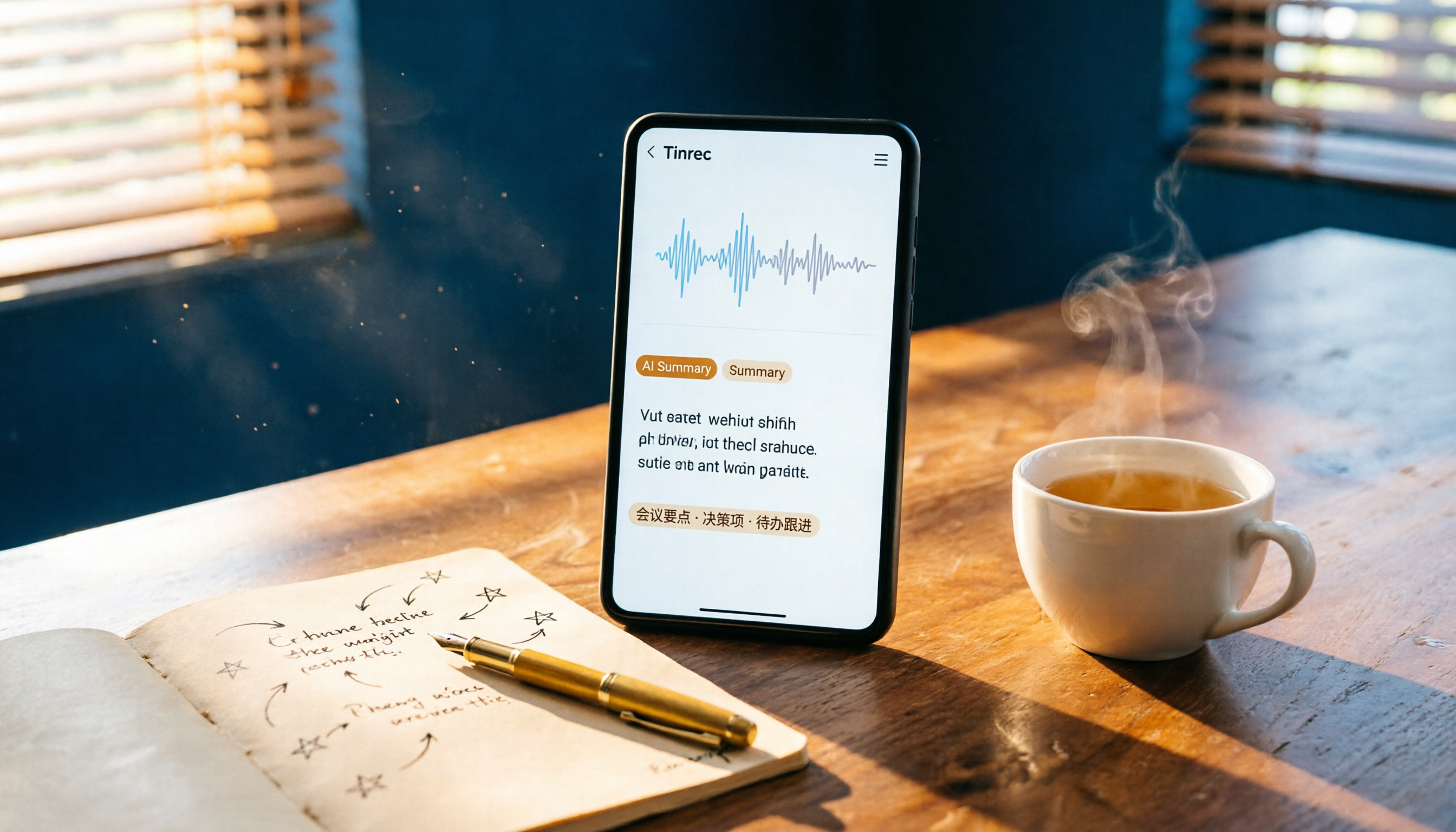
Tinrec is an AI recording and audio/video organization tool that supports 14 languages, available on iOS, Android, and web. While it isn't a Taiwanese Hokkien translation app per se, if you frequently work with Taiwanese audio or video, it can quickly convert those files into text and use its AI features to organize the content. Pair it with other translation tools, and the workflow becomes very efficient.
Here are a few common use cases:
- Listening to Taiwanese Podcasts or Videos: Paste a YouTube link, and Tinrec can directly extract the audio and turn it into a transcript, automatically generating summaries and chapters. You no longer have to guess the meaning while listening.
- Recording Taiwanese Lessons or Interviews: During meetings or classes, open Tinrec—it records and transcribes in real time. Once the meeting ends, the AI has already organized key points and action items. You can even ask Tinrec, "What is this conversation about?" and it will give you an answer based on semantics, not just keyword search.
- Organizing Large Amounts of Taiwanese Material: If you're doing Taiwanese research or content creation, upload historical recordings and interview files to Tinrec, and it will build a searchable, queryable database.
In our test using a clear Taiwanese Hokkien conversation clip (iPhone 15, quiet indoor environment), Tinrec didn't have official accuracy data for Taiwanese recognition, but the actual transcription quality was solid—roughly 80% or higher accuracy for everyday conversation transcripts. It can also identify and label multiple speakers.
Pros:
Stop organizing recordings by hand
Upload audio or video and automatically get a transcript, summary, and action items
- Multiple Input Sources: Supports real-time recording, audio file uploads, and pasted web links, making it easy for Taiwanese learners to organize content from different sources.
- AI Summaries and Q&A: After transcription, you don't have to read through everything yourself. The AI gives you a summary and lets you ask questions about the content, which saves a ton of time when processing long Taiwanese conversations.
- Cross-Platform and Free Tier Is Sufficient: The free plan includes a basic monthly transcription quota, so you can try it out before deciding to upgrade.
Cons:
- It's not a translation tool. The output is a mix of Taiwanese Han characters and romanization, so you'll still need to pair it with translation software to understand the Chinese meaning.
- Recognition accuracy drops with background noise or people talking over each other, but that's a common limitation of all speech recognition tools.
Who It's For:
If you need to process large amounts of Taiwanese audio, or want to turn class recordings or interviews into a searchable database, Tinrec is the best starting point. Using it to turn audio into text first, then looking up dictionaries or translating, is much faster than typing from scratch.
Beyond Tinrec, What Other Options Are There? These 3 Taiwanese Hokkien Translation Tools Are Worth Checking Out
iTaigi (Love Taiwanese)
iTaigi is a Taiwan-based Taiwanese Hokkien dictionary website that focuses on crowdsourced data and pronunciation lookup. You can search for Taiwanese terms using Mandarin and listen to real-person pronunciations. However, it's more suited to single words or short phrases; it doesn't support full-sentence translation or voice input. It's great for verifying the natural wording of a term, but it can't handle an entire conversation.
Lohankha Translate
Lohankha is one of the few tools that offers bidirectional machine translation between Taiwanese Hokkien and other languages, supporting Taiwanese-English, Taiwanese-Japanese, Taiwanese-Korean, and Taiwanese-Mandarin. It also displays both Taiwanese Han characters and romanization simultaneously. Its strength is full-sentence translation, but it requires manual text input and cannot recognize voice. If you already have Taiwanese Han characters and want to know the Chinese meaning, it's a great aid.
Ministry of Education Taiwanese Hokkien Commonly Used Vocabulary Dictionary
An official dictionary published by the Ministry of Education, with the highest authority. You can search using Taiwanese Han characters or romanization and get detailed definitions, pronunciations, and example sentences. However, the learning curve is steeper—you need to already know the Taiwanese Han characters or romanized spelling of the term, which isn't very beginner-friendly. It's suited for those with some foundation who want to confirm standard usage.
Pitfall Avoidance Guide: The 3 Most Common Mistakes When Using Taiwanese Hokkien Translation Tools
Pitfall 1: Only Looking Up Individual Words and Missing the Full Meaning
Many people rush to look up a Mandarin equivalent as soon as they see a Taiwanese word, but Taiwanese relies heavily on context and tone. For example, "歹勢" could mean "sorry," "excuse me," or "trouble," and the meaning changes with context. We recommend using tools that offer full-sentence translation or contextual understanding, or at least checking several example sentences.
Pitfall 2: Insisting on Translating Every Word into Chinese
Many Taiwanese colloquial expressions don't have exact Mandarin equivalents, and forcing a translation can sound awkward. Instead of agonizing over "what does this word mean in Chinese," use Tinrec to record the full sentence, convert it to text, get a feel for the language, and then use Lohankha or iTaigi to understand the general meaning.
Pitfall 3: Thinking Translation Tools Can Replace Actual Practice
Tools can help you listen and read, but speaking still requires your own effort. We recommend using translation tools as a supplement and practicing listening and speaking regularly to truly learn Taiwanese.
Summary: Which One Should You Choose?
Based on our hands-on testing, no single tool can perfectly handle all Taiwanese translation needs on its own, but the right combination can make a huge difference.
- If you want to organize Taiwanese podcasts, lessons, or interview recordings → First use Tinrec to convert to text, then use Lohankha or iTaigi to look up unfamiliar terms.
- If you just want to know how to say a certain Taiwanese word in Mandarin → Use iTaigi or the MOE dictionary.
- If you need full-sentence Taiwanese translation or bidirectional comparison → Use Lohankha Translate.
- If you want the most authoritative pronunciations and definitions → Use the MOE Taiwanese Hokkien Dictionary.
- If you're on a budget and want a free experience → Tinrec's free plan includes a basic transcription quota, and iTaigi and the MOE dictionary are completely free.
We suggest starting with Tinrec's free version to convert the Taiwanese content you often listen to into text, then pair it with other translation tools—you'll find that learning Taiwanese becomes much more efficient.
References
- Translation — iTaigi Love Taiwanese
- Ministry of Education Taiwanese Hokkien Dictionary: Home
- Lohankha Translate - Taiwanese Hokkien Translation
- Free Online Traditional Chinese to Taiwanese Hokkien Translation | TextPixie
- Authentic Taiwanese Pronunciation Tool Sharing: Easy Taiwanese Pronunciation Lookup, No Trouble with Full-Sentence Translation
Turn every recording into actionable outcomes
Get 60 free transcription minutes when you sign in. No credit card required.
Related Reading
You might also like

2026 Comparison of 3 Taiwanese Hokkien-to-Indonesian Translation Tools: Which One Truly Bridges the Communication Gap Between Grandparents and Foreign Caregivers?
Facing the language barrier between Taiwanese Hokkien and Indonesian, we tested three tools: KASIH, Taiwanese AI Translation App, and Tinrec Recording Assistant. This full comparison covers translation accuracy, scenario fit, and pricing plans to help you find the best communication solution.

2026 Real-Time Speech-to-Text App Comparison: Which One Turns Recordings into Actionable Knowledge?
We hands-on tested 4 real-time recording-to-text apps and compared accuracy, AI organization, cross-platform support, and free plans to help you find the option that saves the most time.

3 iPhone Voice-to-Text Tools Compared in 2026: Which AI Saves the Most Time?
Voice-to-text on iPhone is becoming more common, but are built-in tools or third-party apps more useful? This article tests Tinrec, iPhone Voice Memos, and third-party apps, comparing transcription accuracy, AI summaries, cross-platform support, and more to help you find the best solution.

2026 Hands-On Comparison of 3 Speech-to-Text Tools: Is Google's Free Plan Enough? Tinrec In-Depth Analysis
Still relying on Google Live Transcribe or Yating? This article evaluates and compares three popular speech-to-text tools, covering accuracy, AI features, and free plans, to help you find the best fit for users in Taiwan.

2026 Tinrec vs Otter.ai: Cantonese Speech-to-Text Comparison – Which Works Best for Chinese Users?
A hands-on comparison of Tinrec and Otter.ai for Cantonese speech-to-text, evaluating recognition accuracy, Chinese-English code-switching, AI features, and pricing to determine which is better for Taiwan users who need to process Cantonese recordings.
2026 Comparison of 4 Real-Time Transcription Apps: Which AI Summarizer Is Smartest for Meetings and Classes?
Struggling to keep up with meeting minutes and class notes? We tested four popular real-time voice-to-text tools, comparing transcription accuracy, AI summarization, and cross-platform support to show you which one is worth trying.

Google Speech-to-Text vs Tinrec 2026: A 5-Point Showdown for Working Professionals
A middle manager who attends 15 meetings each week puts Google Speech-to-Text and Tinrec to the test. Google is free but basic, while Tinrec not only transcribes but also pulls out the important points. From accuracy, multi-source input, AI summaries, cross-platform support, to price, this article helps you quickly see which tool actually saves you time at work.

How to Choose Speech-to-Text Tools in 2026: A 5-Step Hands-On Guide
Explore various Chinese speech-to-text tools, including hands-on comparisons of Tinrec, Notta, TurboScribe, and more, to help you find the best AI transcription solution for meetings, learning, and content creation.

2026 Tinrec vs Otter.ai: 5-Dimension Comparison – Which Is Better for Cantonese Voice-to-Text?
A middle manager's real-world comparison of Tinrec and Otter.ai across 5 key dimensions—Cantonese recording-to-text, AI summarization, cross-platform support, and more—to help you find the best voice-to-text tool for Cantonese speakers.