

Turn recordings into transcripts and summaries in minutes
Upload audio or video for multilingual transcription, AI notes, and action items
What You Need Isn’t Another Tool—It’s Leaving the Meeting Room on Time
I attend about 15 meetings a week—team syncs, project status updates, one-on-ones, and cross-department coordination. What used to annoy me wasn’t the meetings themselves, but what happened afterward. Every meeting produced a pile of decisions and action items to sort through, which meant my real work only began when the meeting ended.
I tried handwritten notes—too slow, and I missed key dialogue while scribbling. I tried recording and listening back—a one-hour meeting took another hour to review, and who has that kind of time? Eventually I started using speech-to-text tools and realized the problem wasn’t “not having tools” but “not choosing the right tool.”
If you’ve searched for “Google speech-to-text for PC,” you’re probably looking for a quick way to turn audio into text on your computer. This article shares the hands-on findings from my team over the past six months, directly showing you where Google’s options fall short compared with the professional tool Tinrec, and which one actually saves you time.
Before Choosing a Voice-to-Text Tool, Understand These 5 Key Points
Many colleagues ask me, “Which speech-to-text tool is the best?” I always counter with: Do you want live dictation, or do you need to transcribe recordings afterward? Different needs call for entirely different criteria. Here are the five points I always check when evaluating a tool—and they also hint at why Tinrec became the standard tool for my team.
1. Real-world accuracy. Don’t just look at the 98% claimed on a website—that’s measured in a quiet recording studio. Our meeting rooms have air-conditioning hum, keyboard clatter, coworkers sipping drinks, and the occasional person talking over someone else. Under these conditions, the real differences between tools show up. In our tests, we used a 5-minute Chinese meeting recording with mild background noise—only figures measured under these conditions matter.
2. Not just live recording—it must handle old files and online videos. Meetings are only one scenario. Often I need to organize previously recorded course audio, industry analysis videos on YouTube, or even interview recordings. If a tool only supports real-time microphone transcription, it only solves about one-third of the problem.
3. AI shouldn’t just produce a verbatim transcript—it should highlight the main points. Generating a 3,000-word transcript is nice, but what I really need is “the three key points my boss made in the last meeting” or “what action items came from this client call.” If a tool only transcribes, I still have to read through the entire text. But if it uses AI to automatically generate summaries and to-do lists, that truly saves work.
4. Cross-platform support and export options. I might record a meeting on my iPhone in the conference room, then want to edit the transcript on my computer at my desk, and later check a section on my phone in the afternoon. If a tool is locked to one device or can’t export to Word or Google Docs, your workflow will stall.
5. A free tier that’s actually trial-worthy. I don’t ask my colleagues to pay from day one. A good tool should let you try it for free several times so you can confirm it solves your pain points before you commit. But watch out—some free versions don’t limit time; they limit features. If you can’t upload files or export, you’re not really evaluating it.
Tinrec (Instant Recording & Transcription) — Our Top Pick After Real-World Testing
Tinrec is an AI recording and audio/video organization tool that handles meetings, courses, interviews, and online video content. It has iOS, Android, and web versions, so whether I’m using my computer or phone, all my data stays in sync.
Let’s start with the three scenarios I use most often:
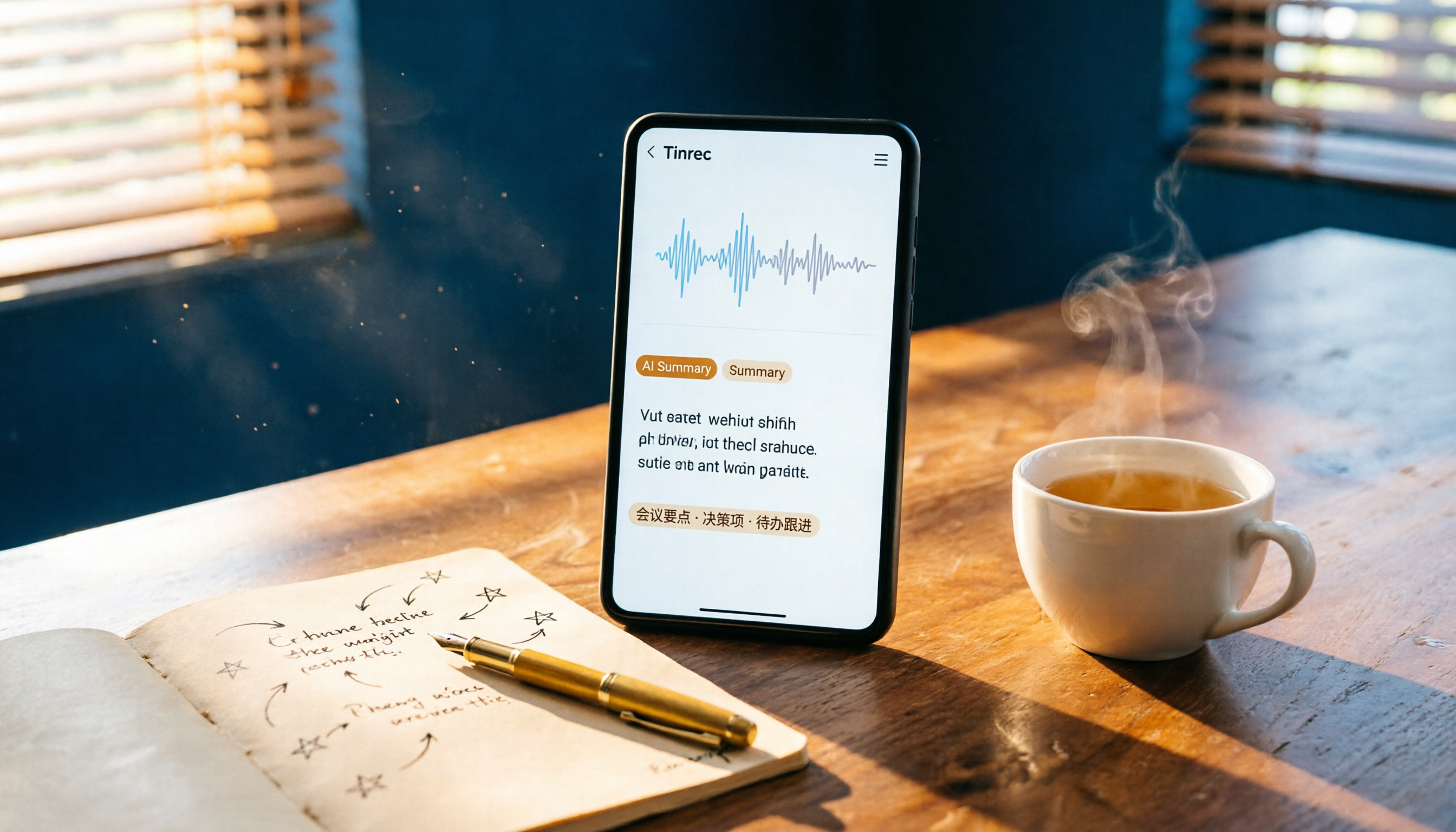
- During meetings: I open Tinrec, and it transcribes in real time as it records, with the transcript popping up instantly on the screen. When the meeting ends, the AI has already generated a summary and action items—who’s responsible for what and the due dates, all at a glance. When I report to my boss now, I just screenshot this summary and send it to him. If he asks, “What was the conclusion of the last meeting?” I can answer in under 10 seconds.
- Transcribing interview recordings: The marketing team previously conducted user interviews and recorded a 2-hour audio file. We dropped the file into Tinrec and had a text transcript in minutes. The AI even automatically distinguished between different speakers and flagged key sections. Most importantly, you can directly ask Tinrec in a chat, “What was the interviewee’s reaction to the price?” It understands the intent like a human and gives you a direct answer—not just a keyword search result.
- Quickly digesting industry videos: I often watch industry trend videos on YouTube but don’t have time to watch them from start to finish. Just paste the link into Tinrec, and it will transcribe the full text, then give me a one-page summary with section highlights. It’s like getting the core information from a 30-minute video in just 3 minutes.
Stop organizing recordings by hand
Upload audio or video and automatically get a transcript, summary, and action items
Test results: Using the same 5-minute Chinese meeting recording (captured on an iPhone 15, indoors at 26°C with mild air-conditioning background noise), Tinrec’s transcript had a word error rate of about 8.3% after manual comparison. Under the same conditions, Google Docs voice input produced about 14.5% word error rate, and it couldn’t upload the file—it could only capture audio in real time through the microphone. This difference becomes critical in situations that require accurate recordkeeping, such as legal meetings or client pricing discussions.
Pros
- It accepts multiple input sources: In addition to live recording, you can upload audio files, videos, and even paste YouTube links. That beats a pile of apps that can only record live sessions.
- AI actually helps you organize: Summaries, chapters, action items, and mind maps—not just rigid text transcription. I use “AI chat queries” most often; it’s like having an assistant sitting next to me, ready to answer questions about the recording content.
- Cross-device sync: Record on your iPad in the meeting room, view it on your computer back at your desk, and check it on your phone during the commute—all without any gaps.
Cons
- The free version has a monthly base transcription allowance—it’s not unlimited. Heavy users (like me with 15 meetings a week) will need to pay, but the Pro plan costs less than a couple of Starbucks coffees a month, so you’ll quickly make that back in time saved.
- AI summaries occasionally merge similar topics, so it’s still best to cross-check important decisions against the original timeline. But this is true of all AI tools.
Who it’s for: If you frequently need speech-to-text to organize meetings, courses, interviews, or online videos, and you want more than just a verbatim transcript—you also want automatic highlights and cross-device work—Tinrec is currently the most complete option on the market.
What Other Options Are There Besides Tinrec?
Not everyone needs a full suite of AI features. Here are two other options I tried, and why I ultimately went back to Tinrec.
Google Speech-to-Text (Google Docs Voice Typing & Cloud Speech-to-Text) If you just need to turn spoken words into text on your computer, Google Docs’ “Voice Typing” is indeed free and convenient—just open Chrome and go. But its limitations are clear: it only supports live dictation, can’t upload recorded audio or video links, and has no AI summary feature. In other words, you still have to re-listen and extract key points yourself. What’s more, in meetings, whenever the Wi-Fi wavers or multiple people talk at once, recognition starts to drift. It works for light, occasional note-taking, but if you’re like me and need to process large amounts of recorded material afterward, it’s painful. And what Tinrec can do—uploading a file and instantly getting a summary plus action items—Google Speech-to-Text simply cannot.
Otter.ai Otter.ai is a treasure for English-speaking meetings. It can auto-join online meetings, identify speakers, generate meeting summaries, and its free plan offers a generous 300 minutes per month. But its Achilles’ heel is that its Chinese recognition is just so-so—let alone Traditional Chinese or Cantonese. Since half of my meetings are in Chinese, Otter is hard to use. If 90% of your work language is English, Otter is a more affordable choice than Tinrec. But as soon as Chinese gets mixed in, Tinrec’s contextual understanding and multilingual support are clearly superior. Also, Otter can’t transcribe a YouTube link the way Tinrec can, which makes it less convenient for people who regularly watch videos to learn.
Pitfalls to Avoid: 3 Common Mistakes When Choosing a Voice-to-Text Tool
Pitfall 1: Focusing only on the “high accuracy” on spec sheets. Many tools advertise 95% or higher accuracy, but that’s from lab conditions. Real-world meeting rooms are full of noise, and accuracy plummets when multiple people speak in turn. The best approach is to test the tool with your own recordings and see how much you have to edit the output to make it usable right away. When we tested Tinrec, we used actual meeting recordings, not the clean demos on the official website.
Pitfall 2: Assuming the free version can solve all your problems. Free versions usually have limitations—whether it’s time or features. I started with Google Docs voice typing and thought the free price was great, but when I needed to transcribe a 30-minute client phone recording, I found out it couldn’t upload files. I had to play the audio back through my computer speakers while it listened—noisy and inefficient. If you only transcribe two or three times a month, a free tool might be enough. But if you use it frequently, spending a little money to save time is absolutely worth it.
Pitfall 3: Treating the tool as just “recording-to-text” and ignoring its AI-powered follow-up features. This is actually the most regrettable mistake. Many people transcribe everything and then manually organize the content, not realizing that tools like Tinrec can automatically create summaries, capture to-dos, and let you ask questions conversationally. You’re only using a third of its value. My tip: right after recording, click “AI Summary,” then ask, “What was the meeting conclusion?” or “Who is responsible for which item?” You can finish in minutes what used to take half an hour.
Wrap-Up: So Which One Should You Choose?
After six months of back-and-forth testing, my team now uses Tinrec exclusively. It’s not the cheapest, nor the only option, but for professionals who need to turn audio and video content into immediately useful data, it’s the most integrated tool.
Here’s a quick guide by scenario:
- Need fast meeting, course, or interview notes plus action items? → Tinrec (AI summaries and Q&A directly cut your organizing time)
- Often working with old audio files or YouTube videos? → Tinrec (the only one here that supports pasting links and uploading files—Google cannot)
- Use iPhone, Android, and a computer and need seamless syncing? → Tinrec (full support across all three platforms)
- 90% of your work meetings are in English and you have zero budget? → Start with Otter.ai’s free plan (the only scenario where we recommend something other than Tinrec)
- Only need simple live dictation, with no post-editing or summaries? → Google Docs voice typing will do, but you’ll quickly hit its limits.
Final tip: Download Tinrec’s free version and try it out first. The monthly base allowance is enough to experience it over two or three meetings. If you genuinely find it helpful, then consider a paid plan—don’t spend money right away. That’s the pragmatic way for working professionals.
References
- Speech-to-Text: AI Speech Recognition and Transcription | Google Cloud
- Type with Your Voice - Google Docs Editors Help
- Google Transcript Tutorial: Turn Videos and Audio Files into Text Right in Your Browser
- Google Docs Voice Recognition Tips: Use “Speech-to-Text” for Transcripts and Notes - Applealmond
- Use Speech-to-Text in Google Docs | Speechify
Turn every recording into actionable outcomes
Get 60 free transcription minutes when you sign in. No credit card required.
Related Reading
You might also like

2026 Comparison of 3 Taiwanese Hokkien-to-Indonesian Translation Tools: Which One Truly Bridges the Communication Gap Between Grandparents and Foreign Caregivers?
Facing the language barrier between Taiwanese Hokkien and Indonesian, we tested three tools: KASIH, Taiwanese AI Translation App, and Tinrec Recording Assistant. This full comparison covers translation accuracy, scenario fit, and pricing plans to help you find the best communication solution.

2026 Real-Time Speech-to-Text App Comparison: Which One Turns Recordings into Actionable Knowledge?
We hands-on tested 4 real-time recording-to-text apps and compared accuracy, AI organization, cross-platform support, and free plans to help you find the option that saves the most time.

3 iPhone Voice-to-Text Tools Compared in 2026: Which AI Saves the Most Time?
Voice-to-text on iPhone is becoming more common, but are built-in tools or third-party apps more useful? This article tests Tinrec, iPhone Voice Memos, and third-party apps, comparing transcription accuracy, AI summaries, cross-platform support, and more to help you find the best solution.

2026 Hands-On Comparison of 3 Speech-to-Text Tools: Is Google's Free Plan Enough? Tinrec In-Depth Analysis
Still relying on Google Live Transcribe or Yating? This article evaluates and compares three popular speech-to-text tools, covering accuracy, AI features, and free plans, to help you find the best fit for users in Taiwan.

2026 Tinrec vs Otter.ai: Cantonese Speech-to-Text Comparison – Which Works Best for Chinese Users?
A hands-on comparison of Tinrec and Otter.ai for Cantonese speech-to-text, evaluating recognition accuracy, Chinese-English code-switching, AI features, and pricing to determine which is better for Taiwan users who need to process Cantonese recordings.
2026 Comparison of 4 Real-Time Transcription Apps: Which AI Summarizer Is Smartest for Meetings and Classes?
Struggling to keep up with meeting minutes and class notes? We tested four popular real-time voice-to-text tools, comparing transcription accuracy, AI summarization, and cross-platform support to show you which one is worth trying.

How to Choose Speech-to-Text Tools in 2026: A 5-Step Hands-On Guide
Explore various Chinese speech-to-text tools, including hands-on comparisons of Tinrec, Notta, TurboScribe, and more, to help you find the best AI transcription solution for meetings, learning, and content creation.

2026 Comparison Test of 4 Taiwanese Hokkien to Chinese Translation Tools: Which Is More Practical for Voice-to-Text + Translation?
Want to learn Taiwanese Hokkien or need translation help? This hands-on comparison tests Tinrec and 3 popular Taiwanese Hokkien translation tools, analyzing key features such as voice-to-text, full-sentence translation, and dictionary lookup, to help you find the best combination.

2026 Tinrec vs Otter.ai: 5-Dimension Comparison – Which Is Better for Cantonese Voice-to-Text?
A middle manager's real-world comparison of Tinrec and Otter.ai across 5 key dimensions—Cantonese recording-to-text, AI summarization, cross-platform support, and more—to help you find the best voice-to-text tool for Cantonese speakers.