

Turn recordings into transcripts and summaries in minutes
Upload audio or video for multilingual transcription, AI notes, and action items
Why You Need a Reliable Voice Recorder
During interviews, constantly looking down to take notes disrupts the flow of conversation and can cause you to miss subtle cues in the interviewee's tone. In class, your hand cramps from note-taking while struggling to keep up with the professor. In meetings, discussions get heated, but afterward, you can't recall the key decisions. These pain points are exactly what a good voice recorder can solve.
But today's voice recorders come in all shapes and sizes: some focus on high-fidelity audio, others boast extended battery life, and some even include AI transcription that generates a full transcript as soon as you finish recording. This article reviews 5 recording solutions for interviews, meetings, and study in 2026, covering both software and hardware, to help you compare quickly.
Option 1 | Tinrec (Instant Recording) – The Most Complete AI Recording Assistant
Tinrec is not a traditional hardware recorder but a powerful AI-powered recording and audio/video organization tool, ideal for those who need to record interviews and quickly convert them into text. It supports mobile, desktop, and web versions, allowing you to record directly with your phone's microphone, upload existing audio files, or paste links to online videos, and convert them to text with one click.
Key Highlights
- Real-time interview transcription: Transcribes as you record, so you get the transcript immediately after finishing—no more hours of replaying and typing. Supports 14 languages including Chinese and English, with excellent recognition for Traditional Chinese interviews.
- AI auto-summarization and chapters: For a 1-hour interview, Tinrec automatically extracts key points, organizes them into sections, and even lists action items. This is incredibly useful for interview reports and meeting minutes.
- AI chat-based querying: You can ask Tinrec questions like you would with ChatGPT: "What key data was mentioned in this interview?" or "What is the interviewee's stance on XX issue?" It finds answers from the recording, so you don't have to listen again.
- Multi-format export and further organization: Transcripts, summaries, and mind maps can be exported to Notion, Google Docs, Word, and more. You can even ask the AI to generate a complete interview report.
Pricing
- Free plan: Includes basic monthly transcription quota, perfect for trying out transcription and AI summaries.
- Weekly pass: Ideal for short-term intensive use, like a week of interviews or finals week.
- Pro monthly/annual plan: Higher monthly transcription quota; annual plan lowers the monthly cost, suitable for frequent recording or long-term data organization.
Who It's For
Busy professionals, students, and content creators who frequently conduct interviews, attend meetings, or take classes, and need to quickly produce written records. Especially those who hate manual transcription and want summaries and key points immediately after recording.
Option 2 | Philips DVT1600 – Classic High-Quality, Long-Recording Model
The Philips DVT1600 is a traditional digital voice recorder designed for interviews and meetings. It has 32GB of built-in storage and can record up to 129 hours. It features a time-jump function to quickly skip to specific points in a recording, making it easy to revisit important segments. It uses a built-in lithium battery that lasts for extended use after a full charge. The interface is intuitive, so even first-time users can get started quickly.
- Key Highlights: High-quality stereo recording, 129-hour storage, time-jump.
- Price: Approximately NT$3,280.
- Who It's For: Users who prioritize sound quality, don't rely on smart features, and prefer traditional button-operated recorders.
Option 3 | ErgoTech MP30 – One-Touch Recording, Easiest to Use
The ErgoTech MP30 focuses on one-touch recording, ideal for situations requiring quick response, such as impromptu interviews or meeting notes. It's lightweight and portable, with good battery life for long recordings. It records in MP3 format, which can be played directly on computers without conversion.
- Key Highlights: One-touch recording, lightweight and portable, MP3 plug-and-play.
- Price: Approximately NT$1,000–1,500 (depending on retailer).
- Who It's For: Students or professionals on a budget who need a simple, reliable recording tool.
Stop organizing recordings by hand
Upload audio or video and automatically get a transcript, summary, and action items
Option 4 | Hongjiayuan M8 – Long Battery Life, Voice-Activated Recording
The Hongjiayuan M8 is a USB-drive-shaped recorder with voice-activated recording, meaning it only starts recording when it detects sound. It's perfect for long-duration recording scenarios like lectures or meetings. The built-in battery lasts for dozens of hours, and its discreet USB-drive appearance makes it low-profile.
- Key Highlights: Voice-activated recording saves space, long battery life, high discretion.
- Price: Approximately NT$800–1,200.
- Who It's For: Students who need to record long lectures or meetings without frequent battery changes.
Option 5 | Free Option: Built-in Phone Recorder + Google Docs Voice Typing
If you only occasionally need to record a short interview or capture an idea, you don't need to spend money on extra equipment. Most smartphones now have built-in recording apps that provide sufficient audio quality in quiet environments. Combined with Google Docs' "Voice Typing" feature (requires Chrome browser), you can also get real-time transcription, completely free.
- Key Highlights: Zero cost, phone is always at hand, meets basic recording needs.
- Limitations: Recording quality is heavily affected by the phone's microphone and ambient noise; Google Docs voice typing accuracy is average and doesn't support mixed Chinese-English or multi-speaker conversations.
- Who It's For: Users with zero budget, very low usage, and who don't mind manually correcting text.
How to Choose Among These Options
- Want the most complete AI organization features (transcript + summary + Q&A + report generation) → Tinrec (the only tool that combines recording, transcription, and AI chat querying)
- Frequently conduct interviews and need high audio quality without relying on a computer or phone → Philips DVT1600 (most solid audio quality among traditional recorders)
- Only need simple one-touch recording, occasional playback, no transcription needed → ErgoTech MP30 or Hongjiayuan M8 (simple operation, affordable price)
- Zero budget and low recording frequency → Use your phone's built-in recorder with Google Docs voice typing as a stopgap
4 Things to Know Before Using Recording Tools
- Recording environment greatly affects accuracy: Even with AI transcription, if the background is too noisy or you're too far from the sound source, the transcribed text will have many errors. During interviews, get as close to the audio source as possible, or use an external microphone (Tinrec works with phone mics for better results).
- Traditional recorders require separate transcription: If you only have recording capability, you'll have to type up transcripts manually. To save time, choose a service like Tinrec with built-in transcription, or upload your audio files to a transcription tool.
- AI summaries are not transcripts; verify important content against the original: AI-generated summaries may miss details or misinterpret meaning, but they help you quickly locate key sections, which you can then verify by listening to the original audio.
- Be mindful of privacy and consent: If you're interviewing others, always obtain their consent before recording. When using cloud transcription services, also review their privacy policies and data storage practices.
Conclusion
In 2026, recording tools have matured significantly. Whether you prefer traditional hardware recorders or want to try AI-powered assistants that automatically organize interviews, there's an option for you. If you want to get organized summaries, key points, and even query the recording via Q&A immediately after an interview, Tinrec offers excellent value. Start with the free plan to experience the convenience of AI transcription and querying, then decide if you want to upgrade.
FAQ
Q1: Which has better sound quality: a voice recorder or an AI recording tool? Generally, mid-to-high-end traditional recorders have better microphone arrays and produce superior audio in quiet environments compared to phones. However, when considering transcription and organization, the time saved by AI tools often outweighs the difference in sound quality.
Q2: Is Tinrec's free plan sufficient? The free plan includes a basic monthly transcription quota, suitable for occasional interviews or meetings. We recommend trying it first to confirm transcription quality and features meet your needs before paying.
Q3: How do I convert voice recorder files to text? You can transfer the audio files to your computer and upload them to Tinrec or another transcription service. Some AI recording tools also support direct file import.
Q4: Which is best for long interviews (2+ hours)? The Philips DVT1600 has 32GB of storage and can record up to 129 hours, offering reliable battery life. Tinrec can also record for long periods as long as your phone has enough battery and storage, and it transcribes in real time.
Q5: Are these tools available in the US? Philips, ErgoTech, and Hongjiayuan traditional recorders are available on major US e-commerce platforms. Tinrec is an online service; you can sign up directly on their website.
Q6: What is the accuracy rate of transcription? It depends on recording quality, ambient noise, distance, and speech clarity. In a good interview environment, Tinrec performs well for Chinese transcription, but it cannot guarantee 100% accuracy. Always verify important content against the original audio.
References
Turn every recording into actionable outcomes
Get 60 free transcription minutes when you sign in. No credit card required.
Related Reading
You might also like
Voice Recorder vs. Phone Recording: 2026 Hands-On Comparison of 3 Solutions, This AI Tool Is Most Practical
Still wondering whether to buy a voice recorder? This article compares phone recording, traditional voice recorders, and the AI recording tool Tinrec, showing you how to achieve professional recording and transcription with just a smartphone.
Tinrec Voice-to-Text App 2026 Review: AI Transcripts + Chapter Summaries, No Need to Buy a Voice Recorder
Still debating between a voice recorder and a mobile app for recording? This hands-on comparison of the Philips smart voice recorder and the Tinrec app covers recording quality, AI organization, cost, and convenience, explaining why more people in 2026 are choosing AI recording apps over traditional devices.
5 Best Voice Recorders Tested in 2025: AI Saves You Hours of Organizing Time
Tired of spending hours on meeting minutes and lecture notes? This article tests 5 voice recorders, from traditional hardware to AI software, revealing which has the most accurate speech-to-text, the most useful AI summaries, and how to preserve voice memories more intelligently.

2026 Tested: 4 Best Student Lecture Recorders Compared – Which AI Note-Taking Tool Wins?
Still using your phone to record lectures? We tested 4 tools, from hardware voice recorders to AI recording apps, to show you which one truly helps organize notes and save review time.
2026 Field Research Audio-to-Text Tools: Online, No Installation, AI Summaries
Field researchers often need to transcribe interview recordings, but manual transcription is time-consuming. This article reviews 5 online audio-to-text tools, comparing free plans, language support, and AI features to help you quickly create transcripts and boost field note efficiency.

2026 Voice Recorder Buying Guide: Tinrec vs Plaud Note – Which One Is Right for You? Hands-On Comparison
Meetings running until 8 PM, then having to listen back to recordings to write minutes? This article compares two AI recording solutions: software powerhouse Tinrec and hardware gadget Plaud Note, evaluating recording scenarios, transcription accuracy, Cantonese support, long-term costs, and AI features to help you find the most time-saving voice recorder for Hong Kong professionals.

2026 Tested: 4 Best AI Meeting Recorders Compared – Which Saves You the Most Time?
Tired of spending hours after meetings transcribing notes? We tested 4 AI-powered recording and transcription tools to find the best time-saving solution for work—whether you need Cantonese support or cross-platform organization, here's everything you need to choose.

5 Best Voice Recorders of 2026: From AI Tools to Traditional Hardware—Which One Meets Your Recording Needs?
This article compares 5 voice recorders, including AI recording assistant Tinrec, SONY, Philips, u-ta M8, and a free smartphone solution, analyzing sound quality, features, and value to help you find the best recording companion.
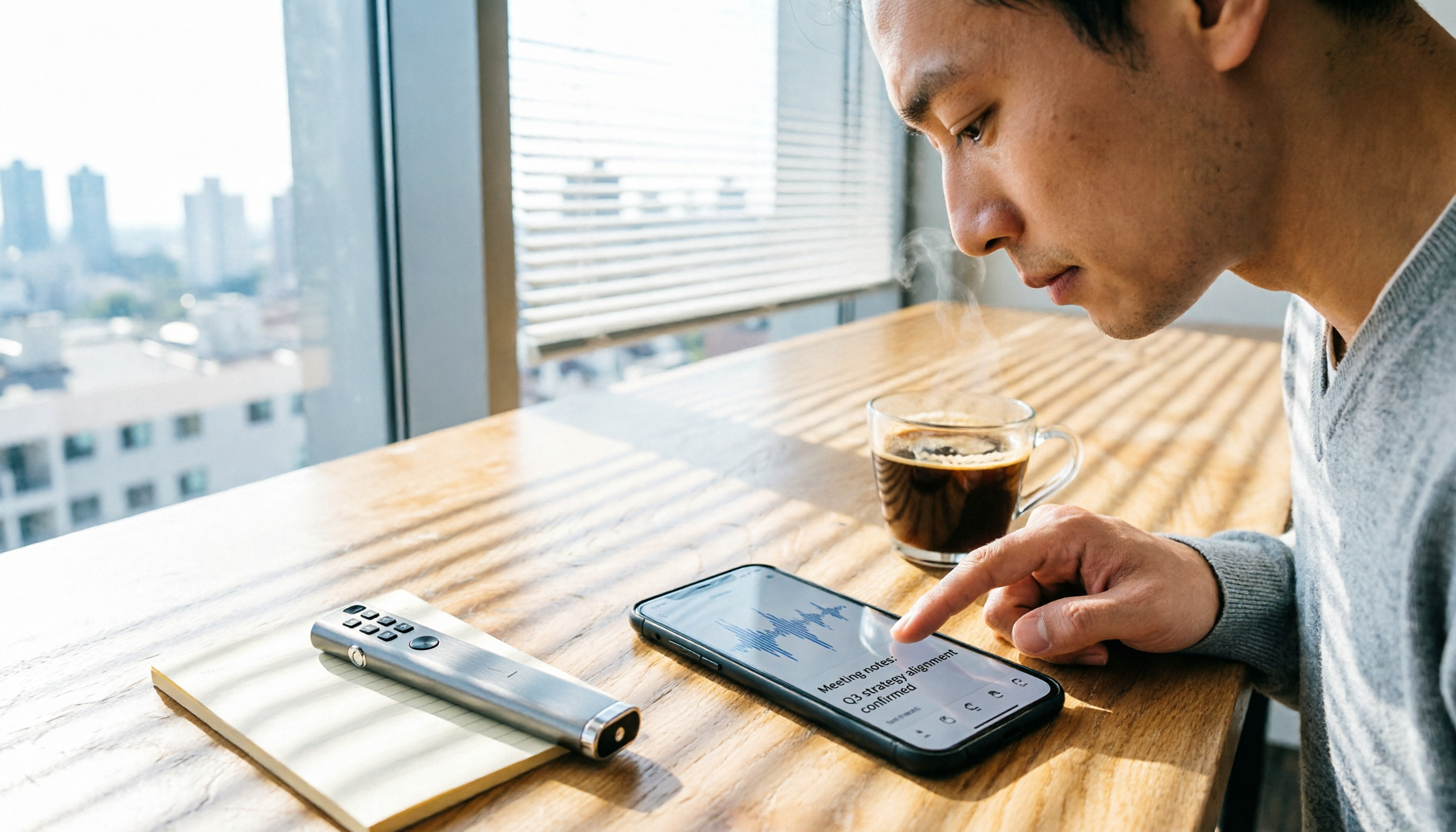
Tinrec vs PLAUD Note Review: AI Software vs Hardware, Which One Is Right for You?
Tired of meetings that run until quitting time, then having to listen to recordings to write minutes? We tested two recording solutions: Tinrec AI software and the PLAUD Note hardware recorder, comparing them across 5 key areas—recording quality, transcription accuracy, AI features, battery life, and portability—to tell you which offers the best value.