

Turn recordings into transcripts and summaries in minutes
Upload audio or video for multilingual transcription, AI notes, and action items
Good Tape vs Tinrec: Which Speech-to-Text Tool Is Right for You in 2026?
Many people think meeting notes are solved by simply downloading an app that turns speech into text.
Honestly, that's one of the most expensive misconceptions I've seen in recent years.
Getting a transcript is just the first step. What really eats up time is what comes next: identifying the conclusion, who agreed to what, what needs follow-up next week, and whether you can still find this conversation three months from now.
Lately, many people have been asking about the Good Tape app and whether there's a better alternative for teams. I'm bringing in Tinrec, which I use myself, to compare them side by side, focusing on what you can do after recording.
Why are people looking for Good Tape alternatives?
The Good Tape app is the official partner app of goodtape.io, available on iOS and Android.
Its logic is simple: record on your phone, and the audio automatically uploads to your Good Tape account, gets transcribed immediately, and then you can edit, summarize, format, and export.
During recording, it detects volume in real time and tells you whether the recording is "healthy," helping you avoid distorted or too-quiet files. Without internet, it saves locally and uploads encrypted once connected.
For things like field interviews or recording spontaneous thoughts, it does the job well.
But the problem usually isn't recording—it's what happens after.
When you start needing to turn meeting data into something shared across the team—multiple people sharing a database, tracking post-meeting action items, or revisiting "what was the budget the client mentioned last time?"—you'll likely need additional tools to fill the gap.
If that resonates, Tinrec is worth checking out.
Tinrec vs Good Tape: What's the core experience difference?
How meetings get recorded
This is the most fundamental difference.
Good Tape is centered on its mobile app, excelling at "record wherever you go." Tinrec, besides mobile real-time recording, also captures computer system audio on desktop, handling online meetings on Zoom, Google Meet, Microsoft Teams, and Webex.
The key is it doesn't require sending a meeting bot into the call. Many companies are sensitive about "a bot in the meeting," and this approach eliminates the need for explanations.
Can the data be used after transcription?
Good Tape gives you a transcript after transcription, which you can edit, summarize, format, and export—sufficient for personal use.
Tinrec focuses on the "after meeting" phase: automatically generating summaries, chapters, key points, and action items, allowing you to ask questions directly about the meeting content, and even using an Agent for post-processing to generate reports, tables, and documents, then export to Notion, Google Docs, OneNote, or Dropbox for further work.
One is "turning speech into text," the other is "turning text into something you can deliver." The difference lies in how much time you need to spend on follow-up work.
Chinese and cross-language meetings
Tinrec places emphasis on Chinese, Traditional Chinese, and mixed Chinese-English meetings. During recording, you can switch between original text, translation, or bilingual view, and teams can maintain their own hotwords to improve recognition of product terms and client names.
Good Tape supports multilingual transcription and has some coverage for multilingual environments.
I must be clear here: no tool should promise a fixed accuracy rate. Actual performance is affected by recording quality, background noise, accents, people talking over each other, and technical terminology—this applies to both. Don't be swayed by marketing numbers.
Team sharing and permission governance
This is where Tinrec pulls ahead.
The team edition isn't "everyone sharing one account" but an independent team space: you can create multiple teams, invite members via link, and set owners, admins, and regular members.
Roles control "who can manage the team," while seats control "who can record, upload, edit, and export." Members without a seat can still view, play, and read team data—useful for those who only listen.
Plus usage analytics, audit logs, team hotwords, and an audio recycle bin, managers have something to check when responsible for budget and data.
Cost structure
Good Tape is free to download, with options from free accounts to Good Tape Pro; actual quotas and pricing depend on the official page.
Stop organizing recordings by hand
Upload audio or video and automatically get a transcript, summary, and action items
Tinrec offers a free personal version, weekly card, Pro monthly and annual cards, depending on usage frequency. The team edition offers a 7-day trial for first-time eligible users (1 free seat, 300 minutes shared team import quota); team monthly is USD 29.80 per paid seat per month, annual is USD 199 per paid seat per year (about USD 16.58 per month), with 2,000 minutes shared import quota per paid seat per month; real-time recording is currently not deducted by minutes.
For small teams, what matters isn't the monthly fee but "how much does one person-hour cost, and how many hours can this tool save?"
Tinrec's core features at a glance
Real-time speech-to-text: Open and start recording, text appears as you speak. In in-person meetings, you can follow along to ensure no key points are missed—the transcript is ready when the meeting ends.
Bot-free online meeting recording: The desktop version captures computer system audio for Zoom, Google Meet, Teams, and Webex. No need to notify participants in advance that "a bot will join"—you can record even if pulled into a meeting last minute.
AI summaries, chapters, and action items: The worst part of a one-hour meeting is having to go back through it. Tinrec automatically segments chapters, extracts key points, and compiles "who does what" into an action list—this is the most valuable part for me.
AI Q&A: After recording, ask directly "What was the conclusion of this meeting?" or "What was the budget cap the client mentioned?" It answers based on the content, no need to manually flip through thirty pages of transcript.
Agent post-processing and multi-format export: You can further generate reports, tables, and documents from meeting content, then export to Notion, Google Docs, OneNote, or Dropbox. Integrating into existing workflows is more practical than adding another unfamiliar system.
Team space: Meeting data belongs to the team; new members can see historical data; when a member leaves or loses a seat, resources are transferred to other active members and won't disappear with the individual account.
Real-world use cases
Weekly stand-up: This is the most typical scenario. Previously, I'd type while listening and spend another forty minutes organizing afterward. Now I open Tinrec desktop and record directly; summaries and action items are ready when the meeting ends, leaving only confirmation and annotations.
Client interviews and requirements discussions: Clients speak fast, go off-topic, take calls mid-conversation—all normal. Tinrec's transcript preserves timestamps, so you can replay that segment to verify, much safer than relying on memory. After organizing, you can export as a document and hand it directly to sales or PM.
Lectures and courses: In a two-hour class, key points are often scattered. Using AI Q&A to ask "What three pricing strategies did the speaker mention?" is much faster than scanning from the beginning.
Cross-language meetings: Mixed Chinese-English is everyday life in Taiwan offices. Real-time translation can switch to bilingual view, so you can follow along during the meeting without waiting until afterward to know what the other party said.
Things to consider when choosing a speech-to-text tool
1. First, clarify whether you lack recording or organizing. If you just need to turn an audio file into text, a lightweight transcription tool suffices; if you need "deliverables directly after the meeting," check whether summaries, action items, and export flow smoothly.
2. Determine whether meetings are mainly online or offline. If online meetings are frequent, you need to handle system audio; if you're often visiting clients offline, the convenience of a mobile app is more important. Tinrec covers both, which is its advantage.
3. Note that "roles" and "seats" are two different things. Many teams buy a tool only to find that those who can manage the team aren't the same as those who can use resources. Tinrec uses roles for governance and seats for usage eligibility—clarify this before purchasing to avoid arguments later.
4. Clarify data ownership. Team data should belong to the team, not the person who uploaded it. Whether it can be transferred when members change, whether mistakenly deleted audio can be recovered (Tinrec's team recycle bin currently retains for 30 days)—these affect daily work more than "how many languages are supported."
5. Don't joke about compliance. Notify before recording and obtain consent as required—this isn't something a tool can solve for you.
Conclusion: Is Tinrec worth a try?
If you're using it alone and mainly need to turn recordings into text with some light organizing, a mobile-first approach like Good Tape is indeed intuitive.
But if you lead a small team with back-to-back meetings, data scattered across everyone's phones, and action items that never match up—Tinrec solves the latter part: bot-free online meeting recording, automatic summaries and action items, AI Q&A around meetings, plus team space, role-based seats, usage and audit.
Honestly, it's not about "who is comprehensively stronger" but "where your pain points are."
I suggest starting with Tinrec's free version and running a real meeting recording through it—see if the transcript flows well, whether summaries capture key points, and whether you dare to hand it over directly. That's more accurate than any review.
A tool only counts when it works smoothly for you; what others say doesn't matter.
References
Turn every recording into actionable outcomes
Get 60 free transcription minutes when you sign in. No credit card required.
Related Reading
You might also like

2026 AI Meeting Transcription Showdown: Tinrec vs Good Tape — Which One Actually Works for Your Team?
Good Tape is well-known among journalists, but teams struggle with post-meeting organization. This hands-on comparison tests Good Tape and Tinrec on the same workflow, covering recording methods, post-meeting outputs, Chinese language experience, team governance, and pricing. Find out which tool fits your usage style.

Good Tape Coupon Codes 2026: Tested & Compared — 5 Things to Check Before You Apply That Discount
Most people searching for a Good Tape coupon just want to save on the first month. This article breaks down the 75% OFF and first-month €9 offers claimed by third-party coupon sites, and compares them with Tinrec on discount reliability, free tier, meeting recording methods, post-meeting outputs, and team costs—so you can think clearly before hitting 'Apply'.

Tinrec vs Good Tape (2026): 5-Factor Comparison for Chinese-Speaking Teams
Good Tape is a Danish AI transcription service built by journalists, emphasizing security, accuracy, and GDPR compliance. Tinrec extends transcription into summaries, action items, AI Q&A, and team spaces. This article breaks down the differences across five dimensions to help you decide which better fits your meeting notes and team collaboration needs.
2026 Comparison of 3 Call Recording Tools: Notta vs. PLAUD vs. Tinrec — Which Is Better for Phone Calls?
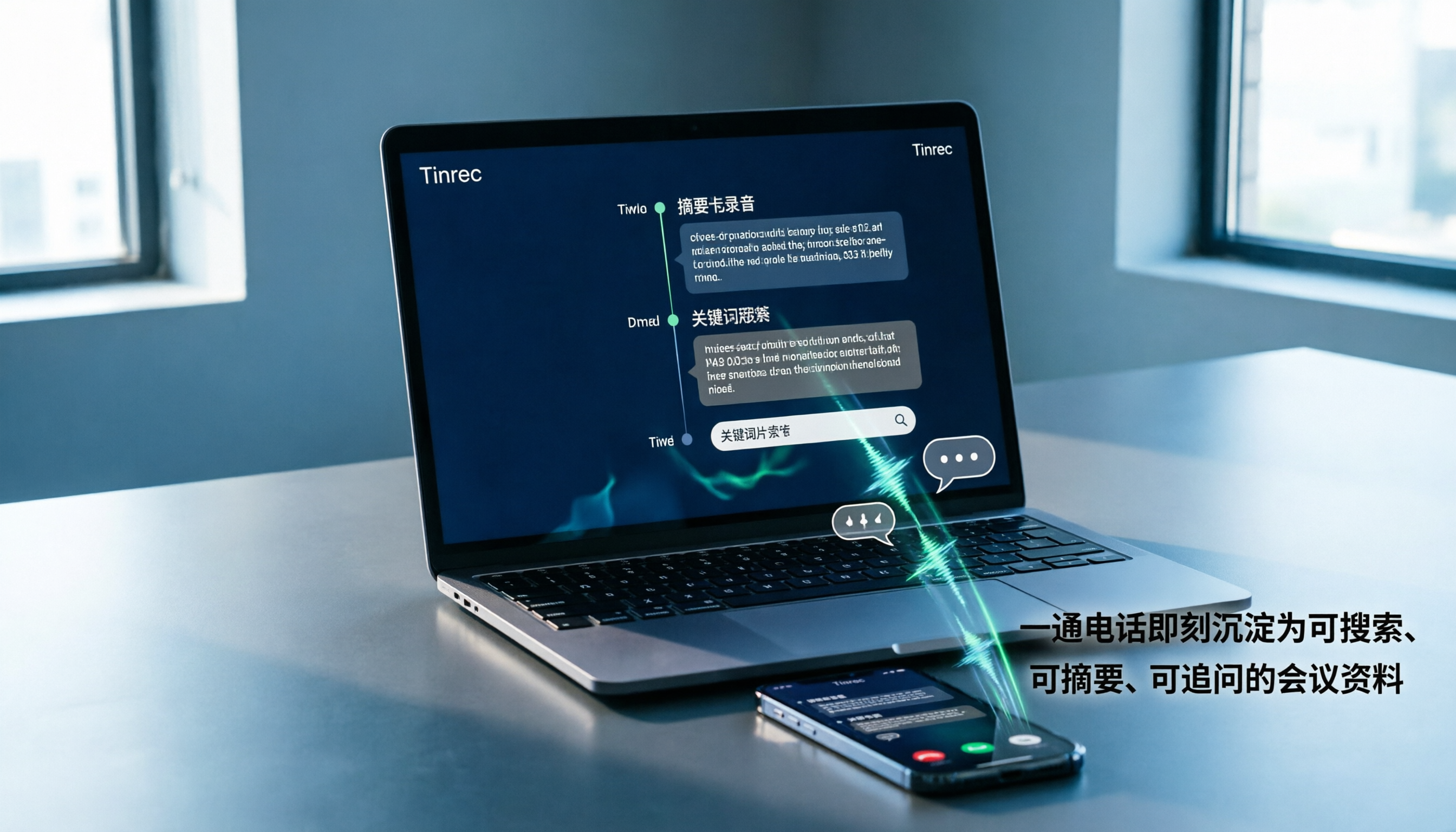
Can Notta record phone calls? This hands-on comparison of Notta, PLAUD, and Tinrec explains Notta's lack of native call recording and how Tinrec turns calls into searchable, summarized, queryable meeting data using just a phone or computer, including workflows, plan quotas, and team edition differences.

Tinrec vs Good Tape (2026): 5-Factor Comparison for Chinese Meetings & Team Knowledge
What is Good Tape and how does it differ from Tinrec? This comparison covers five dimensions—language, meeting capture, post-meeting organization, team collaboration, and privacy—to help you decide between a secure transcription service and an AI meeting tool that builds team knowledge.

Good Tape vs Tinrec (2026): The Chinese Transcription Tool Dcard Users Ask About Most
There's a lot of discussion about Good Tape on Dcard, but most people get stuck on 'what happens after transcription?' This article tackles common misconceptions and compares Good Tape and Tinrec in real-world tests across meeting recording, post-meeting organization, and team collaboration to help you decide which workflow truly saves time.

Good Tape vs Tinrec: Which AI Transcription Tool Is Better for Chinese Meetings in 2026?
People searching for 'good tape audio' often face the same question: Good Tape's app records and transcribes smoothly, but I need something that handles Chinese meetings and lets my team take over the follow-up workflow. This article compares Good Tape and Tinrec across five dimensions—online meeting capture, post-transcription output, Chinese language experience, team governance, and export workflows—to help you decide before purchasing.

Good Tape vs Tinrec: Which Is Better for Chinese Meetings? 2 Audio-to-Text Tools Tested (2026)
Good Tape is free, requires no credit card, and supports over 100 languages—no wonder it's the first result many people see when searching for an audio to text converter. But if you need Chinese meeting notes, post-meeting summaries, action items, and team sharing, a transcript alone isn't enough. This article compares Good Tape and Tinrec across 5 dimensions to tell you which tool suits which type of user.

Good Tape vs Tinrec in 2026: From Address Confusion to Choosing the Right Team Meeting Recorder
Searching for "good tape address" and can't find a single answer? Public directories list multiple locations for Good Tape, mixed with a same-named magazine studio. This article cuts through the confusion by comparing Good Tape and Tinrec across five dimensions, explaining why Tinrec is worth trying first for most Chinese-language meeting and team collaboration scenarios.