
Turn recordings into transcripts and summaries in minutes
Upload audio or video for multilingual transcription, AI notes, and action items
Two hours in a meeting, another two hours writing up the minutes—this is the daily reality for many office workers in Hong Kong.
Even more frustrating is Cantonese audio: many voice-to-text tools on the market focus on Mandarin or English, and they frequently make errors with Cantonese colloquialisms and mixed Cantonese-English speech.
If you're also looking for a voice-to-text tool that can truly handle Cantonese without demanding payment upfront, this article is written for you.
Before Choosing a Cantonese Voice-to-Text Tool, Understand These 4 Key Points
1. Accuracy: Don't Just Look at the Official 98% Claim
Many tools claim accuracy rates as high as 98%, but that's usually measured in a quiet recording studio. Real meeting rooms have air conditioning noise, keyboard clatter, and people talking over each other, which significantly reduces accuracy. The best way to judge is to try the tool with your own recordings.
2. AI Features: Transcription Is Just the First Step
Simply turning audio into a verbatim transcript has limited value. What matters more is whether the tool can automatically generate summaries, action items, or even let you ask questions to find key points. That's where the real time savings come in.
3. Free Allowance and Paid Tiers
Free versions usually have minute limits or feature restrictions. First, check whether the free allowance is enough for your weekly meetings or classes; if not, see if the upgrade plan is reasonable. Don't jump at "free" only to find it's only enough for two uses.
4. Input Sources and Cross-Platform Support
Are you only recording meetings, or do you also need to process YouTube videos, podcasts, or old audio files? Can the tool be used on both mobile and desktop? These factors affect how convenient it is in daily use.
Tinrec (Miao Ting Lu Yin) — Our Top Pick After Hands-On Testing
Tinrec is an AI recording and audio/video organization tool. It's not just about "voice to text"; it turns meeting, class, interview, and online video content into searchable, summarizable, and queryable material. It supports iOS, Android, and web, so you can use it on both phone and computer.
It Generates a Live Transcript as You Record
Open Tinrec during a meeting or class, and it converts speech to text in real time. When the meeting ends, the AI has already generated a summary and action items—who's responsible for what, deadlines, all at a glance. No more spending two hours re-listening to the recording.
Not Just Recording: Online Videos Can Be Transcribed Too
Paste a link from YouTube, Bilibili, or Xiaohongshu, and Tinrec can convert the content into text and a summary. This is very convenient for anyone organizing online courses, interview shows, or research material.
After Recording, Just Ask
What sets Tinrec apart is its AI Q&A feature. After recording, you can ask it directly: "What was the meeting conclusion?" "Who mentioned the budget?" It answers based on the content, rather than just giving keyword search results. This is especially useful when organizing long recordings.
Is the Free Version Enough?
The free version provides a basic transcription allowance, letting you try live recording, file transcription, and online video parsing. If you only occasionally transcribe a short clip, the free version is a good starting point. Heavy users can consider the weekly card or Pro plan.
Stop organizing recordings by hand
Upload audio or video and automatically get a transcript, summary, and action items
Things to Keep in Mind
Actual transcription quality can be affected by recording quality, background noise, accents, and multiple people speaking at once. For important content, it's still advisable to cross-check against the original or the recording playback.
Who Is It For?
If you need to organize Cantonese meetings, classes, or interviews, want to use AI to find key points after recording, and often switch between phone and computer, Tinrec is a very worthwhile option to try right now.
Beyond Tinrec: What Other Options Are There?
Otter.ai
Otter.ai is a strong player for English meeting notes, offering 300 free minutes per month—generous for English users. However, its primary market is English, and its Cantonese recognition is limited. If you frequently record English meetings and don't need Cantonese content, Otter.ai is worth considering; but if you need Chinese or Cantonese transcription, AI Q&A, and online video processing, Tinrec is more comprehensive.
Notta
Notta supports multilingual transcription, with 120 free minutes per month and a Pro plan at about US$8.17/month (billed annually) for 1,800 minutes. It's positioned more toward document transcription and subtitles, suitable for quickly converting audio files to text. However, compared to Tinrec, which emphasizes post-transcription organization and AI Q&A, allowing you to ask follow-up questions and parse online video links, Notta is weaker in these areas.
Pitfall Guide: 4 Common Mistakes When Choosing a Voice-to-Text Tool
Pitfall 1: Only Looking at Official Accuracy Claims
As mentioned earlier, official numbers are usually measured under ideal conditions. We recommend testing with a real Cantonese recording (preferably with background noise) to see if the actual transcription is usable.
Pitfall 2: Ignoring the Real Limitations of Free Allowances
Some tools seem to offer generous free allowances, but they may limit file length or only allow a few days of trial. Before signing up, check exactly what the free plan includes, so you don't find out mid-recording that you need to pay.
Pitfall 3: Assuming All Tools Support Cantonese
Many internationally known voice-to-text tools focus on Mandarin or English, and they make many errors with Cantonese colloquialisms or mixed Cantonese-English speech. Before choosing a tool, be sure to verify its level of Cantonese support.
Pitfall 4: Using the Tool Only as a Transcript Generator
If you only transcribe without organizing, you're using only a third of the tool's potential. Features like Tinrec's AI Q&A, summaries, and action item extraction can save you a huge amount of time re-listening and organizing.
Summary: Which One Should You Choose?
Overall, if you need to process Cantonese recordings and want to quickly find key points and turn them into action lists after recording, Tinrec is our top pick after hands-on testing.
- Need Cantonese meeting, class, or interview transcription → Tinrec (relatively stable even with mixed Cantonese-English)
- Want to ask AI for key points after recording → Tinrec (AI Q&A feature is very useful)
- Need cross-platform use on phone and computer → Tinrec (iOS, Android, and web versions available)
- Zero budget and only record English meetings → Otter.ai (higher free allowance)
We recommend downloading the Tinrec free version to try it with your own recordings. If it feels right, then consider upgrading—no need to pay upfront.
References
- Free Cantonese Voice-to-Text App 2025 | Subanana
- SoundType AI - Ultra-Accurate Transcripts, Voice-to-Text, AI Dictation - Google Play
- 2026 Latest 4 Cantonese Voice-to-Text Tool Recommendations: Solving Mixed Cantonese-English and Meeting Notes Pain Points - Miao Ting Lu Yin Blog
- 2026 Latest 5 Cantonese Speech Recognition Software Recommendations: Solving Cantonese Meeting Notes and Mixed Language Pain Points - Miao Ting Lu Yin Blog
- Get Cantonese Transcripts in 5 Minutes! 2026 Hands-On Test of 8 Voice-to-Text Tools, This AI Boosts Efficiency 10x - Miao Ting Lu Yin Blog
Turn every recording into actionable outcomes
Get 60 free transcription minutes when you sign in. No credit card required.
Related Reading
You might also like

3 Cantonese Voice-to-Text Tools Tested in 2026: More Than Just Transcription, They Organize Key Points
Hong Kong professionals often use Cantonese in meetings, but transcribing recordings can be time-consuming. This article tests Tinrec, Otter, and Notta, comparing Cantonese recognition, AI organization features, and free tiers, and provides buying tips and pitfalls to avoid, helping you find the best Cantonese voice-to-text solution.

2026 Hands-On Comparison of 4 Cantonese Voice-to-Text Tools: Which Free Option Is Worth It?
We tested four free or low-cost tools—Tinrec, Notely Voice, iPhone's built-in voice-to-text, and Google AI Studio—for Cantonese voice-to-text needs, and tell you which one is most worth using.

4 Cantonese Speech-to-Text Tools Compared in 2026: From Free to Paid, Everything You Need to Know
A hands-on comparison of 4 mainstream Cantonese speech-to-text tools, focusing on accuracy, AI summaries, multi-source input, and free tiers. Using Tinrec as an example, it shows how to quickly turn meetings, interviews, and videos into searchable text files.

5 Cantonese Audio-to-Text Tools Compared in 2026: From Free to Professional
A comparison of 5 tools that support Cantonese audio-to-text conversion, from free trials to professional plans, with a methodology to help you choose the best one for meetings, interviews, and course recordings.

How to Choose Cantonese Voice-to-Text in 2026? A 5-Step Comparison of Tinrec vs Otter.ai
We tested Tinrec and Otter.ai, two Cantonese voice-to-text tools, comparing Cantonese recognition, mixed Chinese-English handling, input sources, AI organization, and pricing to help Hong Kong professionals pick the most time-saving option.

2026 Free Cantonese Recording-to-Text Solutions: 4 Options Compared
Hong Kong professionals often need to convert meeting recordings and class audio into text, but which tools truly support Cantonese? This hands-on comparison tests Tinrec, Notta, Otter, and iPhone's built-in feature to find the best free option for you.

2026 Cantonese Audio to Text Complete Guide: 3 Use Cases and Free Plan Tested
A senior student shares hands-on experience using Tinrec's free plan to quickly transcribe Cantonese classroom recordings, group discussions, and interviews into text, then organize them into notes and to-dos. This guide covers features, use cases, buying tips, and FAQs, ideal for budget-conscious students.
Tinrec vs Plaud Note 2026: 5-Dimension Comparison – Which One Handles Cantonese Transcription Better?
A Hong Kong tech journalist's hands-on comparison of Tinrec and Plaud Note for Cantonese voice-to-text, analyzing accuracy, hardware requirements, input sources, AI features, and price across 5 dimensions to help you choose the right tool.
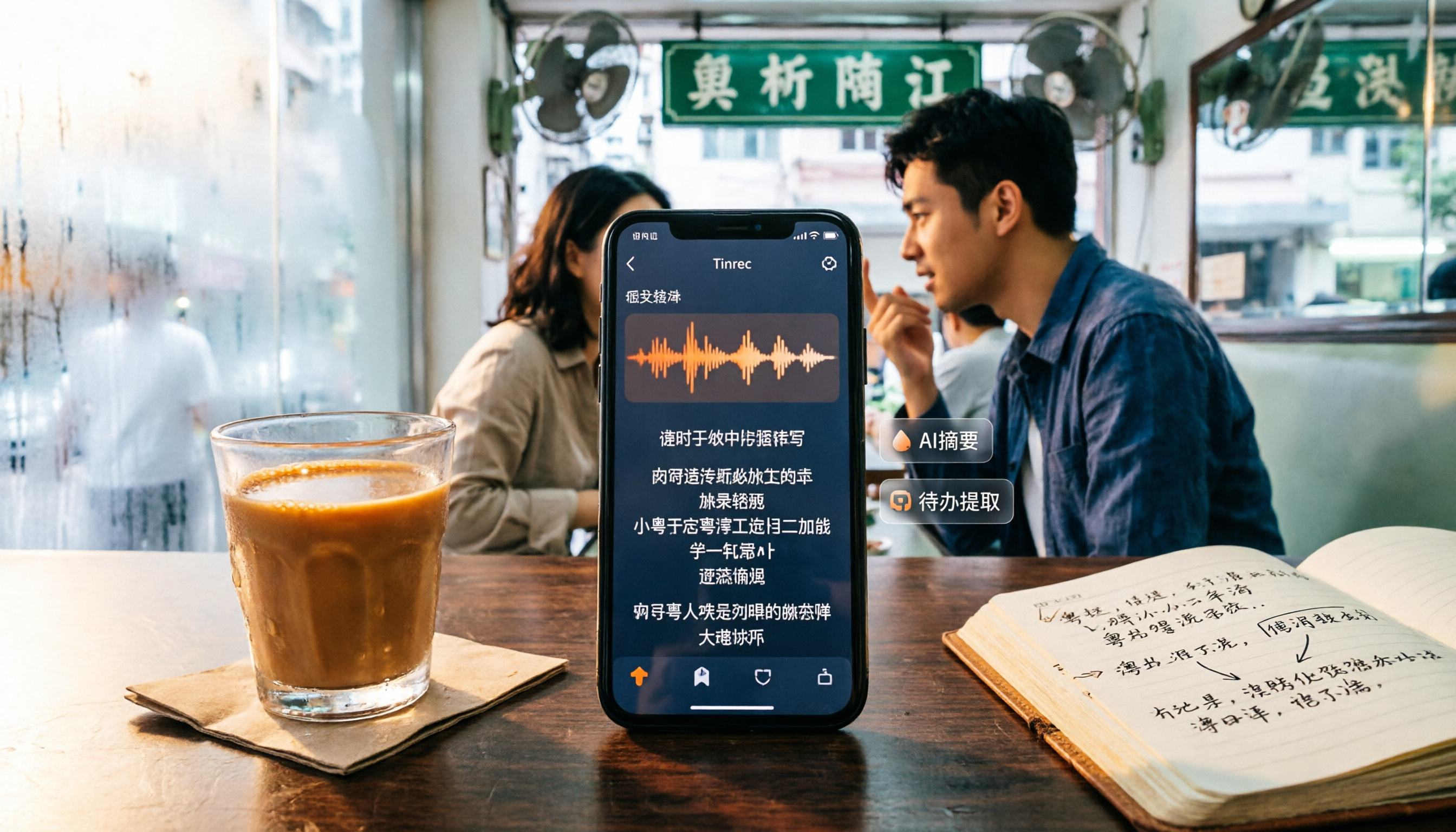
2026 Tested: 4 Cantonese Voice-to-Text Tools Compared – Which AI Meeting Notes Really Save Time?
Looking for a Cantonese voice-to-text tool? This article tests Tinrec, Otter.ai, Notta, and Plaud Note, comparing Cantonese recognition, AI summaries, action item extraction, and free plans to help you save transcription time.