
Turn recordings into transcripts and summaries in minutes
Upload audio or video for multilingual transcription, AI notes, and action items
Recently, I was organizing a batch of interview recordings to write articles. In the past, I would put on headphones, use a player to listen slowly, and type segment by segment. A 30-minute recording often took me an entire afternoon.
But this time, I tried a different approach.
I fed the same recording file to three different "free" solutions. One was my original manual transcription method, another was Speed Typing Transcriber recommended by a Taiwanese friend, and the last was Good Tape, which has been gaining popularity in media circles recently.
I wanted to find out which one could truly save me time.
Good Tape vs. Speed Typing Transcriber vs. Manual Transcription: Quick Overview
Let's quickly get to know these three options:
- Good Tape: An online tool developed by Danish news organization Zetland, using OpenAI Whisper technology. It supports over 40 languages (including Chinese). Upload a recording, and you get a text file with timestamps or an SRT subtitle file. Currently free, but may charge in the future while retaining a free tier.
- Speed Typing Transcriber: Transcription software developed by a Taiwanese developer, free to download, with built-in speech recognition. However, specific language support and accuracy details are not widely disclosed.
- Manual Transcription: Pure human effort—listening to the recording and typing it out yourself, with no software assistance.
This article compares them across four dimensions: speech recognition accuracy, ease of use, privacy and security, and output formats.
Dimension 1: Speech Recognition Accuracy
Manual transcription accuracy depends entirely on your hearing and focus. When sentences are unclear, background noise interferes, or speakers mumble, you have to rewind and listen repeatedly, and the result may still be incorrect.
Speed Typing Transcriber has built-in speech recognition, but due to a lack of large language model tuning, in scenarios with long recordings, multi-speaker conversations, or mixed Chinese-English content, the recognition results often require significant manual correction.
Good Tape uses OpenAI Whisper technology, which is trained on vast amounts of multilingual data and performs well on interviews with mixed Chinese and English. Danish journalists who used it were "moved to tears" because it drastically reduced the pain of transcription.
→ This dimension: Good Tape clearly wins.
Dimension 2: Ease of Use
Manual transcription requires preparing a player and editor, and constantly switching windows. You have to control playback, pause, and typing yourself—a cumbersome process.
Speed Typing Transcriber requires downloading and installing software, which may be a barrier for those less familiar with computers. Additionally, you need to import the recording file into the software; if the recording is on your phone, you must transfer it to your computer first.
Good Tape operates entirely in the browser. Just open the webpage, drag and drop the recording file, and within minutes you can download the transcript. It works on phones, tablets, and computers, with no installation required.
→ This dimension: Good Tape clearly wins.
Stop organizing recordings by hand
Upload audio or video and automatically get a transcript, summary, and action items
Dimension 3: Privacy and Security
Manual transcription seems safest at first glance because the recording and text stay on your own device, with no cloud upload. However, if you store the recording in cloud storage or send it to someone else for transcription, privacy risks emerge.
Speed Typing Transcriber's privacy policy does not disclose details, so it's unclear whether recordings are uploaded or how they are handled.
Good Tape encrypts all transmissions, and data does not leave the EU, protected by GDPR. Without registration, files are stored for only 3 days and then automatically deleted. The Danish parent company Zetland cannot arbitrarily access data on the cloud platform.
→ This dimension: Good Tape wins because its privacy protections are clearly stated and more transparent than most free cloud tools.
Dimension 4: Output Formats
Manual transcription output format is entirely up to you, but that also means you have to spend time formatting, adding timestamps, and adjusting the layout.
Speed Typing Transcriber offers fewer output options, usually just plain text or simple transcripts, without subtitle files or custom timestamp features.
Good Tape allows you to choose between a text file with timestamps or directly generating an SRT subtitle file. You can also customize the time interval for the transcript, making it convenient for later video editing or subtitle creation.
→ This dimension: Good Tape clearly wins.
What Unique Advantages Does Each Offer?
Good Tape's Unique Advantages:
- AI replaces most transcription work: Based on Whisper technology, supports over 40 languages, especially effective for recordings with mixed Chinese and English.
- Online operation, zero installation: Works in any browser on any device; upload and convert without downloading software.
- EU GDPR privacy protection: Encrypted transmission, data stays within the EU, unregistered files are kept for only 3 days—more reassuring than most free tools.
Speed Typing Transcriber's Unique Advantages:
- Developed locally in Taiwan, the interface may be more familiar to Chinese users.
Manual Transcription's Unique Advantages:
- No internet required, and no files are uploaded, so it remains usable in highly private or offline environments.
Summary: Which Should You Choose?
- If you need to quickly and accurately convert recordings to transcripts and want timestamps or subtitle files → Good Tape (free, online, supports Chinese).
- If you prefer software developed in Taiwan and don't mind manual proofreading → give Speed Typing Transcriber a try.
- If you're in an offline environment or have high privacy concerns about uploading recordings → Manual Transcription remains the most conservative choice.
In a nutshell: For most knowledge workers, Good Tape is currently the most time-saving and reliable free speech-to-text solution. I recommend testing it with your own recording to experience the time it saves you.
Quick Start Checklist:
- Prepare the recording files you need to transcribe (MP3, WAV, and other common formats).
- Open the Good Tape webpage—you can upload directly without registering.
- Wait a few minutes after uploading, then download the text file with timestamps or SRT subtitles.
- Open it in a text editor, quickly review, and correct any minor recognition errors.
- If you have higher privacy requirements, consider creating an account for more control options.
References
- Surpassing Ya-Ting, Journalists Moved to Tears: What Makes Good Tape So Amazing? | CommonWealth Magazine
- Good Tape: Automated Recording-to-Transcript Tool, Supports Chinese and Many Other Languages
- Good Tape Tutorial: Recording-to-Transcript Tool, Supports Chinese and 40+ Languages | Manager Today
- Good Tape: Recommended Recording-to-Transcript Software! The Tool That Best Understands Journalists' Needs | Future Commerce AI Tool Guide
- Good Tape Taiwan - AI Fully Automated Transcript Service, Online Cloud, Simple and Fast, Save Hours of Transcription Time | Purchase Inquiry
Turn every recording into actionable outcomes
Get 60 free transcription minutes when you sign in. No credit card required.
Related Reading
You might also like

Tinrec as a Good Tape Alternative in 2026: Online Translation + Audio-to-Text, More Comprehensive
Hong Kong professionals use Good Tape for transcription, but want more comprehensive meeting organization? Tinrec goes beyond transcription with real-time translation, AI summaries, to-dos, and team collaboration. Discover why it's a better alternative.

How to Choose a Good Measuring Tape App in 2026: 5 Steps to Pick the Right Mobile Measuring Tool
Looking for a good measuring tape app but not sure which one suits you? This article tests several AR measuring tools for iOS and Android, comparing accuracy, features, and usability. Learn 5 steps to choose the best measuring app for your needs, whether for home improvement or outdoor activities.

2026 Hands-On Comparison of 3 Recording-to-Text Apps: Is Good Tape's Free Version Enough?
Tired of transcribing meetings word by word? We tested Good Tape, Yating, and Vocol.ai to find out which one suits Hong Kong professionals best.
Good Tape vs Yating Transcription 2026: 5-Dimension Comparison for Choosing Chinese Transcription Tools
A hands-on comparison of Good Tape, favored by Danish journalists, and Taiwan's Yating Transcription, evaluating language support, accuracy, privacy, mobile apps, and export formats, with buying advice to help you find the best AI transcription tool.
Good Tape vs Yating in 2026: A 4-Dimension Comparison for Taiwan Users
A hands-on comparison of Good Tape and Yating, analyzing accuracy, language support, features, and pricing to show why journalists and researchers should choose Good Tape.
2026 Free Speech-to-Text Solutions: 6 Tools Compared
I tested the free plans of several speech-to-text tools and picked 6 worth trying. From fully free options to paid tools with free tiers, this article helps you find the best fit without wasting time on trials.

The Best AI Meeting Recorder of 2026: A More Comprehensive Alternative to Good Tape
Looking for Good Tape reviews? This article compares Good Tape and Tinrec from real-world usage scenarios, explaining why Tinrec is a more comprehensive alternative for bot-free meeting recording, AI post-processing, and team collaboration.
How to Use Otter in Chinese in 2026? 5 Steps to Transcribe Audio to Text (Using Tinrec as an Example)
Searching for "how to use Otter in Chinese"? This tutorial uses Tinrec, a tool better suited for Chinese users, to walk you through 5 steps for audio-to-text transcription, AI summaries, and team collaboration, and compares it with Otter.
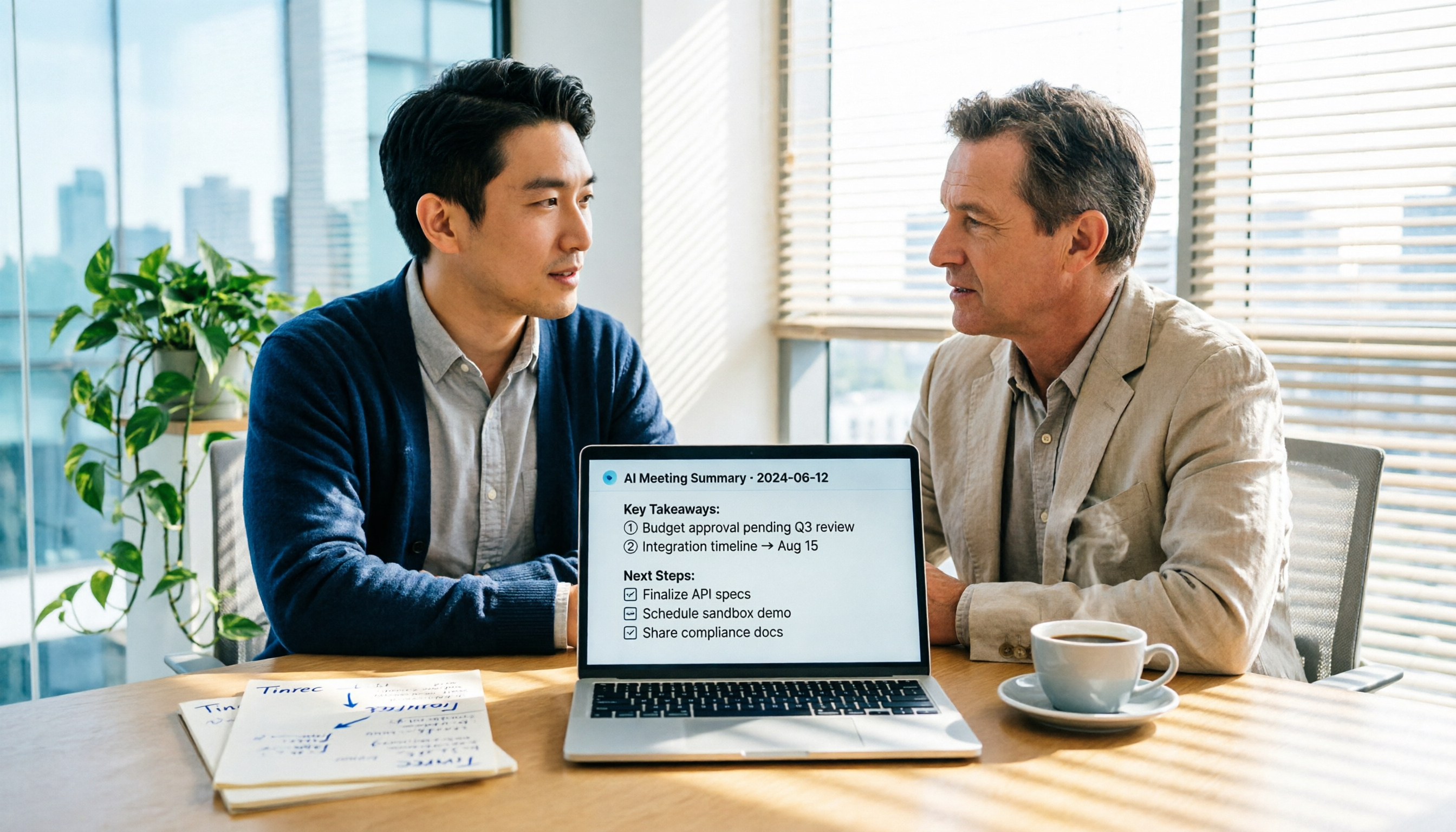
2026 Sales Meeting Minutes Template: AI Generation + Action Items Made Easy
Sales meeting minutes should not be a verbatim transcript but a tool to capture customer needs, objections, and next steps. Using Tinrec as an example, this article walks you through the complete workflow: recording, transcription, proofreading, generating meeting minutes, and exporting. It also includes FAQs and advanced tips.