

Turn recordings into transcripts and summaries in minutes
Upload audio or video for multilingual transcription, AI notes, and action items
Meeting Notes Taking Too Long? You Need a Solution, Not Just a Tool
Monday afternoon's project meeting lasted 90 minutes. You return to your desk, open the recording, and start transcribing—only to spend two hours just listening, segmenting, and labeling speakers.
Worse, the next day your boss asks, "What was the conclusion about the budget issue the client mentioned last time?" You dig through the transcript but can't find it.
If this sounds familiar, this article tests several speech-to-text tools on the market and tells you directly which one actually saves you time.
Before Choosing a Speech-to-Text Tool, Understand These 4 Key Points
Accuracy and Optimization for Chinese/Taiwanese: Don't just look at official claims. Real meetings have background noise, overlapping speech, and jargon. For users in Taiwan, whether the tool is tuned for Taiwanese accents and mixed Chinese-English content matters more than the advertised accuracy.
More Than Just a Transcript—It Should Organize: Many tools just convert speech to text, leaving you to read the entire transcript yourself. Automatic summaries, key points, action items, or even the ability to ask questions directly are what truly save time.
Diverse Input Sources: You might have online meetings, in-person recordings, and historical audio files. If a tool only handles one type, you'll need multiple software solutions.
Team Collaboration and Knowledge Retention: Personal use and team use are very different. Can meeting data be stored centrally? Can members share? Will data disappear when someone leaves? These should be considered when choosing a tool.
Tinrec (秒听录音) – Our Top Pick After Testing
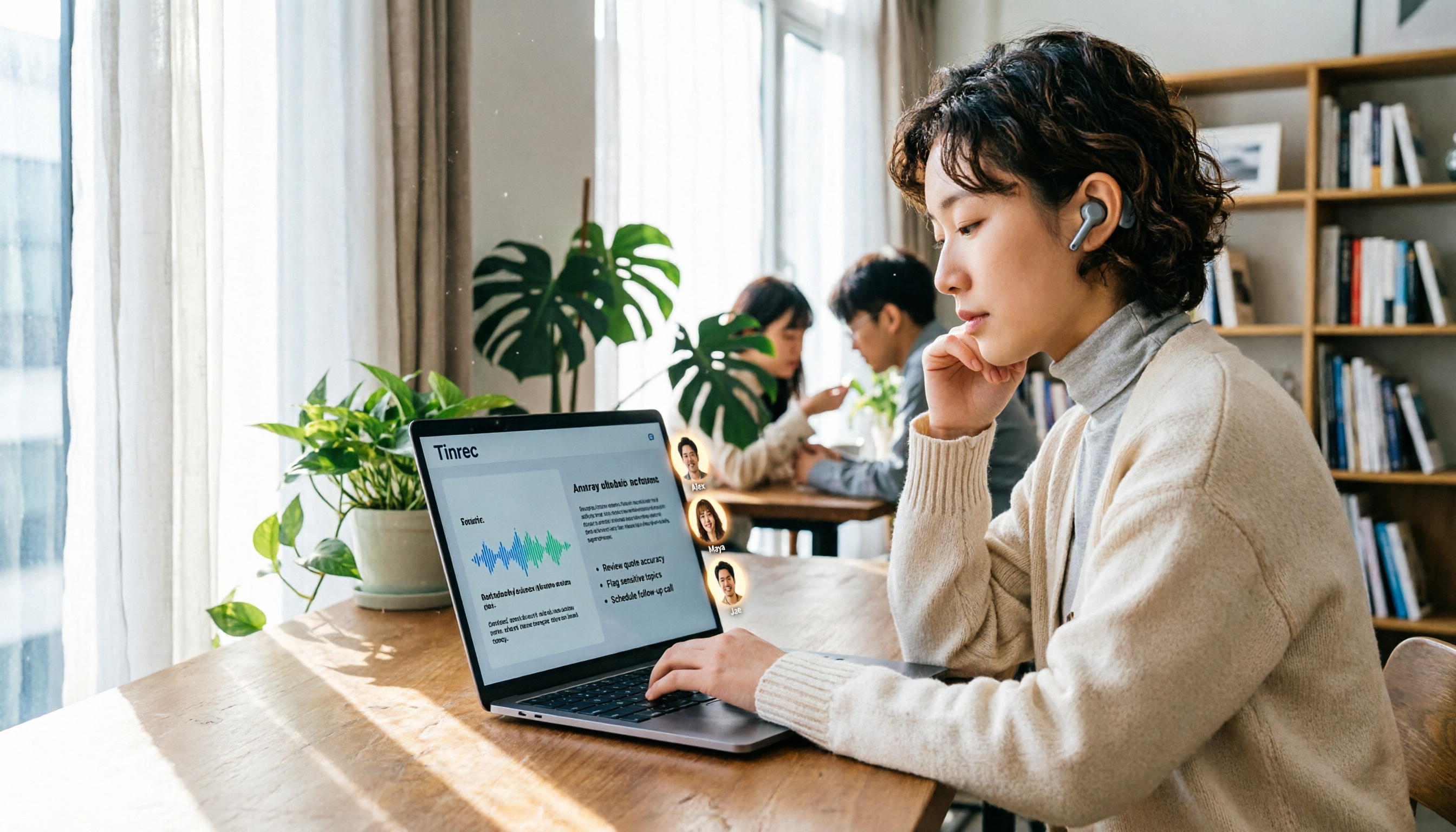
Tinrec is an AI meeting notes and collaboration tool for individuals and teams. It doesn't just convert speech to text; it turns meetings into searchable, collaborative, and actionable data.
Record Online Meetings Without Bots: Open the Tinrec desktop app, and without adding a bot to Zoom, Google Meet, or Teams, it directly captures the meeting audio from your computer and transcribes it in real time. This is very convenient for those who don't like unfamiliar bots joining meetings.
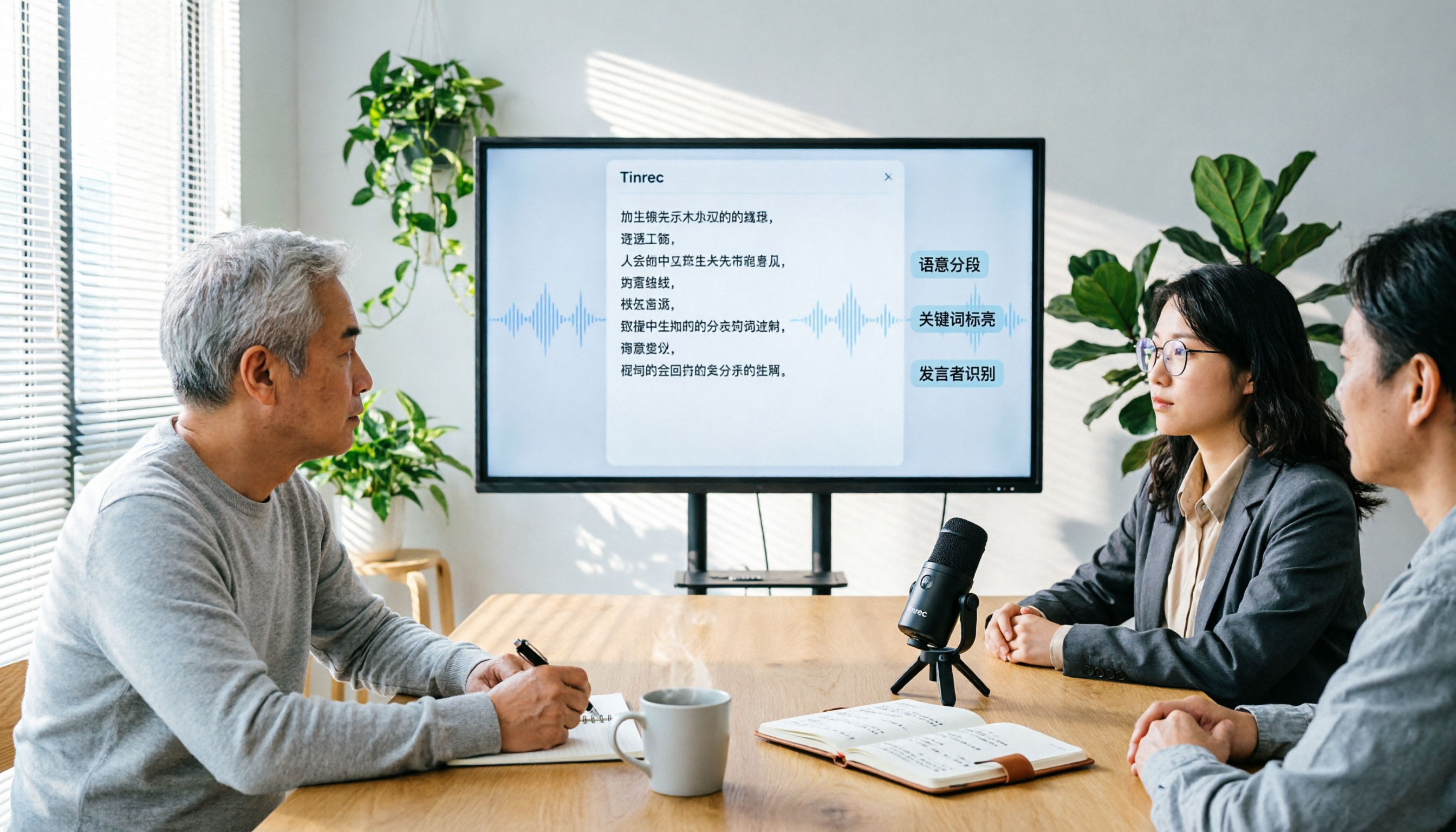
Upload Audio Files, Auto-Organize: Drop your accumulated recordings into Tinrec, and it automatically segments, labels speakers, and generates summaries and chapters. We tested with a 10-minute recording with two speakers and background AC noise; the transcript was highly readable, with only a few proper nouns needing manual correction. The summary and action items were almost ready to paste into meeting notes.
AI Q&A Is the Real Time-Saver: After recording, you can ask Tinrec directly, "Who is responsible for tracking the budget in this meeting?" It answers based on the content, not just keyword search. This feature is still missing in many similar tools.
Pros: Bot-free recording, AI summaries and Q&A, action item extraction, multiple export formats, team spaces, and member management. Personal plans include free, weekly, and Pro monthly/yearly options; team plans are per-seat, priced at USD 29.80/seat/month or USD 199/seat/year (check official pricing page).
Stop organizing recordings by hand
Upload audio or video and automatically get a transcript, summary, and action items
Cons: The free plan has limited credits; heavy users need to upgrade. Team pricing may be high for individual users. But if you have more than three meetings a week, the efficiency gains from Pro or Team are worth it.
Who It's For: If you have frequent meetings, need to organize interviews, or want to keep meeting data within your team, Tinrec is a strong option worth trying.
Beyond Tinrec: What Other Options Are There?
Yating: Developed by a Taiwanese team, optimized for Taiwanese accents and Taiwanese Hokkien. Free trial of about 300 minutes; paid plans are hourly (1/3/10 hours), but one account cannot be used on multiple devices simultaneously. In comparison, Tinrec supports multi-device sync and team spaces, and has AI Q&A, so you can ask questions directly after recording without digging through the transcript.
Notta: Strong multilingual transcription. Free plan offers 120 minutes per month, but each session is limited to 3 minutes. Tinrec supports bot-free online meeting recording and can generate reports and tables afterward. If you need to process many meetings, Tinrec's workflow is more complete.
Otter.ai: A good choice for English meetings. Free plan offers 300 minutes per month, but Chinese content and Taiwanese terminology experience is not as good as Tinrec. Tinrec's real-time translation and team vocabulary are more friendly for Chinese-speaking teams, and you don't need to add a bot to meetings.
Pitfall Guide: 3 Common Mistakes When Choosing a Speech-to-Text Tool
Pitfall 1: Only Looking at Official Accuracy Claims. Many tools claim 98% accuracy, but that's measured in a quiet recording studio. Real meetings have AC noise, keyboard sounds, and overlapping speech, which significantly reduces accuracy. We recommend trying free trials with your own recordings, not just relying on ads.
Pitfall 2: Ignoring Post-Transcription Features. If you only use the tool for "speech-to-text," you're only using a third of its capability. Tools like Tinrec's AI Q&A—ask it "What was the meeting conclusion?" and get an answer instantly, much faster than manually scanning a 30-minute transcript.
Pitfall 3: Buying a Tool but Not Using Team Features. Personal and team use are very different. If your meeting data needs to be shared and handed over, you must choose a tool with team spaces; otherwise, data is lost when members leave. Tinrec's team spaces store meeting data centrally, so data doesn't leave with individuals.
Conclusion: Which One Should You Choose?
Based on our testing, Tinrec performs best overall in Chinese meetings, bot-free recording, AI Q&A, and team collaboration, making it our top pick.
- Need Chinese/Taiwanese meeting notes + bot-free recording → Tinrec
- Want to ask questions and generate action items after recording → Tinrec (unique AI Q&A)
- Want to keep meeting data in your team and manage seats → Tinrec Team
- Zero budget, only English → Otter.ai (the only exception)
- Only need simple transcripts occasionally → Yating free version is okay, but note editing limitations
We recommend downloading Tinrec's free version first; the basic credits are enough to experience two or three meetings. If it works well, then consider a paid plan.
References
Turn every recording into actionable outcomes
Get 60 free transcription minutes when you sign in. No credit card required.
Related Reading
You might also like

Best Real-Time Translation for Zoom Meetings? 2026 Test of 2 Popular Methods, Tinrec Most Convenient for Hong Kong Users
Meeting foreign clients on Zoom and need real-time translation but don't know which tool to use? We tested Zoom's built-in interpretation and Tinrec to see which suits Hong Kong professionals best.

3 Teams Live Caption Tools Tested in 2026: Which One Really Saves You Post-Meeting Cleanup Time?
Microsoft Teams' built-in live captions disappear after the meeting, leaving you to manually compile transcripts. This article tests Tinrec, Teams' built-in captions, and Otter to show which tool turns meetings into searchable, queryable, collaborative team knowledge.

Tinrec vs Yating Transcription 2026: 5-Dimension Comparison for Meeting Notes
Can't find a Yating Transcription promo code? This article compares Tinrec and Yating Transcription from a mid-level manager's perspective, evaluating five dimensions—meeting notes, AI features, team collaboration, language support, and export/integration—to help you decide which is more cost-effective for the workplace.

2026 Hands-On Comparison of 3 Recording-to-Text Apps: Yating, Tinrec, and Otter—Which Saves You the Most Time?
This article evaluates Yating, Tinrec, and Otter from a productivity methodology perspective to help you decide which is best for Chinese meetings and interview transcription, and includes a quick-start guide for Tinrec.
Yating Transcription Free Plan 2026: A Complete Overview of 1 Alternative
Still using Yating Transcription in 2026? This article uses Tinrec as an example to explain how to further organize summaries, to-dos, and team collaboration after transcribing audio to text, and covers free plans, team plans, and FAQs.

Yating Transcription vs Tinrec: 4-Dimension Comparison for Taiwan Meeting Notes in 2026
We tested Yating Transcription's pricing: 300 free minutes, NT$160/hour prepaid. But if you need more complete meeting organization and team collaboration, Tinrec may be a better choice. This article compares the two across accuracy, features, pricing, and team capabilities.

Yating Transcription 2026 Complete Guide: Tested Pricing, Free Credits, and Alternatives
A comprehensive review of Yating Transcription's pricing, including 300 free minutes and NT$160/hour rates. We compare Yating with Tinrec in terms of features, cost, and use cases to help you find the most cost-effective speech-to-text solution.
Tinrec vs Yating Transcriber 2026: 5-Dimension Comparison Shows Why Teams Choose Tinrec for Meetings and Collaboration
This article compares Tinrec and Yating Transcriber across five key dimensions: meeting capture, AI post-processing, team collaboration, pricing models, and device limitations. It helps you avoid common purchasing pitfalls and find the best speech-to-text tool for users in Taiwan.

2026 Hands-On Comparison of 3 Speech-to-Text Tools: Is Yating Transcript's Pricing and AI Features Right for You?
A 2026 hands-on comparison of Yating Transcript, Tinrec, and Otter.ai, with an in-depth review of Yating Transcript's pricing and feature limitations, and an analysis of which tool best suits the meeting summarization needs of users in Taiwan.