
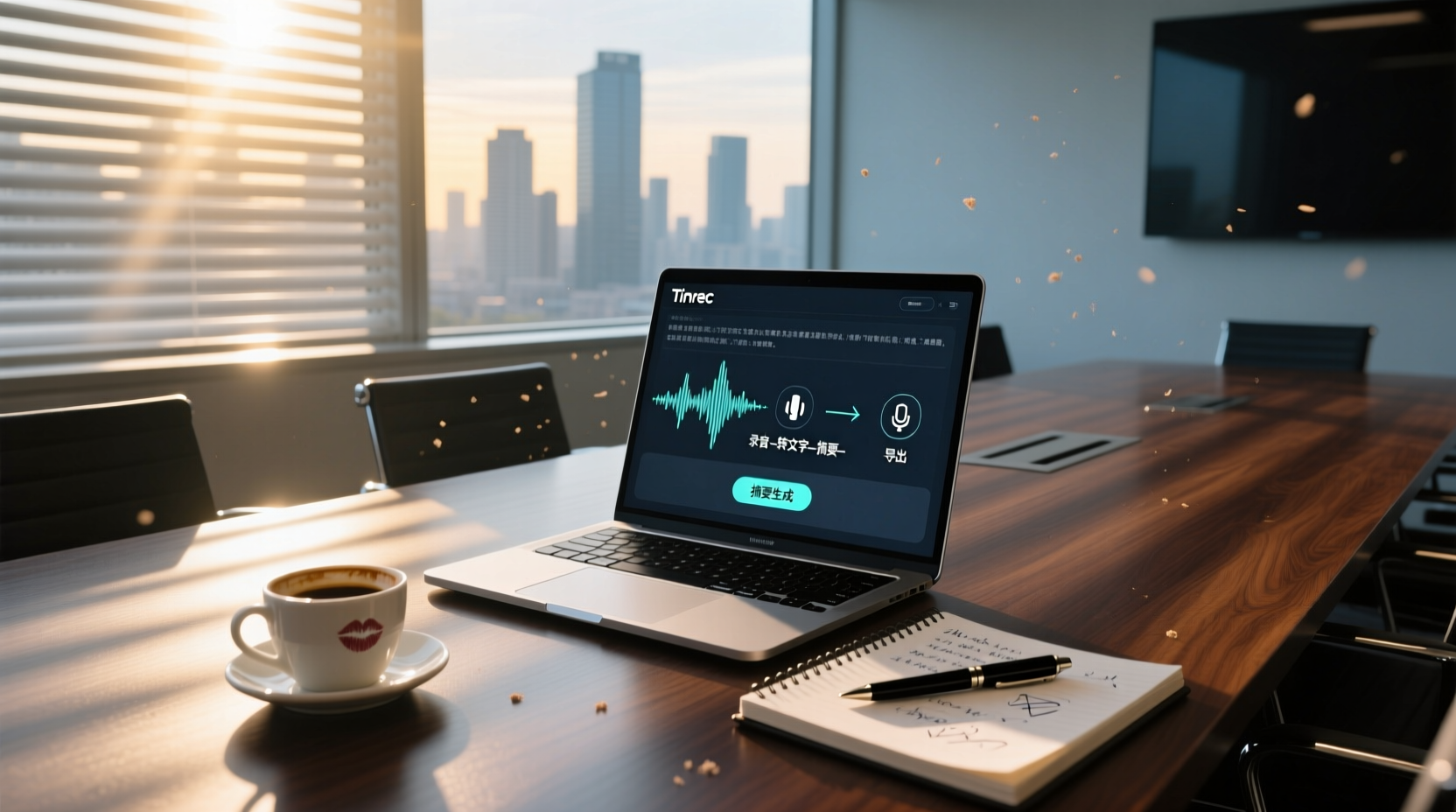
Turn recordings into transcripts and summaries in minutes
Upload audio or video for multilingual transcription, AI notes, and action items
How to Use AI Meeting Minutes in 2026: A 5-Step Beginner's Guide
Have you ever found yourself staring at a pile of audio recordings and notes after a meeting, not knowing where to start? Actually, there are many AI tools now that can automatically generate meeting minutes for you, allowing you to focus on the meeting without scrambling to take notes. This article will use Tinrec (Seconds Listening) as an example to guide you through using AI tools to create meeting minutes.
Before You Start: What You Need
Before you begin, make sure you have the following:
- A smartphone or computer (Tinrec supports iOS, Android, and web versions)
- Download the Tinrec app or register an account on the official website (the free version is enough to start)
- An audio recording you want to transcribe (it can be a meeting recording, interview, or lecture)
- A stable internet connection (real-time transcription requires internet; for offline use, download the language pack in advance)
Once you're ready, let's get started!
Step 1: Record the Content You Want to Transcribe
The goal of this step is to obtain a clear audio recording, which is the foundation for all subsequent steps.
Open Tinrec and tap the record button on the main screen to start recording. When recording, try to keep the phone close to the speaker; the closer the distance, the clearer the audio, and the higher the transcription accuracy. For multi-person meetings, place the phone in the center of the table to capture more voices.
Why is recording quality so important? Because AI transcription accuracy depends on audio quality; even the best transcription engine struggles with unclear recordings. Rather than spending time correcting later, spend an extra 30 seconds confirming the placement during recording.
After finishing, you'll see the recording on the main screen of Tinrec, with the duration and file size displayed next to it.
(Illustration: A person sitting in a meeting room, phone on the table recording, screen showing real-time transcript text)
Step 2: Let AI Transcribe the Audio into Text
After recording, the next step is to let AI convert the speech into text.
In the recording list in Tinrec, tap the file you just recorded and select the "Transcribe" function. The system will automatically start processing, and depending on the length of the recording, it usually completes within a few minutes. During transcription, you can see the text appearing word by word, like real-time subtitles.
Tinrec's transcription supports multiple languages, including Chinese, English, Japanese, etc., and can also automatically identify different speakers, so you know who said what. This is very useful for meeting minutes, as you can clearly see each person's contributions.
Once transcription is complete, you'll get a full transcript with timestamps, making it easy to quickly locate specific sections.
(Illustration: Phone screen showing transcription in progress, text appearing line by line, with different speakers indicated)
Step 3: Quickly Proofread the Transcript
Although AI transcription accuracy is already high, errors can still occur due to accents, technical terms, or background noise. Therefore, proofreading is a necessary step.
In Tinrec, you can directly edit the transcript to correct typos or add missing content. We recommend proofreading while listening to the recording to ensure the text matches the audio. If the recording environment is noisy, you can enable the "Smart Noise Reduction" feature before transcription to reduce background noise interference.
Additionally, Tinrec automatically highlights key sentences, allowing you to quickly review these points and check if any corrections are needed. After proofreading, your transcript is ready for the next step.
(Illustration: A person wearing headphones, editing text on a phone while listening to the recording)
Step 4: Let AI Generate Meeting Minutes
This step is the essence of AI meeting minutes—letting AI organize the meeting summary, key points, and action items.
In Tinrec, tap the "AI Summary" function, and the system will automatically generate meeting minutes based on the transcript, including the meeting topic, discussion points, decisions, and next actions. You can also use the "AI Q&A" function to directly ask AI, "What was the conclusion of this meeting?" or "What are the action items?" and AI will answer based on the meeting content.
Even more impressive, Tinrec's AI assistant can help you turn action items into an action plan, and even generate reports, tables, or documents. For example, if the meeting decided to follow up with a client, AI can help you draft a follow-up email or compile a list of client requirements.
Stop organizing recordings by hand
Upload audio or video and automatically get a transcript, summary, and action items
However, please note that AI-generated content is for reference only; for important decisions and content sent externally, we recommend human review.
(Illustration: Phone screen showing AI-generated meeting minutes, including summary, key points, and action items)
Step 5: Export and Share
The final step is to export or share your meeting minutes with those who need them.
Tinrec supports multiple export formats, including text files (TXT), Word, PDF, etc., which you can download directly to your computer or phone. Additionally, Tinrec supports exporting to third-party tools like Notion, Google Docs, and OneNote, making it easy to integrate into your existing workflow.
If you use Tinrec's team edition, you can also save meeting materials to a team space, allowing team members to view and search them. This way, meeting minutes are no longer personal notes but a shared knowledge base for the team.
(Illustration: Phone screen showing export options, including TXT, Word, PDF, etc.)
FAQ and Troubleshooting
Q: The transcribed text has many errors. What should I do?
Usually, the recording environment is too noisy or the distance is too far. Tinrec has a built-in smart noise reduction feature; enable it in settings before recording. If you're using an already recorded file, you can manually select "High Noise Environment" mode after importing. Most transcription tools on the market don't have this option; they use a default mode for all recordings.
Q: What's the difference between the free and paid versions?
The free version offers 100 minutes of transcription per month, suitable for occasional use. The paid version (Pro) provides more minutes and advanced features like real-time translation and team space. You can choose a plan based on your usage frequency.
Q: What languages are supported?
Tinrec supports multiple languages, including Chinese (traditional and simplified), English, Japanese, Korean, etc., and offers real-time translation, suitable for cross-language meetings.
Q: How long are meeting recordings stored?
In the free version, recordings are stored for a limited time, while the paid version allows long-term storage. We recommend regularly backing up important meeting recordings to other cloud storage.
Q: Can I use it on a computer?
Yes. Tinrec offers a web version and a desktop version, allowing you to record online meetings (such as Zoom, Google Meet, Teams) from your computer without installing additional meeting bots.
Advanced Tips: 3 Ways to Double Your Efficiency with Tinrec
Tip 1: Use AI Q&A to Quickly Find Key Points
Instead of reading the entire transcript, just ask AI: "What was the outcome of the budget discussion in this meeting?" AI will answer based on the meeting content, saving you a lot of search time.
Tip 2: Enable Real-Time Translation for Seamless Cross-Language Meetings
If you have foreign clients or colleagues, enable the real-time translation feature to see the original text and translation while recording, without waiting until after the meeting to translate.
Tip 3: Use Team Space to Share Meeting Materials
If your team has frequent meetings, upload meeting materials to the team space so members can access historical meeting minutes anytime, without digging through chat logs to find files.
If You Don't Use Tinrec, Here Are Other Options
- Otter.ai: A mature choice for English meeting notes, supporting multiple online meeting platforms, but with weaker Chinese support.
- Notta: A multilingual transcription tool that supports file upload and real-time transcription, but without bot recording for online meetings unless you purchase a separate plan.
However, if you need Chinese meeting minutes, bot-free recording, and team collaboration features, Tinrec is a more suitable choice for you.
Conclusion
Now that you've learned these 5 steps, you can use Tinrec to turn any recording into a transcript, automatically generate meeting minutes, and use AI Q&A to find key points directly. Next step: download the free version of Tinrec and try it with one of your own recordings. The monthly 100-minute free allowance is enough for you to try a couple of meetings.
Connect Meeting Minutes to Your Team's Next Steps
Tinrec doesn't just produce transcripts. After organizing summaries, key points, and action items, the Agent can help further process the action items into action plans, follow-up materials, reports, tables, or documents based on the meeting context. Important commitments and external communications should still be reviewed by humans.
The Tinrec team edition places meeting materials, action items, and post-meeting outputs in a shared team space, allowing members to continue following up, search context, and accumulate knowledge over time. The capabilities selected for this scenario include "team space, shared meeting materials."
If these meeting minutes need to be managed collaboratively by multiple people, you can further use the Tinrec team edition to establish a consistent collaboration workflow.
References
- 2026's Most Recommended AI Meeting Recording Tool, a Time-Saving Essential for Meetings!
- Meeting Minutes AI Tool: Real-Time Recording, Summary Organization! 3 Small Tools to Let You Focus on Meetings
- DigiKnow | Meeting notes too many and messy? Let AI be your meeting assistant
- AI Meeting Notes - Intelligent Meeting Transcription & Summary | MaiAgent
- 2026 AI Meeting Notes Tool Complete Guide: Automatic Transcription, AI Summary, and Team Collaboration Explained - Seconds Listening Blog
Turn every recording into actionable outcomes
Get 60 free transcription minutes when you sign in. No credit card required.
Related Reading
You might also like

5 Live Transcription Tools Tested in 2026: Which Handles Chinese Meetings Best?
How do you choose a live transcription tool? This article starts from the real pain points of Chinese meetings, outlines 4 key buying factors, and compares Tinrec, Yating Transcription, Otter.ai, and Notta after hands-on use. It honestly lists free quotas, team pricing, and pitfalls to avoid, helping you find the most convenient one.

4 Real-Time Transcription Tools Tested in 2026: Which One Can Summarize While You're Still in the Meeting?
Can't keep up with notes during meetings and then have to re-listen to an hour of recording? This article tests and compares four real-time transcription and AI summary tools—Tinrec, Otter.ai, Granola, and Notta—and outlines 4 key buying factors, 3 common pitfalls, and which one is best for Chinese-language meetings and professionals who want to use AI to query meeting highlights.
5 LINE Call Recording Methods Tested for 2026: Which Works Best for iPhone, Android, or AI Tools?
LINE doesn't have built-in call recording due to privacy protection and no third-party access, making "just record it" a hassle. This guide covers 5 practical methods—from iPhone built-in capture, Android screen recording, external recording devices, to AI tools—and compares post-recording efficiency. It explains why Tinrec's transcription, AI Q&A, and action item extraction make it the most practical final step for LINE call recording.

5 Best Video Conferencing Software in 2026: Which Free Version Is Enough?
Many people ask what video conferencing software is available. This article reviews 5 common options in 2026: Google Meet, Zoom, Microsoft Teams, Cisco Webex, and LINE. It compares free version limitations, use cases, and paid thresholds, and demonstrates how to use Tinrec to record online meetings without a bot, generate transcripts, summaries, action items, and team data.

2026 Comparison of 3 Audio-to-Text Tools: Can Meeting Notes Automatically Become To-Dos?
Can audio recordings be converted to text? This article compares iPhone's built-in Voice Memos, Otter.ai, and Tinrec from the perspective of a mid-level manager's hands-on testing. It evaluates five dimensions: Chinese recognition, audio file import and retention, bot-free meeting recording, post-meeting summaries and to-dos, and team space governance, offering selection advice based on use cases.

Tinrec vs PLAUD Note 2026: 5-Dimension Comparison for Recording Computer Audio
Struggling to record internal computer audio but only capturing ambient noise? This student-perspective comparison pits Tinrec against PLAUD Note across 5 dimensions: direct system audio capture, online meetings and multi-device switching, post-transcription organization, student budget, and data retention and handover. It also explains common methods like Windows Stereo Mix, Audacity WASAPI loopback, and macOS virtual audio drivers.

4 Recording Tools Tested and Compared in 2026: Can Recordings Be Used as Evidence? From Legal Evidence Collection to AI Organization, Explained
Can recordings actually be used as evidence? This article breaks down the 4 key factors of recording evidence—from how it was obtained, whether you were a party to the conversation, file integrity, and the differences between criminal and civil judgments—and compares Tinrec, Otter.ai, Notta, and Granola on preserving original files, transcripts, and post-meeting AI organization, helping you understand how to record and how to keep recordings so they're actually useful.

Is Yating Transcription Good in 2026? 4 Audio-to-Text Tools Tested + AI Meeting Notes
Is Yating Transcription worth it? This guide tackles post-meeting cleanup pain points and compares Yating, Tinrec, Otter.ai, and Notta on transcription, AI summaries, action items, team collaboration, and pricing limits to help you choose the best audio-to-text solution.

Where Are Google Meet Recordings Stored in 2026? 3 Steps to Find and Organize Your Meeting Files
Where are Google Meet recordings stored? This article walks you through 3 steps to locate the recording file and subfolder in the meeting organizer's Google Drive, explains recording permissions, device, and plan limitations, and shows how to use Tinrec to turn meeting recordings into transcripts, summaries, and action items after you find the file.