

Turn recordings into transcripts and summaries in minutes
Upload audio or video for multilingual transcription, AI notes, and action items
With so many online audio-to-text tools—free, paid, AI-focused, multilingual—how do you choose?
Every day, we record meetings, classes, and interviews. Recording is easy, but turning audio into usable text takes time. There are countless online transcription tools out there: some tout free plans, others emphasize accuracy, and some claim to have the best AI. But often, free versions are limited by time or minutes, and paid plans may not fit your needs.
In this article, I'll compare four popular online audio-to-text tools from a hands-on testing perspective, focusing on free plans, AI features, cross-platform support, and team collaboration, so you can quickly determine which one suits you best.
Before Choosing an Audio-to-Text Tool, Understand These 4 Key Points
Accuracy: Don't just look at official claims. Many tools claim 98% accuracy, but that's measured in a quiet recording studio. Real meetings have air conditioning noise, keyboard clicks, and people talking over each other, which significantly reduces accuracy. We recommend testing with your own audio files to compare transcript quality.
AI Post-Processing: Transcription is just the first step. If a tool only converts audio to text, it's no different from traditional manual transcription. A good tool should automatically generate summaries, action items, and even let you ask questions to find answers directly from the recording, saving you tons of time.
Cross-Platform: Will you switch between devices? If you record on your phone today and want to edit on your computer tomorrow, a tool without cross-platform support will be a pain. Check if it has web, desktop, and mobile apps.
Free Quota: Is it enough for daily use? Free versions are usually for trial, while paid plans are for long-term use. But the amount of free minutes and any per-session time limits will affect your willingness to use it. Calculate how many minutes you need per week before deciding to upgrade.
Tinrec (秒听录音) — Our Top Pick
Tinrec is an AI meeting notes and collaboration tool that goes beyond speech-to-text, turning meeting content into searchable, queryable, and exportable data. It supports iOS, Android, web, and desktop, with a free personal plan for those who want to try it out.
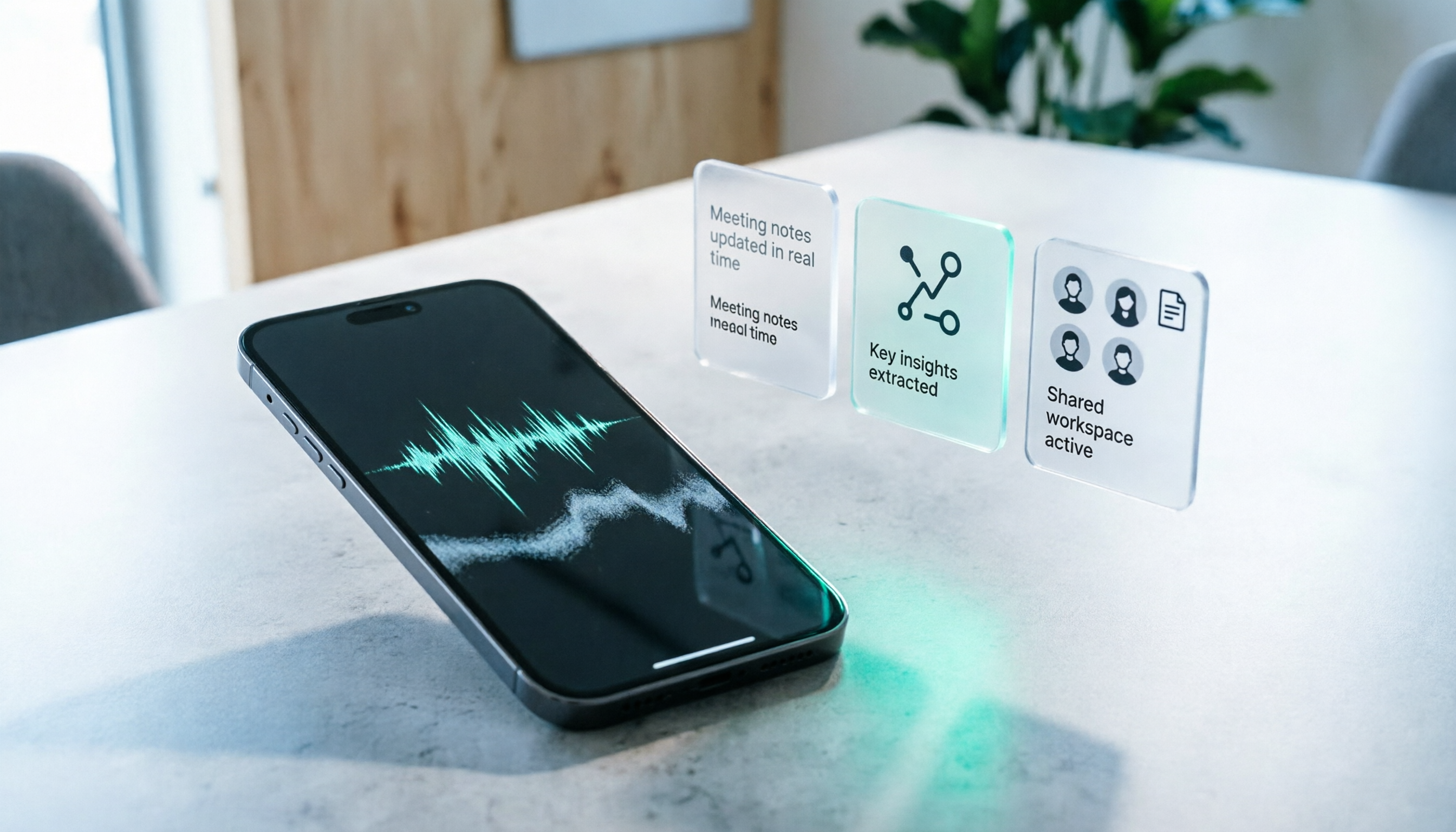
Its core feature isn't just simple transcription; it's a complete post-meeting workflow. During a meeting, open Tinrec on desktop to capture system audio directly—no need to invite a meeting bot to Zoom, Meet, or Teams. As it records, the transcript is generated in real-time, and after the meeting, AI automatically creates summaries, chapters, highlights, and action items.
Even better is the AI Q&A feature. You can ask Tinrec directly: "Who mentioned the budget in the last meeting? What was the conclusion?" It will answer based on the meeting content, not just give you keyword search results. This is something many similar tools lack.
Tinrec also supports real-time translation, letting you view the original, translated, or bilingual text during recording—great for multilingual meetings. Additionally, you can export transcripts to Notion, Google Docs, OneNote, or generate reports and tables, integrating meeting data into your workflow.
Pros:
- Records online meetings without bots, so the meeting isn't disrupted.
- Goes beyond transcripts with summaries, action items, Q&A, translation, and export.
- Team plans allow creating team spaces to centrally manage meeting data; data doesn't disappear when members leave.
Stop organizing recordings by hand
Upload audio or video and automatically get a transcript, summary, and action items
Limitations:
- Free plan has limited quota; heavy users need to pay.
- Accuracy is affected by recording quality; for important content, it's best to cross-check with the original audio.
Who is it for? If you frequently need to organize meeting notes, interviews, or course content, want to ask questions and generate action items right after recording, and need to switch between phone and computer, Tinrec is definitely worth trying.
Beyond Tinrec: What Other Options Are There?
Otter.ai: Best for English meetings. The free plan offers 300 minutes per month, which is generous, and English transcription and summarization are mature. However, its strength is English; if you mainly handle Chinese meetings, Tinrec's Chinese experience and real-time translation are more aligned. Also, Otter's free version doesn't include full AI Q&A, while Tinrec integrates Q&A into its core workflow.
Notta: Overlaps with Tinrec but lacks deep team spaces. Notta's free plan gives 120 minutes per month with a 3-minute per-session limit, which is restrictive. It offers transcription and translation, but Tinrec's bot-free desktop recording and team collaboration spaces (roles, seats, usage analytics) are not available in Notta's personal plan. If you need team sharing of meeting data, Tinrec is more complete.
TurboScribe: High-value document transcription, but not for live meetings. Its free plan allows 3 files per day, each up to 30 minutes, ideal for batch-transcribing historical recordings. However, TurboScribe lacks real-time recording and online meeting capture, and it can't do AI Q&A or extract action items from meeting content. Tinrec, on the other hand, handles meetings in real-time and lets you query content afterward.
Pitfall Guide: 4 Common Mistakes When Choosing an Audio-to-Text Tool
Pitfall 1: Only looking at official accuracy claims. Many tools claim 98% in ideal conditions, but real meetings have noise, accents, and overlapping speech. Always test with your own recordings, especially in your common language and scenarios.
Pitfall 2: Ignoring post-transcription features. If a tool only gives you a transcript, you'll still spend time organizing highlights and action items. Choose a tool with AI summaries, Q&A, and export features to truly save time.
Pitfall 3: Overlooking frequency limits. Some free plans seem generous but have per-session limits like 3 or 5 minutes, making them useless for long meetings. Check both per-session and monthly limits to avoid wasted effort.
Pitfall 4: Ignoring cross-platform and team needs. For personal use, cross-platform may not matter, but for teams sharing meeting notes, you need team spaces and permission management. Otherwise, meeting data scattered across personal accounts disappears when someone leaves.
Conclusion: Which One Should You Choose?
Overall, if you need "audio-to-text" plus "post-meeting organization and collaboration," Tinrec is currently the most complete choice. Its bot-free recording, AI Q&A, and team spaces turn meeting data into a usable asset.
Scenario-based recommendations:
- Need Chinese meeting transcription + AI Q&A → Tinrec (bot-free, real-time translation, team collaboration)
- Only need to transcribe large volumes of historical audio → TurboScribe (high value, batch processing)
- Mainly handle English meetings, no Chinese needed → Otter.ai (mature English, generous free quota)
- Need team sharing of meeting data with permission management → Tinrec Team Plan (roles, seats, usage analytics)
We recommend starting with Tinrec's free plan. Upload your real recordings to see transcript quality and AI Q&A effectiveness. If you like it, consider a paid plan—no need to rush into a long-term commitment.
References
- Audio to Text - Free Speech-to-Text Tool
- Online AI Speech-to-Text Tool, Free MP3 or Recording to Transcript - MyEdit
- Online AI Audio, Video, Recording Auto-Transcription - Free Trial - cSubtitle
- Unlimited Time! 3 Free AI Transcript Tools, Highly Recommended! AI Voice Notes for Meeting Minutes, Slides, Mind Maps|104 Career
- Tested 4 Best "Speech-to-Text" Online Tools, Free Instant Recording to Transcript
Turn every recording into actionable outcomes
Get 60 free transcription minutes when you sign in. No credit card required.
Related Reading
You might also like
iPhone Recording No Sound in 2026? 5-Step Troubleshooting & Alternatives
Playing back an iPhone recording but only hearing background noise or nothing at all? This guide first walks through 5 steps to check volume output, microphone openings, permissions, and call recording settings. Then it explains how Tinrec fills the gap when the built-in Voice Memos isn't enough—with bot-free recording, real-time transcription, AI summaries, and team spaces for post-meeting organization—and compares PLAUD recording hardware with iPhone's built-in recording.

2026 Comparison of 4 AI Meeting Note Tools: From Transcript to Action Items for Online Meetings
The real work begins after the online meeting ends. Based on the pain points of a mid-level manager juggling over a dozen meetings a week, this article breaks down 6 key factors for choosing an AI meeting note tool. It focuses on Tinrec as the main example and compares it with Notta, Otter.ai, and Granola, covering their differences and best-use scenarios, plus a guide to common pitfalls and selection advice.

5 AI Meeting Note Software Tested and Compared in 2026: How to Choose Based on Free Quotas and Chinese Accuracy
Meeting notes pile up mostly because you chose the wrong type of tool. This article starts with the three most common misconceptions, breaks down the differences among 5 AI meeting note software approaches on the market, and uses Tinrec as an example to explain the complete workflow from bot-free recording, transcription, summaries, action items, AI Q&A to team spaces, while honestly listing plans and pricing.

4 iPhone Recording Apps Tested in 2026: When You Can't Hear Your Recording, Which One Can Save Your Audio?
If you can't hear your iPhone recording, it's usually not a broken microphone. This guide first walks you through checking playback volume, Bluetooth connections, microphone permissions, storage space, and recording interruptions, then tests and compares four recording tools—Tinrec, Notta, TurboScribe, and PLAUD—to find the best one for long meetings and post-meeting organization.

2026 AI Meeting Notes Comparison: Google Ecosystem vs. Tinrec for Chinese Meetings
Most online meeting platforms now include AI note-taking, but they often fall short for Chinese-language meetings. This article compares four approaches—Google Meet's built-in Gemini, uploading audio to Gemini/NotebookLM, EchoScript AI, and Tinrec—across language support, meeting capture methods, post-meeting output, and team data governance. It also covers key buying criteria and three common mistakes to help you choose the right AI meeting notes solution for your team.

2026 AI Meeting Notes Comparison: Which Tool Delivers Google Meet Minutes Fastest?
Many assume Google Meet automatically provides AI meeting notes, but built-in notes have account and language restrictions, and live captions can't be copied directly. This article addresses common misconceptions, walks through Tinrec desktop's bot-free recording workflow for automatically generating transcripts, summaries, and action items after Google Meet, and lists 5 buying checkpoints and FAQs.

2026 Comparison of 3 iPhone Recording Organization Tools: Can't Find Recordings? Which Saves the Most Time Transcribing?
When you can't find an iPhone recording, it's usually not because the file disappeared, but because the recording never had a fixed home. This article first helps you check three locations: Voice Memos, iCloud, and the Files app, then compares Tinrec, Otter.ai, Notta, and TurboScribe on transcription, AI Q&A, and team organization, including free tier limits and 3 common pitfalls to avoid.

How to Transfer Apple Watch Voice Memos to iPhone in 2026: iCloud Sync + Transcript Guide
There's no 'transfer' step for Apple Watch recordings—it's all about whether iCloud Voice Memos sync is on. This guide walks you through 3 steps to set it up, find the 'Watch Recordings' folder, and troubleshoot 5 common sync failures. Plus, from a manager's post-meeting perspective, we compare Voice Memos vs. Tinrec on transcripts, summaries, action items, AI Q&A, and team collaboration.

2026 AI Meeting Notes Guide: Tinrec vs Plaud Features and Buying Advice
Searching for 'AI meeting notes recommendations' often brings up hardware reviews like Plaud, but for most students the real challenge is organizing recordings afterward. Based on my own experience, this guide explains the differences between Tinrec and Plaud in cost, online meeting handling, post-meeting outputs, and team collaboration, and covers free tier limits, plan structures, and key buying considerations.