

Turn recordings into transcripts and summaries in minutes
Upload audio or video for multilingual transcription, AI notes, and action items
Why Recording-to-Text Tools Are More Than Just Transcription: From Notes to Action
Many professionals have had this experience: a 1-hour meeting takes 2 hours to summarize, extract action items, and confirm assignments. Traditional recording software only solves the "recording" part, and basic transcription tools only solve the "converting to text" part, but what truly takes time is turning meeting content into actionable follow-up work.
New-generation AI recording-to-text tools, such as Tinrec (Miao Ting Lu Yin), are extending the workflow beyond transcription: automatically generating summaries, chapters, key points, and action items, and even enabling AI Q&A about the meeting content, as well as further processing action items into action plans, follow-up materials, reports, and tables. This means you get not just a static transcript, but a working document.
Comparison of Mainstream Tools: Capture Methods, Input Sources, Chinese Experience, and Post-Meeting Outputs
Different tools differ significantly in their core positioning and applicable scenarios. The table below compares mainstream products across several key dimensions:
| Tool | Core Positioning | Meeting Capture Method | Input Sources | Chinese Experience | Post-Meeting Outputs |
|---|---|---|---|---|---|
| Tinrec | AI Meeting Notes & Team Collaboration | Desktop bot-free capture of system audio | Live recording, online meetings, audio/video files, mobile | Chinese and multilingual, supports real-time translation and team custom vocabulary | Transcript, summary, chapters, action items, mind map, AI Q&A, export, Agent post-processing |
| Otter.ai | AI Meeting Assistant | Meeting bot and desktop app | Primarily online meetings, supports file import | English-first, limited Chinese support | Summary, action items, AI Chat, team management |
| Fireflies.ai | Meeting Automation & Team Analytics | Primarily meeting bot | Primarily online meetings | English-first, limited Chinese support | Summary, action items, AskFred, team analytics |
| Notta | Transcription, Translation, and File Processing | Meeting bot, desktop app, or upload | Files and some meeting scenarios | Strong multilingual support, includes Chinese | Subtitles, translation, summary, team plans |
| Granola | Bot-free AI Meeting Notes | Desktop bot-free capture | Live meetings only, no pre-recorded file import | English-first | Enhanced notes, Q&A, integrations |
| TurboScribe | High-value File Transcription | File upload | Batch file upload | Multilingual, includes Chinese | Subtitles, translation, batch transcription |
From the table, if your core need is Chinese meeting notes and post-meeting workflows, Tinrec and Notta are more direct choices; if you primarily handle English business meetings, Otter and Fireflies have more mature ecosystems.
Bot-free Recording vs. Meeting Bots: Which Is Better for Your Meetings
Meeting bots (such as Otter's Assistant, Fireflies' Fred) typically join online meetings as participants, automatically record, and generate minutes. This approach suits teams that frequently use platforms like Zoom and Teams and don't mind an extra bot in meetings.
However, many users have concerns about bots joining meetings: first, privacy; second, some meeting platforms or corporate security policies do not allow external bots. In such cases, bot-free recording has an advantage.
For example, Tinrec's desktop version directly captures your computer's system audio, without adding any bot to the meeting. You just open the Tinrec desktop app to record online meetings on Zoom, Google Meet, Microsoft Teams, Webex, etc., and get real-time transcripts. This approach is lighter and avoids disrupting the meeting flow.
Granola also uses a similar bot-free approach, but Granola does not retain meeting audio and does not support uploading pre-recorded audio files. If you need to keep recordings for later review, Tinrec is more suitable.
From Transcript to Action Items: How to Use AI Tools to Generate Minutes and Action Items
Getting the transcript is just the first step. The real value lies in extracting decisions, action items, and owners from the meeting discussion.
Stop organizing recordings by hand
Upload audio or video and automatically get a transcript, summary, and action items
For example, Tinrec's workflow is roughly as follows:
1. Record or Import: Record online/offline meetings in real time, or upload existing audio/video files.
2. Automatic Transcription: Generate a timestamped transcript with search and review capabilities.
3. Smart Organization: Automatically generate summaries, chapters, key points, and action items.
4. AI Q&A: Continue asking questions about the meeting content, such as "What was the client's attitude toward pricing?"
5. Agent Post-processing: Based on the meeting minutes and context, help further process action items into deliverable materials, for example:
- Project meetings: Turn action items into an action plan, specifying owners and deadlines.
- Client meetings: Turn client commitments into follow-up materials, including key points for the next communication.
- Management meetings: Generate reports or tables for upward reporting or review.
It should be noted that the Agent's capabilities are still being refined; important commitments, external communications, and key decisions should still be manually confirmed. It cannot replace human judgment, but it can significantly reduce the time from "discussion" to "action."
Team Collaboration: How Meeting Data Becomes Searchable Team Assets
For sales, project, and management teams, meeting data is often scattered across personal devices and chat logs, making it hard to find and reuse. The value of a team plan lies in centralizing this data.
For example, Tinrec's team plan provides a dedicated team space where meeting recordings, transcripts, summaries, action items, and post-meeting outputs are stored centrally. Members can view, search, and reuse historical meeting data, and new members can quickly understand past decisions.
The team plan enables governance through roles and seats:
- Roles determine who can manage the team, members, and audit logs;
- Seats determine whether members can record, upload, edit, and export resources;
- Members without a seat can still view and read team data, but cannot perform resource usage operations.
For example, a sales team can put meeting minutes and follow-up materials from each client meeting into the team space for members to view as needed; a project team can store decisions and action items from requirements reviews to avoid repeated discussions. When a member leaves, their team resources can be handed over to other active members, so data is not lost when the individual leaves.
Buying Advice: Choose a Tool Based on Your Meeting Types and Team Size
When choosing a tool, first clarify your core scenarios:
- Primarily individual use, occasional recording organization: Start with a free plan or weekly card, such as Tinrec's free plan or TurboScribe's free plan.
- High-frequency online meetings, need automatic minutes: If you mainly use Zoom/Teams and don't mind bots, try Otter or Fireflies' free plans; if you prefer bot-free recording, Tinrec's desktop version is more suitable.
- Primarily Chinese meetings, need real-time translation: Tinrec and Notta have better Chinese support.
- Team collaboration and data accumulation: You need a team plan, such as Tinrec's team plan, Otter Business, or Fireflies Business. Pay attention to team space, member management, usage statistics, and audit logs.
- Budget-sensitive: Compare free allowances and paid prices of each tool; note limitations like Otter's 300 free minutes per month and Notta's 120 free minutes per month.
Considerations: Accuracy, Privacy, and the Boundaries of Human Review
- Accuracy: The accuracy of recording-to-text is affected by audio quality, accents, noise, and overlapping speech; no tool can guarantee 100% accuracy. For important content, cross-check with the transcript timestamps and audio playback.
- Privacy: When using recording-to-text tools, comply with local laws and obtain consent from participants when necessary. For meetings involving sensitive information, be cautious with cloud tools and understand their data storage and deletion policies.
- Human Review: AI-generated summaries, action items, and reports may contain omissions or misunderstandings; always manually review key decisions and external communications.
- Team Permissions: Currently, most tools (including Tinrec) offer team-level sharing in their team plans, without file-level granular permission controls. If your team has strict confidentiality requirements, evaluate this limitation.
In summary, when choosing a recording-to-text tool, don't just look at transcription accuracy; consider whether it can help you turn meeting content into actionable follow-up work. From notes to action, and then to team knowledge, that is the core value of modern meeting tools.
References
- Online AI Speech, Video, and Audio File to Text - Free Trial - cSubtitle
- "Speech to Text: AI Transcript, Recording to Text, Voice Memo Real-time Translator" App - App Store
- Audio to Text | Free Online AI Transcription | Proactor AI
- Online Speech-to-Text AI Tool, Free MP3 or Recording to Text Transcript
- SoundType AI Ultra-Precise Transcript, Speech to Text, AI Dictation
Turn every recording into actionable outcomes
Get 60 free transcription minutes when you sign in. No credit card required.
Related Reading
You might also like

2026 AI Meeting Notes Table Tools Compared: Which One Actually Produces a Ready-to-Use Table?
A meeting notes table isn't just about downloading a template—the real question is whether you can produce something you can hand off right after the meeting ends. This article starts with three ways to get a meeting notes table, provides a copy-ready table structure, and walks through the full workflow with Tinrec from recording to transcript, summary, action items, and team knowledge retention. It wraps up with 5 key buying criteria and FAQs.

2026 AI Meeting Notes Showdown: Tinrec vs Otter.ai — Which Is Better for Chinese Meetings?
In 2026, Dcard discussions about AI meeting notes focus on free transcription and summary tools. This article narrows the scope to Tinrec and Otter.ai, comparing them across meeting capture methods, Chinese transcription, post-meeting outputs, team governance, and pricing to help you decide which fits your meeting scenarios.

How to Create AI Meeting Minutes Tables in 2026: 5 Steps from Recording to Table
Still manually pasting transcripts into tables after meetings? This guide starts with how to decide between a transcript and a table, then covers 4 key factors for choosing an AI meeting minutes table tool in 2025, Tinrec's actual workflow, 3 alternative solutions, and the 3 most common pitfalls, plus a 5-step process.

Best AI Meeting Notes Tools in 2026: 4 Tested, This One Excels for Chinese Meetings
We tested 4 AI meeting notes tools in 2026, comparing recording methods, post-meeting output, Chinese recognition, and team data management. Here's why Tinrec suits Chinese and mixed Chinese-English meetings, and which tools fit other needs or budgets better.

Tinrec vs Google Translate 2026: 5-Dimension Comparison — Which Is Better for Real-Time Transcript Translation?
The most time-consuming part of cross-language meetings is often not the meeting itself, but re-listening to recordings and translating them into Chinese afterward. Based on my own trial-and-error experience, this article compares Tinrec and Google Translate on real-time transcript translation across 5 dimensions, and outlines 5 things to consider when choosing a tool, plus FAQs.
6 AI Meeting Transcription Tools Compared for 2026: From Transcripts to Post-Meeting Summaries
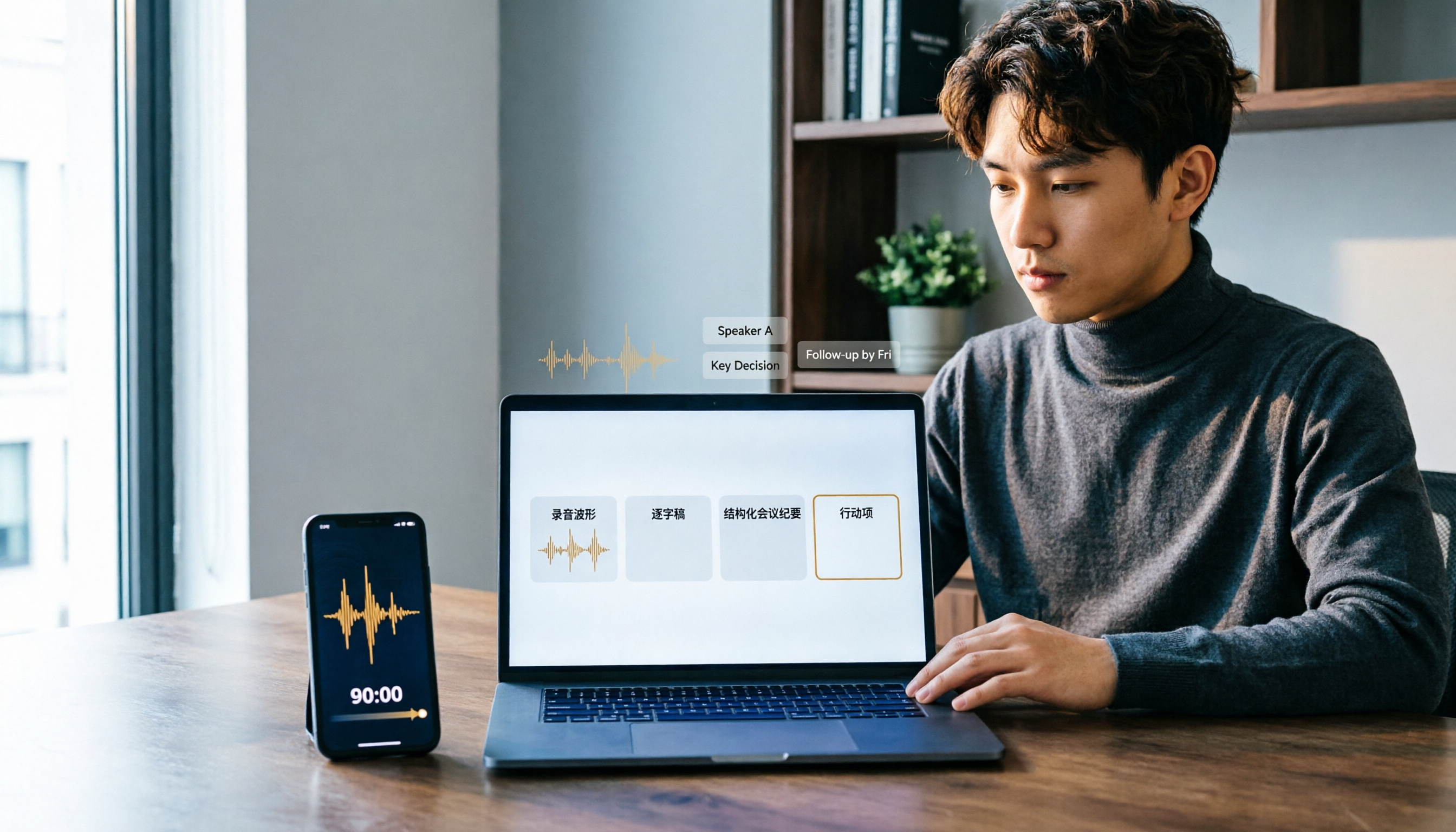
A 90-minute interview recording is sitting on your phone, and the transcript is due tomorrow morning. This article breaks down AI meeting notes into two steps—transcription and organization—and compares six practical solutions, including bot-free recording, multilingual transcription, hardware recorders, and free post-meeting organization tools, to help you choose the right one for your scenario.

2026 AI Meeting Notes Comparison: Tinrec vs Granola for Chinese Transcription and Free Tiers
In Dcard's 2024 AI meeting notes discussions, the most common questions are whether free tiers are sufficient, how well Chinese transcription works, and whether post-meeting summaries can be shared directly. This article compares Tinrec and Granola, two bot-free meeting note tools, across recording retention, old file import, Chinese and bilingual support, post-meeting outputs, team data governance, and pricing to help you decide which fits your meeting scenario.

How to Choose AI Meeting Notes Tools in 2026: 5 Steps to Understand Comparison Tables and Key Selection Criteria
2026 AI meeting notes tool comparison and buying guide: use 5 steps to understand meeting capture, post-transcription processing, Chinese language support, team governance, and pricing quotas, and compare use cases for Tinrec, Otter.ai, Notta, Granola, TurboScribe, and PLAUD.

2026 AI Meeting Notes Comparison: Tinrec vs Notta — Which Is Better for Chinese-Speaking Teams?
A meeting notes table isn't just pasting a transcript. This article uses a typical weekly meeting workflow to compare Tinrec and Notta across five dimensions: meeting capture methods, table output, free quota and pricing, Chinese and real-time translation, and team governance. It also includes a ready-to-use meeting notes table template with fields and a manual verification checklist.