
Turn recordings into transcripts and summaries in minutes
Upload audio or video for multilingual transcription, AI notes, and action items
Why "Easy to Learn" Matters More Than "Feature-Rich": Evaluating Tools by Learning Cost
When choosing a speech-to-text tool, most people tend to look at the feature list or claimed accuracy first. But for beginners new to such tools, what really determines whether they will continue using it is often "how easy it is to learn." Even if a tool is feature-complete, if the interface is complex and the steps are cumbersome, it may be shelved before it can deliver value.
Learning cost can be assessed from several specific aspects: whether the interface is intuitive at a glance, whether the operation steps are streamlined, whether clear guidance or templates are provided, and whether you can quickly find answers when you encounter problems. For most professionals, a tool that can be mastered within 30 minutes and immediately solve the current meeting note problem is more practical than a powerful tool that takes a week to get familiar with.
Take the common scenario of meeting notes: the process you really need is simple: record, transcribe, and organize key points. If the tool complicates this process, for example, by requiring you to set a lot of parameters or understand technical jargon, the learning cost increases, and you may eventually give up because it feels troublesome, reverting to the old manual method.
Therefore, when choosing a speech-to-text tool, it is recommended to first assess your usage frequency and scenarios, then compare the ease of learning. If you use it occasionally, prioritize tools that are simple to operate and quick to master; if you have multiple meetings every week, you can spend a bit more time learning in exchange for more comprehensive post-meeting organization capabilities.
Ease-of-Learning Comparison of Mainstream Speech-to-Text Tools: Interface, Operation, and Time to Proficiency
Differences in ease of learning among tools can be observed from three dimensions: interface design, operation steps, and time to proficiency. Below is a comparison of several common tools, based on official pages; actual experience may vary by version.
| Tool | Interface Design | Operation Steps | Time to Proficiency | Beginner-Friendliness |
|---|---|---|---|---|
| Tinrec | Clean, clear feature sections | Automatic transcription after recording or import; summary and action items generated with one click | About 10–15 minutes | High |
| Otter.ai | More features, requires familiarity with meeting bot setup | Requires setting up meeting links, inviting bots; more steps | About 30–60 minutes | Medium |
| Granola | Clean, but only supports live meetings | Requires desktop app installation; does not support file upload | About 15–20 minutes | Medium-High |
| Notta | Intuitive interface, but some advanced features require exploration | Upload file or record live; transcription can be edited | About 20–30 minutes | Medium-High |
| Built-in Voice Memos on Phones | Minimal, but basic features | Requires manual transcription after recording; no summary or action items | About 5 minutes | Very High (but insufficient features) |
From the table above, Tinrec and the built-in voice memos have the lowest entry barrier, but the latter is too basic to meet meeting note needs. Otter.ai is powerful but has more setup steps, making the learning curve steeper for beginners. Granola and Notta fall in between.
Key to Quick Mastery: Breaking Down the Complete Workflow from Recording to Transcript
Regardless of which tool you choose, mastering the complete workflow of "Record → Transcribe → Organize" is key to reducing learning costs. Below, using Tinrec as an example, we break down this workflow:
1. Record or Import: Tinrec supports live recording, audio/video file import, and desktop app recording of online meetings without bots. You don't need to invite any bots to your meeting; just open the desktop app, capture system audio directly, and start recording.
2. Automatic Transcription: After recording, Tinrec automatically generates a verbatim transcript and simultaneously produces a summary, chapters, key points, and action items. You don't need to manually set any parameters; you can view the results once transcription is complete.
3. Organize and Verify: You can directly edit the transcript, annotate key points, and confirm whether the AI-extracted action items are correct. For important decisions and sensitive data, it is recommended to cross-check with the recording playback.
4. Export and Share: After organizing, you can export the meeting notes as a document or share them with team members. If needed, you can also use the AI assistant to further process action items into action plans, follow-up materials, or reports.
The core of this workflow is "automation": the tool handles the most time-consuming transcription and initial organization, allowing you to focus on verification and next steps. When choosing a tool, pay special attention to whether it offers similar automated workflows, as this can significantly reduce your learning cost.
Stop organizing recordings by hand
Upload audio or video and automatically get a transcript, summary, and action items
Common Learning Pitfalls: Why You Always Feel Tools Are Hard to Use
Many people fail to learn speech-to-text tools not because the tools are inherently difficult, but because they fall into several common pitfalls:
- Pitfall 1: Pursuing the most comprehensive features. The more features, the more complex the interface, and the higher the learning cost. Beginners should first master core functions (recording, transcription, summary) and then gradually explore advanced features.
- Pitfall 2: Ignoring use cases. Different tools suit different scenarios. For example, Granola does not support uploading pre-recorded audio files and does not save meeting audio, so if you need to organize historical recordings, it is not suitable. Before choosing a tool, clarify your primary use case.
- Pitfall 3: Not spending time on tutorials. Most tools have official tutorials or templates; spending 10 minutes to review them can save a lot of time later.
- Pitfall 4: Unrealistic expectations. The accuracy of speech-to-text tools is affected by recording quality, noise, accents, and other factors; it cannot be 100% accurate. If expectations are too high, you may be disappointed and feel the tool is hard to use. The right mindset is to treat it as an assistive tool; important content still requires human verification.
Recommendations for Different Groups: How Sales, Product Development, and Government Employees Should Choose
Different professions have different use cases and needs, so tool selection should be tailored accordingly.
Sales and Business Professionals
Salespeople most often need to record customer communication content and extract commitments and next steps. It is recommended to choose tools that are simple to operate and can quickly generate summaries and action items, such as Tinrec. Its AI assistant can further organize action items into customer follow-up materials, reducing post-meeting organization time.
Product Development and Design Professionals
Product development and design professionals often participate in requirements reviews and technical discussions, needing to accurately preserve requirements and decisions. It is recommended to choose tools that support file import and can generate structured meeting notes, such as Tinrec or Notta. Tinrec's AI assistant can help organize discussion content into PRDs or action items for easy tracking.
Government Employees
Government employees have higher requirements for data privacy and accuracy, and often need to organize meeting notes and deployment items. It is recommended to choose tools that are simple to operate, can be used offline, or allow data control. Tinrec supports multiple input sources, but data security should be noted, and important content should be manually verified.
Learning Cost Differences Between Free and Paid Tools: Is It Worth Paying for Ease of Use?
Free tools usually have basic features. For example, the built-in voice memos on phones can only record, not automatically transcribe; some free online tools can transcribe but may limit session length or monthly minutes, and do not provide advanced features like summaries or action items.
Paid tools typically offer more complete automated workflows, such as Tinrec's AI summaries, action item extraction, and AI assistant, which can significantly reduce post-meeting organization time. From a learning cost perspective, paid tools often have smoother interfaces and workflows, allowing users to get started faster and see results.
Therefore, if you only occasionally need to transcribe a recording, free tools may suffice; but if you have weekly meeting note needs, investing in a highly usable paid tool can save a lot of time and is worthwhile in the long run.
Team Collaboration: When Meeting Data Needs to Be Shared and Followed Up
Once you learn to use a speech-to-text tool to organize meeting notes, the next step is often sharing these materials with team members and continuously following up on action items. If you simply drop files into a chat group, they can easily be buried under new messages and hard to find later; if each person uses their own account to organize, data will be scattered across different places, failing to become a team asset.
Tinrec's Team Space can solve this problem. Team Space centrally stores meeting recordings, transcripts, summaries, and action items, allowing members to view historical meeting content at any time. For example, a sales team can put customer visit meeting materials into Team Space, so new members can quickly understand past customer communication context; a project team can centralize weekly meeting action items in Team Space, where members claim and update progress, and managers can grasp the overall status.
When using Team Space, you need to create a team and invite members. Members can view and play team materials; to record, upload, or edit, they need a seat. When a member leaves or transfers, their team resources can be handed over to other active members to avoid data loss. Note that Team Space currently focuses on team-level sharing and does not support file-level or member-level granular permission settings.
If you are evaluating tools and find that you or your team have needs for sharing meeting data and unified follow-up on action items, consider whether the tool offers a team space, as this affects its practicality in long-term collaboration.
Summary: How to Learn and Start Using with Minimal Time
When choosing a speech-to-text tool, start from learning cost, assess your use cases and frequency, and then compare the interface, operation steps, and time to proficiency. Beginners are advised to choose a tool that is simple to operate and can quickly show results, such as Tinrec, and master the complete workflow of "Record → Transcribe → Organize."
If you need to share meeting data with your team, you can further explore Tinrec's Team Space feature to centrally store meeting materials for easy viewing and follow-up. Finally, remember that tools are just aids; important decisions and sensitive data still require human verification. Choosing an easy-to-learn tool allows you to start using it faster and truly save time.
References
- [AI Voice Notes] 5 Highly Recommended AI Transcription Tools! Generate Transcripts and Meeting Highlights, Free vs. Subscription, Pros and Cons | 104 Career Force
- SoundType AI - Highly Accurate Transcripts, Speech-to-Text, AI Dictation
- 11 Speech-to-Text Software Recommendations: Meeting Notes, Real-Time Translation, Subtitle Generation
- Tested 4 Best "Speech-to-Text" Online Tools Recommended, Free to Convert Recording Files to Transcripts
- Speechify Studio | #1 AI Video, Voice, Slides & Dubbing | Speechify
Turn every recording into actionable outcomes
Get 60 free transcription minutes when you sign in. No credit card required.
Related Reading
You might also like

2026 AI Meeting Notes Table Tools Compared: Which One Actually Produces a Ready-to-Use Table?
A meeting notes table isn't just about downloading a template—the real question is whether you can produce something you can hand off right after the meeting ends. This article starts with three ways to get a meeting notes table, provides a copy-ready table structure, and walks through the full workflow with Tinrec from recording to transcript, summary, action items, and team knowledge retention. It wraps up with 5 key buying criteria and FAQs.

2026 AI Meeting Notes Showdown: Tinrec vs Otter.ai — Which Is Better for Chinese Meetings?
In 2026, Dcard discussions about AI meeting notes focus on free transcription and summary tools. This article narrows the scope to Tinrec and Otter.ai, comparing them across meeting capture methods, Chinese transcription, post-meeting outputs, team governance, and pricing to help you decide which fits your meeting scenarios.

How to Create AI Meeting Minutes Tables in 2026: 5 Steps from Recording to Table
Still manually pasting transcripts into tables after meetings? This guide starts with how to decide between a transcript and a table, then covers 4 key factors for choosing an AI meeting minutes table tool in 2025, Tinrec's actual workflow, 3 alternative solutions, and the 3 most common pitfalls, plus a 5-step process.

Best AI Meeting Notes Tools in 2026: 4 Tested, This One Excels for Chinese Meetings
We tested 4 AI meeting notes tools in 2026, comparing recording methods, post-meeting output, Chinese recognition, and team data management. Here's why Tinrec suits Chinese and mixed Chinese-English meetings, and which tools fit other needs or budgets better.

Tinrec vs Google Translate 2026: 5-Dimension Comparison — Which Is Better for Real-Time Transcript Translation?
The most time-consuming part of cross-language meetings is often not the meeting itself, but re-listening to recordings and translating them into Chinese afterward. Based on my own trial-and-error experience, this article compares Tinrec and Google Translate on real-time transcript translation across 5 dimensions, and outlines 5 things to consider when choosing a tool, plus FAQs.
6 AI Meeting Transcription Tools Compared for 2026: From Transcripts to Post-Meeting Summaries
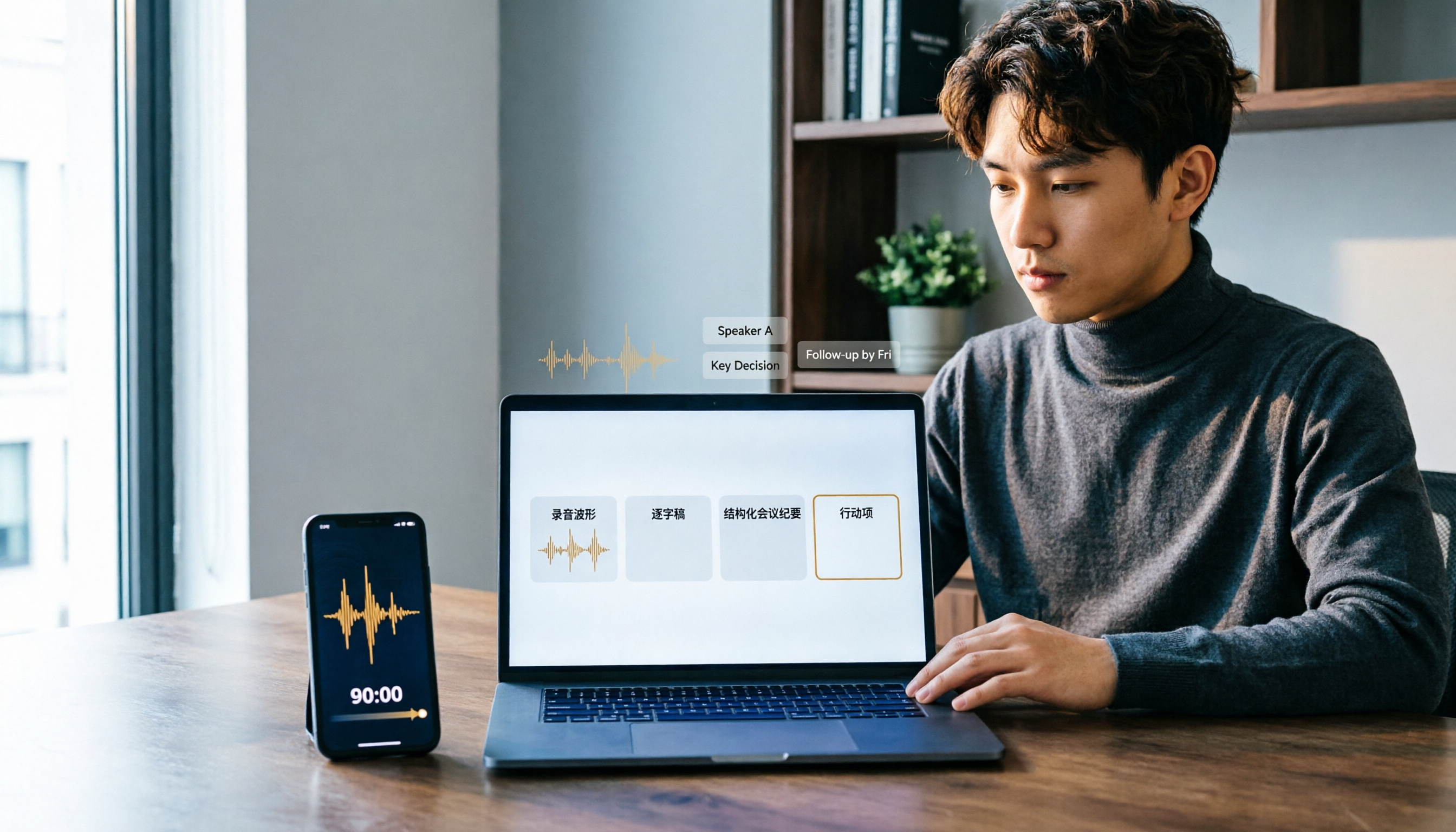
A 90-minute interview recording is sitting on your phone, and the transcript is due tomorrow morning. This article breaks down AI meeting notes into two steps—transcription and organization—and compares six practical solutions, including bot-free recording, multilingual transcription, hardware recorders, and free post-meeting organization tools, to help you choose the right one for your scenario.

2026 AI Meeting Notes Comparison: Tinrec vs Granola for Chinese Transcription and Free Tiers
In Dcard's 2024 AI meeting notes discussions, the most common questions are whether free tiers are sufficient, how well Chinese transcription works, and whether post-meeting summaries can be shared directly. This article compares Tinrec and Granola, two bot-free meeting note tools, across recording retention, old file import, Chinese and bilingual support, post-meeting outputs, team data governance, and pricing to help you decide which fits your meeting scenario.

How to Choose AI Meeting Notes Tools in 2026: 5 Steps to Understand Comparison Tables and Key Selection Criteria
2026 AI meeting notes tool comparison and buying guide: use 5 steps to understand meeting capture, post-transcription processing, Chinese language support, team governance, and pricing quotas, and compare use cases for Tinrec, Otter.ai, Notta, Granola, TurboScribe, and PLAUD.

2026 AI Meeting Notes Comparison: Tinrec vs Notta — Which Is Better for Chinese-Speaking Teams?
A meeting notes table isn't just pasting a transcript. This article uses a typical weekly meeting workflow to compare Tinrec and Notta across five dimensions: meeting capture methods, table output, free quota and pricing, Chinese and real-time translation, and team governance. It also includes a ready-to-use meeting notes table template with fields and a manual verification checklist.