

Turn recordings into transcripts and summaries in minutes
Upload audio or video for multilingual transcription, AI notes, and action items
The Pain Points of Traditional Chinese Meetings: Why Transcription Quality Matters More Than Feature Count
For professionals in Taiwan and Hong Kong, the real challenge begins after a meeting conducted primarily in Traditional Chinese. You might have an audio recording or have just finished an online meeting, and now you face: How do you get a transcript? How do you extract key points? How do you list action items? If handled manually, a 1-hour meeting often takes an additional 1–2 hours to organize.
There are many speech-to-text tools on the market, but most are designed primarily for English, and the quality of Traditional Chinese transcription varies widely. Some tools claim multilingual support, but their output often contains simplified Chinese characters, wording that doesn't match Taiwan or Hong Kong conventions, or errors when mixing Chinese and English. For professionals who need to turn meeting content into formal records, client follow-up materials, or internal deployment documents, transcription quality directly affects the efficiency and credibility of subsequent work.
Therefore, when choosing a tool, you shouldn't just look at the number of features; you should first confirm whether it can truly handle the Traditional Chinese meeting content you deal with daily.
Traditional Chinese Support Comparison: Who Can Really Handle Taiwan and Hong Kong Meeting Language
Different tools vary significantly in their support for Traditional Chinese. Here is a comparison of several mainstream tools:
| Tool | Traditional Chinese Transcription | Mixed Chinese-English Handling | Real-time Translation | Notes |
|---|---|---|---|---|
| Tinrec | Supported | Supported | Supported | Custom team vocabulary to improve recognition of specialized terms |
| Otter.ai | Limited | Limited | No | Primarily for English meetings; limited Traditional Chinese support |
| Fireflies.ai | Limited | Limited | No | Chinese experience not as good as Tinrec |
| Granola | Limited | Limited | No | Does not support uploading pre-recorded audio and does not save meeting audio |
| Google Cloud Speech-to-Text | Supported | Supported | Requires integration | Provides API; requires development skills |
Take Tinrec as an example: it supports Traditional Chinese transcription and real-time translation, can handle mixed Chinese-English content, and offers team vocabulary features to improve accuracy for commonly used specialized terms. This is particularly useful for teams that frequently use specific product names, client names, or internal abbreviations.
Granola offers a good experience for English meeting notes, but it does not support uploading pre-recorded audio files and does not save meeting audio, which is a significant limitation for Traditional Chinese users who need to process historical recordings. Otter.ai's Basic free plan provides 300 minutes per month, but it is primarily for English meetings, with limited Traditional Chinese support. If your meetings are primarily in Chinese, you may not get ideal transcription results.
Bot-Free Recording vs. Meeting Bots: Which Approach Suits Your Online Meetings Better
The recording method for online meetings directly affects the flow and privacy of the meeting. Traditional meeting bots (such as Otter.ai and Fireflies.ai bots) need to join the meeting as participants, which adds complexity and may make attendees uncomfortable.
Tinrec's desktop version uses a bot-free approach, directly capturing the computer's system audio without requiring an additional bot to join the meeting. Simply open Tinrec desktop, and it can record meeting audio from platforms like Zoom, Google Meet, Microsoft Teams, and Webex, generating transcripts in real time. This simplifies the recording process and avoids bots appearing in the attendee list, making it more suitable for business meetings that require minimal disruption.
Granola also uses a bot-free approach, but it does not save meeting audio and does not support uploading pre-recorded audio, which may be insufficient for teams that need complete audio archives.
Stop organizing recordings by hand
Upload audio or video and automatically get a transcript, summary, and action items
From Transcript to Actionable Data: How Post-Meeting Outputs Affect Your Work Efficiency
Transcription is just the first step; what truly affects work efficiency is the post-meeting output. Traditional tools may only provide a transcript, leaving you to manually organize summaries, key points, and action items. Newer AI tools, such as Tinrec, automatically generate summaries, chapters, key points, and action items, and support AI Q&A, allowing you to ask follow-up questions about the meeting content.
Furthermore, Tinrec's AI assistant (Agent) can use the meeting minutes and context to help turn action items into deliverable post-meeting work products, such as action plans, follow-up materials, reports, tables, or documents. For example, after a client meeting, the AI assistant can organize the client's needs, commitments, and next steps based on the discussion, and generate a draft follow-up email for you to review and send.
This means you get not just a static transcript, but a working document that can directly reduce the time spent on post-meeting organization and document creation.
Team Collaboration and Knowledge Accumulation: How Meeting Data Becomes a Team Asset
For teams, meeting data should not remain on individual devices. Tinrec's team edition provides a team space where meeting recordings, transcripts, summaries, action items, and post-meeting outputs can be centrally stored, shared, and searched by members.
In practice, team administrators can create a team space, invite members, and allocate seats. Once members have a seat, they can record, upload, edit, and export meeting data. Members without a seat can still view, play, and read team data, but cannot perform resource-usage operations.
For example, a sales team can place records and follow-up materials from each client meeting into the team space, so new members can review historical meeting data to understand client backgrounds and past commitments, avoiding redundant questions or missed details. A project team can centrally manage action items and decisions from weekly meetings, making it easier to track progress and accountability.
Note that Tinrec's team edition currently focuses on team-level sharing and does not support file-level granular permissions. If your team needs finer-grained permission control, you may need to pair it with other tools.
Buying Recommendations: Choose the Best Tool Based on Your Meeting Types and Team Size
When choosing a speech-to-text tool, evaluate based on the following questions:
1. What language are your meetings primarily in? If primarily Traditional Chinese, prioritize tools with high Traditional Chinese support, such as Tinrec. If primarily English, Otter.ai or Fireflies.ai may be more mature.
2. What post-meeting outputs do you need? If you only need a transcript, basic tools suffice; if you need summaries, action items, reports, etc., choose tools with AI post-processing capabilities.
3. Are your meetings online or offline? For online meetings, consider bot-free recording tools (like Tinrec, Granola); for offline meetings, confirm whether the tool supports live recording or file upload.
4. Do you need team collaboration? If multiple people need to share meeting data, choose a tool with a team space, such as Tinrec's team edition.
5. What are your budget and quota needs? Free quotas and paid plans vary by tool; evaluate based on usage frequency and meeting duration.
For professionals in Taiwan and Hong Kong, if you frequently handle Traditional Chinese meetings, need bot-free recording, and want to turn meeting data into team assets, Tinrec is worth considering.
Important Considerations: Accuracy, Privacy, and the Boundaries of Human Review
Finally, when using speech-to-text tools, there are several points to keep in mind:
- Accuracy is not 100%: Transcription quality is affected by recording quality, background noise, accents, overlapping speech, and specialized terminology. For important content, cross-check against the transcript timestamps and audio playback.
- Privacy and authorization: Recording and transcription involve personal data. Before use, confirm the tool's security measures and comply with local laws; obtain consent from meeting participants when necessary.
- Human review: For AI-generated summaries, action items, and post-meeting documents, important decisions and externally sent content should be reviewed by a human to avoid errors due to AI misinterpretation.
- Price and feature changes: Prices and free quotas may change at any time; check the official latest information before purchasing.
Choosing the right tool can significantly reduce post-meeting organization time, but the final judgment and responsibility remain with the user. We hope this guide helps you find the most suitable speech-to-text solution for your needs.
References
- 5 Online Speech-to-Text Recommendations (Lazy Pack)
- AI Speech-to-Text Tool Recommendations: 8 Comparisons, Which Is Best for Meeting Notes, Transcripts, and Voice Input? — Leading Times
- Speech-to-Text: AI voice typing & transcription | Google Cloud
- 11 Speech-to-Text Software Recommendations: Meeting Notes, Real-time Translation, Subtitle Generation
- Tested 4 Best Online Speech-to-Text Tools Recommended, Free to Convert Audio Files to Transcripts in Seconds
Turn every recording into actionable outcomes
Get 60 free transcription minutes when you sign in. No credit card required.
Related Reading
You might also like

2026 AI Meeting Notes Table Tools Compared: Which One Actually Produces a Ready-to-Use Table?
A meeting notes table isn't just about downloading a template—the real question is whether you can produce something you can hand off right after the meeting ends. This article starts with three ways to get a meeting notes table, provides a copy-ready table structure, and walks through the full workflow with Tinrec from recording to transcript, summary, action items, and team knowledge retention. It wraps up with 5 key buying criteria and FAQs.

2026 AI Meeting Notes Showdown: Tinrec vs Otter.ai — Which Is Better for Chinese Meetings?
In 2026, Dcard discussions about AI meeting notes focus on free transcription and summary tools. This article narrows the scope to Tinrec and Otter.ai, comparing them across meeting capture methods, Chinese transcription, post-meeting outputs, team governance, and pricing to help you decide which fits your meeting scenarios.

How to Create AI Meeting Minutes Tables in 2026: 5 Steps from Recording to Table
Still manually pasting transcripts into tables after meetings? This guide starts with how to decide between a transcript and a table, then covers 4 key factors for choosing an AI meeting minutes table tool in 2025, Tinrec's actual workflow, 3 alternative solutions, and the 3 most common pitfalls, plus a 5-step process.

Best AI Meeting Notes Tools in 2026: 4 Tested, This One Excels for Chinese Meetings
We tested 4 AI meeting notes tools in 2026, comparing recording methods, post-meeting output, Chinese recognition, and team data management. Here's why Tinrec suits Chinese and mixed Chinese-English meetings, and which tools fit other needs or budgets better.

Tinrec vs Google Translate 2026: 5-Dimension Comparison — Which Is Better for Real-Time Transcript Translation?
The most time-consuming part of cross-language meetings is often not the meeting itself, but re-listening to recordings and translating them into Chinese afterward. Based on my own trial-and-error experience, this article compares Tinrec and Google Translate on real-time transcript translation across 5 dimensions, and outlines 5 things to consider when choosing a tool, plus FAQs.
6 AI Meeting Transcription Tools Compared for 2026: From Transcripts to Post-Meeting Summaries
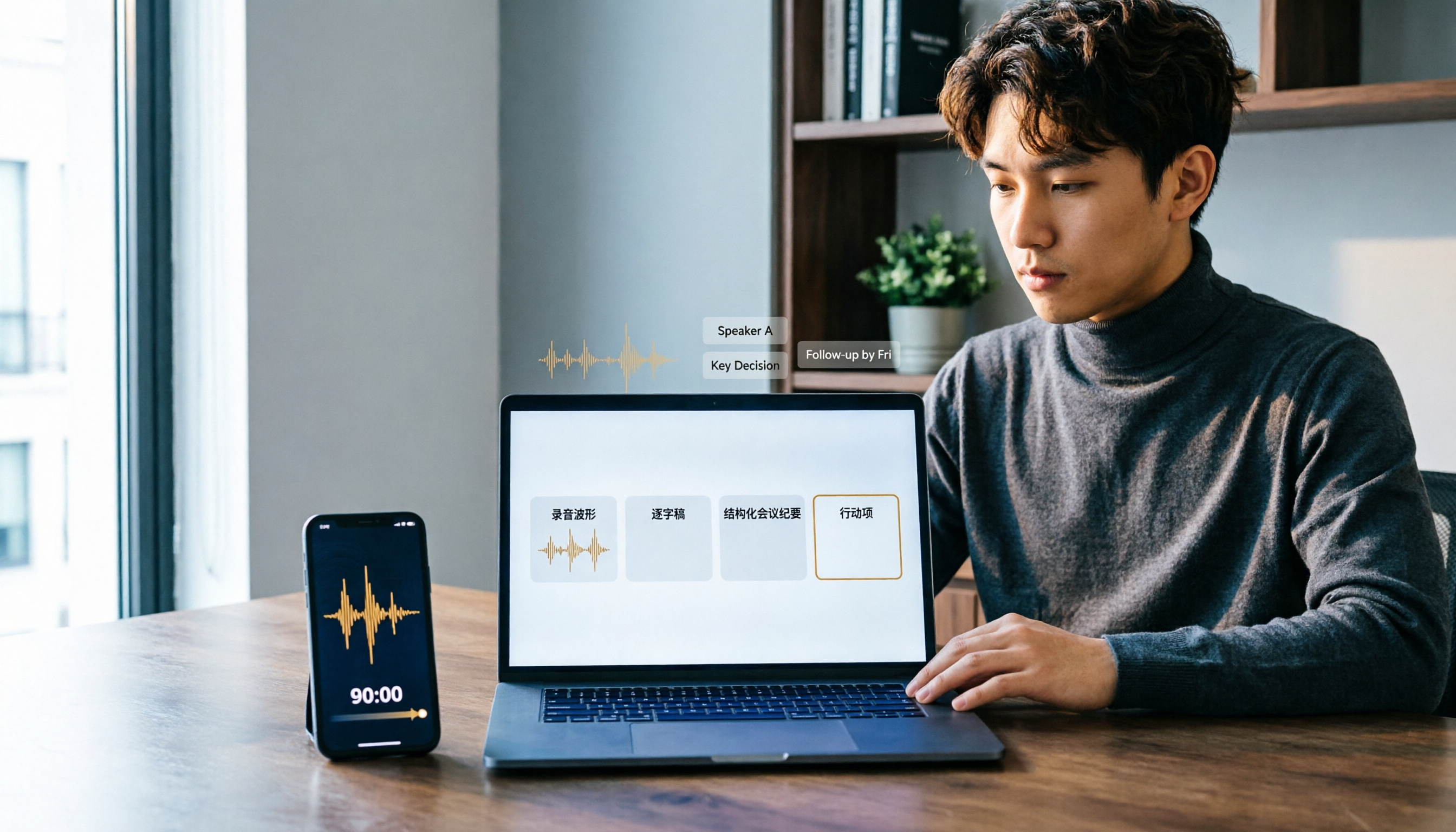
A 90-minute interview recording is sitting on your phone, and the transcript is due tomorrow morning. This article breaks down AI meeting notes into two steps—transcription and organization—and compares six practical solutions, including bot-free recording, multilingual transcription, hardware recorders, and free post-meeting organization tools, to help you choose the right one for your scenario.

2026 AI Meeting Notes Comparison: Tinrec vs Granola for Chinese Transcription and Free Tiers
In Dcard's 2024 AI meeting notes discussions, the most common questions are whether free tiers are sufficient, how well Chinese transcription works, and whether post-meeting summaries can be shared directly. This article compares Tinrec and Granola, two bot-free meeting note tools, across recording retention, old file import, Chinese and bilingual support, post-meeting outputs, team data governance, and pricing to help you decide which fits your meeting scenario.

How to Choose AI Meeting Notes Tools in 2026: 5 Steps to Understand Comparison Tables and Key Selection Criteria
2026 AI meeting notes tool comparison and buying guide: use 5 steps to understand meeting capture, post-transcription processing, Chinese language support, team governance, and pricing quotas, and compare use cases for Tinrec, Otter.ai, Notta, Granola, TurboScribe, and PLAUD.

2026 AI Meeting Notes Comparison: Tinrec vs Notta — Which Is Better for Chinese-Speaking Teams?
A meeting notes table isn't just pasting a transcript. This article uses a typical weekly meeting workflow to compare Tinrec and Notta across five dimensions: meeting capture methods, table output, free quota and pricing, Chinese and real-time translation, and team governance. It also includes a ready-to-use meeting notes table template with fields and a manual verification checklist.