
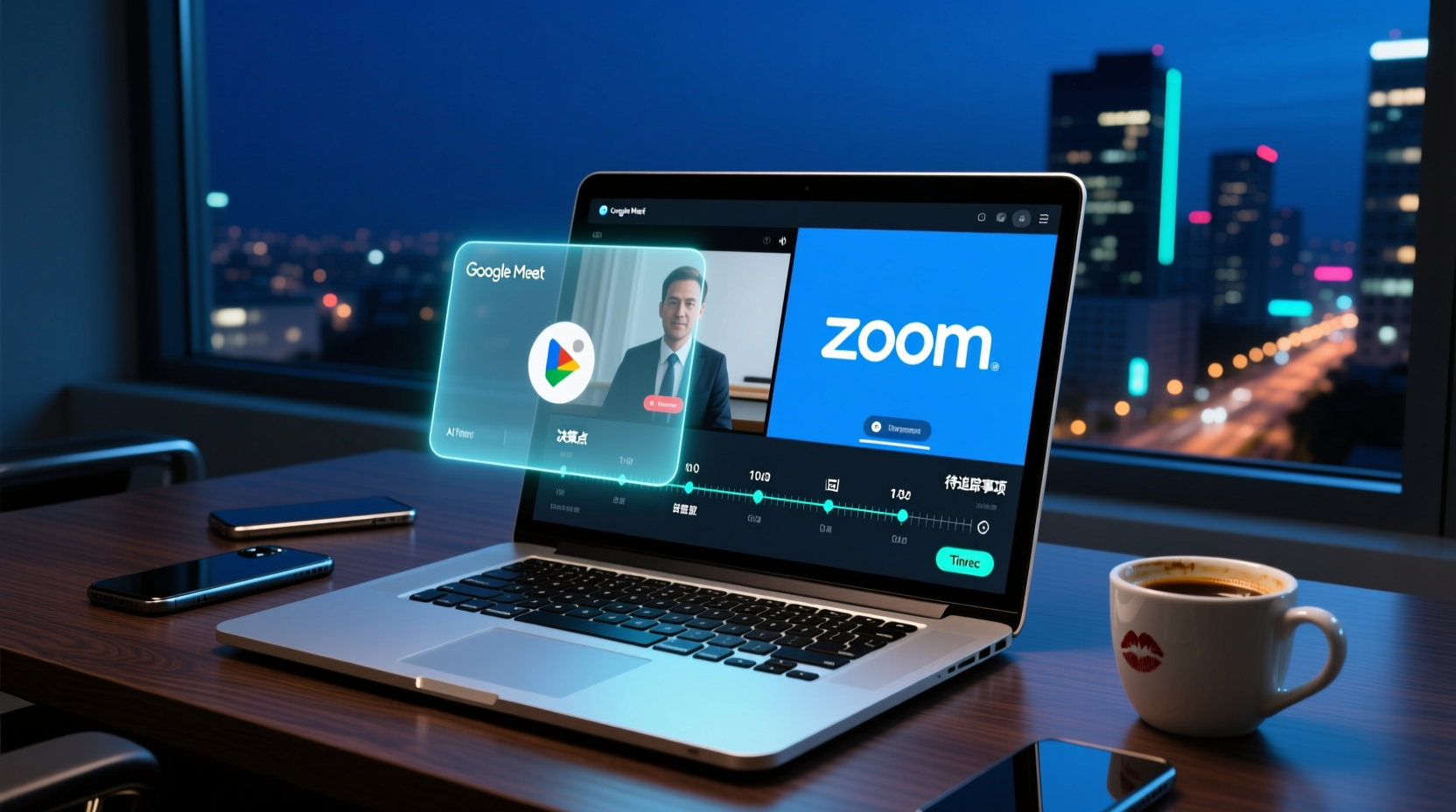
Turn recordings into transcripts and summaries in minutes
Upload audio or video for multilingual transcription, AI notes, and action items
Let's get straight to the point: Which is better, Google Meet or Zoom? The answer isn't "one is absolutely better," but rather "which one fits your ecosystem better."
If you already use Gmail, Google Calendar, and Google Drive, have a small team, and your meetings are mainly internal communication, Google Meet is the more cost-effective and convenient choice.
If your team is larger, your meetings are more complex, and you need more interactive tools or deep customization, Zoom's flexibility gives it an edge.
In short: Google Meet suits small teams in the Google ecosystem, while Zoom suits larger teams that need advanced features and scalability.
But regardless of your choice, there's a common pain point: After meetings, transcripts, decisions, and action items often get scattered and untracked. This article not only helps you quickly decide on a platform but also shows you how to use Tinrec to fill the gap in post-meeting documentation.
Google Meet vs Zoom: 5 Key Differences
First, take a look at this quick comparison table, then we'll break it down item by item:
| Comparison Item | Google Meet | Zoom |
|---|---|---|
| Free plan meeting duration | 60 minutes (as of 2025) | 40 minutes (unlimited for 1-on-1) |
| Free plan participant limit | 100 participants | 100 participants |
| Ecosystem integration | Deep integration with Google Workspace | Richer third-party apps and integrations |
| Meeting experience | Clean, stable, low latency | Feature-rich but busier interface |
| Best for | Small teams, Google ecosystem users | Medium to large teams, those needing advanced features |
> Note: Free plan limits may change; always refer to official pages.
Difference 1: Free Plan Limits
The free plan is often the first thing people compare.
Google Meet's free plan supports up to 100 participants and meetings up to 60 minutes. For most small teams' internal meetings, 60 minutes is usually sufficient.
Zoom's free plan also supports 100 participants, but group meetings are limited to 40 minutes (1-on-1 meetings are unlimited). After 40 minutes, you have to start a new meeting, which can be annoying for teams that often have longer meetings.
If you only meet occasionally and with a small number of people, Google Meet's free plan is more user-friendly.
Difference 2: Meeting Experience and Stability
Google Meet has a clean interface with features centralized on the screen, making it almost effortless to learn. It performs well in browsers, requiring no software installation—just open a webpage to join a meeting.
Zoom's interface has more features, so it might take a bit of time to get used to initially. But its stability is equally excellent, and it offers more meeting control options, such as waiting rooms, breakout rooms, and virtual backgrounds.
If your team values "just open and use, no fuss," Google Meet is more intuitive; if you need more meeting management tools, Zoom is more comprehensive.
Difference 3: Built-in Features and Integrations
Google Meet's biggest advantage is its deep integration with Google Workspace. Meeting invitations are created directly from Calendar, recordings are automatically saved to Drive, and document collaboration can be launched instantly within Meet. For teams already using Gmail and Google Docs, Meet is a seamless choice.
Zoom, on the other hand, offers richer interactive features, such as whiteboards, polling, emoji reactions, and breakout rooms. Its app marketplace has numerous third-party integrations, allowing connections to CRMs, project management tools, and more.
If you need "highly interactive meetings" or "post-meeting integrations with other tools," Zoom is more flexible; if you only need "meet, record, and share," Google Meet is simpler.
Difference 4: Suitable Team Types
Based on the above differences, here are our recommendations:
Stop organizing recordings by hand
Upload audio or video and automatically get a transcript, summary, and action items
- Small teams (5-20 people): Google Meet is usually more suitable because the free tier is sufficient, integration is convenient, and costs are low.
- Medium to large teams (20+ people): Zoom is more suitable because you'll likely need more management features, interactive tools, and scalability.
- External client meetings: Zoom's waiting rooms, recording, and meeting link management are more professional.
- Quick internal communication: Google Meet's clean interface and Google ecosystem integration are more efficient.
Whichever You Choose, Don't Miss Meeting Notes
Choosing a platform is just the first step. The real question is: After the meeting, who remembers the decisions? Who tracks the action items?
Both Google Meet and Zoom have built-in recording and transcription features, but these have limitations:
- Recording files can be large and time-consuming to organize.
- Transcripts are usually just verbatim text, without summaries, highlights, or action items.
- Meeting materials are scattered across platforms, making unified search and tracking difficult.
If you only meet occasionally, manual organization might suffice. But if you have multiple meetings each week, post-meeting organization often takes more time than the meeting itself.
Use Tinrec to Fill the Post-Meeting Documentation Gap
Tinrec is an AI meeting notes tool that supports recording Google Meet and Zoom meetings without a bot. You don't need to invite a bot to your meeting; just open the Tinrec desktop app on your computer, and it captures system audio to generate a real-time transcript.
Step 1: Record the Meeting Audio
Whether you use Google Meet or Zoom, Tinrec can record. It captures the audio playing on your computer, so you don't need the host's permission, and you don't have to worry about bots being blocked.
Step 2: Automatically Generate Summaries, Action Items, and Highlights
After the meeting, Tinrec automatically organizes summaries, chapters, highlights, and action items. You don't have to re-listen to the entire recording to quickly grasp the meeting's conclusions and next steps.
Step 3: AI Assistant Helps Create Post-Meeting Deliverables
Tinrec's AI assistant doesn't just summarize; it can also help you produce actionable work products based on the meeting content. For example:
- Turn action items from a project meeting into an action plan.
- Transform commitments from a client meeting into a follow-up email.
- Generate reports or tables from management meeting content.
Simply provide the transcript or summary, and the AI assistant can turn discussions into executable documents, saving you hours of manual work.
Step 4: Export and Integrate into Your Workflow
Tinrec supports multiple export formats, including Notion, Google Docs, OneNote, and more. You can bring meeting minutes and to-do lists directly into your favorite collaboration tools for continued tracking and execution.
Team Collaboration: Centralize Meeting Materials in a Team Space
If you meet with your team, Tinrec's team plan lets you store meeting recordings, transcripts, summaries, and action items in a centralized team space.
- Members can access historical meeting materials, so new team members can easily catch up on context.
- Meeting materials belong to the team, so even if someone leaves, the data remains.
- Admins can manage members, seats, and permissions to ensure data security.
For example, suppose your weekly project meetings are held on Zoom. After each meeting, Tinrec automatically organizes the transcript and action items into the team space. Project members can review decisions from previous meetings at any time, and new members can quickly understand project progress.
Important Notes
- Tinrec records via system audio, so you need to start it manually; it does not automatically join meetings.
- For critical decisions and sensitive information, we recommend human review before publishing.
- Before recording or transcribing, ensure compliance with local laws and obtain consent from participants.
Conclusion: Which Should You Choose?
Here's our direct advice:
- If you're already in the Google ecosystem, have a team of fewer than 20 people, and your meetings are mainly internal, choose Google Meet.
- If your team is larger, needs advanced meeting features, or frequently meets with external clients, choose Zoom.
But regardless of your choice, we recommend pairing it with a tool like Tinrec to ensure meeting notes are never missed, action items are tracked, and team knowledge accumulates.
Meetings aren't just about "getting through them"; they're about turning discussions into action. Choose the right platform, then use the right tools to truly improve meeting efficiency.
References
Turn every recording into actionable outcomes
Get 60 free transcription minutes when you sign in. No credit card required.
Related Reading
You might also like

2026 Comparison of 2 User Interview Analysis Tools: Tinrec vs Otter.ai — Which Handles Chinese Interview Organization Better?
After user interviews, transcribing, extracting insights, and organizing action items take the most time. This article compares Tinrec and Otter.ai across recording capture, Chinese transcription, post-interview follow-up, audio file import, team knowledge retention, and pricing plans to help you decide which tool fits your interview workflow.
2026 Meeting Recording Knowledge Base Comparison: Why Tinrec Is the Top Notta Alternative
A meeting recording knowledge base isn't just about turning recordings into transcripts—it's about making every meeting searchable, queryable, and transferable. This article examines the decision points for team data retention and compares Tinrec vs. Notta on bot-free recording, AI Q&A, team spaces, and Chinese language experience, plus an overview of Tinrec's core features, use cases, and buying advice.

4 AI Meeting Transcription Tools Compared for 2026: Which One Actually Builds a Searchable Meeting Archive?
Spending all day in meetings and then overtime writing notes? This article approaches the decision from whether meeting content can be retained long-term, comparing four AI meeting tools. It covers five key factors to understand before choosing, hands-on experience with Tinrec's bot-free recording and AI Q&A, and four common pitfalls to help you find a meeting archive you can actually search later.
Team Knowledge Base vs. Meeting Notes in 2026: A 5-Dimension Comparison — The Difference Isn't Just Whether You Can Find It Again
Meeting notes and team knowledge bases are often treated as the same thing, but they differ in purpose, lifecycle, searchability, action linkage, and ownership. This article breaks down the differences across 5 dimensions and explains how to use Tinrec to turn scattered meeting notes into a searchable, queryable, and transferable team knowledge asset.

2026 Complete Guide to AI Team Meeting Assistants: Auto-Generate Transcripts, Summaries & Action Items
From student group projects to internship team weekly meetings, how do you actually use an AI team meeting assistant? This 2026 complete guide first breaks down common misconceptions, then explains core capabilities, real-world use cases, and 6 key considerations for choosing one. It also demonstrates Tinrec's full workflow for bot-free online meeting recording, real-time transcription, AI summaries, action item extraction, and meeting Q&A.

2026 Comparison of 4 Meeting Data Centralization Solutions: Stop Treating Cloud Storage as Organization
Centralizing meeting data isn't just dumping attachments into a shared cloud drive. This article examines common pitfalls, breaks down four common approaches to meeting data management, and uses Tinrec as an example to explain real-time transcription, AI summaries and action items, AI Q&A, team spaces, and seat governance. It concludes with 5 purchasing considerations and FAQs.

Tinrec vs Notta 2026: 5-Dimension Comparison — Which Is Better for Team Meeting Databases?
A mid-level manager who holds 15 meetings a week compares Tinrec and Notta across 5 dimensions to help you choose the right team meeting database. From bot-free recording and AI action item extraction to team spaces and pricing quotas, get it all in one article.

How to Take Sales Meeting Notes in 2026: 5 Steps from Recording to Customer Follow-Up
Sales meeting notes shouldn't wait until the meeting ends. This article breaks down the complete process in 5 steps, from recording, transcription, AI summaries to customer follow-up, and compares Tinrec and Otter.ai dimension by dimension to see which is better suited for Hong Kong sales teams communicating in Chinese.

5 AI Meeting Knowledge Base Tools Tested and Compared in 2026: Can Meeting Notes Become Searchable Team Assets?
Meeting notes aren't just about speed—you need to find them later. This article approaches the topic from a purchasing decision perspective, breaking down the core capabilities of AI meeting knowledge base tools, real-world use cases, and 5 key buying considerations. It uses Tinrec to demonstrate a complete workflow: bot-free online meeting recording, transcripts and real-time translation, AI summaries and action items, AI Q&A, and team spaces with seat governance.