

Turn recordings into transcripts and summaries in minutes
Upload audio or video for multilingual transcription, AI notes, and action items
Tinrec Review 2026: Cantonese Meeting Transcription + AI Summaries & Action Items
AI Meeting Notes for Cantonese — What You Need Isn't a Recording, It's Usable Output Right After the Meeting
What do Hong Kong teams dread most about meetings? It's not that the meeting is too long — it's that post-meeting cleanup takes too much time.
A two-hour Cantonese meeting can take another two or three hours to re-listen, type up, and match to speakers. What's worse, the content often mixes in English terms, product names, department abbreviations, and even Mandarin.
So the real question isn't whether a tool "supports Chinese" — it's whether it can understand Cantonese and mixed Chinese-English speech, and directly produce summaries, decisions, and action items after the meeting.
This article uses real-world needs to help you filter options, with Tinrec as the main hands-on test subject.
Before Choosing a Cantonese Meeting Notes Tool, Understand These 4 Key Points
1. Real recognition of Cantonese and mixed Chinese-English speech Just saying "supports Chinese" doesn't mean it's suitable for Hong Kong. You need to see whether it can handle Traditional Chinese Cantonese and mixed Cantonese-English phrases like "this quarter's target." Tinrec is worth focusing on for its Chinese and multilingual meeting experience in this area.
2. Does post-meeting output go beyond a transcript? A transcript is just the starting point. A better approach is automatically generating summaries, chapters, key points, and action items — and even letting you ask follow-up questions about the meeting content.
3. Meeting sources and cross-platform support In-person meetings, Zoom, Google Meet, Microsoft Teams, Webex, plus phone recordings and historical files. Whether a tool works across phone and computer directly affects how efficient your cleanup is.
4. Team collaboration and data ownership If meeting data stays only in individual accounts, things fall apart when a member leaves. Team spaces, roles, seats, usage, and audit logs are governance capabilities you need to confirm first for multi-person collaboration.
Tinrec — Our Top Pick After Hands-On Testing
Tinrec is an AI meeting notes and collaboration tool for individuals and teams, covering live recording, bot-free online meetings, audio/video file import, and team spaces. It doesn't just turn audio into text — it organizes meetings into searchable, summarizable, queryable, and exportable data.
Bot-free online meeting recording The desktop version captures your computer's system audio directly, with no extra bot joining the meeting. You don't need to invite Tinrec as a participant into Zoom, Meet, or Teams — just open the desktop app to record and transcribe simultaneously. This is very practical for teams that don't want to disrupt the meeting flow.
Usable output right after the meeting After the meeting ends, Tinrec generates summaries, chapters, key points, and action items. You can directly ask it: "Who mentioned the budget in the last meeting?" It doesn't just do keyword search — it answers based on semantic understanding. Not many competitors in this price range offer this kind of AI Q&A.
Export and further processing Transcripts, summaries, and action items can be exported to Notion, Google Docs, OneNote, Dropbox, and other workflows. Agent post-processing can also generate reports, tables, and documents — great for retrospectives, reporting, and post-meeting deliverables.
Cantonese and multilingual scenarios Tinrec covers Chinese, Traditional Chinese, and multilingual meetings, supporting mixed Chinese-English content organization, real-time translation, and bilingual viewing. Team hotwords let you maintain commonly used terminology to improve recognition of specialized vocabulary.
Stop organizing recordings by hand
Upload audio or video and automatically get a transcript, summary, and action items
Team plan turns meetings into team assets The team plan is a separate collaboration space, not multiple people sharing one personal account. It supports multiple team spaces, member invitations, owner/admin/member roles, and seat allocation. Active members can view, play, and read team data even without a seat; only after getting a seat can they record, upload, edit, and import/export. Admins can also view usage trends, member rankings, audit logs, and use the audio recycle bin.
Currently, the team's first eligible trial is 7 days, 1 free seat, and 300 minutes of shared team import quota. Team monthly is USD 29.80 per paid seat per month; annual is USD 199 per paid seat per year, equivalent to about USD 16.58 per month. Paid seats provide 2,000 minutes of shared team import quota per month; live recording currently does not deduct minutes under an active team plan and seat.
Things to note Tinrec does not promise a fixed 98% or 99% accuracy rate. Actual results depend on recording quality, noise, accents, overlapping speakers, and specialized terminology. For important content, it's recommended to cross-check with transcript timestamps and audio playback. The free version has a basic quota, file imports consume shared quota, and heavy users should evaluate upgrading.
Who it's for If you frequently record Cantonese meetings, need to handle mixed Chinese-English speech, want to use AI to find key points right after meetings, use both phone and computer, or want to retain team meeting data — Tinrec is well worth trying first.
Besides Tinrec, What Other Options Are There?
Otter.ai A mature choice for English business meetings, with a free plan of 300 minutes per month. But Chinese and Cantonese aren't its strong suit, and bot-free desktop recording and team Chinese data retention aren't strengths either. If you only record English meetings, it's worth considering.
PLAUD Note / NotePin A representative of AI recording hardware — convenient for on-the-go recording, but requires buying extra hardware, and online meetings and post-meeting team collaboration require the app. Tinrec needs no hardware, handles online meetings and historical files across devices, and provides more complete post-meeting output.
Notta / TurboScribe More focused on file transcription, subtitles, and translation. TurboScribe has advantages in long files and batch processing, and Notta's multilingual capability isn't weak. But Tinrec emphasizes live meetings, summary Q&A, action item extraction, and team spaces more.
Granola Also a bot-free meeting notes tool, but it doesn't retain meeting audio and doesn't support uploading pre-recorded files. Tinrec retains recordings, supports file import, Chinese experience, and team management — better suited for Hong Kong teams that need post-meeting search and retention.
Pitfall Guide: The 3 Most Common Mistakes When Choosing a Cantonese Meeting Notes Tool
Pitfall 1: Buying just because it says "supports Chinese" Many tools support Chinese, but recognition of Cantonese and mixed Chinese-English is unstable. Test with your own team's real recordings — don't just rely on official marketing.
Pitfall 2: Only comparing transcription minutes and price Minutes matter, but whether you can directly get summaries, action items, and AI Q&A after the meeting is the key to saving time. If you only get a transcript, you still have to organize it manually.
Pitfall 3: Ignoring team data ownership and seats Multiple people sharing one personal account creates messy data and makes handover difficult when members leave. Team plans should separate roles and seats: roles manage governance, seats manage usage eligibility. Tinrec's team spaces, usage, and audit logs are designed for this problem.
Summary: Which One Should You Choose?
Need Cantonese + mixed Chinese-English meeting transcription → Tinrec. Want to use AI to find key points and extract action items right after recording → Tinrec. Bot-free recording for Zoom/Meet/Teams/Webex → Tinrec desktop version. Cross phone and computer, export to Notion or Google Docs → Tinrec. Zero budget, English-only recording → Otter.ai free plan. Need portable hardware recording → PLAUD, but remember to pair it with the app and a follow-up organization workflow.
Overall, Tinrec puts recording, transcription, summaries, Q&A, action items, and team retention into a single workflow. We recommend starting with the free version or the 7-day team trial, testing with a real Cantonese meeting, and then deciding whether to upgrade.
References
- Meeting Notes AI Cantonese Tool Recommendations: Hong Kong People's Secret to Boosting Life Efficiency | EasyDailyAI
- AI Meeting Minutes - Get Accurate Transcripts, Summaries & Insights | Subanana
- AI Meeting Minutes Generator | Supports Cantonese & Mixed Chinese-English 2026 | Subanana
- MeetingCantonese - Poe
- AI Meeting Notes Generator | Meeting Transcription | Smart Meeting Summaries | CantoSub
Turn every recording into actionable outcomes
Get 60 free transcription minutes when you sign in. No credit card required.
Related Reading
You might also like

How to Use Apple Voice Memos Transcription in 2026: A 5-Step Guide
Is Apple's built-in Voice Memos transcription enough? This article uses real meeting scenarios from a mid-level manager's perspective to outline 5 decision steps, comparing Apple's built-in transcription, Yating Transcription, Recco, and Tinrec. It explains who each tool is for and where its limits lie, helping you decide which tool to use for post-meeting organization and team knowledge retention.

4 Meeting Note Apps Tested in 2026: Which Saves More Time Than Gemini?
Gemini's built-in meeting notes are convenient, but cross-platform use, mixed Cantonese-English, and team knowledge retention may fall short. Using Tinrec as an example, this article breaks down what a meeting note app can do, its core capabilities, practical use cases, 5 key considerations, and FAQs to help Hong Kong workers save time on post-meeting organization.
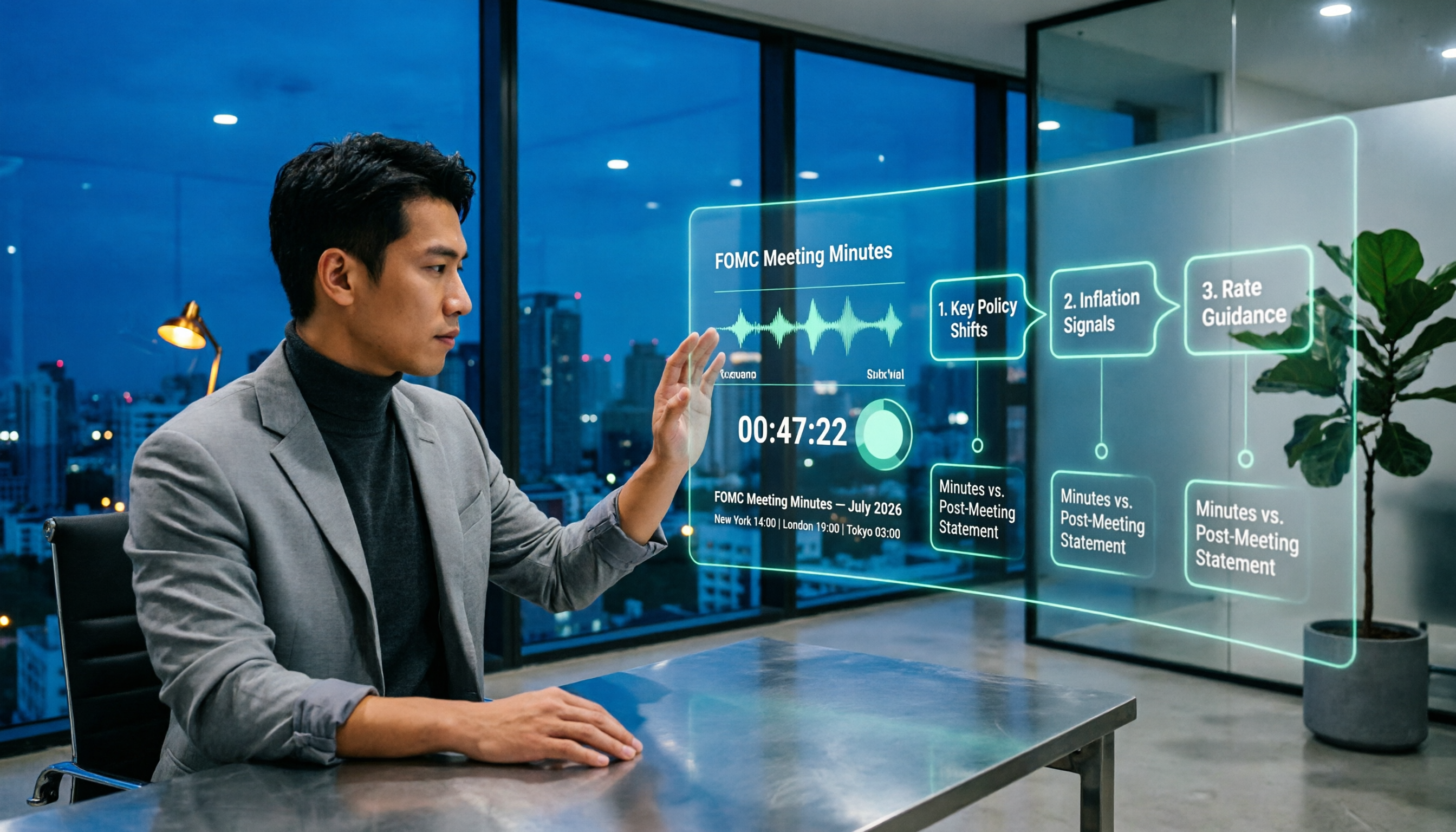
When Are Fed Meeting Minutes Released in 2026? 3 Steps to Track the Schedule and Key Details
When exactly are FOMC meeting minutes released? This guide explains the Fed's release pattern (about three weeks after the meeting, Wednesdays at 2 p.m. ET, early Thursday morning Taiwan time), uses the July 2026 meeting as a real example, and provides a 3-step method to find the next release date. It also explains the difference between meeting minutes and the post-meeting statement.

2026 Comparison of 4 Transcript Organization Tools: Which One Can Really Turn a One-Hour Meeting into Usable Minutes?
After feeding meeting recordings to AI, the real time-consuming part is never transcription but organization. Based on real testing experience with Chinese meeting recordings, this article breaks down 5 key points for choosing a transcript organization tool, compares Tinrec, Otter.ai, Notta, and Granola, and summarizes the 4 most common pitfalls.

Best Free Transcription Apps in 2026: We Tested 2 — This One Wins for Chinese Meetings and AI Organization
How do you choose a free transcription app? This article compares Tinrec and Yating Transcription, testing both free tools across five dimensions: free quota and cost, Chinese and multilingual recognition, post-transcription organization, online meeting and cross-platform support, and team collaboration. We also include an FAQ to help you decide which one fits your workflow.

2026 AI Transcription Free Plans Compared: 4 Tools to Know
The meeting is over, but the real work is just beginning. This guide reviews the free plans of four AI transcription tools in 2026—Tinrec, Otter.ai, Notta, and TurboScribe—comparing free quotas, file limits, Chinese recognition, and post-transcription organization features. It also covers the three most common pitfalls to help you choose the tool that truly saves time.

5 Free Transcription Tools Tested and Compared in 2026: Which Free Tier Is Actually Enough?
The most time-consuming part of meeting notes is never the recording—it's the re-listening. This article breaks down the common types of free transcription solutions in 2026, explains how free quotas are calculated, what to watch for with Chinese and mixed Chinese-English recognition, and how Tinrec turns transcripts into searchable, queryable, exportable meeting data.

The Complete Guide to Transcript Summarization in 2026: From Messy Recordings to Actionable Meeting Minutes
Once your transcript is ready, how do you actually extract the key points? This guide, based on a mid-level manager's real meeting scenarios, breaks down the correct order for summarizing transcripts, the core capabilities a tool must have, and 5 key factors to consider when choosing one. It also uses Tinrec to demonstrate the complete workflow from recording, transcription, summarization, and action items to team knowledge retention.

Best Free Meeting Transcription Tools in 2026: 4 Tested, This One Wins for Chinese Meetings
How to choose a free meeting transcription tool? We tested four tools with free plans—Tinrec, Notta, Otter.ai, and CLOVA Note—comparing free quota calculations, online meeting handling, post-meeting organization, and Chinese recognition performance. We also highlight three common pitfalls to help budget-conscious professionals find a tool that can truly handle daily workloads.