
Turn recordings into transcripts and summaries in minutes
Upload audio or video for multilingual transcription, AI notes, and action items
What Is Vocal Fry in Chinese? 3 Common Translations
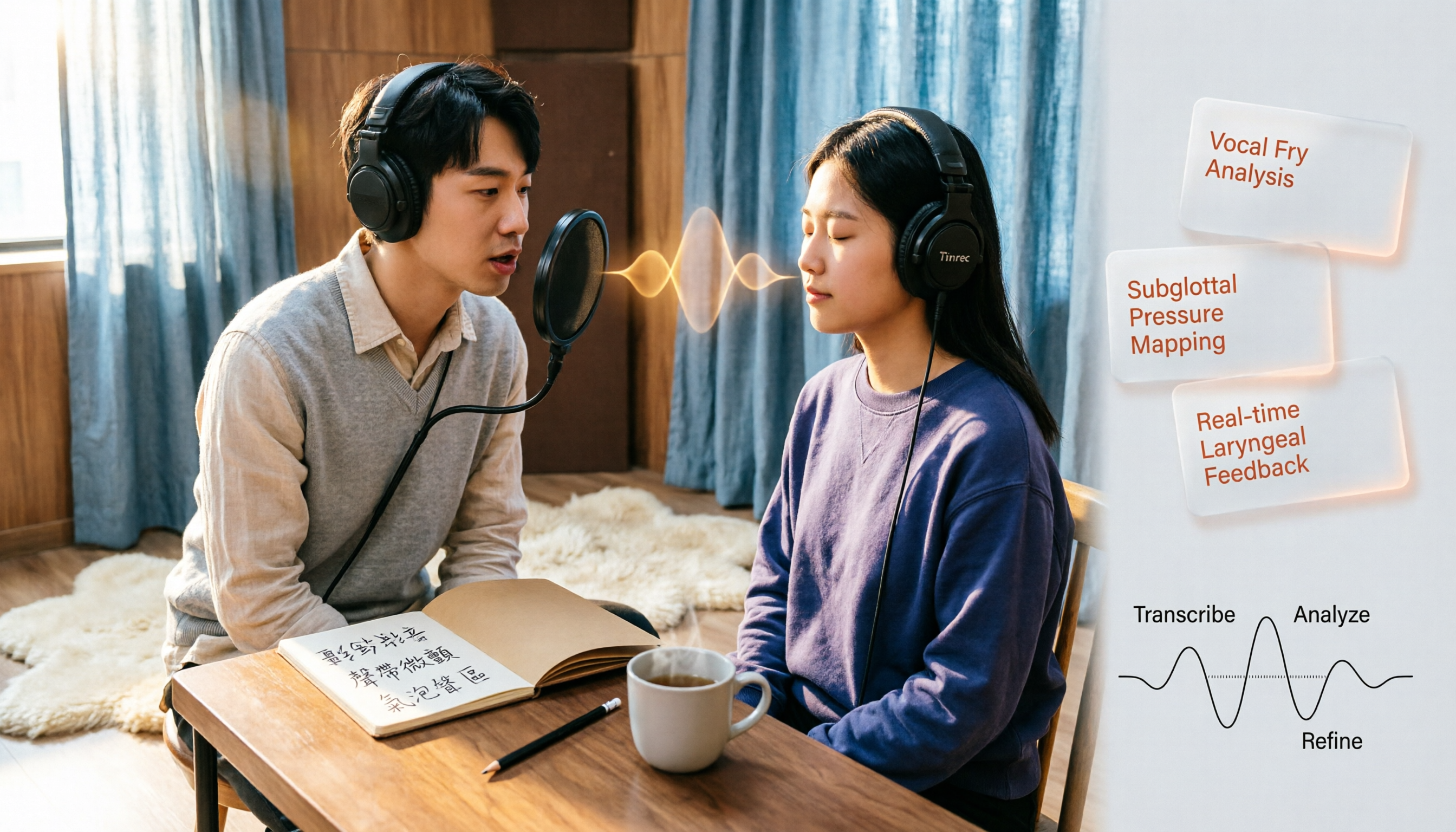
There is no single definitive Chinese translation for vocal fry, but the most commonly used and easiest to understand term is "氣泡音" (qìpàoyīn, literally "bubble sound"). Next, "聲帶微顫" (shēngdài wēichàn, "slight vocal cord vibration") leans toward describing the sound characteristic, while "氣泡音聲區" (qìpàoyīn shēngqū, "bubble sound register") is a more technical term used in vocal music and phonetics.
- 氣泡音 (qìpàoyīn): Most common in everyday speech and singing tutorials — for example, singing technique videos directly call vocal fry "氣泡音."
- 聲帶微顫 (shēngdài wēichàn): Some English-Chinese dictionaries use "the sound produced by slight vocal cord vibration" to explain it, emphasizing the low-frequency irregular vibration.
- 氣泡音聲區 (qìpàoyīn shēngqū): Wikipedia uses "氣泡音聲區" to correspond to vocal fry register, referring to the lowest pitch register.
Bottom line: If you just want to know what vocal fry is in Chinese, remember "氣泡音" first. If you see "氣泡音聲區" in vocal music or phonetics articles, they are referring to the same type of vocal production.
Why Is It Called Vocal Fry? Clues from Cambridge Dictionary
Cambridge Dictionary's explanation notes that vocal fry is named after a sound association — it is thought to resemble the sound of hot fat crackling. This is why English uses the word "fry." But if translated literally into Chinese as "油炸聲" (yóuzhá shēng, "deep-frying sound"), it could easily be mistaken for food or noise. Chinese readers are more familiar with "氣泡音" because it describes the low-frequency, intermittent, bubble-popping auditory sensation.
Common Misconception 1: Mistaking Vocal Fry for Hoarseness or Falsetto
Vocal fry is not a synonym for hoarseness, nor is it falsetto. Wikipedia's definition states: the vocal fry register is the lowest pitch register, produced by air passing slowly through a relaxed glottis; during phonation, the arytenoid cartilages in the larynx come together, causing the vocal folds to close tightly, and a large portion of the vocal folds vibrates irregularly, producing a distinctive crackling sound.
Hoarseness is usually related to vocal fold fatigue, inflammation, or poor control; falsetto is a different register altogether. Mixing the three together will leave you still not knowing what vocal fry actually refers to, even after searching in Chinese.
Common Misconception 2: Thinking Vocal Fry Has Only Downsides
Some people hear vocal fry at the end of sentences and perceive it as lazy, low, or informal. But from a singing perspective, if controlled properly, vocal fry can produce notes much lower than the modal voice, and is often used as a warm-up, relaxation, or bass ornamentation technique.
Stop organizing recordings by hand
Upload audio or video and automatically get a transcript, summary, and action items
Therefore, the problem is not vocal fry itself, but the context of use, volume, and control. Forcing the throat to imitate it is what actually causes injury.
Common Misconception 3: Only Reading Definitions Without Listening
Vocal fry is an auditory phenomenon — just reading Chinese translations makes it hard to grasp the feel. A more effective approach: find a recognized vocal fry example, record yourself imitating it on your phone, then play it back for comparison.
If you need to document your practice, Tinrec (秒聽錄音) supports real-time recording-to-text, AI summaries, and key point organization, turning practice recordings into reviewable transcripts. But it is not a vocal coach — for voice health issues, you should still consult a vocal teacher or speech-language pathologist.
How to Compare "氣泡音, 聲帶微顫, 氣泡音聲區"?
| Translation | Accuracy | Best For | Note |
|---|---|---|---|
| 氣泡音 (qìpàoyīn) | High | General queries, singing tutorials, everyday communication | Most recommended general Chinese term |
| 聲帶微顫 (shēngdài wēichàn) | Medium-High | Dictionary translation, describing sound characteristics | Easily confused with vibrato |
| 氣泡音聲區 (qìpàoyīn shēngqū) | High | Vocal music, phonetics, academic writing | More technical, rarely used in daily conversation |
Basic Principles for Safe Vocal Fry Practice
- First relax your shoulders, neck, and throat — do not squeeze or strain.
- Phonate "ah" at a very low pitch, slowing the airflow.
- Feel the relaxed vocal folds and low-frequency irregular vibration, rather than forcing the sound out.
- Keep each practice session short; stop if you experience pain, phlegm buildup, or discomfort.
- If you want to use it in singing or professional voiceover, it is best to have a teacher listen to your actual vocal production.
Summary: How Should You Say Vocal Fry in Chinese?
• General queries: "氣泡音" is clearest. • Academic or vocal music: "氣泡音聲區" is more precise. • Dictionary-style description: "the low-frequency sound produced by slight vocal cord vibration." • Vocal reminder: It is one of the lowest pitch registers, not hoarseness or falsetto, and forcing the throat to imitate it is not recommended.
For most readers, remembering that "the common Chinese translation of vocal fry is 氣泡音" is enough. What to do next: listen to examples, practice in short sessions, and seek professional guidance when needed.
References
Turn every recording into actionable outcomes
Get 60 free transcription minutes when you sign in. No credit card required.
Related Reading
You might also like

4 Apple Watch Recording to iPhone Tools Compared in 2026: Sync, Transcribe, AI Summarize
How do you sync Apple Watch recordings to iPhone? After syncing, how do you transcribe, summarize, and find key points? This article first shows you how to enable iCloud sync, then compares 4 recording organization tools side by side, including Tinrec, Otter.ai, Notta, and Granola, from free to paid at a glance.

2026 Comparison of 5 Recording Tools: How to Choose Between Plaud Voice Recorder and AI Meeting Assistants
Starting from Plaud recording use cases, this guide compares Plaud Note, NotePin, Tinrec, Otter, Notta, and TurboScribe in terms of recording, transcription, summarization, and pricing to help you decide whether to buy hardware or use an AI meeting tool.

Free Zoom Meetings in 2026: 100 Participants and 40-Minute Limit Explained
Free Zoom meetings support up to 100 participants, but meetings with 3 or more people are limited to 40 minutes. This article breaks down the actual limits of the free plan and common misconceptions, explains why post-meeting organization is the real time sink, and tests how Tinrec uses bot-free desktop recording, real-time transcription, AI summaries, and action items to turn Zoom meetings into searchable, trackable meeting data.

PLAUD NotePin Review 2026: AI Transcription Tested + Tinrec Meeting Notes Comparison
PLAUD NotePin review and buying guide. We test the wearable recording capsule from hardware audio capture to AI meeting notes, and compare Tinrec's Chinese meeting support, bot-free recording, and team collaboration to help you choose the right tool.

Tinrec vs PLAUD NotePin 2026: 5-Dimension Comparison — Is a Voice Recorder Worth Buying?
Starting from the PLAUD voice recorder trending on Dcard, this comparison examines PLAUD NotePin, Note Pro, and Tinrec across five dimensions: audio capture, post-meeting organization, team collaboration, cross-device support, and cost structure, helping you decide whether to buy hardware or choose software.

2026 Zoom Meeting Notes Tools Compared: Which AI Summarizer Works Best Without a Meeting Bot?
The pain starts after the Zoom call ends—notes are incomplete, you don't want to rewatch the recording, and records are scattered everywhere. This article tests three approaches: Tinrec, Zoom's built-in AI, and Otter.ai, comparing bot-free recording, Chinese recognition, post-meeting summaries, and team data ownership. It also highlights three common pitfalls to avoid before buying.

How to Use Microsoft Teams Meetings: 3 Meeting Note Methods Tested in 2026 — The One Without a Bot Is Easiest
Stuck in the lobby after clicking a Teams meeting invite? Can't find the meeting ID? This article first explains the 4 basic actions for using Teams meetings (joining a meeting, instant vs. scheduled meetings, in-meeting controls, cross-device access), then from the real needs of mid-level managers, tests and compares 3 meeting note methods, explaining why Tinrec — which doesn't use a meeting bot — is best suited for Chinese Teams meetings and team knowledge retention.

How to Use Zoom Meetings in 2026: 2 Recording Methods Compared — Which One Auto-Generates Meeting Notes?
Starting from the actual process of joining a Zoom meeting, this comparison examines Zoom's built-in transcription versus Tinrec across 5 dimensions: starting a recording, post-meeting organization, Chinese language experience, cross-platform data retention, and team collaboration — helping you decide which method to use for meeting records.

4 Teams Meeting Recorder Tools Tested in 2026: Where's the Meeting ID and How to Organize After Recording?
First, learn how to find your Teams meeting ID from the meeting invite, Outlook scheduling, and the Teams join screen. Then, we test and compare four meeting recorder tools—Tinrec, Otter.ai, Notta, and Granola—to see which is best for Chinese meetings, bot-free recording, and team data retention.